Tides wait for no one

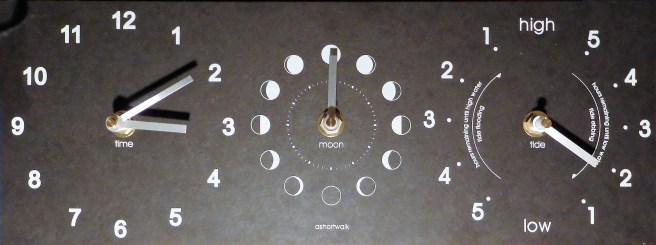
This three-ring clock made for a really appreciated Christmas gift. Its dials (not digital!) track the phases of the moon as well as the rhythm of the tides, which are truly impressive where I’m now living and change every 6 hours and 13 minutes or so. I can know before setting forth what to expect along the waters, especially if I’m thinking of tide pooling or looking for sea glass.

For their part, moon cycles are supposed to be related to mood swings and creativity and, as I’ve heard, even artificial insemination of cattle, whether the calf is going to be male or female. (I got that from some very scientific farmers, by the way.)

Since the night sky around here is often clouded, I do like not being ignorant of what lunar phase we’re in, even if I might scoff at its significance. It’s kinda like having X-ray vision.

All in all, these revolutions make me feel more connected to my place in the universe. Wherever that is.

Terrain can be mountainous without stunning heights

Somehow, much of Downeast Maine feels mountainous, even without the loft. The highest points in Washington County, for instance, are Lead Mountain, at 1,479 feet elevation in Beddington, and Pleasant Mountain, 1,373 feet, in Devereaux Township, mere foothills in some other places I’ve lived. Yet the terrain has steep slopes that still challenge motor traffic, as well crests that offer long views of seemingly unending forest.

In that way, it has a lot in common with the Allegheny range in Pennsylvania or neighboring West Virginia, which touts itself as the Mountain State.

The elevations here can be misleading, since much of the landscape is only 20 or 30 miles from the ocean. The town of Wesley, for example, population 98 or so, occupies a highland reaching only 226 feet above sea level, but that’s also a windswept blueberry barren with far horizons. The drifting snow piling up on State Route 9 there can be treacherous, as I learned the hard way.

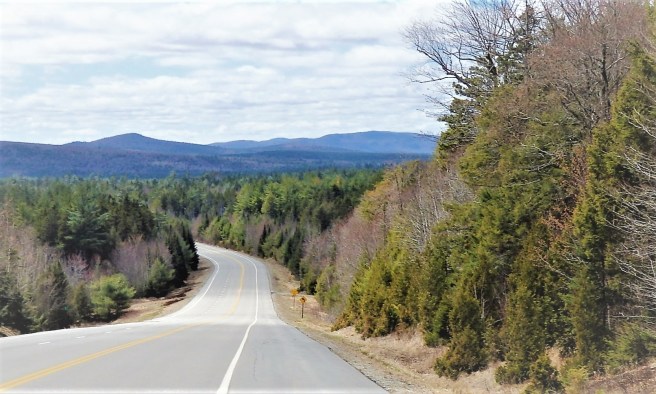
View while driving State Route 9 through T30 MD BPP, one of the unincorporated – and uninhabited – townships in Washington County.

The highway itself sometimes runs along ridges as long as it can before dropping to a streambed below and then climbing to the next crest. I’m struck to see the next landmark cell-phone tower on my route not off in the distance in front of me but rather far to my right or left with a chasm and lake in-between.

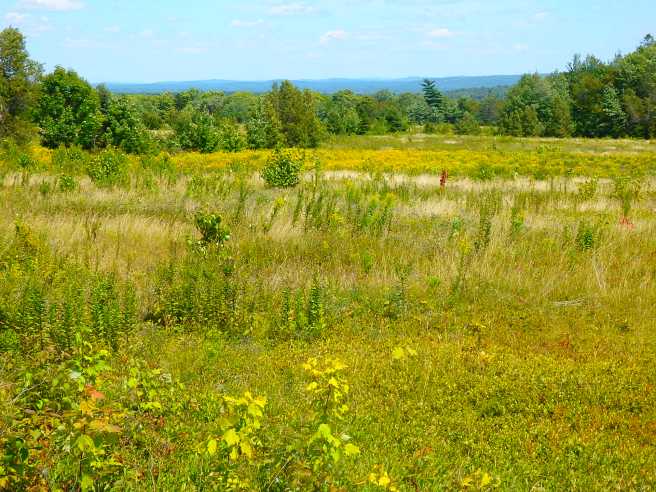
The contrast in colors during summer helps. In winter, this would all blend into variations of white.
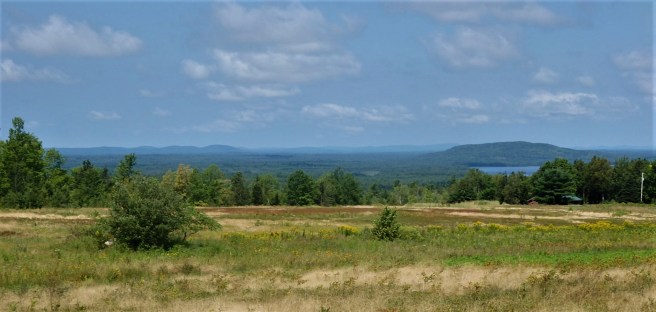
Approaching Pocomountain and lake in Princeton, as viewed across a blueberry barren.

Much of the land is boulders and exposed bedrock rather than rich loam.

There are reasons, then, those hills are named mountains. Pay heed.

Let’s acknowledge another annual turning point

Looking at the low temperature here and then the ten-day forecast, I observe a turning point in the season. This may be the last day of the year that our low reading is near zero, much less in the negative range. We’re heading upward into the teens and above as the minimum.

It may be cold, but no longer bitterly so.

Not that we’re anywhere near getting warm.

What’s the equivalent where you are?

You don’t need a weatherman to tell which way the wind blows, nosirree

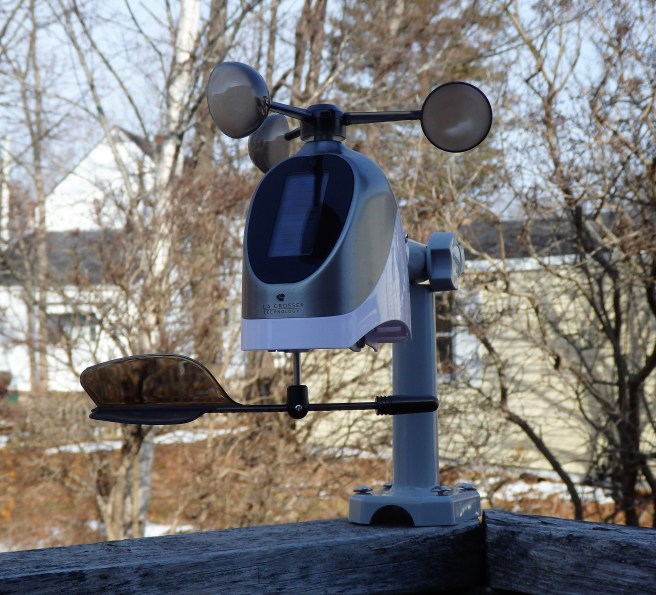
Not when you have one of these.

The heart of the station is this unit, joined by a rain gauge nearby. They send data via Bluetooth to a digital monitor indoors.

Thanks to this Christmas gift of a personal weather station, I’ve been watching the local weather direction and speed closely, along with the fluctuating temperatures, barometric pressure, and humidity indoors and out. Rainfall will be fun to observe, but snowfall – alas – is a problem.


Microclimates? Dress accordingly

My awareness of microclimates – ways weather conditions in small spots differed from the wider scene – came early one spring when I was dwelling in an orchard in Washington state. There were critical hours once the trees began blossoming when a frost could devastate a year’s crop. Cherries were particularly susceptible, but the apricots, peaches, pears, plums, and apples were also at risk. Remember, a whole year’s income could be wiped out in a few hours.

Frost-fighting measures, such as smogging pots, propane heating lines, airplane propellers pulling the slightly warmer air aloft down into the groves, or spraying the trees with water to form a protective ice coating around the blooms, were all costly. Essentially, it was a gamble. The orcharists relied on alarms sent out on special radio frequencies, usually in the wee hours, before taking action. Sometimes three feet of elevation made the difference in whether to act or simply ride it out – or, in the other direction, whether any action would be futile.

Years later, in New Hampshire, I encountered something similar, where a band somewhere between Manchester and the seacoast could vary by ten degrees within a mile or five. It could mean setting out in shorts and being uncomfortably cold on arrival. Or setting out in long pants and sleeves only to be sweating.

Once, in Dover, I saw an 11-degree drop – plus a cloud bank – between one side of the bridge into Newington and the other. Another time, I left for work in 39-degree favorable conditions only to encounter freezing rain and a hill that took a half-hour to go down midway to the office.

Now that I’m living on an island in Maine, I hear a common saying that our temperature is typically ten degrees cooler in summer and ten warmer in winter than it is even at U.S. 1 on the other side of the causeway, just seven miles away.

The differences were even more dramatic one morning when I checked last month. Our reading was plus 4, but inland had minus 8, on one ridge an hour’s drive away, or minus 14 at a lake a few miles away. Close by us but inland only 15 to 20 miles away were readings of minus 12 and minus 15.

A few days later, we had a minus 3, but Calais, 25 miles north and on a tidal river, was minus 25!

Do you experience anything similar where you live?

Add or subtract 22 degrees from 70 to get an idea of how much the impact can be. I mean, the 90s are usually miserable while the 50s mean keep the furnace running and maybe the car windows rolled up. Unless you’re a native New Englander. (I’m not.)

Well, it is Groundhog Day, which is really the end of Solar Winter, by one calendar, or the halfway point of Calendar Winter, another. Either way, we’re entering a stage when things warm up a tad but can produce some horrendous snowfall in my part of the universe.

Once again, I’m ever so glad I’m no longer having to commute to an office, day or night.
Just from one storm

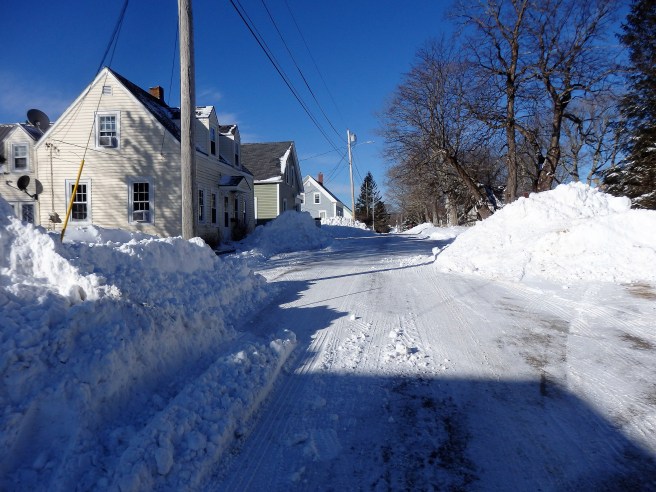
We had generally cleaned up from earlier snowfalls, with only a light covering left in town, before last weekend’s blizzard blew in. And, oh, my, did it!

Officially, we had 19 inches, though stiff wind and wicked gusts left some patches surprisingly bare, along with most roofs, but then piled the offset precipitation in the lee.

We were also hit with a widespread electrical outage, which fortunately was repaired in about only an hour or a bit more. I was braced for two or three before getting worried. Oh, I do miss having a wood-fired stove, though one is in our plans. And we do have a generator on order, one that would have been in by now if only we weren’t trying to relocate its proposed placement to allow for a tiny future full-sunlight garden, which is, in fact, now buried by the snow plow driver. Life gets complicated.

Shoveling out the front entry allowed for lighthearted conversations with passers-by, not all of them walking dogs. One woman even showed me a phone picture of her son or son-in-law’s back door, which was floor-to-ceiling snow when they opened it. Yes, I was deeply grateful ours wasn’t anything like that theirs.

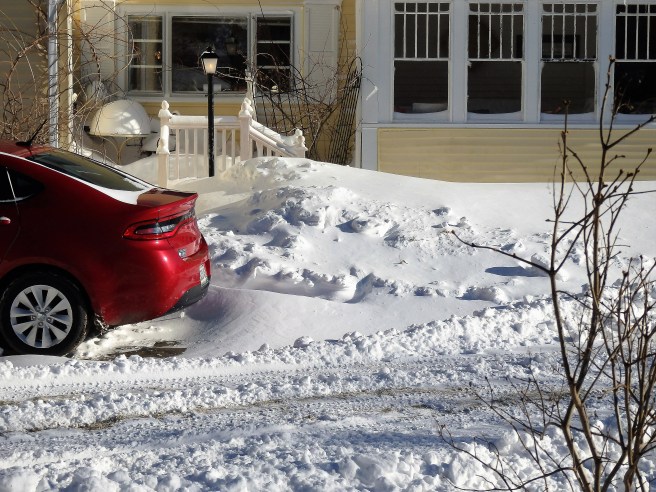
So far, according to the weather service, we’ve had about 48 inches so far this season, but this last storm was the doozy, as you can see from our digging out. But, wait, there’s more, as the cliche goes. Tomorrow and the day after are expected to deliver another foot or so, the figures are still bouncing around. Dial up, scale back. Yeah, folks around here are skeptical of the forecasts, for good reason, but not stupid, either.

Reminds me of the guy behind me at the IGA checkout before the last blast. He had baby spinach and some related healthy ingredients followed by an impressive selection of wine. And you thought it was always milk, bread, and canned soup that got cleaned out?

Now, the big question is this:

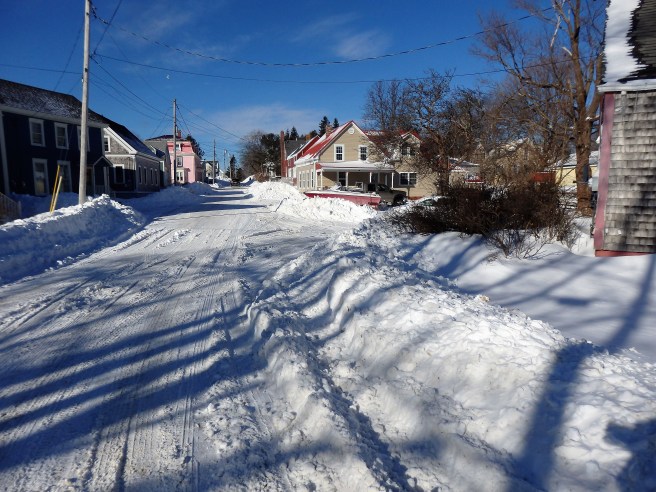
If we get hit by this much snow in the days ahead, where we will put it?


Note the raised porch.

Traditionally, February and March can bring the big whammies in New England and neighboring Upstate New York. This could get interesting. Or even tedious.

Something new I’ve been seeing in the weather alerts

Living along the ocean, I’ve seen gale warnings become a regular part of the forecast. You’ve heard of gales of course. But freezing spray?

I hadn’t given it much thought till now. Remember that magical “sea smoke” I’ve been observing? It no doubt condenses on vessels. As does moisture whipped up from the surface by those gale-force winds. Either way, here’s what the weather service says:

Freezing spray may render mechanical and electronic components inoperative. Ice accretion on decks and superstructures may result in some loss of stability. Very strong winds will cause hazardous seas which could capsize or damage vessels and reduce visibility.

During freezing spray conditions the U.S. Coast Guard advises that you ensure all lifesaving equipment remains free of ice.

Mariners should prepare for accumulation of ice on their vessel and consider altering plans to avoid or mitigate these hazardous navigating conditions.

Mariners should prepare to remain in port, alter course, and/or secure the vessel for severe conditions before conditions deteriorate.

And that’s for today’s steel-hulled ships. Imagine what it was like back in the days of sails and no warnings. As for trying to walk on decks or man the rigging?

And you thought freezing rain was bad? Seems it has a nastier brother.


On relating to some special place you’ve explored in depth 

Tourists may get a taste of a distinctive natural wonder in a particular landscape during their brief stay, usually in prime season, but it’s not the same as dwelling there through an entire year. A winter night or storm, for example, is a much different cosmos than a summer day.

I’ve been fortunate to have experienced some remarkable destinations through all their varying weather, thanks to my career moves, but never to the degree of living largely alone, as Henry David Thoreau did at Walden Pond or Henry Beston along the dunes on Cape Cod.

I’ve come to know both places firsthand over the rotating years, and so reading the two classic books that emerged from them evoked personal awareness of scenes that likely struck the general reader as exotic or even confounding. I never would have appreciated them the same way had I still been in the Midwest or Pacific Northwest, for certain. Quite simply, the encounters provided a stronger foundation for revelation of so much I had missed.

One of the fringe benefits of my second marriage was that my stepdaughters’ Grandpa Jim lived in Wellfleet on the Lower Cape, or what Beston more clearly calls the Outer Cape. (Understand that the Upper Cape is south of the Lower Cape, much the way Downeast Maine is really up the coast. Welcome to New England.) So we got to visit throughout the year, making me a big advocate of visiting popular travel sites in the shoulder season. There’s no way to describe walking several miles along the surf below the bluffs and having the expanse totally to myself – in perfect weather the week after the normally crowded Labor Day.

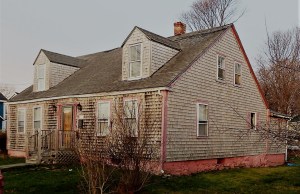
There’s a reason it’s called a Cape, or more technically, a full Cape. Here’s how ours in Eastport looks before the renovations begin. It was likely built more than a dozen years before Henry David Thoreau retreated to Walden Pond.

My wife used to gaze on the few remaining gray cabins atop the bluffs and voice a dream of living in one of them – the National Parks Service has been removing them piecemeal – noting that you wouldn’t want to have anything there you wouldn’t mind losing to a hurricane or nor’easter.

Beston’s 1928 The Outermost House tells of spending a year in just such a house only one town south of Grandpa Jim’s, and so I could envision and even smell much of what he describes.

At first, I was put off by the feathery, slightly Victorian language, as well as the affectatious British spellings rather than American, but once Beston presented some sharp, detailed observations of wave and wind motion and sound, I was captivated. His examination of waterfowl and other birds, especially, is admirable, but the range of shore and sea life he portrays is also encyclopedic.

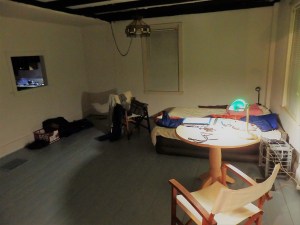
Here are my luxury accommodations the first months in town. I essentially lived in two rooms, spilling over into two more.

He writes from a time when the Cape still retained an older character that was being overlapped by newer ways that included telephones and flashlights, both unlike today’s suburban feel, and his book is credited with inspiring the creation of the Cape Cod National Seashore to protect the wildlife and geology he treasured – as many of us do today, thanks to the protections.

My reading came a few months after moving into my own equivalent of Beston’s cabin, albeit it much further up the coast and in a fishing village – still in view of the ocean.

You’ll be hearing a great deal about it through the coming year.

Are there books you’ve especially enjoyed because they’re rooted in places you know?

Why L.L. Bean started making all those kayaks, canoes, and duck boots

Maine is bigger than you’d think, and half of it is still unpopulated.

In fact, the easternmost county in the USA is more than twice the size of Rhode Island or New York’s Long Island – or, if you prefer, bigger than the two of them put together. And it’s merely half of Downeast Maine, with Hancock County comprising most of the western flank.

Washington County, aka “Sunrise County,” has a population of only 32,000 – about the size of Juneau or Fairbanks, Alaska, or Dover, New Hampshire, my home of the previous 21 years. You know, the one I repeatedly referred to as a small city. My, how my perspective’s changing!

Most Downeast folks live near the rugged coastline, with the largest municipality in Washington County being Calais, the connection to mainland Canada, followed by Machias-East Machias, Eastport, Lubec, and Jonesport.

The four largest public high schools have about a hundred graduates a year – combined.

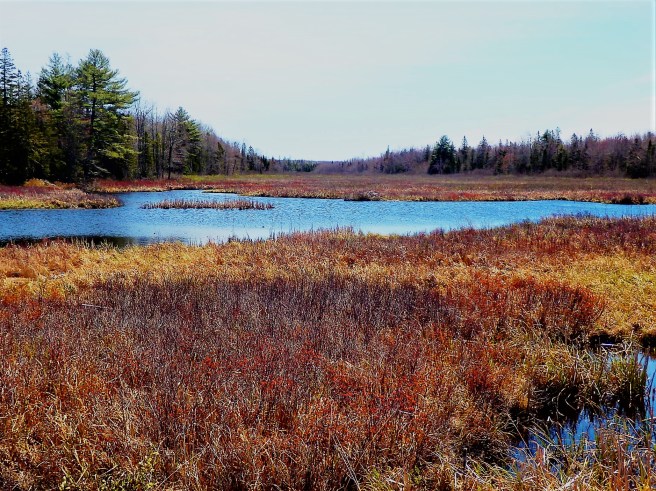
One of the many streams and wetlands.

There are many reasons Downeast reminds me of the Far West, though it’s generally much wetter. In fact, 21 percent of the county is covered with water, much of it as big ponds running along the valleys between the low-elevation mountains. Many of these often island-specked bodies extend two to five miles in length and at least a mile across. And that’s before getting to the bogs and fens or wild rivers and tide meadows or marshes and swamps or prolific beaver ponds. The technical definitions vary, depending perhaps on how wet your shoes get. Quibble as folks might, the northern half of the county seems to be more lakes and wetlands than solid ground. I’m not sure if the Atlantic bays and coves even count in this tally. Quite simply, we’re surrounded by a lot of liquid, so watch where you step.

Lake Meddybemps

What also strikes me is how little development rings the shoreline of the lakes. Many have only a few “camps,” as we New Englanders call the cabins, trailers, or cottages and their docks, with the remainder in full, unspoiled forest. Make a bid, if you must.

It does make for a lot of unspoiled tranquility, for those who are so inclined, if you can deal with black flies and mosquitos. Moose often come as a bonus.

Often you’ll even see a beaver lodge.

Sea smoke

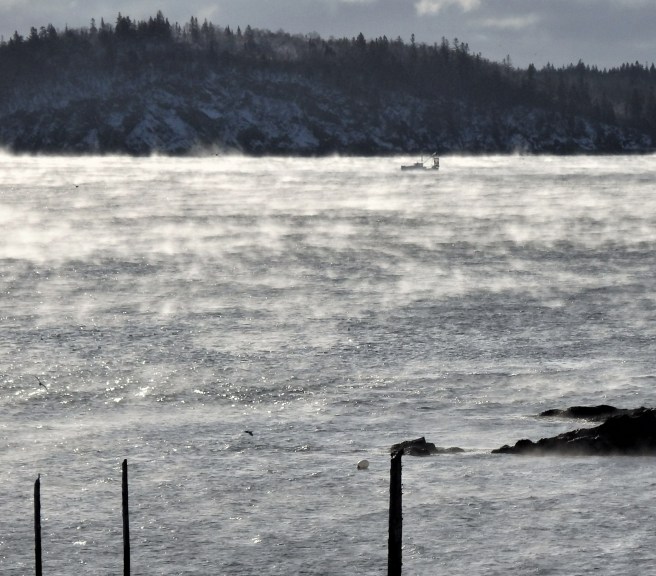
Surrounded by wisps of vapor, a scallop boat dredges in the waters between Maine and New Brunswick.

Driven by low temperatures and low humidity, vapors known as sea smoke rise from the warmer waters of the sea below. Not that they’re anywhere what you or I would call warm. Still, some mornings you cannot even see the water from any distance but only a churning cake frosting, and when it races in a stiff breeze, the effect is eerie, like looking down on a storm.