On relating to some special place you’ve explored in depth 

Tourists may get a taste of a distinctive natural wonder in a particular landscape during their brief stay, usually in prime season, but it’s not the same as dwelling there through an entire year. A winter night or storm, for example, is a much different cosmos than a summer day.

I’ve been fortunate to have experienced some remarkable destinations through all their varying weather, thanks to my career moves, but never to the degree of living largely alone, as Henry David Thoreau did at Walden Pond or Henry Beston along the dunes on Cape Cod.

I’ve come to know both places firsthand over the rotating years, and so reading the two classic books that emerged from them evoked personal awareness of scenes that likely struck the general reader as exotic or even confounding. I never would have appreciated them the same way had I still been in the Midwest or Pacific Northwest, for certain. Quite simply, the encounters provided a stronger foundation for revelation of so much I had missed.

One of the fringe benefits of my second marriage was that my stepdaughters’ Grandpa Jim lived in Wellfleet on the Lower Cape, or what Beston more clearly calls the Outer Cape. (Understand that the Upper Cape is south of the Lower Cape, much the way Downeast Maine is really up the coast. Welcome to New England.) So we got to visit throughout the year, making me a big advocate of visiting popular travel sites in the shoulder season. There’s no way to describe walking several miles along the surf below the bluffs and having the expanse totally to myself – in perfect weather the week after the normally crowded Labor Day.

There’s a reason it’s called a Cape, or more technically, a full Cape. Here’s how ours in Eastport looks before the renovations begin. It was likely built more than a dozen years before Henry David Thoreau retreated to Walden Pond.

My wife used to gaze on the few remaining gray cabins atop the bluffs and voice a dream of living in one of them – the National Parks Service has been removing them piecemeal – noting that you wouldn’t want to have anything there you wouldn’t mind losing to a hurricane or nor’easter.

Beston’s 1928 The Outermost House tells of spending a year in just such a house only one town south of Grandpa Jim’s, and so I could envision and even smell much of what he describes.

At first, I was put off by the feathery, slightly Victorian language, as well as the affectatious British spellings rather than American, but once Beston presented some sharp, detailed observations of wave and wind motion and sound, I was captivated. His examination of waterfowl and other birds, especially, is admirable, but the range of shore and sea life he portrays is also encyclopedic.

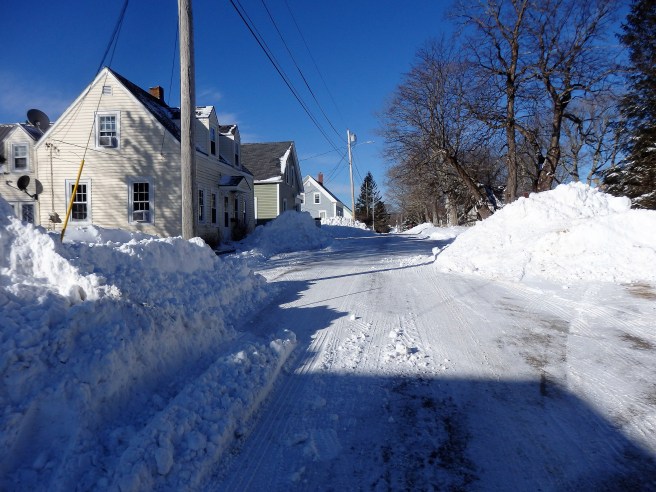
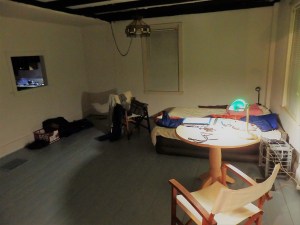
Here are my luxury accommodations the first months in town. I essentially lived in two rooms, spilling over into two more.

He writes from a time when the Cape still retained an older character that was being overlapped by newer ways that included telephones and flashlights, both unlike today’s suburban feel, and his book is credited with inspiring the creation of the Cape Cod National Seashore to protect the wildlife and geology he treasured – as many of us do today, thanks to the protections.

My reading came a few months after moving into my own equivalent of Beston’s cabin, albeit it much further up the coast and in a fishing village – still in view of the ocean.

You’ll be hearing a great deal about it through the coming year.

Are there books you’ve especially enjoyed because they’re rooted in places you know?

Why L.L. Bean started making all those kayaks, canoes, and duck boots

Maine is bigger than you’d think, and half of it is still unpopulated.

In fact, the easternmost county in the USA is more than twice the size of Rhode Island or New York’s Long Island – or, if you prefer, bigger than the two of them put together. And it’s merely half of Downeast Maine, with Hancock County comprising most of the western flank.

Washington County, aka “Sunrise County,” has a population of only 32,000 – about the size of Juneau or Fairbanks, Alaska, or Dover, New Hampshire, my home of the previous 21 years. You know, the one I repeatedly referred to as a small city. My, how my perspective’s changing!

Most Downeast folks live near the rugged coastline, with the largest municipality in Washington County being Calais, the connection to mainland Canada, followed by Machias-East Machias, Eastport, Lubec, and Jonesport.

The four largest public high schools have about a hundred graduates a year – combined.

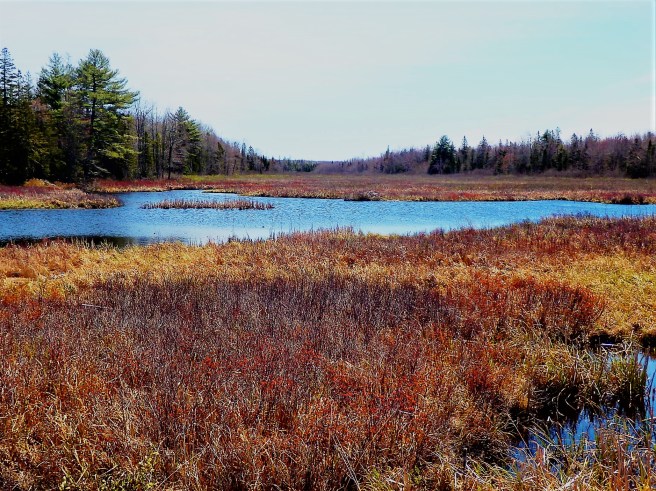
One of the many streams and wetlands.

There are many reasons Downeast reminds me of the Far West, though it’s generally much wetter. In fact, 21 percent of the county is covered with water, much of it as big ponds running along the valleys between the low-elevation mountains. Many of these often island-specked bodies extend two to five miles in length and at least a mile across. And that’s before getting to the bogs and fens or wild rivers and tide meadows or marshes and swamps or prolific beaver ponds. The technical definitions vary, depending perhaps on how wet your shoes get. Quibble as folks might, the northern half of the county seems to be more lakes and wetlands than solid ground. I’m not sure if the Atlantic bays and coves even count in this tally. Quite simply, we’re surrounded by a lot of liquid, so watch where you step.

Lake Meddybemps

What also strikes me is how little development rings the shoreline of the lakes. Many have only a few “camps,” as we New Englanders call the cabins, trailers, or cottages and their docks, with the remainder in full, unspoiled forest. Make a bid, if you must.

It does make for a lot of unspoiled tranquility, for those who are so inclined, if you can deal with black flies and mosquitos. Moose often come as a bonus.

Often you’ll even see a beaver lodge.

Sea smoke

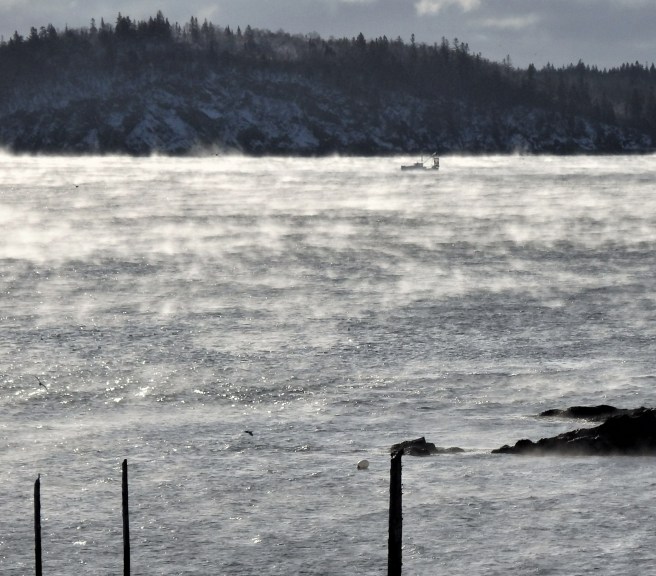
Surrounded by wisps of vapor, a scallop boat dredges in the waters between Maine and New Brunswick.

Driven by low temperatures and low humidity, vapors known as sea smoke rise from the warmer waters of the sea below. Not that they’re anywhere what you or I would call warm. Still, some mornings you cannot even see the water from any distance but only a churning cake frosting, and when it races in a stiff breeze, the effect is eerie, like looking down on a storm.

How this new life’s looking one year later

I’ve been living in Eastport a full year now. Admittedly, during the initial four months, I was commuting the 300 miles back to Dover every weekend or so, mostly to help declutter the house and prepare it for sale. What amazed us, though, was how quickly my loyalties switched – Eastport was where I felt at home, not the house I’d lived in for the previous 21, the longest of anywhere else in my life.

As you know, I delighted in Dover. Some of my previous moves had left me homesick for a year or more – the colleagues I missed, the social and arts circles, the landscape and opportunities. Even in some of the less attractive places, there was something or someone I regretted leaving behind or unfinished.

This time, though, it felt more like dropping a fantastic perfect lover by being swept away by someone more exotic. You know, leaving a knight’s castle to go off to live on a shack on an island with a mermaid, even if she smelled like fish. (Remember, we’re talking about homes here, not actual people.)

Trying to sort out the reasons for the ease of my quick identity shift has been tricky.

I was at a point in my new creative project where extended solitude would be very helpful. And it was. You know, the writer’s retreat or arts colony.

Covid had also already distanced me. I was no longer swimming laps daily and seeing that crowd. Quaker worship and committee work was on Zoom. Choir in Boston was suspended. With museums and concerts canceled, there wasn’t even any point in taking the Amtrak down and back. And the research I was doing had enough resources online that I could finish the project. There are some questions that might be answered if I had a few weeks to spend in the reopened archives, but I’m content to leave off where I have for now.

Eastport has more of an active arts scene that Dover did, though there was plenty once you included a few neighboring towns. It’s just that the one here feels more organic, as you’ll likely be hearing. We have to be resourceful, since there’s nothing like Boston over the horizon, as there had been in Dover.

Getting back out in the wilderness has been especially invigorating, even if the years are taking a toll on my hiking abilities. Ditto for taking yoga classes on the waterfront here in town.

Did I mention meeting a series of fascinating people, all with rich stories and experiences?

Or the artists-in-residence or world-class chamber music performances by local pros?

Quite simply, I’ve declared this was my best summer ever. The prior highs had always had some big downsides – trouble at the office, upheavals in romance, unnecessary complications. Not so this one.

We had hoped to get the renovations under way, but all of the contractors have been booked out for a year – and even if we had one on the job, supplies have been hard to get, as is the case everywhere. The delay does give us a chance to plan more thoroughly for what we want to see done. And it did mean I didn’t have everything torn up for the workers. I’ll leave that for next summer.

Running on the wind

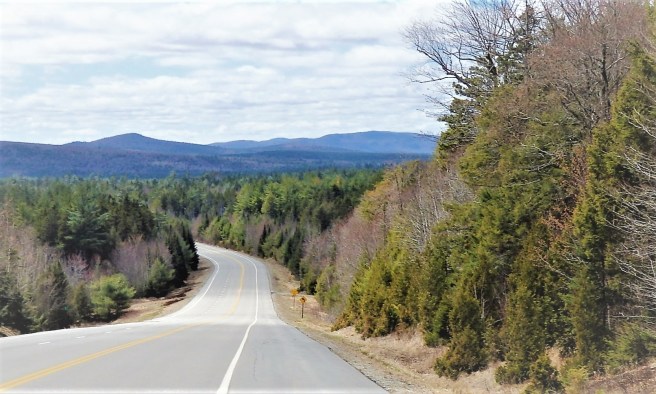
One sight always catches our breath as we drive Route 9 across what sometimes feels like the fringe of civilization as we’ve known it. And, for the uninitiated, the state highway from Bangor to Calais can become pretty monotonous in its long uninhabited stretches. As they say, make sure you have a full tank of fuel before you tackle it.

On a clear day, from a dozen miles away you might catch glimpses of a corner of the windfarms on Weaver Ridge and adjoining hills in Hancock County – I’ve counted at least 30 towers before the road dips away – but there are more tucked away in the high terrain. Still, nothing can prepare you for that first flash of the big blades turning gently in the air right in front of your face, or so it seems.

Each blade weighs 1½ tons, even though it appears svelte.

They dance gracefully – sometimes as a solo, then as a pair, or four. You spot them to your left but they suddenly show up on your right – the roadway twists along the slope. As those slip behind you, more giants rise above the hedge of forest. And all too soon, you’ve moved on.

The towers and their blades are bigger than you’d suspect. In fact, at the moment, they’re the tallest wind-powered electrical generators onshore in America, though much larger ones are projected for offshore installation.

The hub stands 382 feet above the ground – that’s more than the length of a football field – and the blade tips reach to 585 feet.

Wind generation accounts for nearly a third of the electrical production in Maine, though the state also imports a fourth of its electricity from Canada, largely Hydro Quebec.

I am baffled by the “not-in-my-backyard” opponents to similar windfarms. They still want energy for their computers and refrigerators and lighting, right?

A tractor-trailer rig could easily be parked in the gearbox or “cabin” attached to the hub.

As if these “spoil the view”? I find them mesmerizing, even enhancing as a kind of sculpture and a reminder of the currents in the air itself. They definitely look better than a toxic oil refinery – and there’s no awful smell. For that matter, they strike me as much more attractive than a television transmitter or cell phone tower as a hilltop crown. And they do remind us of the charming Dutch windmills in a much smaller scale.

The latest installation, 22 Vesta towers and turbines, cost $150 million and went into full operation earlier this year.

Sometimes they seem to play peek-a-boo as you drive.