My buddy Mike can do the honors

You never know what we'll churn up in cleaning a stall

As we were cleaning up after our monthly turn of cooking and serving dinner at the local “soup kitchen,” I turned to a trio of high school students who help our Quaker Meeting crew in the project.
“Hey, stick around and you can hear a performance of ‘Messiah.'”
They gave me glazed looks of incomprehension.
“You know, the ‘Hallelujah Chorus.’ I’ll be singing in it.”
One of them changed her expression. “Oh! I know that!”
And she started to sing, but it wasn’t Handel.
My turn to smile.
“Ah, Leonard Cohen. My choir has a lovely arrangement of that, and it’s fun to sing.”
And then I sang a few measures from the classic oratorio, which they did recognize.
The evening’s event wasn’t my choir but an ad hoc assembly of singers from everywhere in the region, all of us stepping in with no rehearsal – you may know of similar Messiah Sings, a tradition that’s spread widely. It’s a blast and a great community celebration.
Meanwhile, the repertoire of my choir has a couple of dozen Hallelujah pieces. One’s in Russian, others in African tongues, and several in English. Funny thing, the word is part of nearly every language. That, along with Amen, Coca-Cola, and OK.
By the way, Cohen’s lyrics are powerful, honest, and heartbreaking, deeply grounded in Biblical incidents yet also personally confessional. His is a truthful and humbling counterpoint to Handel’s majesty.
Which experience better fits your reality this season?
As the vocalist in a lovely jazz trio at a party the other night led us in “Silver Bells,” with its echo in “It’s Christmastime in the city,” I was struck but the beauty of the lyric’s repeated sibilants. They simply sparkle and produce a visual impression of tiny white lights on an icy night.
The song returned to my mind while shoveling snow a few days later, and this time I was captivated by the appropriateness of the adjective “silver.” Not “gold” or “brass” but silver. Again, there’s a visual impression, but this time, also a suggestion of bright clear sound. Gold, in contrast, would somehow make me expect something more velvety or reserved or distant, while brass would point toward a louder, stronger, more industrial tone.
Yes, the poet in me is still wowed at that choice of “silver.”
Would any other word do the trick?
During its first 200 years, Boston Puritanically refused to acknowledge Christmas as a special day of the year. The legislature actually banned observances in 1659, and December 25 was a school day for long afterward. As many Yankees stalwartly and proudly noted in their journals, the 25th was simply “an ordinary day.” You could be fined for any outward show of holiday festivities, though there seems to be no evidence that actually happened. Still, nowhere in the Bible is the date set, and, frankly, the faithful did note that so many of its customs had blatantly pagan origins. Christmas in Massachusetts didn’t become a public holiday until 1856.
Slowly, though, things have changed, and Christmas in New England has become something of an ideal setting. And so, with its many fine live cultural performances, Boston is now considered a prime destination at this time of year, especially when snow heightens the effect.
Here are ten events to take in.
And that’s before we getting to ice skating or hockey, for those looking for something more active.

The old church is rechristened, as it were, when their live rock nights take over. In What’s Left, my novel many of the musicians are already connected to the family restaurant, one way or another.
As I explain in a passage that was more than anyone needed in the final version:
Much to their credit, Dimitri and Graham and Barney and Pia have a knack for attracting talent – and for listening to all their ideas. It isn’t all just food-oriented, either.
Oh, I’m so glad Cassia’s stopped talking like this. In the final version, she’s refreshingly snippy.
~*~
Thanks to her aunt Yin, a teenaged Cassia winds up booking up-and-coming acts – ones that can play well in their old church. It’s a matter of people skills and organizational skills, especially, along with taking good advice from her musically alert cousins.
Imagine stepping in for her. What kind of music or other entertainment would you most like on the schedule? Is there a local band or singer or comedian (nobody widely known yet) you’d like to pitch to Cassia if you could? (Feel free to add a link to their website or YouTube action, if you wish.) Go ahead, shamelessly plug them, be the loyal fan club – let the world know! Go wild, oh yay! Me? How about a weekly contradance?
Let me confess, as an author, this was an impulse purchase for me. Have you ever driven through an old residential neighborhood and noticed an old church just plunked down in the middle of the block?
The one in my novel What’s Left sits next to the family manse. Here’s an early description of the site, one I decided not to include in the final version:
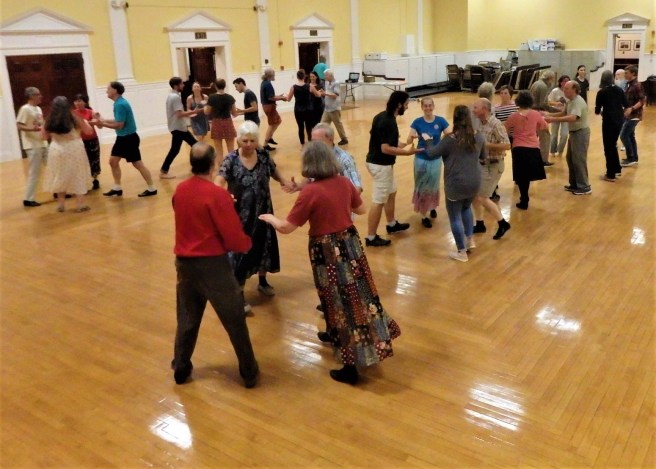
One thing that hadn’t been discussed when he left was the use of the old white church. We bought it just because we could. Thea Nita has joked it was the missing lot on our Monopoly board, and you could agree that she’s right. Yes, it was a great indoor playground for us kids but, as I’ve learned, that hardly justified the expense. Early uses included folk dancing, especially square dances and New England contras – events that included live music and callers, along with instruction. And there were a few weddings. It wasn’t a particularly big church, though – the pews held maybe a hundred people? Well, we promptly put those into storage.
Oh, I’m so glad she stopped talking like this! In the final version, she’s pretty snippy. You get the idea.
~*~
I’m ready to up that capacity number somewhat, anyway. Wouldn’t 200 be more fitting?
If you’re like me, music’s an essential part of life. I’m in a community choir that rehearses in the social hall of a church that rents out space for our offices, too – we do a big Christmas production at Harvard every year. I could imagine something similar working out of this space.
Where do you go for live music or dancing? Do you prefer a small club setting? An auditorium? A big arena? Or just somebody’s garage or basement? What kind of neighborhood is it in?