Ways this move was easier than others in my life

I’m not counting the few times I relocated across town. I mean the big moves, from one state to another, even from one part of the country to another.

You already know my fondness for Dover – and I have been intensely loyal to some of the locales I’ve made home but not others – yet this transfer of fidelity has been rather startling in its speed.

Dover? That was the address I had longest anywhere, edging out my native Dayton. Yet the 300-mile leap from Dover to Eastport was a breeze in comparison to the others I’d done. It’s rather perplexed both my wife and me.

Here are a few factors.

  1. We needed to downsize, and our house and garden and stuffed barn were more than we could keep up with. Quite simply, they were weighing on us, not just emotionally but especially when we looked at our bank balance.
  2. I had been to Eastport. Apart from Dover, where I had been worshiping as a Quaker, the previous moves had dropped me in as a total stranger. I hadn’t even visited Indiana University until showing up as a student in the middle of my sophomore year. Well, there was my return as a research associate, this time with a wife and a duplex rental on the other side of town. I hadn’t even been to Binghamton, New York, for a job interview.
  3. Eastport had a few things I was anticipating. Quoddy Head State Park had rekindled a sense of wilderness I’d left behind in the Pacific Northwest 40 years earlier. And the local choir had a repertoire much like our Revelsingers in Boston. Plus, I had been to the small Quaker Meeting and worked in projects with one of its outstanding members.
  4. I wasn’t alone. Eastport started out as my elder daughter’s wild dream, soon supported by my wife. Where else could we afford to live so close to the ocean? Back to downsizing, but as a whole-family venture. No more Lone Ranger sans Tonto, even if I was coming up as the vanguard. Their visits were festive occasions.
  5. We weren’t doing it all in one fell swoop but rather in stages. For the first four months, I was commuting back to New Hampshire almost weekly as we prepared our old house to market – meaning largely decluttering and cleaning. On this end, we still need to make renovations before filling this place with goods now in storage. Frankly, I’m enjoying doing more with less.
  6. Emotionally, Covid had already distanced me from many connections. I wasn’t swimming daily, for one thing, so that part of my routine wasn’t severed. I hadn’t even seen my pool buddies or the lifeguards for the better part of a year. We Quakers were worshiping and conducting business by Zoom, and I could keep that connection going a while longer. I was even getting together monthly online with Dover’s religious leaders and a Seacoast writers’ schmooze.
  7. Being in the middle of a big writing project gave me a crucial focus and meant the solitude on this end was welcome. Normally, access to libraries would be essential to what I was investigating, but I found rare resources in my computer searches and downloads. Yes, times have changed.
  8. There was no accompanying sense of failure or betrayal. My job hadn’t been terminated or taken an unacceptable turn – gee, that could lead to another Tendrils! (You know, the modern American workplace – see my novel Hometown News for examples.) I didn’t even have a new job to confront – what a relief! My lover hadn’t just dumped me or failed to reconnect when I arrived, and I wouldn’t be searching for love, either. Nor had I left paradise for an industrial or suburban wasteland.
  9. I’ve enjoyed exploring with an eye for what I’d introduce to the others on their visits. And meeting some fascinating new folks, likewise. I still feel I’m living in a real-life Northern Exposure.
  10. Well, there were moments of feeling exiled, like “What have I done wrong,” but they were soon countered by reclaiming some of my independence. I’d gotten spoiled, as far as food goes, and not really cooked anything for two decades, other than lighting the grill or popping something in the microwave. (Well, there was a fried rice that impressed one of our Chinese guests.) But now our morning phone calls have included cooking advice and insights. That sort of thing. I’ve been pleased with my dinners, even the ones I wouldn’t serve anyone else, should I have to. As for exile? Nah, I’ve never felt more comfortable anywhere.

They called it Assault and Battery, or just Sodom

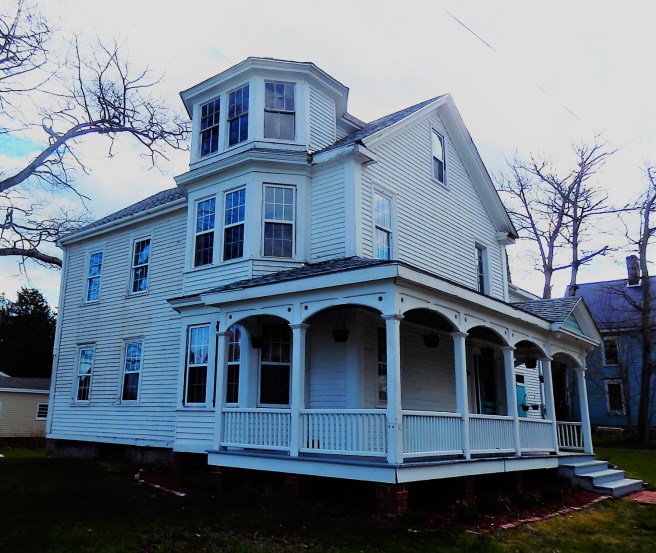
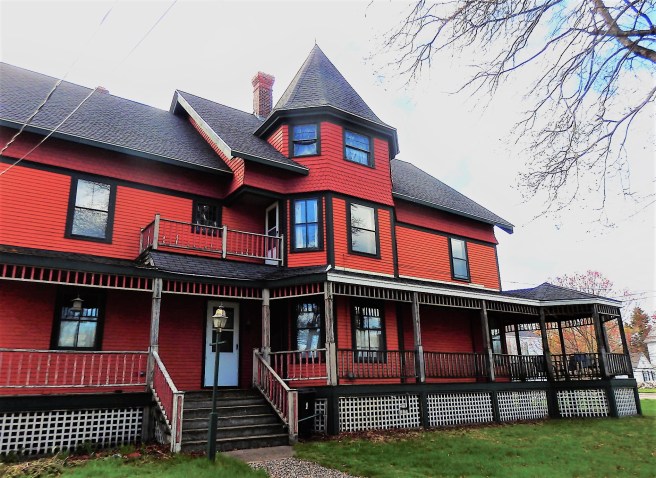
Some people and places just get bad raps for no reason. That used to be the case for the neighborhood just south of Battery Street. Or Assault and Battery, as the ditty went.

Or, in the more salacious version, Sodom and Gomorrah.

You can read the street sign yourself.

Residents of the allegedly more reputable North End of town, meanwhile, got dubbed Dog Islanders, after the tiny island at its tip, one that once had a lighthouse nobody in town could see.

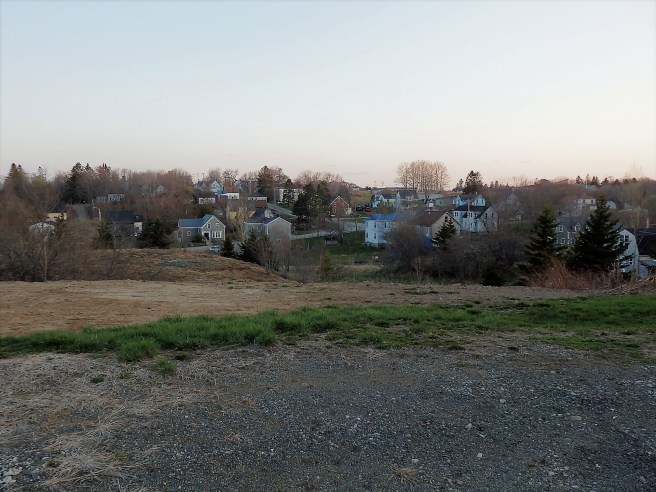
The neighborhood viewed from South Street.

Definitively, the two parts of the village were separated by Shackford Cove (aka Huston’s) , which ran further inland than it does today, as well as a seemingly nameless stream at the bottom of some steep banks. And the cove did have four shipyards at one time as well as the world’s largest sardine cannery a bit later.

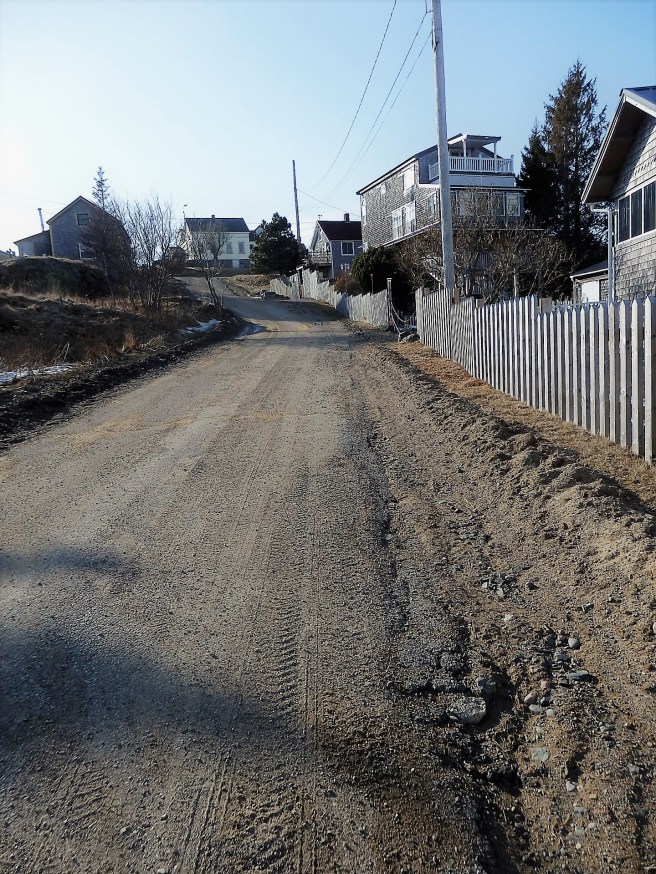
There are also some steep streets that end in the ocean.

Today, though, it has some fine homes mixed in, a few with some of the most spectacular views in town.


Am I the only blogger working from Downeast Maine?

I don’t mean broadcasters or newspapers reissuing their material online, nor do I mean Facebook or Twitter snapshots and quips. Blogging, as you know, is more varied, personal, and I’d say engaged than that. It requires a special focus.

At the moment I’m finding it difficult to locate anyone else posting anywhere in the Pine Tree State, apart from gloating visitors and a few writers sharing a site based elsewhere.

It’s not that folks hereabouts are aloof, not by any means, as I’m discovering in my new locale. I’m fascinated by the stories they tell as well as the unique landscape we share, but I’m still new on the scene.

Welcome to my workstation, for now.

Our little city stretches from heads to coves

When it comes to finding your way about town, you need to know more than just the names of the streets.

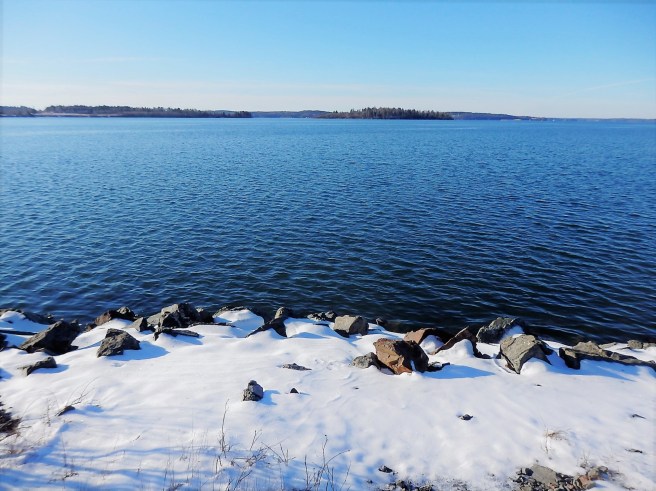
Eastport’s a city of islands, with Moose Island the biggest and most inhabited. It’s roughly six miles long and three wide, at the most, but that still adds up to 20 or so miles of shoreline, I’m guessing.

So people will refer to Buckman Head or Estes Head or Todd Head or Kendall Head or, for variety, Harris Point, punctuated by coves.

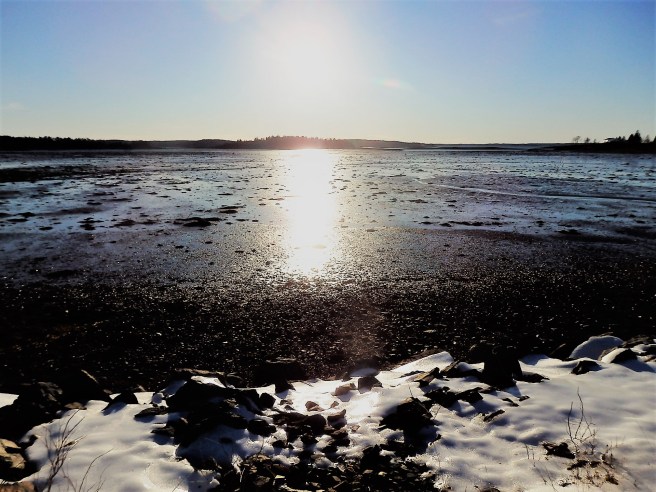
Harris Cove and Harris Point at low tide. Deer Island, New Brunswick, lies beyond.

So there’s Broad Cove or Deep Cove, which flank Shackford Head, or Prince Cove, for instance. As well as Carrying Place, Half Moon, and Johnson coves. Plus a few more. And that’s before we get to the neighboring towns, up and down the coast, which also name places this way.

Welcome to my new world.

Post Office and old Customs House

Anchoring one end of Eastport’s main street downtown is the Post Office and former Customs House.

Though the Customs role has moved closer to the Breakwater but not so the mail, especially this time of year..

The building still bespeaks of a special authority and order.
From the water, it’s a landmark.
And inside, the post boxes are pure vintage.
As is the staircase up the tower.


As an example of the kind of excellent journalism we’re missing these days, let me offer this modest example

My wife forwarded me a link to a Washington Post article about the ways international supply-chain problems impacted a small, family-owned, dairy north of our place in easternmost Maine and its signature product, a chocolate milk with a passionate following.

For me, it’s a great piece of journalism, or as I told her, my ideal of reporting.

In fact, it fit into the aspirations I present in my novel Hometown News.

Personally, I favor longer pieces that take a long-range view, as this one does, especially when they encapsulate a much bigger, more difficult, issue in ways that hit home.

In contrast, the trend has long been for shorter, faster, less complex dispatches that move on to the next sensational blast. You know, the 24-hour news cycle. Or less. Most of it is forgettable, puff in the air, hit-me-with-what’s-next superficiality.

Instead, what we have here is a consequence of assigning a reporter full-time to the Northeast, as the Washington Post does, in one of those expenses that might seem superfluous to the bean counters who fill too many executive positions in too many industries. In fact, we can blame them for much of the supply-side issues that plague us. Prestige, after all, is rarely seen as a quantifiable asset.

Moreover, I doubt the Post would have found this story without that marginal investment. (The nearest daily newspaper, fine as it is, finds itself way too overwhelmed by everyday issues to dig into something requiring an investment of time like this. In fact, one of the things I that drew me to working at the New Hampshire Sunday News was the opportunity to assist similar projects, where we might have a week to dig into the dimensions and then display the findings properly.)

I also love the fact that the Post hired an excellent photographer to pursue the story, too, and paid for his time to look beneath the obvious surfaces. Again, it takes time to get a feel for what’s beneath the surface and come up with something fresh and expressive. His shots tell a full, parallel, story of people dedicated to their seemingly commonplace employment. What emerges is almost like a film score underpinning a movie.

Better yet, in this case, the difficulty encountered was about chocolate – who couldn’t love that! As well as the schoolchildren who loved the dairy’s chocolate milk as part of their lunches. You can’t build a better connection than you do with kids, except maybe through the words of their parents, as this report does.

My kudus to reporter Joanna Slater and photographer Tristan Spinski – and their unnamed editors for publishing this.

If only we could see much more along this line of journalism!

Parts of Maine often resemble the Far West 

Maine is larger than the rest of New England combined, and except for much of Vermont, it was settled much later than the rest of the six-state region. That is, the parts of the state that were ever settled at all. Half of the Pine Tree State has no year-round population at all, for good reason.

The result is that there are paved roads where you can drive for miles and see nary a utility line or a mailbox, much less a house. Often, the only human activity you detect is timbering or mining. Hunting and fishing are a way of life. It wasn’t that far out of Bangor I used to see the bear-hunt guide sign.

Those roads remind me of driving from town and out toward a mountain pass on my way to trails in the high country out West.

There are trails for hiking or ATVs just about everywhere, many of them through conifer forests like those of the Far West. Here’s one at Shackford State Park within Eastport’s city limits.

Downeast Maine’s open blueberry barrens on the ridges, meanwhile, give me a sensation of the Big Sky Country of Montana or the Horse Heaven Hills of Washington state, except that the blue overhead isn’t the same deep intensity.

I believe that the presence of Indigenous peoples is another part of the mix. Eastport is adjacent to the Passamaquoddy’s Pleasant Point Reservation, as we’re reminded every time we drive to or from our island. They’re one of the four tribes comprising the Wabanaki Alliance in the state.

Yes, there is a kind of frontier feel around here. I’d suggest calling the area the Far East, but that name’s already been taken.

Fact is, many of the old ships that sailed to the Far East were built along these shores rather than those of the Far West.