

You never know what we'll churn up in cleaning a stall
For those of us who come to New England from other parts of America, the insistence that here we live in either a town or a city but nothing in between comes as a shock. There’s no saying “near” anywhere, even if the place has its own post office. Nope, either city or town, the difference being the kind of government it has.
Eastport, for instance, is a city, while neighboring Lubec, roughly the same size, is a town.
And each may have its own neighborhoods or villages, further complicating the picture. A town typically has its historic center, even when larger development came later somewhere else within the boundaries – maybe out along the railroad tracks, for instance, or the mills. Note that when you look at maps.
Maine adds a third twist to this model. Much of the state was surveyed into parcels, typically six-by-six-mile squares, that never lived up to expectations, at least in terms of habitation and development. They remain uninhabited, seasonally or year-’round, or lack sufficient population to self-govern themselves.
Here in the Pine Tree State, they’re designated as townships or even plantations, though some do have names or have reverted by necessity from self-rule to management by the state.
Thus, when driving along you might see a highway marker like the one announcing that you’re entering T26 ED BPP.
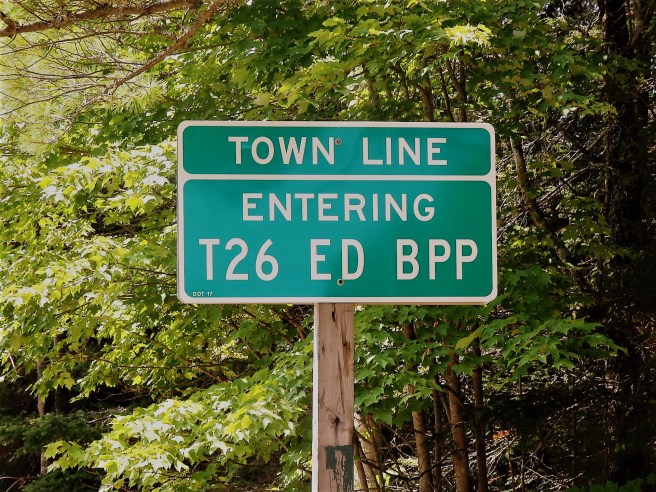
There are many more signs like this, equally baffling. This one translates as Township 26, Eastern District, Binghams’ Penobscot Purchase. Don’t ask me more, I’m already confused, as I’m sure you are.
There’s even another variation, PLT, for Plantation – and, no, it has nothing to do with fields of cotton or tobacco.

Significantly, more than half of the state is uninhabited. Hard to think of that, considering the urban and suburban density and congestion of so much of the rest of the Northeast.
Somehow, nobody’s counting mosquitos or moose in the equation.
What do you have to explain to others about the political setup of the place you live? Ward politics? The county sheriff? The nut jobs, right or left?
 Has to be the biggest business employer in Washington County, where jobs that pay well are scarce. Some days, the vapor plumes can be seen miles away, and ditto for the smell. Much of the bundled pulp is shipped from the Cargo Pier in Eastport.
The plant also makes kraft paper and tissue.
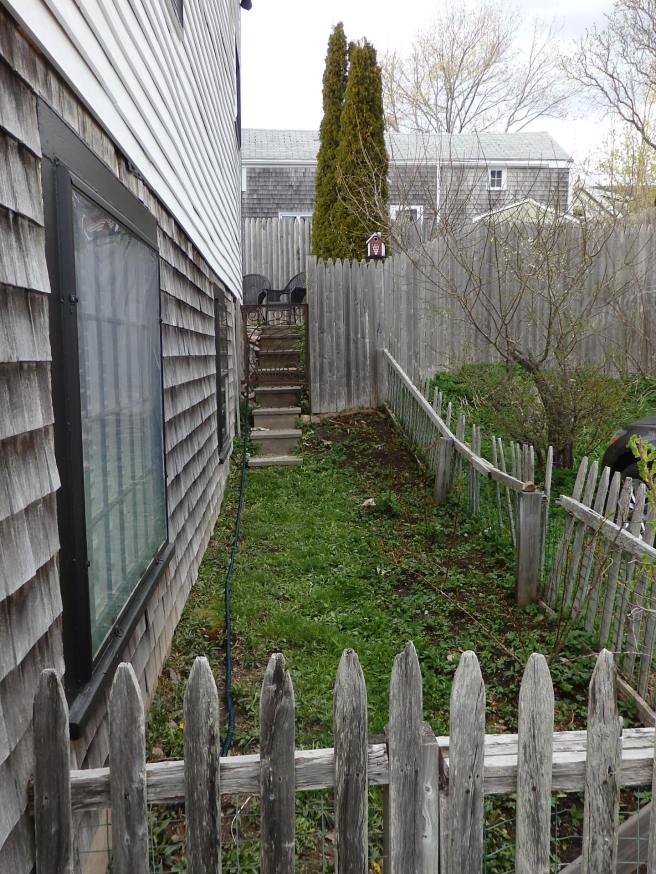
I know the big scenes around here are irresistible, but for me these snippets sometimes say everything about the place, too. Small spaces can be precious, too.
The joke is that moose don’t have horns, they have antlers. The Moosehorn National Wildlife Refuge excuses itself by noting that it’s named after a brook that meanders through the preserve. Not that it’s the only fine body of water.

And the U.S. Fish and Wildlife Service adds that the preserve is home to much more than moose, bear, beaver, and deer. For example, some 223 bird species have been identified in its two divisions – the 31-square-mile Baring Division to our northwest and the 13-square-mile Edmunds Division to our west, both within a half-hour drive from Eastport.
The terrain is varied, much of it wetlands, and a third is protected as wilderness.
I especially appreciate the miles of hiking trails, some along former roads.
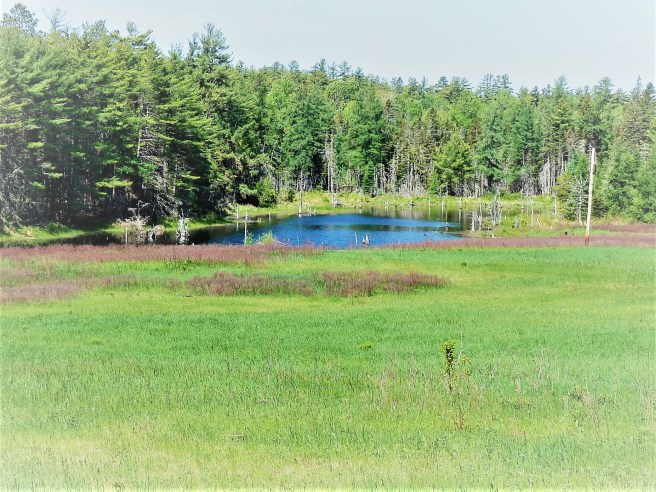
What I wasn’t expecting on one outing was the moose I encountered on a grassy roadside near a flowage.
When I first spotted the tawny hump amid the green, I thought it might have been one bent over grazing, in which case I’d need to approach cautiously, or else just a big rock.
Instead, it became a mystery.
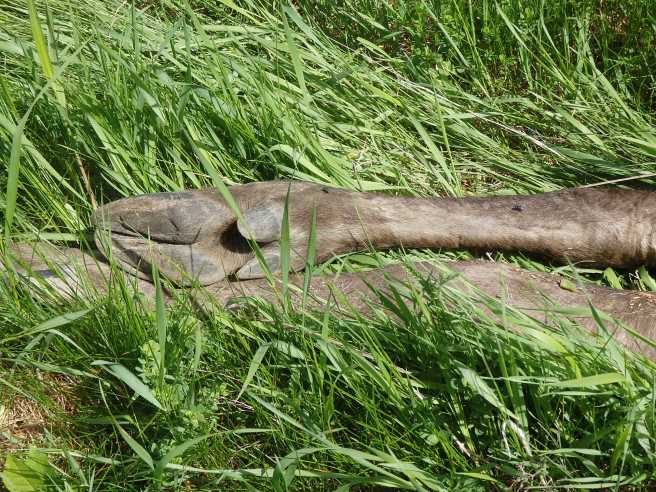


Tire tracks in the grass had me wondering if a ranger driving down the gated-access lane had tried to veer away from the animal on the roadway, only to have it bolt into the oncoming vehicle.
The carcass was fresh enough that a solitary vulture overhead wasn’t even taking notice.
Later, back in town, I began picking up details. Everybody seemed to have more to add, most of it from Facebook.
Seems the baby male was hit on Charlotte Road earlier in the morning. (Baby? It was bigger than me.) Folks were wondering what took the wildlife officers so long to clear the road. They then took the remains into the preserve, to return to the food chain. Mama Moose, meanwhile, spent the rest of the day wandering forlornly.
It is a relief to know that moose collisions aren’t so common around here that they’re taken for granted. Deer, on the other hand, as everyone will remind me – keep your eyes open.
What’s the most surprising thing you’ve ever encountered out on a walk? Or even a drive?

I never paid much attention to gale warnings before moving to the island.
Seems there’s a “small craft advisory” every other day, not that I sail.
Even in this tranquil life.
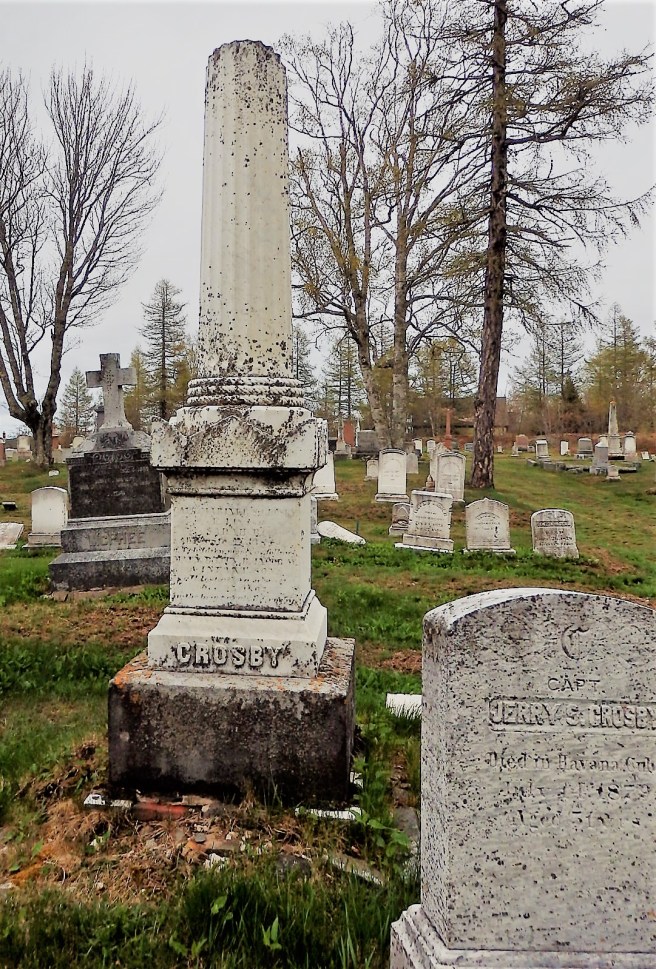
Capt. Mariner S. Crosby. Given his Christian name, it was inevitable that he would take to the sea. That’s what struck me the first time I wandered through Hillside Cemetery.
The second time I went to the graveyard, I was looking for that marker but couldn’t find it. Back home and at my computer, Find-a-Grave led me to the rest of the inscription, which is admittedly rather worn away, as well as some additional facts.
What I found was this:
“Lost at sea with his family and the Brig Sarah B. Crosby,” named for his wife. She and the four children, one of them an unnamed infant, are then listed on the white memorial – Jacob W., Mary B., and Lucy B.
The date of their demise is uncertain, “around Oct. 25, 1867” – in season for a hurricane or some other vicious storm, although a fire in a wooden ship can’t be ruled out.
I trotted back to the cemetery for a closer look. Here it is:
The Chamber of Commerce website reveals more:
“Mariner Crosby was the master of the brig ‘Maria White’ in 1852 and the schooner ‘Mary Jane’ in 1855. From 1861-1863 Mariner was the master of the barque ‘Charles Heddle,’ also built by C.S. Huston,” in Eastport. Around the corner from me, actually. “Mariner’s last command was the brig ‘Sarah B. Crosby,’ named for his wife, which was built in Pembroke. He commanded this vessel from 1863 to 1867 when the vessel was reported overdue. Mariner, his wife Sarah and four children, as well as the crew and passengers, were lost at sea without a trace.”
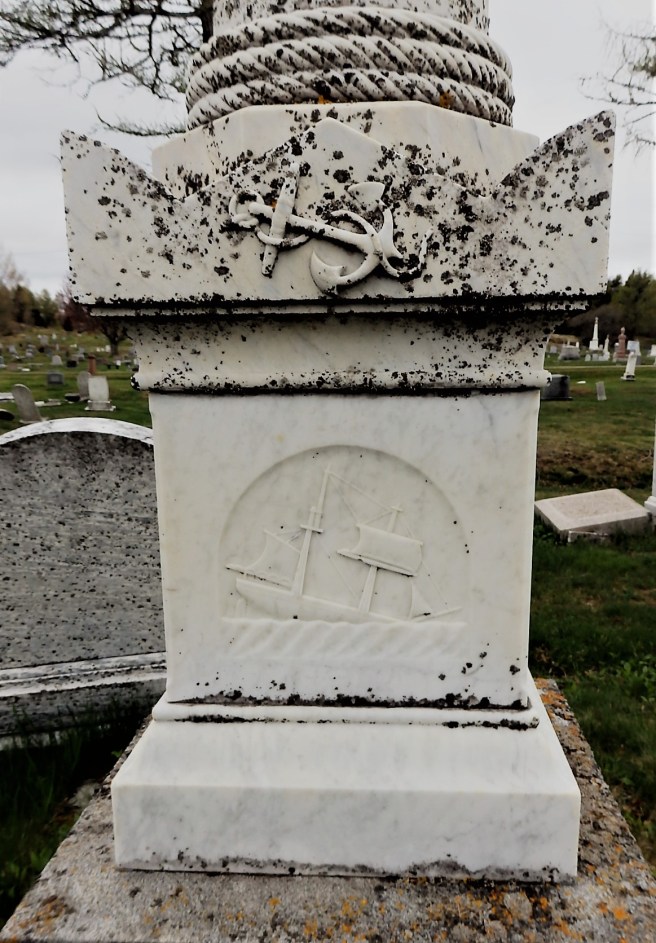
We’re not even told where the ship was bound, much less about its cargo, passengers, or crew. And a brig did require significant manpower to manage the massive square sails.
The two-masted 316-ton “Sarah B. Crosby” was built in Pembroke by George Russell in 1863 and then based out of Portland, bound for ports such as New York and St. John, New Brunswick.
I started to investigate and found a bit more.
She knew the travails of the sea, having wrecked at treacherous Sandy Hook, New Jersey, on March 1, 1865, with the passengers and crew safely removed. And then, after being abandoned, she was reclaimed and repaired, with shipments of coal from Halifax, Nova Scotia, later in the year.
On March 19, 1867, the New York Herald carried this notice: “Brig Sarah B Crosby (of Portland), Crosby, Measina, Jan 27, with fruit to Lawrence, Giles & Co, passed Gibraltar Feb 16; has had heavy westerly gales, with snow and hail, and split sails. Mar 13, latitude 41 30, longitude 65, spoke ship Michigan, from Liverpool for London.” (Measina, a mystery unto himself, was first mate. They would have been just off England at the time this information was relayed.)
I would like to know more in general about wives and children traveling with captains. It turns out to have been common, with a significant number of the children being born at sea or spending a large part of their childhood there. Wives were partners with shares in the business, whether they went abroad or stayed ashore. They even learned navigation, but did not interfere with the cook aboard ship. There were strict lines of authority. Beyond that, what were Sarah’s views and experiences? Was she even related to the 1841 Robert Bates house a few doors up the street from me? She was only 33 or so at the end; there’s no age for Jacob, though Mary would have been around 11 and Lucy, only seven.
While Mariner grew up in Eastport, the son of a Nova Scotia immigrant, Sarah was the daughter of a hotelier in Calais, Maine, best I can tell. Her father came from Massachusetts; her mother, New Hampshire. Mariner Crosby and Sarah E. Bates were married in Eastport February 12, 1855, by the Baptist minister Nathaniel Butler, of note himself. We have no idea how they met.
Mariner came to the sea naturally. At least two of his four brothers were also sea captains. Not just sailors or first masters but skippers.
Capt. Jerry died in Havana in 1879.
And Christopher Crosby led the racing yacht “Coronet” that defeated the “Dauntless” in a famed trans-Atlantic race in 1897. He went to sea at age 17 and was skipper by the time he turned 19. Yes, born to the sea.
And that’s as much of their story as I’m able to find, all prompted by one name in stone.
There I was complaining about not being able to continue swimming laps since Covid curtailed everything, especially followed by my relocation from Dover and its wonderful indoor pool. I certainly wasn’t getting in any regular exercise routine once I moved up here, and one month of yoga down by the waterfront did impress me with just how much this body’s deteriorated from 50 years of neglect. Geeze, how humbling!
I’ve never been one to pursue a solo fitness regime.
But then, when some enlightened souls opened the high school gym for walkers in the early morning, I stepped up, apologies for the pun, but it was something and definitely not at the mall, not that we have anything like that anywhere around. Well, I have posted some photos of Shead High’s gym. Maybe I was getting into shape for some summer hiking?
In the process, I met some interesting folks, all women – guys my age rarely seem to recognize how out of shape they’ve become, apart from maybe weight lifting – and the suggestion kept arising that I should try the twice-a-week fitness sessions at the, uh, senior center. (I really hate that term and definitely prefer to call it the Old Firehouse.)
Most of the time, though, once I started attending, I was the only male in the circle. What a revelation! Yes, I remember ages ago when I would have killed for such odds in my favor, yet these days I’m definitely married. (Got mine!) But still, you wouldn’t believe what I hear. It could be a highly rated TV series, if we could find a focus. Oh, well. As they say, laughter is the best medicine.
The hour-long class is definitely well planned, a blend of stretches, isometrics, cardios, and the like. It can challenge the beginner and adept equally well.
Nonetheless, when the temperature approaches 60 or so, indoors or out, they insist on opening the windows. Claim it’s too hot.
I am, on the other hand, still freezing.

