Why Yankee mariners wintered in the woods

You might think the ideal time to work in a forest would be spring or fall, but that’s not how it’s turned out in logging in the great northern forests of New England and New York state. Instead, the time to be out harvesting trees is deep winter. Yup, below zero around here.

I first learned of this when trying to order firewood after an uncommonly warm winter in New Hampshire. Because the ground hadn’t frozen hard enough long enough, the cutters hadn’t been able to access much of the woods with their heavy equipment. The result was a marketplace shortage.

For contrast, mud season can be notorious, so much so that come spring, logging roads are closed to prevent destruction. Much of Maine, in particular, is either standing water, once the ice melts, or boggy, including soft peat bogs. And in late spring and early summer, hoards of nasty black flies swarm about – the defenders of wilderness, as some contrarians contend.

~*~

Folklorists examining the songs of Maine have noticed that many of the songs from the old lumberjack camps originated at sea. You know, as shanties and the like. At first, these scholars were puzzled, but then they realized that winter was a treacherous time to be out on the water. Many sailors instead headed for the forests, to work in the camps for the season. Somehow, though, any songs originating in the woods failed to travel the other direction.

Historically, the logs were stacked along streams, awaiting the spring melting and surging high waters that the timber could ride to ride millponds. That, in turn, could be exciting, demanding, and deadly work where mariners would continue.

From there, the sailors went back out on the ocean.

Mechanization has changed much of that, on land and sea, but not the reality of mucky soil.

We’ll see what global warming does to the industry.

Maine has a raft of unincorporated townships, and some of them even have names

For those of us who come to New England from other parts of America, the insistence that here we live in either a town or a city but nothing in between comes as a shock. There’s no saying “near” anywhere, even if the place has its own post office. Nope, either city or town, the difference being the kind of government it has.

Eastport, for instance, is a city, while neighboring Lubec, roughly the same size, is a town.

And each may have its own neighborhoods or villages, further complicating the picture. A town typically has its historic center, even when larger development came later somewhere else within the boundaries – maybe out along the railroad tracks, for instance, or the mills. Note that when you look at maps.

Maine adds a third twist to this model. Much of the state was surveyed into parcels, typically six-by-six-mile squares, that never lived up to expectations, at least in terms of habitation and development. They remain uninhabited, seasonally or year-’round, or lack sufficient population to self-govern themselves.

Here in the Pine Tree State, they’re designated as townships or even plantations, though some do have names or have reverted by necessity from self-rule to management by the state.

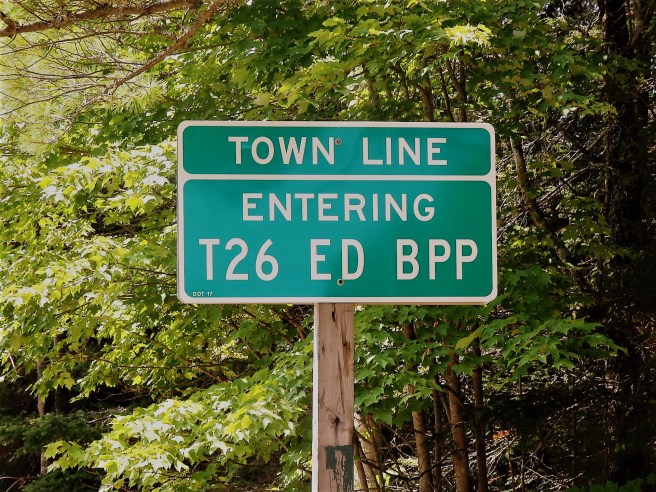
Thus, when driving along you might see a highway marker like the one announcing that you’re entering T26 ED BPP.

There are many more signs like this, equally baffling. This one translates as Township 26, Eastern District, Binghams’ Penobscot Purchase. Don’t ask me more, I’m already confused, as I’m sure you are.

There’s even another variation, PLT, for Plantation – and, no, it has nothing to do with fields of cotton or tobacco.

The Plt stands for plantation, which has nothing to do with a privately owned farm in Maine.

Significantly, more than half of the state is uninhabited. Hard to think of that, considering the urban and suburban density and congestion of so much of the rest of the Northeast.

Somehow, nobody’s counting mosquitos or moose in the equation.

What do you have to explain to others about the political setup of the place you live? Ward politics? The county sheriff? The nut jobs, right or left?

Not just moose but a murder mystery, too

The joke is that moose don’t have horns, they have antlers. The Moosehorn National Wildlife Refuge excuses itself by noting that it’s named after a brook that meanders through the preserve. Not that it’s the only fine body of water.

Canoeing, kayaking, and fishing are welcome.
The marked lanes make for some lovely strolls.

And the U.S. Fish and Wildlife Service adds that the preserve is home to much more than moose, bear, beaver, and deer. For example, some 223 bird species have been identified in its two divisions – the 31-square-mile Baring Division to our northwest and the 13-square-mile Edmunds Division to our west, both within a half-hour drive from Eastport.

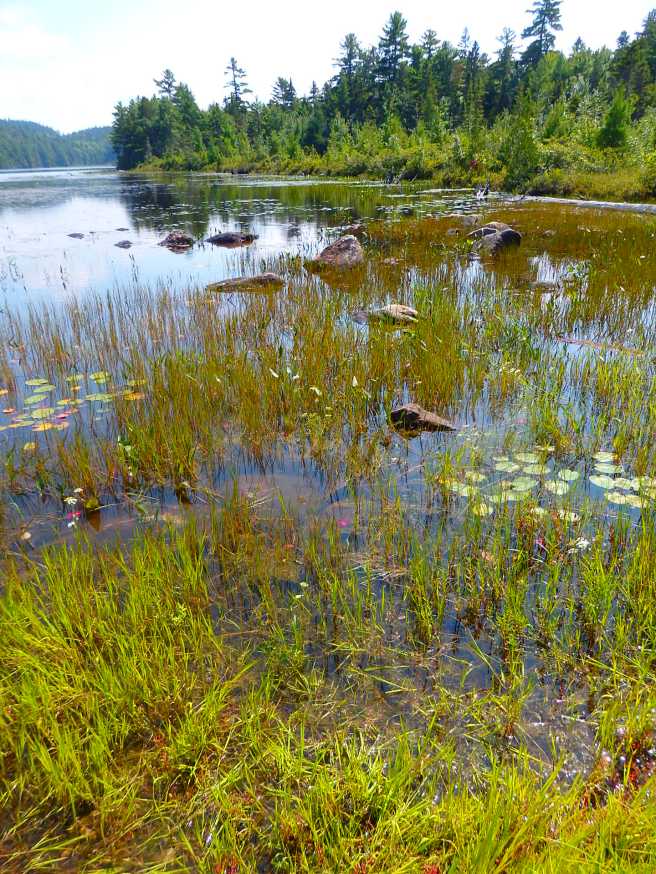
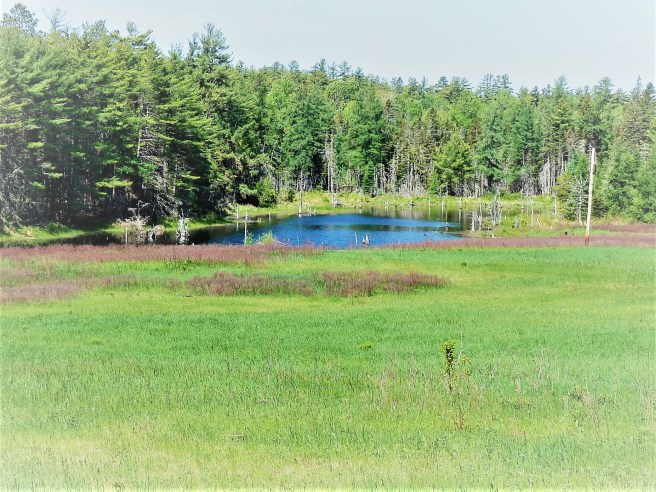
The terrain is varied, much of it wetlands, and a third is protected as wilderness.

I especially appreciate the miles of hiking trails, some along former roads.

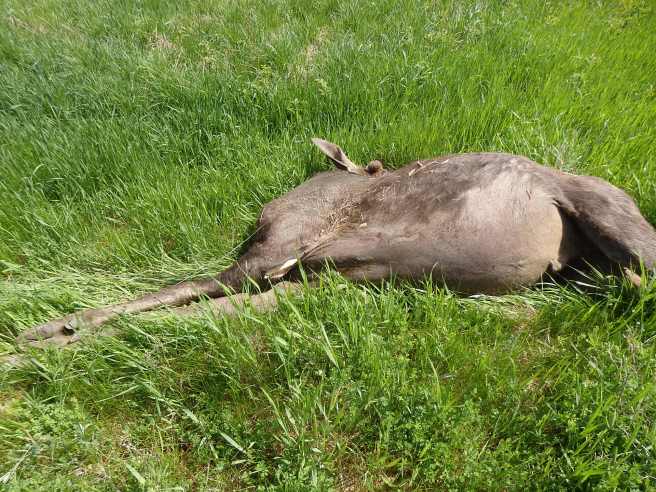
What I wasn’t expecting on one outing was the moose I encountered on a grassy roadside near a flowage.

When I first spotted the tawny hump amid the green, I thought it might have been one bent over grazing, in which case I’d need to approach cautiously, or else just a big rock.

Instead, it became a mystery.

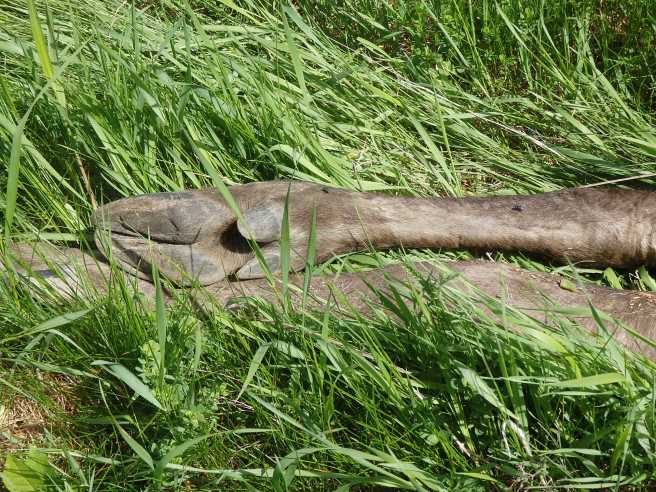
The hooves and legs.
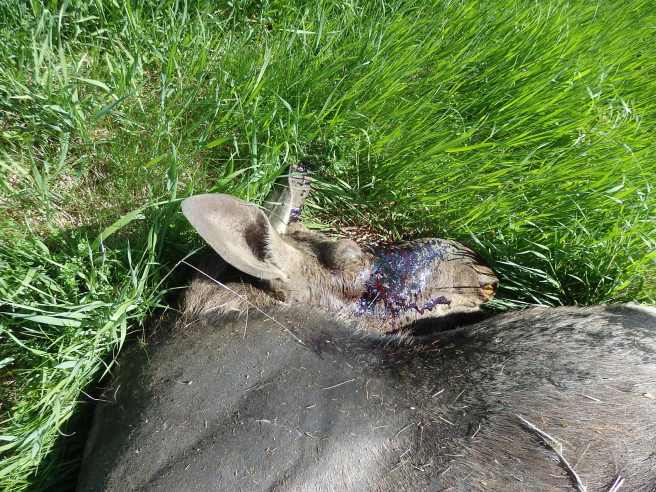
Apart from the head injury, the body was in fine shape – no mat of ticks, for one thing.
It really is a big, powerful jaw.

Tire tracks in the grass had me wondering if a ranger driving down the gated-access lane had tried to veer away from the animal on the roadway, only to have it bolt into the oncoming vehicle.

The carcass was fresh enough that a solitary vulture overhead wasn’t even taking notice.

Later, back in town, I began picking up details. Everybody seemed to have more to add, most of it from Facebook.

Seems the baby male was hit on Charlotte Road earlier in the morning. (Baby? It was bigger than me.) Folks were wondering what took the wildlife officers so long to clear the road. They then took the remains into the preserve, to return to the food chain. Mama Moose, meanwhile, spent the rest of the day wandering forlornly.

It is a relief to know that moose collisions aren’t so common around here that they’re taken for granted. Deer, on the other hand, as everyone will remind me – keep your eyes open.

For my entire hike, I was the sole human experiencing sights like this.

What’s the most surprising thing you’ve ever encountered out on a walk? Or even a drive?