WHEN THE DAUGHTER TAKES OVER

When I wrote the four novels that formed my Hippie Trails series, Cassia was nowhere in sight.

But now that she’s taken center stage in What’s Left, she’s changed my perspective on those earlier novels. Quite simply, I’ve revised them to bring them more into line with her story. Drastically revised them, in fact – deep cuts, offset by new material.

Quite simply, they’re now her discovery of her father and his era rather than mine. Having a character take over a book is rather eerie, actually, especially when she’s livelier and more interesting and more critical than I’d be. Moreover, she wasn’t even present in those earlier works – they’re all before her birth. Before she was even conceived, as it were.

That hasn’t stopped her from pushing for more extensive revisions than I had anticipated. Not only are the novels all retitled – and two are even compressed into one – but many of the characters are renamed, a few new figures are introduced, and hefty cuts are offset by rich new detail and restructured storylines.

So what we have now is Daffodil Uprising, Pit-a-Pat High Jinks, and Subway Visions. And the series they form with What’s Left is no longer Hippie Trails but Freakin’ Free Spirits.

Well, quite simply, my wife hates the word “hippie,” says too often these days it translates as “loser” or “lame,” and I wanted something that might fit bohemians over time … in this case from Cassia’s Greek great-grandparents right down to today.

By the way, I’m still blaming Cassia for my putting so much else aside in the past five months. She just wouldn’t shut up, and she can be quite bossy. Admittedly, though, I’m much happier with the novels as they’ve evolved and finally emerged. Let’s hope she is, too.

As for you and other readers? That’s the real question.


TWO TWEAKS IN THE DESIGN

As I moved from the Advance Reading Copy to the First Edition of my new novel, I decided to make two tweaks in the cover design.

The photo itself remains unchanged. It’s the typeface that altered.

When I lined the original cover up beside the covers for the related books in the cycle of Cassia’s discoveries, I realized it’s serif typeface was out of step with the sans serif on the other three volumes. As much as I love serifs (they have more character, for one thing), I also saw that a sans would have more punch on the thumbnail size used to display most ebooks. OK, so that changed.

Again, as I considered the four books together, I saw something else happening. The next book in line, Daffodil Uprising, features a prominent daffodil bloom in a bright yellow antique-style drawing. The contrast between its artwork and the photo on What’s Left works, I think, but the white title somehow felt out of step.

That’s when the thought flashed, “You idiot! It has to be yellow! Like the yolk! Like the daffodil, too!”

Here’s the progression. First, the ARC:

What’s Left

Then the sans serif:

And finally color:

What’s Left

So here you have it. Any reactions?


AND NOW FOR THE FIRST EDITION

The cardio incident in January threw off my planned marketing campaign to support the Advanced Reading Copy availability of my new novel, What’s Left, but maybe that’s a good thing.

Instead, “laying low” meant I had time to read all of the frothy Richard Avedon bio I’d been given at Christmas, and that had me rethinking the particulars of the life of a photographer. Remember, in the novel, Cassia’s father is a famed photographer, though nothing like Dick. The negatives and glossy prints her Baba leaves behind establish the foundation for much of her own recovery and growth.

At the time, I was already planning to revise the four novels that form the backstory to What’s Left – my Hippie Trails series – but had no intention of becoming as immersed in that project as I did. Well, it’s one of the big reasons I’ve been AWOL or missing in action the past five months. I’ll leave that for an upcoming post.

One critical reaction to the new novel, however, sent me back through the story to make some crucial changes.

The Advance Reading Copy used no quotation marks. Not one. Since the story is being told by Cassia, who’s to say she’s quoting others exactly or is instead paraphrasing what she remembers hearing them say? That is, filtering them into her own voice? The quotation-mark-free approach, I hoped, would present the tale as her own rich interior experience, but it was unconventional and apparently a challenge for some readers to follow. Since engaging everyone in this story is far more important to me than my personal pursuit of a literary technique, I yielded in preparing the first edition. Yes, I have to admit, judiciously adding quotation marks here and there does clarify the flow.

The revision also had me simplifying much of the grammar and syntax. As much as I love long, complex sentences, not everyone is comfortable reading, say 17th century literature. Besides, this novel is being told by Cassia, not me.

Well, this official version, the first edition, is now available. I think the tweaks make a huge difference, and I’m grateful for those who’ve given me feedback.

Hope you enjoy it.

CHARACTER OR ACTION DRIVEN?

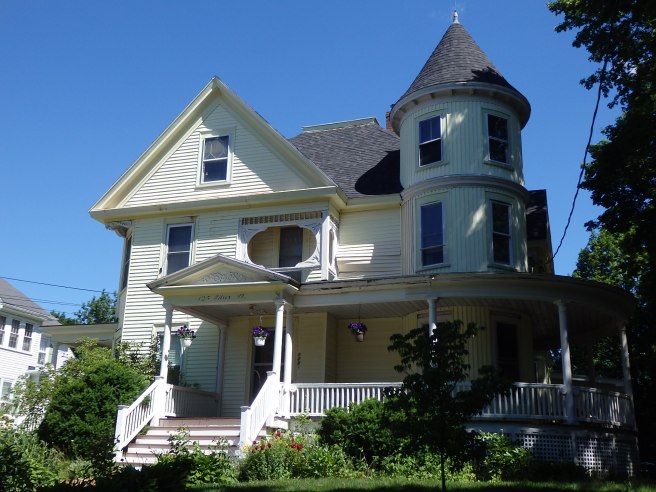
A large Queen Anne-style house with a distinctive witch’s hat tower something like this is the headquarters for Cassia’s extended family in my new novel, What’s Left. If only this one were pink, like hers.

A common question for novelists asks whether their book is driven primarily by the development of its characters or by the actions of its plot. It’s not one that had been front-and-center for me until my newest work began taking shape. For one thing, my previous fiction all falls under the category of Experimental, and, for another, I’ve usually been of a contrarian nature. Maybe the earlier stories were more event or episode driven than action propelled, and characters added whatever they had. As I’ll say, up till now. Or, as I might add, a journalist is more concerned about what’s happened than the motivations of the individuals involved.

My new novel, What’s Left, was initially envisioned as a kind of post-hippie history – an update flowing from the ending of my first published novel, in fact. But then it began turning into a different kind of history, going back further to her immigrant great-grandparents. Well, at that point the story could develop either way, based on the characters or their encounters. What clarified the direction for me was my decision to have her father vanish in an avalanche halfway around the globe, which precipitates her obsession to know just who he really was. And that made it character-driven.

As she discovered more about her father – and her colorful, extended family – I realized I wanted to know more about Cassia herself, starting with her reactions to the clues she was uncovering.  In the end, What’s Left is about her, told in her voice from age 11 into her early 30s. As for the history? It’s bound to be in her blood.

Continue reading “CHARACTER OR ACTION DRIVEN?” →

WHEN THE STORY GOES WHERE IT WANTS

Carmichael’s, the restaurant her family owns in my new novel, has me looking more closely at others.

Over recent years, I’ve been especially fascinated by the hippie outbreak and its legacy. We had a taste of what society could be and let it slip away, or so the story goes. In reality, nobody ever fit the hippie stereotype, and while the impression is that the movement died out, so many of its concerns continue – from environmental awareness and sustainable economics to racial and sexual equality to social justice activism to Asian and Native spiritual traditions to back-to-the-earth and natural living and so on. It’s a long list, actually.

Continue reading “WHEN THE STORY GOES WHERE IT WANTS” →

DO THEY HAVE TO BE SYMPATHETIC CHARACTERS?

Carmichael’s, the restaurant her family owns in my new novel, has me looking more closely at others.

One of the conundrums I’m left with in my new novel, What’s Left: What if you don’t like her father, her deceased Baba, as she recovers him? (Or recovers from him.) Is it essential to your enjoyment of the story?

Or worse yet, what if you don’t like her?

Continue reading “DO THEY HAVE TO BE SYMPATHETIC CHARACTERS?” →

AND NOW, FOR A COVER!

Thanks to everyone who responded to my earlier invitation for comments regarding a few possible covers for my newest novel.

The survey ended in mixed results and prompted some heated in-house discussion, ultimately sending me back to the drawing board for a more compelling design.

Just what do we want as a cover, anyway? Are people’s faces a help or a distraction? Does a jacket work best if it somehow reflects a scene in the story, as my earlier mock-ups attempted to suggest? Or is reaching for a less constrained, emotional reaction more effective?

What’s Left

As you see, I’ve opted for the later. Here the image invokes a sense of being broken out from a protected shell and falling through space. It’s also appropriate for a family that owns a restaurant – food being a theme running throughout the story. Will this cover encourage a browser to open the book to discover, in effect, just what happens to the yolk? Where it will land?

That, of course, is my goal. To see if it fits, go to Smashwords, where you can order your own Advance Reading Copy for free. The offer will expire after 90 days, when the first edition comes out at $4.95, so act now.

Your early reactions will be most welcome in preparing for that release.

PRELUDE & FUGUE 28/

an elephant with flowers painted
around the eyes and painted toenails

four zebras sipping water

*   *   *

luxurious green tent on safari white bone
ornaments through noses armed for the hunt
and cocktails already served
three African bushmen in a field of wrinkled flesh
eyelid (the elephant) the rain
is needed, sticky or no sticky (unlike the rhino)

zebras, black and white in a splash of vibrant green
with netting over the bed
luxurious green tent on safari white
bone ornaments through their noses
armed for the hunt and cocktails
already served three bushmen in a field
of wrinkled African flesh, an eyelid (the elephant)
the rain is needed, sticky or no sticky
(unlike the rhino) zebras, black and white

in a splash of vibrant green            with netting
over the bed’s luxurious green safari tent
white bone noses armed for the ornamental
hunt cocktails served by three bushmen
in an African field of wrinkled eyelids needing rain
sticky or no sticky the elephant (unlike the rhino) or
zebras, black and white in a splash
of vibrant green netting over the bed ornaments

beasts leaping from dust into a tropical river
before a tiger atop a car spirals between
four zebras sipping water the way
a camel’s nose runs ahead of its mouth:

the hairy trunk and mouth of an elephant, so spotted
forages on hind legs, trunk and tusks upraised to the tree

the elephant with flowers painted
around the eyes and painted toenails
still leaps from the dust into a tropical river

a camel’s nose runs ahead of its mouth from hind legs
upraised to the tree in front of the tiger
atop a car of spiraling spots

the hairy trunk and mouth with flowers painted
around the eyes guarding four zebras sipping water
and the foraging beasts leap from dust into the river
running ahead of its mouth

a camel on hind legs, the tree painted with flowers
and toenails a feeling of life finally coming together

atop a car, four zebras leap from the dust
into a hairy river and forage
a feeling of life finally coming together these days

~*~

Poem copyright 2016 by Jnana Hodson
To see all 50 Preludes & Fugues, click here.

WHAT HAPPENS WHEN THE QUOTATIONS BLUR?

When someone speaks of an event while quoting someone else, how accurate is that quotation? How much is a recasting by the teller, perhaps years after the event being related?

In drafting my newest novel, as I turned to a first-person narrative by someone who never even met many of the characters she’s telling about, I realized that her quoting them was actually a filtering through her own voice. In other words, the precision of their voice was in question. Would it be right to put their input in quotations marks? Or eliminate the quotation marks and let the telling float in and out of some recollection?

I’ve opted for the latter. Will it work for the reader, though? We’ll see.