rather usually either/or aesthetic I find pleasing when it cloisters balance, order, tasteful in adornments and stylish you don’t see too many up this way in such possessions as clothing, what could be a trick question but instead they detest news briefs intruding on soap operas especially since a house comprises much more than domesticity
One of my favorite lines I cut out of my novel What’s Left, was this quip:
I want some backbone in my religion. You can’t sit without it.
But as I looked at the flow of the story, I just couldn’t find a good place to develop some pushback from Cassia in her teens, where it would have been most appropriate.
Still, if you know anything about the practice of meditation itself — often called sitting — you just might enjoy the double-meaning.
Another way I thought of raising more color regarding their Buddhist identity was through rounds of Tibetan holidays. The names and special touches alone can be charming: New Year’s archery; incense to drive away evil ghosts; Sho Dun “yogurt festival”; the Meeting of the Eight Guardians (stay inside to avoid evil outdoors); Golden Star to wash away greed, passion, jealousy and to abandon ego; the washing festival. Think of the picnics and ritual bathing.
I might have also built something on the Eight Auspicious Symbols, including conch shell, parasol (crown), victory banner, golden fish, or treasure vase. The Endless Knot is the name of a chapter, though.
Beyond that, I kept looking for synonyms for Buddha or Buddhism. One of my favorites, which I didn’t use, is the hanging cliff-side wonders. Some of those monasteries are no place for anyone with a fear of heights!
~*~
Many traditions have special dishes for specific holidays — secular or religious. Sometimes it’s even a family thing, rather than something everyone does.
What’s your favorite “holiday food”?
~*~
Church-sponsored Greek festivals are popular events in many towns across America. And, yes, men do much of the cooking. Opa!
what upset me was the basic ineptitude that causes such accidents and delays to happen, still, if it hadn’t been for a couple of foolhardy neighbors one-thirty a.m., fire alarm, dashing outside before smoke in a neighboring apartment turned into flames, only then did I think who brought the blaze under control with fire extinguishers while eating way too much smoke, the fire trucks would have arrived to an attic entirely aflame so I should have carried my computer files out, too, but why the fire department took thirteen minutes to respond from a station just five blocks away is inexcusable
Do you ever look around and see people who seem to get a lot more done than others? I could tell you about some of the lifeguards at the indoor pool where I swim, the ones who do their school homework when they’re not watching us splashing around. Uh, swimming laps — something they can do four times faster than us geezers.
Well, in my novel What’s Left, the narrator has a similar question, one regarding many members of her family. (You won’t find it in the final version of the book — but it’s true all the same.)
I return to the question, How do they manage? All that they do?
~*~
Her aunt Nita, as we’re told, sticks to a routine and limits her evening activities. Her father could easily split his workweek into 20 hours of photography and 20 of Buddhist focus. Her mother would be putting in more at the press but still devoting considerable free time to practicing and rehearsing music.
Some others just seem to go without sleep or rise before dawn to get an early jump on things.
Tell us about somebody you know who seems to be super-human. Do they have some secret you see?
~*~
A fragile, old film negative sits atop a light box. Cassia had to learn how to handle these gently. Very gently.
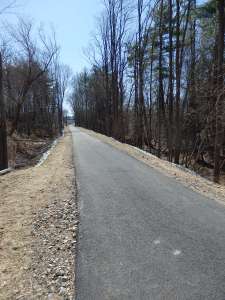
Dover’s four-mile-long community trail is a gem and has provided more than a few photo ops I’ve shared here at the Barn. Its southern leg starts at the Amtrak station downtown and, until recently, ended unceremoniously at residential Fisher Street with some delightful scenes in-between. Considered the urban leg, it’s paved for bicycle use as well as pedestrians and runners.
The northern leg kicks off at Fourth Street and follows the Cocheco River up to Watson Road, with its waterfalls and dam. One kink in that route – approaching at the Spaulding Turnpike bridge – was cleared up a few years ago, as was improved access to the trail itself at Fourth Street more recently. Some memorable cross-country skiing from the Watson Falls down to the Spaulding and back had me feeling I was up in the White Mountains rather than still inside the city limits.
Now, after being on the drawing board for more than six years, a 2,000-foot-long portion of the rail-to-trail pathway has extended the southern end almost all the way to the Sawyer Mills apartments and made ready access for middle- and high-school students.
No motorized vehicles allowed. What a delightful luxury! I think of the trail as Dover’s own Central Park.
There were complications getting permission to skirt some commercial properties along the way, as well as drainage issues and some serious poison ivy. Remaining railroad ties made walking difficult – forget the bicycle or the baby stroller.
Now that winter’s over, the stretch has been graded and paved and, where necessary, fenced off – in a stylish way, I’d say – and while some final touches remain, it’s already attracting happy pedestrian traffic.
You can bet I’ll be checking it out on my return visits.
It’s somebody’s back yard. Really. An industrial parking lot is just ahead on the trail.
If you’re still on the fence about breaking some sod and scattering seeds or selecting six-packs of young plants, think about this.
Gardening is time-consuming. There’s a lot to do before planting and harvesting. Even before and after. Wouldn’t you rather be doing something else?
Heartbreaking. There’s always a sacrificial crop each year. You never know which one it will be.
Demands weeding. And more weeding. Especially if you’re largely organic. They’re back in a flourish overnight.
Messy. You have to have someplace out of sight to hide all the pots and bags you’ve pulled out of the shed or garage. As for those weeds you uprooted? They get thrown somewhere.
Debris-producing. You can’t compost it all, especially the woody stuff. And, yes, you can put that in those big brown-paper bags and haul them to the dump, or you can find somewhere to establish a brush pile. And then, at some point, you’ve got to do something with that brush pile before it requires a building permit.
Anxiety-producing. Just listen to my wife watching the weather report or me anticipating the water bill when we’re having to water intensely through a dry spell. And that’s before hailstorms or frost warnings or …
Unforgiving. For example, when a crop arrives, it’s often a flood that must be picked pronto or spoil. And just picking it isn’t enough. You can’t eat it all, so somebody has to can or freeze it. Now! Before it starts rotting or wilts.
A magnet for invaders. Birds, picking out sees and later berries. Slimy garden slugs, taking bites out of anything fleshy, like strawberries and tomatoes, or greens. Squirrels digging mindlessly, often planting walnuts as they go, which then sprout into stinky treelets with tenacious roots. Woodchucks, which can devour a row of their choice overnight. (See item 2.)
Costly. Those bags of potting soil and additives and pesticides (even organic) add up, as do the flats of seedlings, even once you’re past the round of catalogue orders at the beginning of the year. As I was saying about the water bill?
Let’s not overlook replacing broken tools. Or lost ones.
~*~
Well, all those benefits do come at a price. Best you know now!
Fellow planters, be frank. What other downsides would you acknowledge?
My novel What’s Left includes reflections on a first generation of a family business dynamic, somewhat like one I also describe in passing in Nearly Canaan.
In reality, the model of a restaurant run by two brothers and their wives was one I observed in a small Midwestern city where I edited the local newspaper. In this case, their roots were Italian, not Greek, and the economy was essentially farming and two large factories, without a university or county seat to boost business.
Do you have any insights on ways siblings interact when they run a business together?
in outward affairs, a broken toe and off I went, steering in late snow to the emergency room blizzard, too, in sandals now, finally wearing eyeglasses for reading, blame the computer screen and more balding Maine coast from time to time, plus some light rowing and canoeing, and chamber music in mountain villages . still, the annual boat dance with live country folk band and callers cruises Boston Harbor Smell the breeze in its permutations of loving



 Jnana's Red Barn