escaped from Washington right after morning Beltway constipation at least a few traffic tie-ups, one just north of Baltimore, normal construction on the Jersey Pike (45 mph zones, observed closely after getting a $75 fine a few years back), a bit on the George Washington Bridge and Cross-Bronx Expressway ho-ho-go
Tag: Life
Hate to admit my handwriting’s deteriorating
I used to be an artist, which meant I had some motor-function ability, as they say of hand and finger control.
But these days?
I can’t blame it all on aging, can I?
Or even declining eyesight when I’m trying to decipher my notes.
Favorite canines from a non-dog lover
Eastport is filled with dog walkers, even more than Dover was, and their perspicacity in making the rounds umpteen times a day amazes me. What else do they do with their lives?
Don’t count me as a dog lover. I grew up having cats. You never step in their poo or take them for walks. And now, rabbits. Ditto.
That said, here are some dogs I’ve had to deal with, one way or another.
- Grimm. The one in Mike Peters’ comic strip. I had a small role in getting it rolling. Still love the caustic humor.
- Rin-Tin-Tin. A frontier mascot in a TV series we watched back in the black-and-white days of TV. Gee, how could I forget Rusty, orphaned in an Indian raid, much less the fact his dog was a then-exotic German shepherd or their home was a U.S. cavalry outpost? I always wanted a pair of gloves like the lieutenant’s.
- Lassie. Another TV star. Gee, when’s the last time you saw a collie? They used to be everywhere, in no small part because of this show.
- Silas. Our neighbor’s German shepherd back in Indiana. He appears in my novel, Nearly Canaan.
- Sal. The big pit bull my younger daughter and her roommate rescued from a shelter. An amazing animal who had one unacceptable quirk. This story ends sadly.
- Our neighbor’s Irish wolfhounds. They would hang over the six-foot fence separating our yards and howl mournfully. Maybe they knew their lives were doomed to be short, a problem with huge dog species.
- Blue. Maybe you know the song? “I had a dog and his name was Blue, bet you five dollars he’s a good dog, too.” Get me the Kleenex.
- Pluto. The mopey Disney cartoon character, not Roman mythological ruler of the underworld. Back to childhood, naturally.
- Simon and Schuster. A pair of basset hounds walked around here by an aspiring writer and her dutiful partner.
- Snoopy. Back to the funny pages, we have Sparky Schultz’ classic and patient observer of human folly. I didn’t appreciate him until he was nearing the end of his run. I think Mike Peters’ wife had a role in opening my eyes here.
Honorable mentions to Fang in Harry Potter or Toto in Wizard of Oz. If only I were a fan of those works.

Tell me about your dogs. Please!
In uniform some of these histories never quite go away
you have no idea how long since I even allowed myself the luxury of dreaming like this, it’s very healthy, I’m told, hmm, as plane tickets to Dallas! (naw!) (just kidding!) security deposit on a new apartment, so I can move from this one; then use the returned deposit here for some of the foregoing, cunningly
Among our best guests in Dover
Once the renovations are finished in our old Cape, we’ll be looking to pick up where we left off in Dover, back before Covid interrupted travel and entertaining.
In no particular order, among the guests we remember fondly:
- Primary election volunteers who often slept on our floors, including a Congressional chief of staff, a British journalist, an authority on smallpox and anthrax, and Muslim college students from Detroit.
- Chinese college students doing volunteer internships.
- The quirky, queer, Quaker comedian and performance artist and Bible scholar. Seriously.
- The retired economics professor and Friends committee colleague.
- My usual roommate at Yearly Meeting sessions.
- My best friend from my high school year, despite my living on the wrong side of the tracks.
- My former landlords in the Happy Valley.
- The other Quaker among Baltimore Mennonites and his wife.
- The Passamaquoddy traditional healer and his apprentice.
- My goddaughter, most recently from Germany, and any of her friends, including the one who grew up to become mayor of a notable Maine city.
Who have been among your favorite guests?
Our newspaper is the Quoddy Tides – not Times
One of the factors in our decision to relocate to Eastport was the quality of the local newspaper, which appears every second and fourth Friday of the month.

There’s nothing flashy about its tabloid-format editions, but everything I see strikes me as solid, even compelling, community journalism.
The quirky – and unique – use of Tides rather than Times in its name is not just humorous but altogether appropriate. The paper reports on all of the communities the tides touch on in Washington County, Maine, as well as many in neighboring Charlotte County, New Brunswick.
One of my ongoing criticisms of American newspapers over the past half-century is that very few of them give you a feel for the place they serve. Ownership by out-of-state corporations is only part of the problem. Continuing cutbacks in coverage is another. (I play with those and other factors in my novel Hometown News.)
For most dailies and weeklies, there’s a generic look and taste in the stories. Everybody has city-council and school-board meetings, for heaven’s sake, and most car crashes are just as boring.
Somehow, though, that’s not the case with the Quoddy Tides.
Consider the lead on a report of the start of the important commercial scallop harvest, a story that was presented on Page 2 but teased from the front page by a dramatic black-and-white photo of a fishing boat plowing through rough seas:
“Winds gusting over 50 knots did not deter many Cobscook Bay area scallop fishermen from going out on the first day of the season on December 1. About three-quarters of the fleet of over 20 draggers based in Eastport and about 10 boats from Lubec headed out that day.”
Remember, it’s not just windy with choppy surf. This is December, blowing icy water. As for a feel of the place, just listen to the quotes in the next sentence:
“Lubec fisherman Milton Chute observes, ‘The tops were blowing off the water like it was pouring,’ and Earl Small of Eastport says that while it was ‘sloppy steaming back and forth,’ once the boats were on the lee shore either off Lubec or down in South Bay, it wasn’t bad towing out of the wind. ‘It’s not as dangerous as people think,’ says another Eastport fisherman, Butch Harris, noting that two or three boats will fish together in case anyone gets in trouble. ‘It was a rough ride out, but once you’re there fishing it’s not that bad.’ Harris points out that scallop fishermen have only so many days that they’re allowed to fish. ‘If you don’t go, you lose it,’ he notes.”
Much of their quotes, I’ll venture, is pure poetry. And off the cuff, at that.
The rest of the story fills out the page, detail after detail. I bet you’ll think of some of this dedicated labor, too, next time you eat seafood.
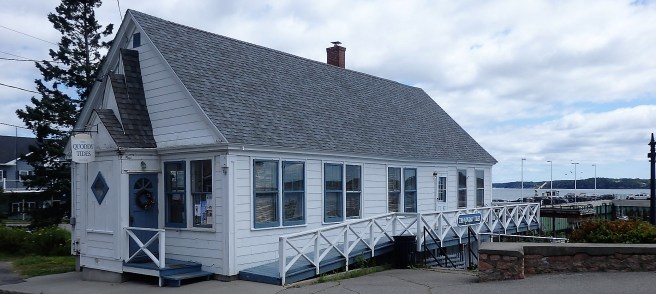
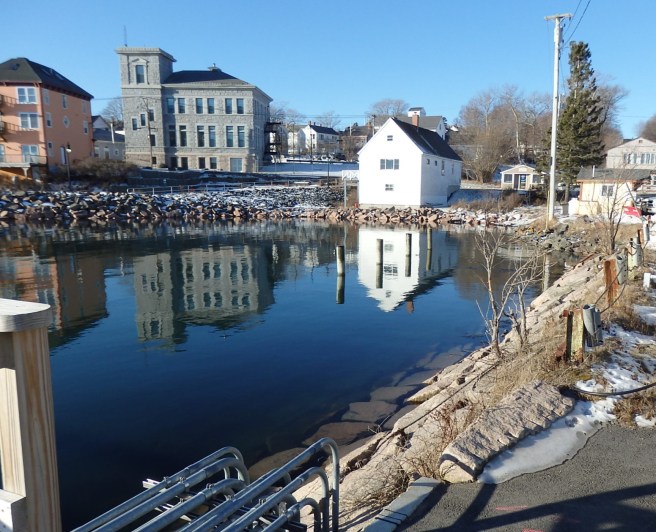
The Tides was founded in 1968 by Winifred B. French, the wife of Dr. Rowland Barnes French, M.D., and mother of five. They moved to Maine from Arizona in 1953 so he could help found the Eastport Health Center, itself a remarkable story in community medicine.
Winifred had no background in journalism, but she saw a need, studied hard, and ventured forth in launching and editing a small-town paper with a regional outlook. In 1979, for good reason, she was named Maine Journalist of the Year. Remember, the Tides isn’t a daily or even weekly newspaper, it’s every two or sometimes three weeks.
Reporters attend public meetings rather than chasing afterward by phone, correspondents provide meat-and-potatoes servings of neighborhood interest, Don Dunbar contributes top-drawer photography, and local columnists all weigh in for what becomes must-read pages throughout the area. The mix skirts the glib boosterism and doom-and-gloom morbidity too prevalent elsewhere.
Winifred died in 1995, but son Edward French and his wife, Lora Whelan, continue on her model. (Another son, Hugh, heads the Tides Institute and Museum – note that Winifred’s sense of “tides” continues there, too.)
I like the fact that the stories don’t carry datelines. Nope, the reader doesn’t get a chance to turn off on the basis of a single word. The region is closely interlinked by people living in one place and working in another or having family elsewhere, so it’s all of interest or should be – both sides of the U.S.-Canadian border.
I also like the fact that headlines come in just two sizes, with a serif face used for a touch of variety. There’s no need to scream to draw attention. Instead, we get an orderly and fair-minded sensibility.
So that’s an introduction. I could go on and on.
In some ways, it reminds me of Annie Proulx’ novel The Shipping News, without the dreariness and grimness.
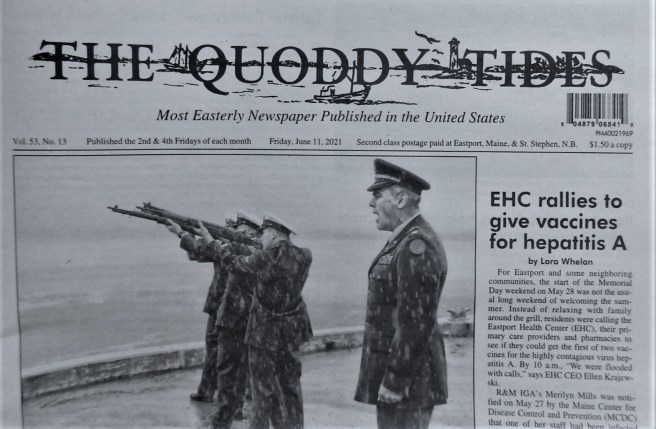
One thing I would tweak is the nameplate, which goes back to the first edition. That shoreline still seems to strike out the paper’s name.
Still, it’s a joy to be retired and not have to be in the midst of producing all this. These days I do delight in being able to sit back and simply enjoy what I’m reading – even if I do on occasion feel an urge to “fix” something on the page.
What – or whom – do you look forward to reading the most? On a regular basis. (Apart from this humble scribe.)
As a guild member
normally, straight into the (meager) savings or IRA but with tax changes anyway thought I’d hold on to it for a while and for a switch dreamed and played, asking myself what I’d like to do with it? pay off on the car? (naw!) finally get a CD player, some Ives and Camerata discs, and those new Boston Acoustic speakers? (now that would be a wonderful self-indulgence!) or how about finally breaking down and getting those twelve-year-overdue cross country skis? gee, I could even finally throw in a ten-speed bike, too! not knowing what the IRS had uncovered but then, surprise
How can anyone ever read all of what’s pouring in?
There’s just so much out there, in print and especially online, and it keeps proliferating daily, even hourly, and I don’t know about you, but I’m in the camp that finds it truly overwhelming.
Everywhere, each minute, make that second, we’re expanding outward, away, from any notion of a renaissance man, and woman, who could possibly be well informed on every facet of a civilized society.
Even in science – or maybe, especially in science – it’s become impossible to keep abreast of the flood.
Interdisciplinary collaboration has become more essential than ever, but also more elusive.
Is this leading toward disintegration?
Is this, in fact, the root of the reactionary backlash around the globe, not just the Trumpian cultists?
Yeah, the folks who rely on Fox TV biased “news” in the USA.
I look at the crises facing our children and grandchildren, and these are critical, but there are so many it’s mindboggling trying to decide where to pitch in taking a stand. Climate change, population explosion, racism, corrupt politics, the one percent and injustice, environmental protection, medical systems, education … Hey, I’m back to hippie era causes on steroids.
How are we supposed to preserve our sanity and still press toward a better future?
We still have to be informed, right? And thinking clearly?
Signs we’re reverting to ghost-town status
The indicators started showing up by the last week of August but are inescapable now. Eastport’s locking up for the winter.
As evidence?
- The passenger ferry to Lubec has already been hauled out of the water and is up on props in the boatyard for annual maintenance.
- The Tides Institute Museum is closed for the season, with the Eastport Art Gallery set to do likewise at the end of the month.
- I trot down to Horn Run Brewing and find it closed today. Gotta check the new schedule. Not that I expected its popular deck to be open all year. And other restaurants have curbed back as well.
- Nobody’s out on the Breakwater.
- Rosie’s hot dog stand is closed and its sign thanks us for a good summer.
- I haven’t seen a super yacht for a month, much less tied up at the dock.
- Most of the out-of-state license plates are gone, along with the luxury car models. It’s mostly Maine and New Hampshire now, and soon it will be about all Maine.
- Well, there is a sole convertible stubbornly zipping about – but just one, with its driver bundled up.
- There just aren’t as many folks around, period. At least the dog walkers are holding up their end.
- There’s an uptick in the number of houses for sale as some Summer People realize they can’t keep up with another year. And the places are staying on the market longer.
Which door is the real one?
Don’t know about where you live, but in New England, the front door typically is rarely used.
That insight was confirmed when I was canvassing for the Census and we had to leave a notice behind when nobody was home. Often, the real door is the one at the rear of the house.
It’s a curiosity that reminds me of something I once read about Zen temples in Japan, which were initially copies of ones in China.
The Chinese loved symmetry, which the Japanese detested, and so when the imported designs were expanded, they grew to one side or the other. Many old New England houses also have many additions, most famously the connecting barn.
Well, for the record, our back door is where the action is, and it runs through a mud room addition from the kitchen.
Now I’m starting to think about trying to enter by the right door as a metaphor for life. Like maybe there’s a hidden key, even. The one others know about, but not you or me?

