because I haven’t really known how to shop for myself expertly I’ve hated selecting birthday or Christmas that is, excepting books and records and a few groceries I’d like for myself you’d think spending would be a simple if you had enough cash and my dependable depression reflected insufficient variety or sassy style on the racks here but price tags on anything I desired conveyed, As I learned, kid, look, you aren’t worth anything as far as your job and life are concerned and maybe if you stole from dying widows or threw single-parent kids into the street, you’d be rich and then honestly, most men still dread shopping so what do you really want in gift wrapping?
Tag: Life
A few things that peeve me royally
Look, don’t make me elaborate. Here are a few, in no particular order.
- Getting stuck in traffic
- Having my plans derailed
- Overly loud music or TV or movies or mufflers
- Not being able to make out the dialogue or lyrics. Along with people singing way out of tune
- People cutting in line or who who can’t count the limit in the express checkout
- Stupidity of all sorts, but willful stupidity most of all
- Arrogance
- Lateness or just not showing up, as promised
- Lying and cheating
- Abuse of authority slash power or gross injustice in general
Your turn! Lay it on!
Still the white emptiness
that or the alternative, boredom, besides, we’ll have the rest of eternity to recover Ahem, amen, what’s this, a partner? or simply another vaporous angel?
Living in sweats
The thought had once appalled me. Like was this the epitome of laziness, that you really didn’t bother to get dressed for the day? Or that perhaps you’d gained so much weight you wanted something that would hang loose rather than accentuate anything?
Skip ahead to retirement and then the Covid shutdown, and I’m having to admit there have been days when I’m living happily in sweats, especially in the depth of a northern New England winter.
Sometimes I even think of it as luxury, not having to venture outdoors.
Oh, what a bum I’ve become kind of feeling!
How do you dress for everyday comfort?
Moose on the loose
This was going to be about squirrels, my nemesis in Dover, but now I’m thinking of Bullwinkle and his kin.
After all, I am living on Moose Island, not that I’ve seen any in town yet. But then I’m not seeing many squirrels here, either. Instead, it’s mostly deer.
Now, for the star of today’s show.
- Moose are the biggest member of the deer family and, unlike the others, prefer to be solitary rather than in herds.
- A bull can weigh in at up to 1,500 pounds, while a cow can be up to 1,000 pounds.
- Their broad, “open-hand” shaped antlers (not horns) can stretch up to six feet end to end.
- Calves stay with their mothers for a year or more but are weaned at five months.
- Their mothers are quite protective and have been known to kill bears with their kicks.
- They’re adept swimmers and can trot at up to 35 miles an hour, despite their slow-moving, sedentary, and dumb image.
- They’re a road hazard. They’re drawn to the pavement for the salt that’s been spread to melt snow and ice. And then they think they can outdo a car or truck, not that they don’t do some serious damage.
- A bull can eat up to 71 pounds of food a day – half of it aquatic plants needed to balance the bark in their diet.
- The fall mating season includes energetic fights between bulls over a desired cow.
- Their hide is often covered with a blanket of thousands of parasitic winter ticks, which stay attached for up to six months, sapping a moose of energy, blood, and hair. They’re the leading cause of death in moose less than a year old and diminish adult cow reproduction.
Not just moose but a murder mystery, too
The joke is that moose don’t have horns, they have antlers. The Moosehorn National Wildlife Refuge excuses itself by noting that it’s named after a brook that meanders through the preserve. Not that it’s the only fine body of water.
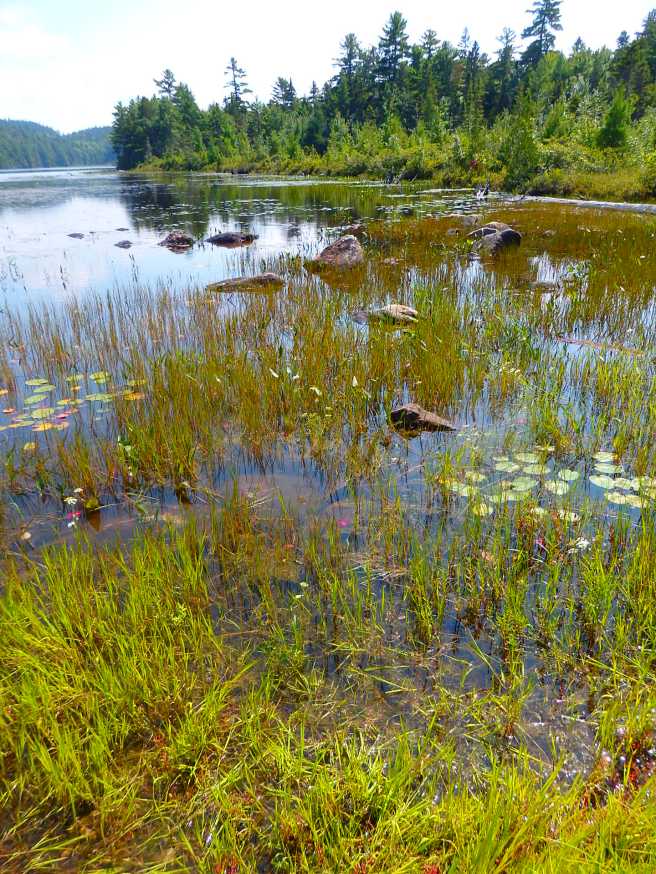
And the U.S. Fish and Wildlife Service adds that the preserve is home to much more than moose, bear, beaver, and deer. For example, some 223 bird species have been identified in its two divisions – the 31-square-mile Baring Division to our northwest and the 13-square-mile Edmunds Division to our west, both within a half-hour drive from Eastport.
The terrain is varied, much of it wetlands, and a third is protected as wilderness.
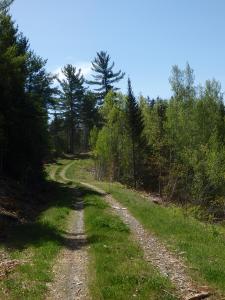
I especially appreciate the miles of hiking trails, some along former roads.
What I wasn’t expecting on one outing was the moose I encountered on a grassy roadside near a flowage.
When I first spotted the tawny hump amid the green, I thought it might have been one bent over grazing, in which case I’d need to approach cautiously, or else just a big rock.
Instead, it became a mystery.
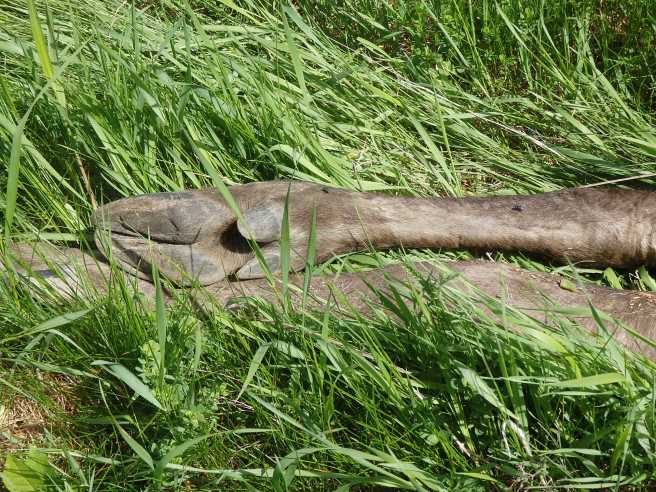
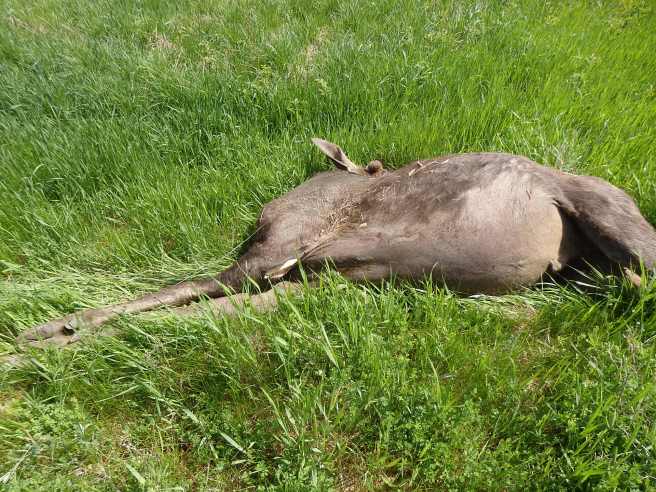
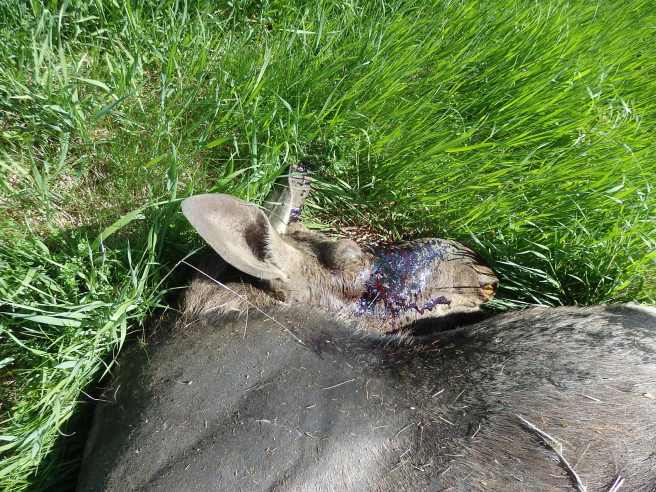
Tire tracks in the grass had me wondering if a ranger driving down the gated-access lane had tried to veer away from the animal on the roadway, only to have it bolt into the oncoming vehicle.
The carcass was fresh enough that a solitary vulture overhead wasn’t even taking notice.
Later, back in town, I began picking up details. Everybody seemed to have more to add, most of it from Facebook.
Seems the baby male was hit on Charlotte Road earlier in the morning. (Baby? It was bigger than me.) Folks were wondering what took the wildlife officers so long to clear the road. They then took the remains into the preserve, to return to the food chain. Mama Moose, meanwhile, spent the rest of the day wandering forlornly.
It is a relief to know that moose collisions aren’t so common around here that they’re taken for granted. Deer, on the other hand, as everyone will remind me – keep your eyes open.
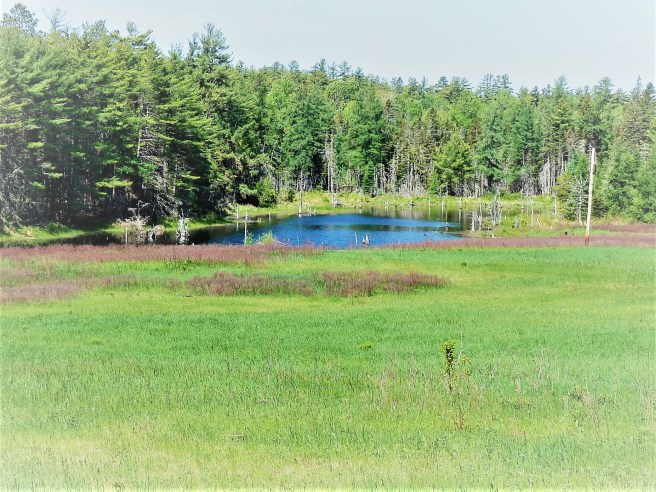
What’s the most surprising thing you’ve ever encountered out on a walk? Or even a drive?
Querido Pedro
what should imbibe a tone of its own at least the dialogue you know back to the earth or center city I’d say boho was largely suburban youths trying to head simultaneously in opposite directions ill equipped for either but rife with contradictions of youthful rebellion, colorful partying, prankster mentality as well as individuals in search of authentic and lasting values as the whole outbreak proves you know how much I still miss it
Weather confession
I never paid much attention to gale warnings before moving to the island.
Seems there’s a “small craft advisory” every other day, not that I sail.
Even in this tranquil life.
Some of my favorite food flavorings and spices
In my relocation, I’ve often been on my own. And that means fully recognizing my tastes in food, rather than relying on my wife’s memory of what delights me.
Let’s go.
- Real vanilla. And yes, I now know there are differences between Mexican, Madagascar, and Indonesian beans, which are really orchids. These are quite distinct from that artificial stuff, by the way. And for the record, I’m not a chocolate guy, but if you must, make it dark or white but not in-between.
- Butterscotch and toffee. I’m a sucker.
- Butter or olive oil. As my wife says, quoting others, fat carries the flavor. One, though, is better than the other in the cardio category.
- Garlic. Onions and I don’t get along, but this alternative is glorious, especially in the ones we’ve raised. It even saved our marriage.
- Leeks. Ditto.
- Miso. I’m fond of Japanese cuisine, OK?
- Rice vinegar. As I was saying?
- Sesame oil. Ditto.
- Rosemary. Maybe it’s the way it goes with lamb and other Greek dishes. Or simply the way we grow our own.
- Fresh, coarse, ground pepper. Anything wrong with the basics? Well, we could add parsley or basil here, if we wanted.
What would you add? Or maybe subtract?
Too many zeroes for zero
as I repeated through hazy defaced New Jersey and New York via Fort McHenry Tunnel just before afternoon traffic congealed, Singing along, too, just see what you’ve done? all your fault, baby (ask me about the Greek who got a banker’s check from France with a few too many zeros which the local bank cashed so he abandoned his Dairy Queen and fled home with several million in his pocket and the FBI on his tail . they couldn’t find him but our reporter did . good old Gus.) Carnally encased desiring a conjunction of such calculations

