Is it even a sanctuary? I call mine a studio, while my spouse refers to it as my lair.
In my first four apartments, mine was in a corner of a room, including three where I sat cross-legged. (Not an option any more, thanks to aging. The sitting on the floor, I mean.) The fourth had a circular utility spool on its side as a table and some kind of chair. If you don’t remember that piece of hippie furniture, just ask.
In later moves, I rented apartments having a second bedroom I could dedicate to the Real Work.
The most impressive was in the small townhouse, where my dream studio occupied the only bedroom upstairs. With its hanging ferns, it looked pretty impressive – from the street, especially, I configured the downstairs into a comfy studio apartment.
There’s the question about sitting in front of a window, providing some kind of view. Annie Dillard, for one, has weighed in totally against that, preferring concrete blocks. At the other extreme, I remember overhearing one wannabe writer detailing to her husband all of the remodeling that was to be done to their house so she could take up writing the novel she planned.
I’ve had both. My office chair in the townhouse gave me a commanding view of the parking lot and water tower beyond. Well, the arrangement gave me a feeling of command, period. In my second apartment in Baltimore, my studio overlooked a set of AM radio towers but my desk stared straight into a wall. The first had looked down on some small urban backyards and an A&P grocery beyond an alley.
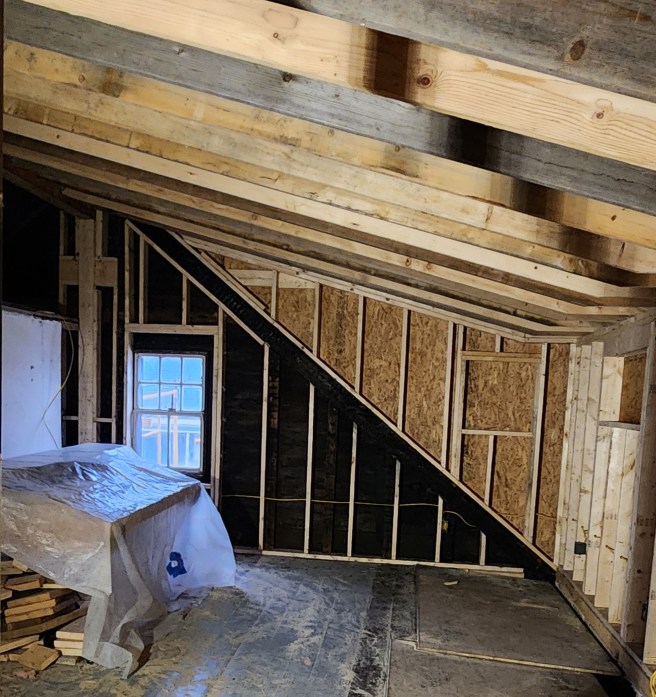
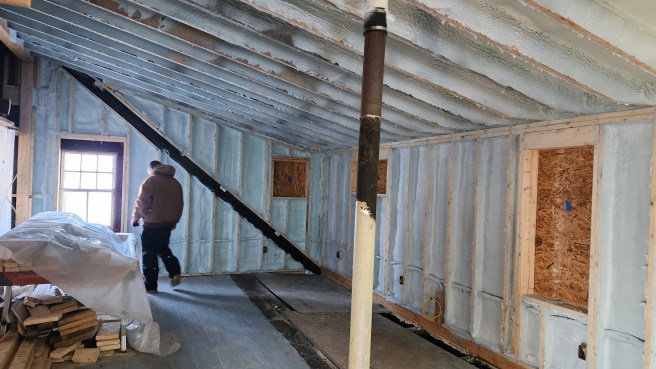
Once I moved to Dover and remarried, I wound up in the north half of the third floor, under the eaves, as you can see in previous posts here at the Red Barn.
At the moment, I’m in a corner of my bedroom, in front of a window and our backyard. Once our renovations are finished, I’ll be upstairs but with the window further above me.
Since I’m pretty much paper-free these days, I need far less tabletop and filing cabinets – remember those? You can’t even give them away any more. They’re rather like used pianos.
Well, one friend gets a new chair for each new book, sometimes nothing more than an aluminum lawn chair, and he’s done quite well, getting reviewed in both the New York Times and its Sunday book section or magazine and sometimes showing up on the bestseller list.
What’s usually overlooked is the supporting space – filing cabinets (yes, a few remain), bookshelves, tables, additional seating, even a daybed or couch, perhaps. Dillard, I recall, had some kind of cube. I think fondly of a Mainer who had the top half of a small barn remodeled for his library and cozy reading and writing space – it was the inspiration of what I hoped to do to our red barn, a dream that never quite materialized.
One big transformation for me has been the shift from paper to digital. I mean, I rarely print out anything anymore. For a while, I didn’t even have a printer. And, when I was up on the third floor, our printer was down on the main floor, accessible to the rest of the family. That wireless connection was a huge advance over the proprietary cord attachment.
I require far less room now than I did when I dreamed of converting the top of my red barn into a studio and library. My, that was grandiose! I hate to think what the heating bill would have been, just for starters. And besides, once we went from five to two in the household, the entire equation changed.
~*~
Equally fascinating is a writer’s use of time.
Charles Bukowski insisted on daily “butt time” at the keyboard, while Jack Kerouac would charge up for a two-week mostly sleepless typing orgy every six months or more.
I’ve known both but lean more these days toward Bukowski.
For much of my adult life, I felt guilty for the reality that writing took away from so many other things I “should” be doing. It was somehow selfish. One summer, though, at a Quaker gathering on the Bowdoin College campus in Maine, I was in a workshop on prayer. The facilitator handed us each a card and told us to write a prayer request – for something for ourselves. For most of the circle, maybe all, this came as a shock. We were prepared to pray for world peace or people we knew, but not ourselves.
So we broke out into groups of three or four, and prayed for each other’s requests. To my surprise, I felt liberated. One participant told my writing was my gift and to respect that. It made it much easier for me to dedicate one day a week to my writing efforts – I was on a four-day workweek at the time, but managed to continue that focus after going back to the traditional five.
~*~
My productive time in college was after midnight. After living in the ashram, that shifted to dawn. During my sabbatical, it was two stretches – one roughly 10 am to 2 pm and then after 10 pm to whenever.
I had big daily and weekly schedule plans for my retirement years, but now that I’m there, those are either amusing or embarrassing. I spend way too much of my life at this laptop, let’s simply say.
Remember, Internet and blogging weren’t a factor back when I was dreaming of being free of the daily office.
Earlier in this series I touched on authors who said they wrote only two or four hours a day and my shock that it wasn’t more.
Now, though, I’m seeing that in a different light. In my time with the newspaper syndicate, my “productive” time was a mere hour-and-a-half to two hours a day when I called on editors in person. The rest of the time was travel, preparing for the sales call, following up with phone calls and letters, filing expense and mileage reports along with reactions – what I term infrastructure. It’s a pattern I see as more common than the assembly line productivity that’s somehow instilled in me. You know, the reaction when you see a Road Work sign and then see three guys doing nothing more than smoking a cigarette.
Or, as I realized when I was stationed in the composing room on a Saturday night and moving pages for the Sunday editions, I more than earned my week’s pay in an hour-and-a-half as we raced to meet deadline. It was a furious crush. If those papers weren’t in supermarkets or readers’ homes across the state on time, we’d lose sales and subscribers.
In other words, you can’t go by assembly-line wage thinking.