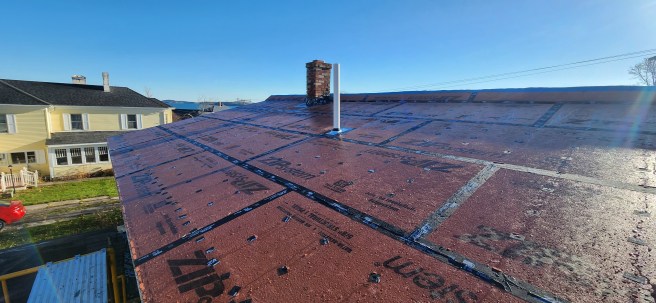
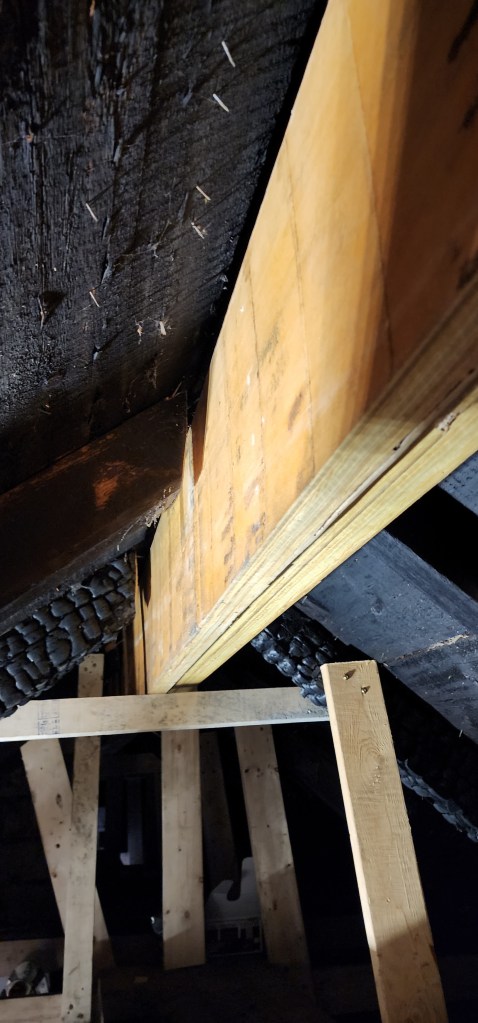
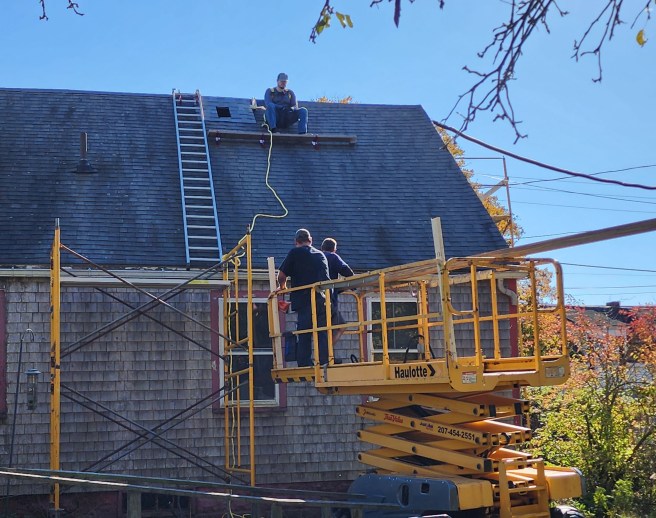
So far, no lipstick. And then? Zip, zip, zip!

After a week or more of finetuning the ridgepole and columns, Adam was ready for more drama. It was time for the old roof and rafters to go.

By now, much of the time the work was mostly loud reverberations punctuated by pounding and thuds within the top half of our house. Most of it mystified me. It often sounded like a war zone, especially when the air compressor kicked in. Not that I’m complaining.

Here we were, six weeks and thousands of dollars later and nothing we’d done was of the sort that would appear on a flip-this-house kind of a video streaming channel – the superficial changes that one local inspector we know dismisses as “lipstick.”

You do have to love an old house. Or, for perspective, an old lover.

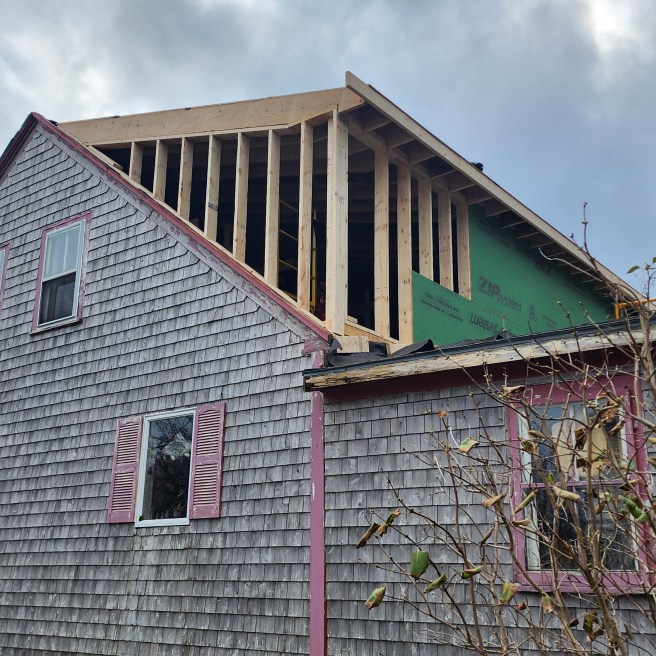
Now we faced the decisive moment. Off with the back half of our upstairs!

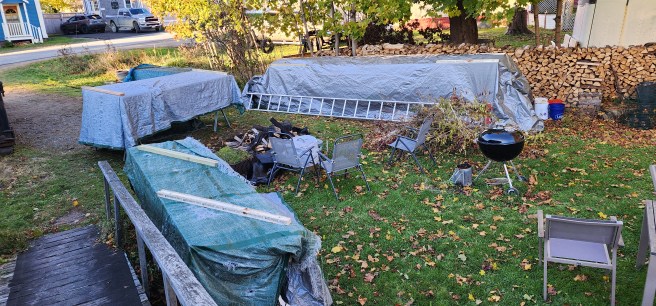
A large, “rolling” dumpster was in place.

That saw appeared like the fin on a shark.
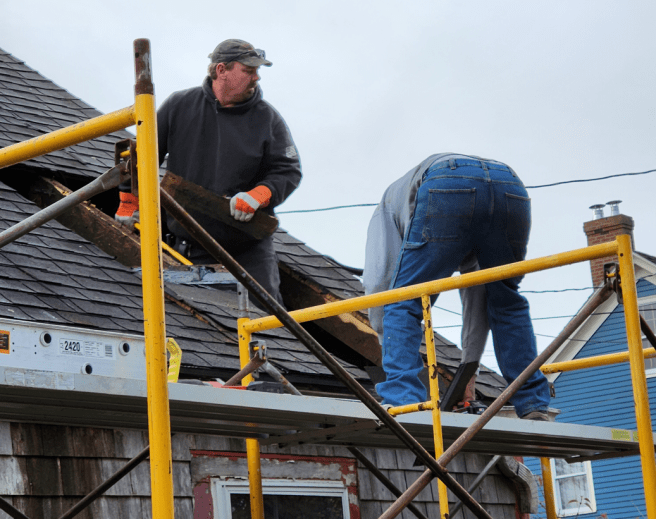
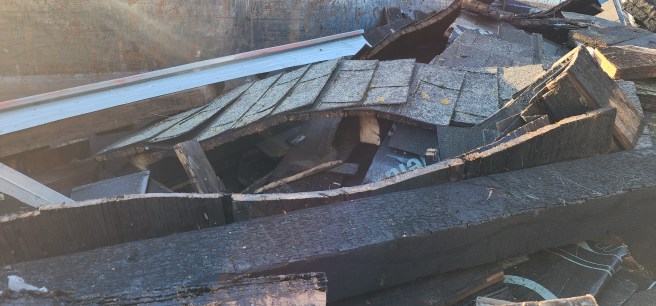
And then the roofing was removed in panels.

We got an idea of what a deck up there would be like.

The dumpster quickly filled.


Ten random questions

  1. So what if it’s NOT historically true?
  2. Is there any egg in a Chinese egg roll?
  3. Who was Jack Russell?
  4. Has anyone used “Jack Russell Terrier” as a nom de plume?
  5. Can brilliance compensate for lack of depth?
  6. Enemies? Present within? Or without?
  7. How are you supposed to answer, “How ya doin’?”?
  8. What’s that noise?
  9. What do I have to do to get my books banned?
  10. Is it better to have no taste than bad taste?

Our home’s new backbone was surgically inserted

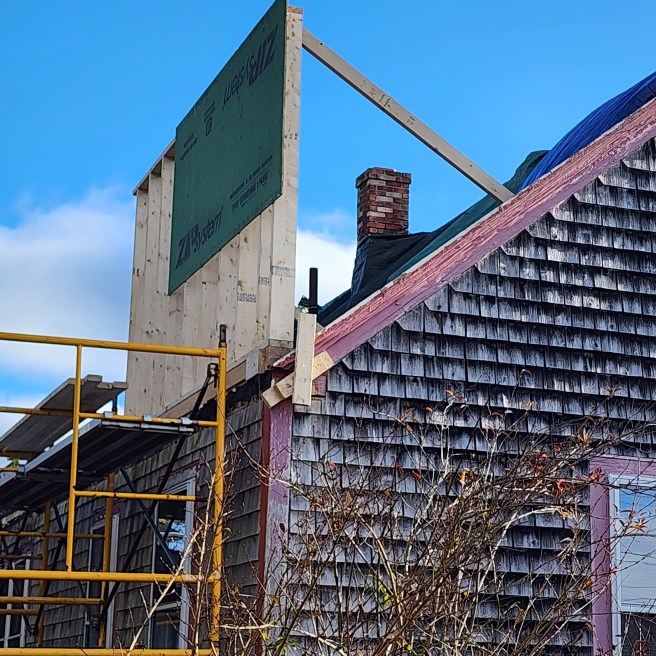
The last Saturday in October arrived clear and cool. We were now officially a month into the project, and Adam showed up with a crew of three for the dramatic operation of inserting a ridgepole. It was rather like laparoscopy, if you want to consider the small incision he made near the top of a street-facing gable.

Here’s how it went.

There was also the column to insert.


There was no anesthesia.

Two years on the road came as a welcome respite

The ‘80s hit me with a couple of hard setbacks. First, Mount St. Helens blew up, as did my job in what I had seen as my Promised Land. I went bouncing back east, first to a stint along the upper Mississippi in Iowa and then three years in the Rust Belt of Ohio, where my shirt-sleeve management position ate up 60 hours or more of my life every week. Shortly after my first marriage fell apart there, my job was eliminated. At least I had a hot love going, with an engagement to be announced once I could relocate to Baltimore, where she had moved for her studies.

Somehow, I landed a field representative job with the Chicago Tribune’s newspaper features syndication service, one that allowed me to move anywhere I wanted within the 14 northeastern states I would be covering. Baltimore was perfect.

Except, once I ensconced in the top floor of an 1840s rowhouse in a gentile in-town neighborhood, my beloved wasn’t. If only I could get a straight answer from her.

Complicating matters was that I was out on the road three weeks out of four, home only to unpack and repack on the weekends. The job introduced me to a world many American men know: frequent flyer lounges, taxis and limos, hotels and motels, expense and mileage reports, quarterly sales meetings, three-piece suits custom made at Joseph Banks, a company car, bonuses. Newspaper management, especially on the smaller papers that I had known, were nothing like that. You might get a nice note from your boss or someone up the ladder thanking you for a particular job well done.

Getting from one sales call to the next gave me a lot of time for thinking as I drove or even reading, if I was flying. The time allowed me to decompress from a decade that had included 11 addresses in seven states. I could journey at ease or read or revise earlier manuscripts at night in my room, whatever its number.

My personal life included some of the loneliest nights ever but also led to my best friendship ever, a Plain Quaker who worked as a supermarket meatcutter when he wasn’t working as a nurse. I also had a circle of Mennonites who introduced me to four-part a cappella part-singing, a step that would lead me to the excellent choirs I would join in Boston and Eastport. I also visited among Friends, aka Quakers, and sometimes managed a few hours for genealogical libraries and archives or walking through cemeteries where my ancestors are buried. I even revisited the ashram and my old stomping grounds in upstate New York.

None of this apart from the newspaper world has entered my fiction directly. I thought she would be a fine character to build on, except in retrospect it turned out all too banal. What these experiences did feed was my poetry later.

Thanks to my best friend from my junior high and high school years, who was now living an hour south – unlike the previous decade, where we kept landing on opposite ends of the country – I obtained my first PC, something some of his buddies were building. It had 5¼-inch floppy disks, which would be ancient history to so many tech-savvy youths today.

In my travels, I saw much industrial wasteland. Not just Pittsburgh and western Pennsylvania or Sparrows Point outside Baltimore, but also around Philadelphia, across upstate New York, in Worcester and Buzzards Bay and the Merrimac/Merrimack River in Massachusetts and New Hampshire.

The newspaper industry was also taking hard hits. As manufacturing jobs disappeared, so did readership for afternoon papers, which were read by people taking the bus home or waiting for dinner. That greatly reduced the opportunity to place new features in their pages. As I was told, only a few years earlier, I would have had no difficulty selling to editors. Now, the challenge was keeping them happy with what they were already buying. I also saw great turnover at the helm of papers. I would curry an editor and have promises for a sale once the new annual budget was approved, only to find that he was no longer there in a year. The position I had aspired to and been groomed for was now revealed to be something less than desirable.

What became clear to the five of us out on the road was that the business was in trouble. One or more of us would be cut. I was the one. Besides, I really never was much of a salesman.

My observations of visiting other papers did augment my actual newsroom experiences that would emerge as the novel Hometown News.

What makes a place ‘home’ for you?

One of the big themes running through my novel What’s Left was that “family” can mean so many different things to so many different people.

Maybe it’s all the renovations going on in our old house, but recently I’ve been pondering many varied understandings of the word “home,” too.

For starters, sampling of what others have said, a home is:

  1. “Where one starts from.” (T.S. Eliot)
  2. “Where we should feel secure and comfortable.” (Catherine Pulsifer)
  3. “A shelter from storms – all sorts of storms.” (William J. Bennett)
  4. “Where there’s one to love us.” (Charles Swain)
  5. “Any four walls that enclose the right person.” (Helen Rowland)
  6. “Where my habits have a habitat.” (Fiona Apple)
  7. “Not where you live but where they understand you.” (Christian Morgenstern)
  8. “A place that gives you unconditional love, happiness, and comfort. It may be a place where you can bury your sorrows, store your belongings, or welcome your friends. A happy home doesn’t require the trappings of opulence.” (Simran Kuhrana)
  9. “A machine for living in.” (Le Corbusier)
  10. “The place where, when you have to go there, they have to take you in.” (Robert Frost)

Is it even a place at all?

Cecilia Ahern insists it’s a feeling. Lemony Snicket pegs that as homesick, “even if you have a new home that has nicer wallpaper and a more efficient dishwasher than the home in which you grew up.” Maya Angelou relates it to an ache “in all of us, the safe place we can go as we are and not be questioned.” For John Ed Pearce, it’s a state of  mind, somewhere “you grow up wanting to leave, and grow old wanting to get back to.” Edward Sharpe senses home as his beloved’s presence, “Wherever I’m with you.” Edie Falco connects it family when he returns to them from his paying job and realizes they make his labors “richer, easier and more fun.” For May Sarton, it must have “one warm, comfy chair” as the line between being “soulless.”

As for a big hole in the middle of our house

While waiting three years for our big renovations to transpire, I often joked that living here was like camping. I won’t go into the list now, but I did accept defects that could have greatly raised my blood pressure if they weren’t already on the to-be-addressed list.

I could even go into the pro-gentrification argument that if big repairs weren’t being undertaken, these dwellings were well on their way to collapse.

Our renovation, daunting as it is, remains a minor effort compared to a few others in town, including true mansions being brought back from the brink. One is a fussy restoration project to keep the place as close to historic accuracy as possible, apart from wiring and a kitchen upgrade. Another is to improve its Victorian social showcase qualities.

I’m also finally understanding why so many old houses out in the surrounding countryside have been left to fall in. They simply weren’t worth the cost of upgrading, not when you could build newer, better, even closer to the world for less.

One of the annoyances we had tolerated was the big cavity where the second chimney had stood – the one that was about to collapse when we bid on the house.

We had passed on an offer to rebuild the brickwork, no matter how charming a working fireplace would have been. The chimney would have limited our remodeling options on the second floor, or so I argued, and without it, we do have a 2½-by-5-foot space to develop into a closet or something on the main floor. Patching the floor itself would be a huge improvement, as well, rather than having a light covering that couldn’t bear weight.

The cavity now provided a place where that 28-foot-long LVL column could run down through the house, as well as some new electrical wiring.

And, during a later break, Adam even fixed the holes.

Yes, step by step, it was all coming together.

How the style and ethics of my journalism career clashed with my literary ambitions

When I sat down to my personal writing, I felt an ongoing tension between the daily grind of newspaper editing that paid my bills, contrasted to my ambitions for something more permanent, more confidential, and more creatively advanced than the anonymous work that went into the next day’s trash. The pejorative “hack writer,” often applied to newspapermen from the early 18th century on, was what I aspired to rise above. The term has haunted me ever since reading Samuel Johnson’s derision.

In my private labor I aimed for something unique, thoughtful, sophisticated, meticulously developed, complex, and even challenging for both me and the reader. If news stories limited attribution for a quote as the neutral “said,” I nearly banished that colorless word from my prose, relying instead on everything from “answered” or “asserted” to “cried” or “swore“ to “wept” or perhaps “whispered,” with a wide range of variants in between. Do note, I’ve come to treasure a thesaurus for ways in can enrichen a text and sharpen the underlying thought and feelings, even though doing so requires additional time and consideration.

My journals, on the other hand, sought mostly to catch up on my life from the previous entry, often in cryptic terms I might get back to and fill in later, though that rarely happened.

~*~

Hemingway could write for a sixth-grade level reader because he was no longer in a newsroom. It could kill you, believe me, if it’s all you got to do.

I needed to foster my literary ambitions simply to keep my editing skills sharp.

It did make for tension in my private work, though. I still love a good 250-word sentence.

~*~

Let me also say something of the ethics. Being told not to wear a politician’s campaign button. No appearance of partisanship. Leonard Downing of the Washington Post even refused to vote in an election for fear it would taint his neutrality or objectivity.

Were we, as one girlfriend taunted me, ethically castrated? My first editor, Glenn Thompson, worked behind the scenes to get progressive things in motion and did urge us interns to have causes.

By the way, I have worked for some very conservative papers and also some very liberal ones. It didn’t affect what I did for them.

Things we still need a can opener for

I don’t eat canned soup anymore – can’t stand it, not after being upgraded at home.

Beer, meanwhile, has a tab or comes in a bottle.

So here are my reasons for not throwing our can opener into the trash:

  1. Tuna fish
  2. Tomato paste, as well as whole and diced tomatoes
  3. Sweet corn
  4. Sweet condensed milk
  5. Garbanzo beans (already softened)
  6. Pumpkin filling, not just for pies
  7. Coconut milk
  8. Chipotle
  9. Pineapple (not fresh)
  10. Baked beans

If we only had a dog or cat and their cans of pet food. 

At last, getting set for the big magic trick

Three weeks into the project, I noted my wonder at how quickly the work was going.

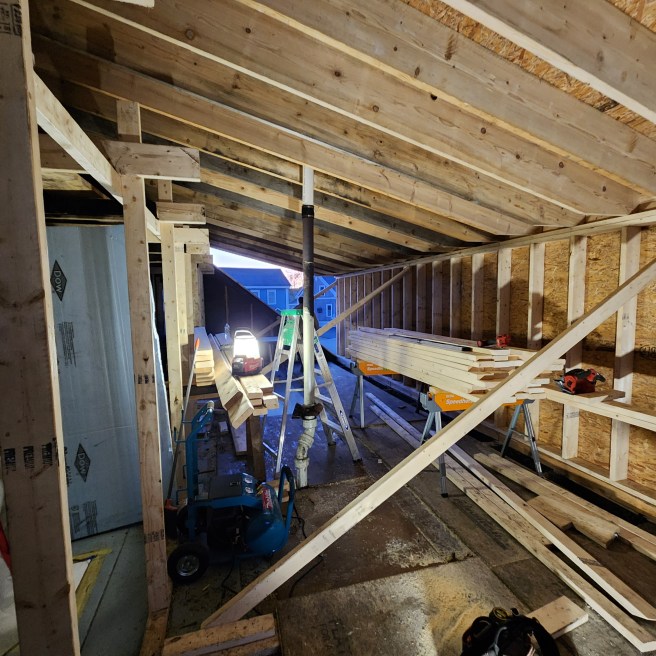
The back half of the upstairs interior was now exposed, giving us a sense of how much flooring and headspace we would be gaining. And we could see all of the rafters. Unobstructed? Adam had set up an impressive indoor workshop on the back half of the second floor, while the front two rooms clustered many of our possessions, now under plastic.

That said, I also noted my concern at how slowly the work was going.

The old roof over the back half of the house was still in place, and the clock was ticking down toward winter.

What dawned on me as I gazed up toward to the peak of the rafters was that the ones from the back – which were about to disappear – secured the ones at the front of the house, the half of the roof that would have to stay well in place into late spring or early summer. A few of those charred rafters would actually be remaining like forever, a nod to history and all that.

In a flash, the urgency of the new laminated ridge pole and supporting columns made sense. Without them, the whole roof would come crashing down and, in turn, there would be nothing to hold up the new one. One earlier contractor’s proposal for premade trusses to create a gambrel roof on both sides now became comprehendible – so that’s what he meant? We weren’t exactly communicating, and his results wouldn’t have been our first choice. As we were hearing, not every carpenter today knows how to frame a roof from scratch.

~*~

The key to achieving this was a recommended custom-made laminated veneer lumber ridge pole running the length of the house. Or more accurately, three pieces that would be joined together once they were inside and raised into position. Each one was 1¾-by-14-inches by 40-feet and weighed 280 pounds.

In addition, another custom-made LVL 3½-by-3½-inches by 26-feet was delivered for the remaining supporting column. That one would run down the cavity where our second chimney had been, the bricks that had been on the verge of collapse when we bought the place.

~*~

The new ridge pole would have to slip in where the rafters from each side were now overlapping. What would hold them up as he sawed them asunder? The answer was temporary framing underneath.

We were really, really glad Adam knew what he was doing, though we suspect he was losing some sleep over it. We do know he was doing his research and some thorough calculations.

had

The electrical line coming into our house had to be moved to one side of the gable to allow for the ridge pole to come into the house. That meant getting the utility to come out for a free service.

Inside, our contractor was making cuts accurate to one-sixteenth of an inch. Sometimes the beam below, cut in the early 19th century, varied by a half-inch within the length of the two-by-sixes they would be supporting.

We were beginning to appreciate the fact that Adam was our contractor and not just our carpenter/electrician. He was making the arrangements and phone calls. Viking Lumber was making nearly daily deliveries from Machias.

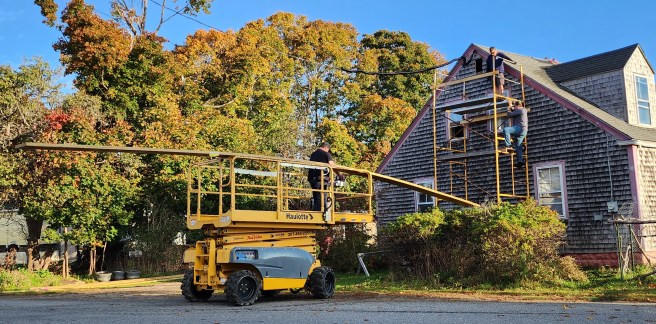
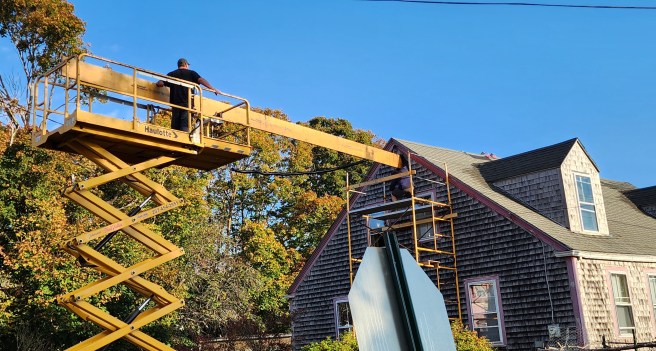
After working largely solo, he lined up a crew to manage the pieces into the upstairs floor and then higher once inside. There was also the matter of a rented lift, positioned outside.

A lot of coordination had to come into place, even before discovering the power line coming into the house needed to be moved. Hello, Versant?

He had additionally expertly erected scaffolding by himself.

At that point, it really felt like this was happening.

So here we were, Week Four, the end of October, and the laminates were arriving – all four pieces. Well, make that five – Hammond Lumber had ordered a wrong size for the column and had to rush the corrected order down to our site.

Have you ever done genealogy?

While living in the small industrial city that’s the setting for Hometown News, I began exploring my genetic roots, at least on my father’s side. It involved a lot of correspondence, especially with a cousin of my dad’s generation, as well as probing whatever records we could dig up.

By this time, my spiritual practice had recentered in the Quaker stream, or Society of Friends, where it turned out my ancestors had been active from the early 1660s until my great-grandfather moved from North Carolina to Ohio and “married out” in 1893. I now had access to historic minutes, correspondence, journals, and other resources that proved helpful.

My findings are presented on my Orphan George blog, should you be interested.

What fascinates me in regards to my fiction is the fact that so many of my ancestors were essentially countercultural in regard to the broader society. They were pacifist, for one, and wore distinctive garb and used distinctive language. (Sound hippie?) In North Carolina, their community had the first manumission society in the state, buying freedom for slaves and transporting them to safer lands. This was not the Deep South of popular culture.

These findings, and the research methods, proved quite helpful when I drafted my nonfiction New England history, Quaking Dover.

The techniques and insights also played into my novel What’s Left, where I took Cassia’s lineage on both sides back to her great-grandparents, including their quite different faith traditions.

I am intrigued by the values and practices from one generation to another. What is rejected and what is embraced?

In my case, I discarded the mainstream Christianity and lifestyle of my parents and grandparents only to find myself later reconnecting with much of the radical Christianity and countercultural outlooks of my great-grandparents. Well, most of them on my dad’s side. My mother’s were an entirely different matter.

As I’ve found, genealogy often presents a much different history than we’re taught in the conventional versions, especially when our focus is on everyday people rather than the political and military leaders and the upper class. The lives can go ways we wouldn’t have plotted. For instance, my family in North Carolina had a gold mine.