It’s not like our project’s so unusual in the bigger picture

Those of you who have constructed a house from scratch must be looking at our renovation like it’s peanuts. And, in many ways, it is. We weren’t starting with talks with an architect or even inspecting an undeveloped site beforehand. No, that must be truly thrilling. There’d be none of the frustration of trying to retrofit your dream into what others had done before you, either.

For the record, we did look seriously at a couple of undeveloped sites in town and played with the challenges, but they were beyond our means, leaving us to always lament the spectacular views that others now enjoy while also wondering how we would have managed the timing.

Still, to be fully honest, I have to say what’s unfolded before us is truly exciting, at least from our end. That kinda brings me back to that adage about writing about what you know, or at least what you find most fascinating at the moment.

But it’s also humbling. Just consider how much of daily existence we take for granted, at least in the so-called developed world.

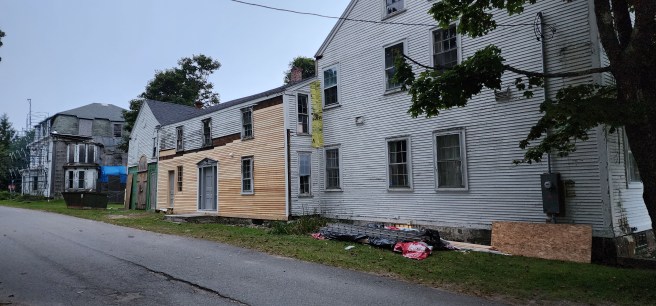
The Isaac Hobbs mansion, off to the far corner of our block, is undergoing a thorough restoration. Half of it was about to cave in when we bought our property, but that’s no longer the case. The new owner wants to be historically accurate, as far as possible. In contrast, we want ours to be more livable. Besides, most of the period detail was ripped out decades ago.

A further block up the street, a more spectacular upgrade is being given to the circa 1807 federal house Aaron Hayden built and General Samuel D. Leavitt transformed into mansard mansion in the 1880s. It had fallen into foreclosure before its bold new owners came to town on the heels of Covid.

Leavitt was also Eastport’s first mayor.

Reader, beware, if you must.

What do you mean, how do I write?

Isn’t it obvious, one word at a time? Except it’s more complicated than that, and every writer approaches the deed differently.

I would like to approach a writing project the way Neal Welliver did his large-scale paintings, starting in the upper left-hand corner and finishing in the lower right. He worked with a tightly defined palate, too. Instead, I wind up more like Mark Rothko, painting over earlier parts, adding or scraping off layers – what’s known as “painterly.”

For novelists, the difference is posed as “outliner,” meaning someone who starts out with an outline and pretty much sticks with it, versus a “pantser,” going by the seat-of-the-pants with perhaps a vague sense of a destination, which may very well change en route.

You can guess which camp I’m in. As another artist put it, what’s the point of putting all that work in if you already know the ending?

For the record, I hated outlining when it was assigned as school homework. It seemed redundant.

~*~

I don’t like formal prompts, by the way. Instead, I often start with something that keeps nagging at me, the way the flash of a trackside worker in Brooklyn – a gandy dancer – turned into a subway line hitchhiker. (Maybe that third element, the unique word, turned the trick.)

As a project percolates, so do related ideas during the rest of my day, leading to piles of scribbled notes to weave in. When I lived in New Hampshire’s seacoast region and worked in Manchester, I had an hour commute in each direction, largely through rural country. I kept a notebook and pen at hand as I drove. Likewise, some of my favorite lines in What’s Left came to mind while swimming laps in the city’s indoor pool. As soon as I was back in the locker room, I was scribbling. Getting up from the keyboard every hour or so, sometimes adding a short walk, also works wonders. As a journalist, some of my best headlines came on my way to the men’s room or back.

Much of my writing then becomes the way of connecting two thoughts or flashes.

Outtakes from other projects also get recycled, though they rarely wind up quite how they began. I’ve drawn heavily from correspondence, maps, and photos as well, as well as silent meditation. As has been said, some of the best barns in New England were designed in Quaker Meeting, and it is amazing how many problems get worked out by stepping away from them.

~*~

As much as I’ve longed for an editor or a partner truly in sync with what I’m about, that hasn’t been the case, not since my first lover, back in college. Instead, I’ve been a lone ranger. It’s meant putting big projects aside for several months or even years before coming back to them afresh.

~*~

There are also the epiphanies when a character starts dictating the story, as well as the times of slogging through mud.

I should also mention learning from other writers, especially by example.

~*~

Determining when a work is finished is usually a mystery. My high school art teacher used to say I either stopped too so or else overworked a piece. I’d prefer too soon, since my usual taste leans toward austere. Think Quaker, Shaker, or Zen.

Another answer would be that I stop when I have nothing more to say on the project, for now. Or, as I’ve heard elsewhere, when the writer just gets tired of it.

As a newsman, a more common answer was the arrival of a deadline.

Some disturbing trends about suicides

In my March 19 post noting the arrival of spring, I noted that the months of April, May, and June are generally the leading time of the year for suicides.

Among other trends in the United States, consider:

  1. Males are almost four times more likely to kill themselves than are females.
  2. Guns are the most common form of suicide, accounting for more than half of the deaths. Suffocation is second, at one-quarter, and poisoning at 12 percent.
  3. Between 2001-2020, suicide rates rose roughly 36 percent.
  4. It’s the tenth leading cause of death overall.
  5. By age groupings, people 85 and older have the highest rate (22.4 per 100,00), followed by 75-84 (19.6) and 25-34 (19.4). For 35- to 54-year-olds, it’s the fourth leading cause of death; for 10- to-34-year-olds, it’s the second highest cause.
  6. It’s now the leading cause of death for 13- and 14-year-olds, having doubled in the decade of 2008 to 2018. Bullying, school stress, and use of social media are considered potential causes. Higher rates are also reported among young people who identify as lesbian, gay, or bisexual compared to their peers who identify as heterosexual.
  7. Among racial/ethnic groupings, non-Hispanic American Indian/Alaska natives have the highest rate (28.1), followed by non-Hispanic white (17.4). Non-Hispanic Asian has the lowest (6.8).
  8. The American Psychological Association notes that suicides have increased most sharply in rural communities, where loss of farming and manufacturing jobs has led to economic declines over the past quarter century. Economists Anne Case and Angus Deaton, examining the steep rise in deaths from suicide, drugs and alcohol among white, middle-aged Americans in that period, argue these “deaths of despair” are linked to a deterioration of economic and social well-being among the white working class.
  9. Others with higher-than-average rates of suicide are veterans as well as workers in certain industries and occupations like mining and construction.
  10. For every suicide death, there were another three hospitalizations, eight emergency room visits, and 38 self-reported suicide attempts.

I wasn’t expecting to have the plumber in this early in the game

As I said, the best place in the house for our new woodburning stove was occupied by a large cold-air intake duct for the furnace. We needed a plumber to move the vent over a few feet. “Piece of cake,” as we were told. Well, he needed a carpenter, too. We were already covered there. Ditto for the electrical.

In addition, as I’ve explained, the best pathway for the wood stove’s metal pipe chimney ran right through a cubbyhole where our water heater sat. We were already intending to replace the unit for a more efficient heat-exchange model anyway, so we bumped that up in the timeline. As long as the plumber was in, right?

And while Thomas was at it, the float on our old, jerry-rigged sump pump had begun sticking, causing the cellar to flood, so that could go, too. No problem, he’d replace that at the same time.

If we like him, there’s a lot more ahead – a kitchen remodel, a new bathroom upstairs, and then remodeling the little one downstairs that’s way too outdated. Oh, yes, and the outdoor faucets.

Its pad was installed earlier.

So that’s how the heat-exchange water heater was installed in the cellar, under the old, inefficient water heater. Adam, our contractor, handled the new concrete footer and the electrical wiring. We’re told it should also dehumidify our cellar. Now that’s a happy bonus!

And all this was wrapped up the day before Christmas Eve.

Why do people want to know about writer’s workroom?

Is it even a sanctuary? I call mine a studio, while my spouse refers to it as my lair.

In my first four apartments, mine was in a corner of a room, including three where I sat cross-legged. (Not an option any more, thanks to aging. The sitting on the floor, I mean.) The fourth had a circular utility spool on its side as a table and some kind of chair. If you don’t remember that piece of hippie furniture, just ask.

In later moves, I rented apartments having a second bedroom I could dedicate to the Real Work.

The most impressive was in the small townhouse, where my dream studio occupied the only bedroom upstairs. With its hanging ferns, it looked pretty impressive – from the street, especially, I configured the downstairs into a comfy studio apartment.

There’s the question about sitting in front of a window, providing some kind of view. Annie Dillard, for one, has weighed in totally against that, preferring concrete blocks. At the other extreme, I remember overhearing one wannabe writer detailing to her husband all of the remodeling that was to be done to their house so she could take up writing the novel she planned.

I’ve had both. My office chair in the townhouse gave me a commanding view of the parking lot and water tower beyond. Well, the arrangement gave me a feeling of command, period. In my second apartment in Baltimore, my studio overlooked a set of AM radio towers but my desk stared straight into a wall. The first had looked down on some small urban backyards and an A&P grocery beyond an alley.

Once I moved to Dover and remarried, I wound up in the north half of the third floor, under the eaves, as you can see in previous posts here at the Red Barn.

At the moment, I’m in a corner of my bedroom, in front of a window and our backyard. Once our renovations are finished, I’ll be upstairs but with the window further above me.

Since I’m pretty much paper-free these days, I need far less tabletop and filing cabinets – remember those? You can’t even give them away any more. They’re rather like used pianos.

Well, one friend gets a new chair for each new book, sometimes nothing more than an aluminum lawn chair, and he’s done quite well, getting reviewed in both the New York Times and its Sunday book section or magazine and sometimes showing up on the bestseller list.

What’s usually overlooked is the supporting space – filing cabinets (yes, a few remain), bookshelves, tables, additional seating, even a daybed or couch, perhaps. Dillard, I recall, had some kind of cube. I think fondly of a Mainer who had the top half of a small barn remodeled for his library and cozy reading and writing space – it was the inspiration of what I hoped to do to our red barn, a dream that never quite materialized.

One big transformation for me has been the shift from paper to digital. I mean, I rarely print out anything anymore. For a while, I didn’t even have a printer. And, when I was up on the third floor, our printer was down on the main floor, accessible to the rest of the family. That wireless connection was a huge advance over the proprietary cord attachment.

I require far less room now than I did when I dreamed of converting the top of my red barn into a studio and library. My, that was grandiose! I hate to think what the heating bill would have been, just for starters. And besides, once we went from five to two in the household, the entire equation changed.

~*~

Equally fascinating is a writer’s use of time.

Charles Bukowski insisted on daily “butt time” at the keyboard, while Jack Kerouac would charge up for a two-week mostly sleepless typing orgy every six months or more.

I’ve known both but lean more these days toward Bukowski.

For much of my adult life, I felt guilty for the reality that writing took away from so many other things I “should” be doing. It was somehow selfish. One summer, though, at a Quaker gathering on the Bowdoin College campus in Maine, I was in a workshop on prayer. The facilitator handed us each a card and told us to write a prayer request – for something for ourselves. For most of the circle, maybe all, this came as a shock. We were prepared to pray for world peace or people we knew, but not ourselves.

So we broke out into groups of three or four, and prayed for each other’s requests. To my surprise, I felt liberated. One participant told my writing was my gift and to respect that. It made it much easier for me to dedicate one day a week to my writing efforts – I was on a four-day workweek at the time, but managed to continue that focus after going back to the traditional five.

~*~

My productive time in college was after midnight. After living in the ashram, that shifted to dawn. During my sabbatical, it was two stretches – one roughly 10 am to 2 pm and then after 10 pm to whenever.

I had big daily and weekly schedule plans for my retirement years, but now that I’m there, those are either amusing or embarrassing. I spend way too much of my life at this laptop, let’s simply say.

Remember, Internet and blogging weren’t a factor back when I was dreaming of being free of the daily office.

Earlier in this series I touched on authors who said they wrote only two or four hours a day and my shock that it wasn’t more.

Now, though, I’m seeing that in a different light. In my time with the newspaper syndicate, my “productive” time was a mere hour-and-a-half to two hours a day when I called on editors in person. The rest of the time was travel, preparing for the sales call, following up with phone calls and letters, filing expense and mileage reports along with reactions – what I term infrastructure. It’s a pattern I see as more common than the assembly line productivity that’s somehow instilled in me. You know, the reaction when you see a Road Work sign and then see three guys doing nothing more than smoking a cigarette.

Or, as I realized when I was stationed in the composing room on a Saturday night and moving pages for the Sunday editions, I more than earned my week’s pay in an hour-and-a-half as we raced to meet deadline. It was a furious crush. If those papers weren’t in supermarkets or readers’ homes across the state on time, we’d lose sales and subscribers.

In other words, you can’t go by assembly-line wage thinking.

When up turns down turns up

For many people, worship – or even spirituality – is a way of escaping everyday life and conflict.

For Friends, in contrast, worship is a place and time to embrace it, face it, transform it, find harmony and appropriate action.

Not that I would have said that before. In fact, for years the high I felt in the hour did provide me a weekly respite.

Skillsets that became useful in my non-fiction book

Returning to that adage, “Write about what you know,” I realize how some work experience from my past gave me a unique edge in drafting Quaker Dover.

For instance:

  1. My journalism career included an early gig of pure research for a daily Action Line column. (We had an editor/writer, a secretary, and two researchers – big time!) Writing and editing, of course, were the staples of the rest of those years.
  2. From writing and then revising the novels, of course, I had explored the dynamics of building a large book and then the distinguishing qualities of fiction in contrast to journalism. I even learned to excise a hundred or more pages from a manuscript and not weep.
  3. My long service in Quaker meetings, as presiding clerk in addition to committee work and visitation, steeped me in the decision-making process and culture of the Society of Friends, past and present. Along the way, I gained familiarity with our peculiar customs and historic language, ranging from liberal “unprogrammed” worship at one end and old-order conservatives at another to pastor-led evangelical at the other extreme.
  4. Genealogy research accompanied much of those discoveries, especially as I gleaned the old minute books and journals. (Many of my findings appear on my blog, Orphan George.)
  5. Triangulation of three or more differing versions of an event, as I encountered especially in material and correspondence regarding my grandparents, became helpful in considering Colonial history in New England. I could live with the ambiguity while letting the conflicting accounts still add to the bigger picture.
  6. My long interest in geography – maps, especially – came to play in placing Dover in perspective with the rest of New England as well as Devonshire in England itself.
  7. My training as an artist in high school and my work with photojournalists in the years after came in handy in examining portraits of Quakers (once those were permitted) as well as related locations. Sometimes I could see where an individual was in regard to changes affecting Quaker practice and the world around them.
  8. Online sleuthing, rather than archives (which I had explored in the genealogy), came to the fore during the Covid-19 lockdowns. Somehow, I think my experience in formatting my novels as ebooks, fed into this, but I had already devoured many digital texts by the time I became amazed at the number of rare old, arcane books I could download for free.
  9. Despite the fact that Quaking Dover is a history involving political conflict, I was surprised to find that my political science degree didn’t add that much, though the way Vincent Ostrom had taught us to closely read an argument came in handy, especially in looking at a system from the ground up rather than top-down.
  10. Moving to Maine before the final revision and publication also added to my perspective as I settled in. Dover, like much of New Hampshire, gravitates toward Boston, as did much of the Dover Quaker history. Little did I suspect just how much Dover Friends and the broader community influenced the growth of Maine to the east and northeast once the territory reopened to English settlement once the conflicts with the French and their Native allies wound down – earlier than I had presumed, in fact.

As an added complication, we were getting a woodburning stove

Considering the frequency and length of electrical outages in Maine, having an emergency heat source in place was a high priority. I’ll explain later what derailed us from going directly from an emergency generator. Wood heat was the more obvious answer for us, but the big obstacle was that we didn’t have a usable chimney. We couldn’t just run up to Tractor Supply or Tru-Value, pick out a cast-iron stove, plug it in, and breathe a sigh of comforting relief.

Instead, we needed some professional advice, and that’s where we were stymied. Local inquiries led nowhere. The nearest wood stove and fireplace dealers were 2½-hour drives away.

Since Ellsworth has two, that’s where we headed. The smaller dealership was far more helpful than the other – and it referred us to a nearby chimneysweep who, after we approached him, did agree to install a stove for us as well as, more crucially, addressing the chimney situation.

While a previous woodburning cook stove in the kitchen had vented into the same flue that the furnace uses, that’s now contrary to building code.

Tim confirmed that our best smoke-venting option was to run an insulated metal chimney pipe straight up next to the existing brick one. At this point, with our upstairs about to be torn apart and the rafters exposed, we wouldn’t be disrupting anything there. Our ultimate placement of the stove itself would require moving a water heater and a cold-air vent in the floor. Not that big of an issue, now that we had a contractor. Glory be!

As for the existing but inefficient hot water heater? That advanced our planned acquisition of a heat-exchange water heating unit, but just where?

That’s when Adam, our contractor, lined up a license plumber, Thomas. You’ll be meeting more of him later.

~*~

Back to the central decision, which stove?

From my days in the Pacific Northwest, I was impressed with the pioneering Norway’s Jotul brand, a view reenforced by our purchase and intensive use of a small model in New Hampshire two decades ago.

Still, looking for maximum efficiency of our new stove, I was pressed to research other available options. After all, a lot has happened in the interim. And how, as I discovered.

Since our stove was also for a power-outage alternative and not just supplemental heat, wood pellets were out of the question. Alas, perhaps. A pellet fire isn’t quite the same when it comes to simple repose.

Two new considerations for me were cast-iron versus straight metal. The former takes longer to warm up but holds longer. The latter, the opposite.

Since much of our usage Way Downeast involves offseason chilly mornings and evenings in spring and autumn, the metal models gained an advantage over cast iron. We’ll see how that holds.

A complicating factor was catalysts, which would require attention every few years – and, more critically, by whom? By this point, Jotul slipped from the picture.

From my book Quaking Dover, I knew that soapstone and other heat sustainers worked as efficiency boosters, but in this round, the added cost and weight didn’t fit our setting.

Vermont Castings, which had been our principal rival to Jotul, fell from consideration over quality control issues, as other, newer, brands came to the fore: Ambiance, Blaze King, and HearthStone, among them.

We did have to quibble about how our stove would look and function in our situation, but in the end, after a thorough review of the efficiency specs, sizes, and prices, we went with a Lopi model, one from an enterprising Pacific Northwest outfit.

Alleluia. We even got it installed before deep winter kicked in.

Second floor.

A view up the pipe before it was capped.

Meanwhile, on the ground floor.

And there it was, just in time for Christmas.

~*~

Let’s be honest. The new stove wasn’t entirely about emergency heating. It was mostly about having the utter pleasure of wood warmth. It was even about reducing our onerous fuel oil bills, even before we add heat-exchange units upstairs.

After waiting three years to get the renovations underway, the unfolding events sometimes felt chaotic. So much happened at once.

Still, looking at the glossy brochures, I’m left thinking there’s a much bigger picture left to be presented. Sitting back against the unrivaled comfort of a wood fire and reading in my favorite chair is an unsurpassed pleasure in my book. This was a definite improvement over our previous winters.

As a slide flash, as a writer I’m reminded about the adage, “Write only about what you know.” Is there anything like this in a novel? Or even a movie? Maybe the bearskin rug in front of a fire as a photo?

By the way, we never heard back from the other stove dealership. The bigger one. We do have an affinity for smaller is beautiful, especially when it’s family-centered.

Wandering through a personal wilderness without Moses or Miriam

Nothing was holding me Baltimore, as much as I loved it. And so, getting back into the American workforce in my mid-30s, I wound up in New Hampshire with the equivalent of a basket of wet literary laundry on those 5¼-inch floppy diskettes.

Although I had called on newspaper editors throughout the region, New England was largely unfamiliar to me. Apart from one couple in Boston, I knew no one. Beyond that, my love life was in ashes.

Thus, I unpacked in a new life along the Merrimack River in New Hampshire, the first of three addresses I would have in the state, fully intent on revising the lode I had mined and finding a literary agent or publisher once I got settled into my new job on the night shift.

What intrigues me looking back is that nothing in my life after my move to Baltimore prompted new fiction. Some details got woven into the revisions, but my literary output during the next three decades was mostly poetry, a more manageable format considering my hours of paid labor. Writing fiction demands the luxury of immersing yourself fully in the lives of your characters. It takes more than a full day once a week.

Besides, unlike my previous settings, New England has been thoroughly mined as far as fiction goes. What could I add to the picture? It had more layers and nuances than my previous locations, and many of them remained cryptic. Besides, I had enough to contend with in my existing manuscripts and the rapidly changing, increasingly confounding, commercial book world. Fewer publishers were accepting fiction, and those that did kept merging. More ominously, they weren’t nurturing promising authors with the hopes of getting a hit five books down the road but rather expected a blockbuster right out of the starting gate – if you could get in. It felt a lot like I had encountered as a newspaper syndicate field representative.

I was, however, appearing widely in the small-press literary scene, mostly with poetry but also chapter excerpts from the lingering novels. It kept me going.

~*~

My persistence finally paid off. After collecting the proverbial stack of rejections and a more widespread snubbing in which agents didn’t even bother to return the self-addressed-stamped-envelope, I finally got a nibble to co-publish with a Santa Barbara press of some distinction. Three years after my move to New England, Subway Hitchhikers appeared in print, right into what became the worst bookselling season in memory, thanks to the First Iraq War. Just my luck.

I did get one extended – and favorable – review, but that was it, no matter how much I pushed the self-promotion. My job schedule, which included a double-shift on Saturday, didn’t help. I couldn’t go to book fairs or author workshops.

My copies to sell appeared shortly after I had moved to a small townhouse atop the highest point in town. Moving them into the hands of readers and reviewers was the next challenge. As I said about the book market?

What did change was my self-image. Publication, for me, was the equivalent of a Master’s degree. I had something to show for my work. People respected that, even if they didn’t buy a copy. As for my personal life? There was a second Summer of Love! I was back in the euphoria of the early ‘70s, only better.

The swirl also had me thinking I could solve the tangle of my Pacific Northwest tale, so I kept revising, usually on a vacation week or holiday weekend.

And then, in 2005, Adventures on a Yoga Farm was published – as a pioneering ebook at PulpBits in Vermont. Again, it went nowhere as far as recognition, though several incarnations later, it’s Yoga Bootcamp and a much better book. As for timing? The yoga movement hadn’t yet rebounded and PDF books never really caught on. There I was ahead of the curve.

Somewhere in that stretch, my PC’s green screen went dead, already obsolete, meaning forget finding a replacement. Instead, the option was to upgrade to a new computer, one with a hard disk and telephone access to an online browser. Email was still somewhere off in the future. And I had to convert all of my keyboarded material from WordPerfect 4.1 to Microsoft’s Word. I wasn’t happy.

Are you one of the folks who recognizes these steps? Or are they all way before you came along?

And who sez the writing life is glamorous or that it runs along the lines of the movie plot were you’re suddenly rich and famous?

As I look back on this period, I see myself in a kind of wandering in the Sinai without a Moses or his sister Miriam to guide me. At least I developed an active social life, largely through contradancing and Quakers, and I was regularly riding Boston’s Green Line in underground tunnels.

Next up, a set of chain-reaction decisions

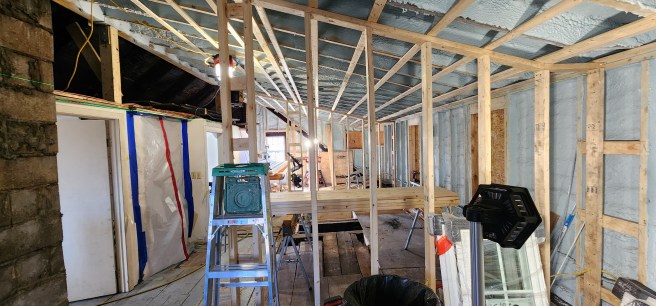
The roofing wasn’t the only thing taking place. We had to make some more key decisions regarding the next steps.

First was settling on the size and shapes and placement of windows in the back half of the house. We’ll examine those later. The glossy catalogues had a wide range of types and sizes, but no prices. For now, Adam needed to know where to frame them.

To do that much, we had to finalize our upstairs layout, at least roughly. A new bathroom and laundry room were part of that, details to come later.

Getting that far included electrical outlet placements along the exterior walls.

Those were steps that had to be taken before the spray-foam insulation crew showed up – which they did, two days after promised and leaving us with a nonrefundable Airbnb reservation. On top of that, we were required to be out of the house for 24 hours after they finished. Back to the Airbnb reservation. The crew’s deadline here was also contingent on a bigger job they were doing downtown – the two brothers live an hour-and-a-half from Eastport. We were second in line.

Before.

And after. Note that a diamond window in the corner is no longer in the plan.