When’s the last time I had a vacation? A REAL vacation?

Not since remarrying 23 years ago, curiously, even though we have taken some delightful extended weekends here in New England but not yet beyond.

The closest I’ve come to solo is the week of the annual sessions of New England Yearly Meeting of Friends, held on college campuses in early August. But there, the emphasis has been on doing Quaker business and spiritual renewal together.

Maybe that’s one reason I’m so excited by my upcoming windjammer adventure, whatever the weather.

Better yet, it’s following on one of our family weekends away, the Common Ground Fair in Unity, Maine. Even if I expect to be spending part of that manning the Quaker booth there.

And better yet, I’ll be with a dear friend of my retirement years – somebody who grew up on the waters, unlike me.

So what’s your idea of a “vacation” Even in a shoulder season, where we are now?


Looking for sportswriters and editors who crossed over to the news side

Through much of my career, I never quite appreciated the sports staff. The sports desk was over there in its own corner or maybe even a separate room or suite. Unlike the cops beat or business or education or even the courts coverage that filled the “real” news.

But it did produce some of the best political writers and editors in the business.

Their perspective, facing two teams, essentially – especially baseball, with its daily games in season, and delivering on tight deadlines – provided a character-based focus in contrast to those of us who were more policy driven.

Its baseball angle for some fine writers first came to my attention in John Updike’s prose and later David Halberstam, though they didn’t have newspaper experience.

The drama of contests, strategies, determination, hard work, fairness, and a vision is central in their work, along with the reality that so much of the field is about losers who persist and sometimes come out on top or have lasting influence, especially within the realm of a hometown team. Not a bad paradigm.

These former sportswriters and editors were around me throughout my career, though I never kept a list and now wish I had. On the national scene in my time, though, I can point to Charles P. Pierce, Mike Lupica, Ward Just, and Mike McAlery as prime examples of those who broadened their game.

Curiously, I haven’t seen that crossover occurring much from a football foundation. Perhaps that game’s more like a weekly television series or shouting match than the realities of a daily grind.

I’ll let up for now before I’m playing out of my league. But I do want to hear more from others – players and fans alike.

America’s most celebrated wildlife artist was a Frenchman

Or more accurately, the bastard son of a Frenchman in Haiti.

Yet, despite the iconic honor given his name, few have seen his legendary work in its full glory.

I’m speaking, of course, of John James Audubon, in the anglicized version of his name.

While I had viewed his work behind glass framing in art museums, nothing prepared me for my hands-on encounter with the four folio print volumes. That happened in Indiana University’s rare book Lilly Library when a librarian interrupted to ask if I would help her return two of the volumes to the cart so she could take them by elevator back to the stacks.

Yes, they really did need two people to move. As I’m seeing now, the books measured about 29½ inches by 39½, otherwise known as double elephant paper, the 435 prints being the same size as the original drawings.

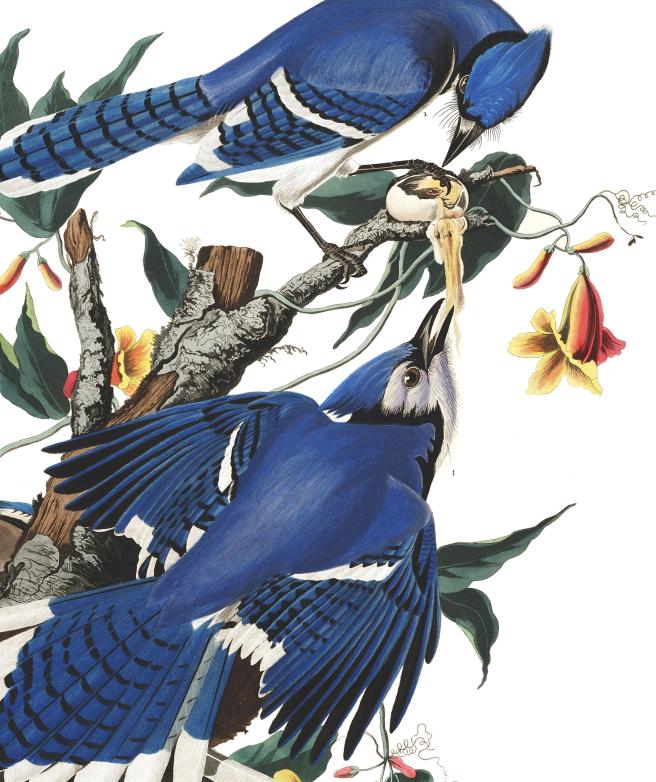
We decided to take a peek and were both blown away. It was as if the birds had been pressed full-size onto the plate. You could actually see the veins in each feather. And that was, it turns out, a copy of the original. Oh, yes, and each species was presented full size, with some favored vegetation.

As for the color? Unbelievable. You have no idea how much is lost through any glass.

We both admitted it was too much for a single viewing.

Well, we had an acquaintance who was terrified of blue jays.

Now, for ten more facts.

  1. As an 18-year-old, Jean-Jacques Audubon was sent to Pennsylvania on a false passport to avoid conscription into Napoleon’s army.
  2. A feud originating during his research in Kentucky closed off American support for young Audubon’s work. Instead, his backing came from England, where subscribers underwrote the classic Birds of America.
  3. One bookseller claimed it would never succeed because the book took up an entire table to view and would render other volumes useless.
  4. A reduced-size two-volume collection, a gift from my younger daughter, has me appreciating the radical design and style of many of the images. There was no way, after all, to approximate the original color, yet any approximation opened other dimensions.
  5. He worked from actual specimens he had shot and killed, arranged in lifelike settings.
  6. He did create a controversy regarding the smell of turkey vultures, or what some of us call buzzards.
  7. Some of the birds he discovered remain a mystery.
  8. He’s known mostly by copies of copies or even additional copies, each time diluting the impact of the originals.
  9. He had nothing to do with the national Audubon Society or its Massachusetts and New Hampshire spinoffs.
  10. He’s buried in New York City.

Back in the saddle again (I hope)

For the past few weeks, I’ve been pretty much out of action. Good thing I schedule most of the Barn releases well in advance.

The latest sequence of setbacks started when I knocked a martini glass over, splashing my laptop keyboard, while talking to my wife. And here I’ve been the one to scold others about drinking coffee right over the computers. Ah!

Many of the keys became irreparably stuck or functionless, so it was time to move on to a new machine.

Things were going well with moving my files over from Carbonite until Microsoft’s One Drive got in the way. I have way too many photos for the MS service unless I opt to pay, which I prefer not to do. It’s a Big Brother Is Watching You sort of thing. We’ve been warned.

I wound up taking both machines to a highly recommended computer guy an hour down the road.

Just kept telling myself I wasn’t screwed, not between that and the fact that my beloved elder stepdaughter had given me an external hard drive for one Christmas and I had all but maybe my last two months’ worth of new writing and photos backed up there.

Alas, I’ve also been vigilant about erasing photos from my cell phone gallery and my Google photos. Get the picture? It’s just too easy to get bogged down in all the clutter otherwise.

Being without a computer is an exercise of its own these days. I’m far from the point of using my phone for most of my online browsing and emailing, and I’m definitely not drafting blog posts much less a novel there.

That said, enough of the whining. I’m back.

~*~

Just in time to keep a nervous eye on Hurricane Lee, which may have Eastport as a target. We’d rather Lee go out to sea, well to the east of Nova Scotia to our east. We’ll see.

~*~

The lead headline in the Bangor Daily News the other day touted another development:

Eastport Set to Host Record 15 Cruise Ship Visits This Fall.

The first ship arrives tomorrow, ahead of the autumn foliage.

Quite simply, Eastport is being discovered as a unspoiled destination, in contrast to crowded Bar Harbor or the state’s biggest city, Portland.

Here’s hoping the rogue hurricane season doesn’t disrupt this trend.

~*~

Here’s also hoping for fine conditions at the end of the month and the schooner cruise on my schedule.

In the meantime, there’s a lot of writing I need to attend to, not all of it mine.

Best wishes to you all.
Here I am living in a most photogenic terrain

Others have pointed out that most of the places I’ve resided in have been rich in natural beauty. While I’ve dampened that with an argument that you can find beauty wherever you are, or at least visual stimulation, I do have to concede how rarely that’s the case.

Many places, in fact, are brutal on the eyeballs.

Part of the attraction to Eastport for me was, after all, its access to wilderness and a rugged shoreline. Good shots seem to be waiting everywhere.

It shouldn’t be surprising that I’m overwhelmed by the number of solid photos I’ve been taking. How on earth is one supposed to organize them, much less share them?

It’s not like the old days of light meters, F-stops, film, or even focus, either.

Digital makes it a snap. All you have to do is look and see something.

And, yes, sometimes the camera – or cell phone – sees something more.

Eastport is a pedestrian-friendly village with old houses and storefronts, meaning more variety and detail than you’d find in the average drive-by suburb. It’s surrounded by forests, shorelines, and streams that present more opportunities. No wonder we see people pointing their lenses everywhere, and not just for selfies.

Where are all of these images going to go, anyway?

Forget what you think you know about pirates

The popular image, shiver me timbers, comes straight out of Disney.

To set the record straight:

  1. They didn’t punish people by making them walk a plank blindfolded. Instead, the victims were killed immediately or keelhauled – tied to a rope and dragged behind the ship.
  2. They didn’t say “Ahoy!” or “Matey!” I’m not so sure about “Argh!”
  3. Female pirates had to disguise themselves as men to protect themselves. But, by some accounts, there were many of them.
  4. Forget the buried treasure. And their loot was often something other than gold or jewelry.
  5. In fact, maps and some books were more treasured as booty than gold.
  6. Captains were elected and could be removed. Who would have thunk?
  7. The eyepatch wasn’t to hide a missing eye but rather to allow for rapid visual adjustment between above deck and below. Anyone want to try that for verification?
  8. Conditions aboard a pirate ship were often more civilized than those on merchant vessels, where lousy rations and low pay were often common.
  9. The skull-and-crossbones Jolly Roger wasn’t the only terrifying pirate flag, by far. How about Black Bart’s one having himself holding an hourglass with the Devil? Or Captain Low’s blood-red skeleton standing at the ready?
  10. Pirates still flourish today, especially in the Indian Ocean and parts of the Pacific.

Well, Eastport’s annual pirate weekend festival’s coming up. We’re bracing for the invasion.

Calais, the one just north of us

The biggest municipality in sprawling Washington County is the city of Calais, pronounced CAL-us, like hardened skin, rather than the French Cal-LAY, its namesake port on the English Channel.

Set north of Eastport and having a population of slightly more than 3,000, it’s the retail hub of the county and neighboring Canada and the principal international border crossing for traffic to and from the industrial port city of Saint John, New Brunswick, and other coastal points.

With that in mind, here are a few more facts.

  1. Thanks to the border traffic, much of it as Sunbury tractor-trailer rigs, Calais has all of the permanent traffic lights in the county. Three, make that four, if I’m counting right. Yup, pay attention.
  2. It’s the eastern terminus for the Airline Highway, a section of State Route 9 that connects those trucks to Interstate 95 in Bangor and all points south and west in the U.S.
  3. Calais abuts Saint Stephen in Canada, which has both a candy museum and manufacturer and the best health fitness center in our region. The Saint Croix river separates them before continuing upstream as the international boundary.
  4. Calais has the only new auto dealership in the county, as well as the only Walmart.
  5. It’s home to the community college.
  6. The first European to explore the place was Samuel de Champlain in 1604.
  7. That year he was one of two leaders in settling on an island in the tidal stretch of the river. That effort was abandoned the following spring after a brutal winter in which more than half of the colonists perished. Had the venture succeeded, it’s possible we’d all be speaking French here. Today the site of this first French settlement in New France is commemorated at the Saint Croix international historical park.
  8. While its name honors French assistance to the American Revolution, I should also point out that the original had also sometimes been part of England.
  9. It was first settled by Daniel David Hill of York County, Maine. He was likely a descendant from an old Quaker family affiliated with Dover, New Hampshire.
  10. In summer, it’s often much hotter than Eastport. In winter, it’s typically colder.

Oh, yes, there’s even a tiny movie theater we want to check out.


The joy of paying bills online

Longtime readers of the Red Barn know my identity as a neo-Luddite, someone who resists many technological advances for ethical reasons. You know, let’s keep people employed.

But after some of you encouraged me to move ahead on the banking front, and heeding your advice, I’ve made the leap. And now I’m asking, “When is the last time I wrote a check?”

Actually, it was for cash, only because I’m still resisting the ATM option. I do like face-to-face, especially in a small town, OK? And I believe an awareness of personal spending is important.

That said, among the unanticipated consequences of the shift is the fact I no longer need to keep a separate ledger, except for the checks I actually write, and my wife has instant access to those numbers, too, for our shared expenses covered there. (I won’t get into the details of our domestic bill-paying, but it’s worked for us.)

It’s also led to my using my credit card in many small-transactions instances, much like my younger daughter,  rather than cash. As she does for a cup of coffee.

But now there are new questions, like what am I going to do with all of these commemorative postage stamps I ordered as a bargain online? In response to Donald Trump’s destruction of the U.S. Postal Service?