We were on hold – as in stuck – even with our money shrinking in the bank

Our gloating over our timing of selling our previous house at the giddy peak of a hot market soon darkened when we realized two nationwide tides were running against us as we tried to move ahead in our current dwelling. One was the soaring price of construction materials. The other, as inflation kicked in, was the erosion of the purchasing power of our working nest egg.

If it were only me here, I could pretty much survive quite nicely in two rooms. One of them was what I came to call my dorm, the quarters where I slept in one half and wrote in the other. The second chamber was the kitchen. That left our north parlor, with the video screen and two sofas, and the south parlor, as a guest room and storage.

When it’s been two of us, the space situation became more problematic, especially with just one small bathroom.

We still didn’t need the upstairs for much, except when others visited. We certainly didn’t want to pack in too much storage until the new roofing and reframing were done. Everybody we approached about the overhead project was booked out a year or two ahead, and most of them declined to commit to another. One who promised to the job then backed off for a season, so we waited, only to be ghosted in the end.

Whether it was just me here or maybe four of us fulltime, the overhead work and much more needed to be done. It couldn’t be put off forever.

In the absence of a dependable contractor, we did inch ahead on a few fronts.

One was a large garden shed that cost us half-again as much as it would have a few months earlier. I can joke that it’s my new barn, though it’s not red and is much, much smaller than the namesake for this blog. Still, it’s surprising what a difference it makes – almost like a garage without parking for a vehicle or two.

Another concern was a classic wood-burning cookstove that occupied the heart of the kitchen and was an inefficient supplemental heat source. Besides being a major weight on our sinking floors, it had a stovepipe feeding downward into our surviving chimney, which was also used by the furnace, a violation of current building codes. I saw the stove as a both fire and health hazard. It had to go. Distinctive it was, both as a liquor cabinet/bar and as a fun place to stash junk food and other treats for visiting family to raid, I’m glad it did find a new home, as I explained in Chief Doe-Wah-Jack’s Pride and Joy, June 10, 2022.

And then, as you may have followed here last year, we went ahead with some raised garden beds. I do wish you could have tasted some of the harvest, and I’m happy to repeat that the ravenous deer around here did not penetrate our improvised barriers, unlike the previous summer at the community garden.

Living in these conditions has carried a sense of camping. You know, as in not quite permanent. I haven’t even described our makeshift kitchen setup or the rain dripping inside windows or the cramped, windowless bathroom.

All the same, I can say I’ve never felt as much at home as I have here. Maybe that has something to do with the abundant natural light in the first-floor rooms. Or maybe with my life in general. Or maybe the lingering good vibes of Anna M. Baskerville. Or more likely, all three.

But that couldn’t go on forever. Repairs and renovation needed to be done, if only we could find an available superman. I mean, this is my fourth winter in this place and I wasn’t the only one aging. I could sense it in the walls, too.

Hope I’m not sounding whiny.
 

Can a location be a fictional character, too?

In my big writing projects, landscape and geography have formed a major thread.

It’s most prominent in the novel that became Nearly Canaan, which is outwardly more about tensions with an unstable spouse, the trials of career ambitions, and a sequence of three locales that culminate in volcanic explosion on all fronts. Perhaps raising a personified landscape to the fore would have been too melodramatic, but it was an option I’m now seeing I overlooked. You know, the fantasy genre.

Even so, places are a primary ingredient in my fiction and poems.

My four years in the desert of the Pacific Northwest were a revelation. I felt myself on the brink of everything I had hoped for. It seemed embodied in the landscape, including the ways the Indigenous presence resonated in the earth itself.

And then everything exploded and I was, essentially, exiled from Eden.

By the time I could hunker down to collect the debris, I was on the East Coast. I had also lost the extended elation of feeling that my big breakthrough as a poet was about to happen.

I’d say I’ve leaned toward celebrating the good and lovely sides of life – a hopeful optimist, though I loathe that term – but I finally recognized in later revisions the importance of acknowledging the ugly, too, and the overwhelming desecration that’s occurred across this land and the globe despite what I saw in the better sides of the hippie alternative.

~*~

I am a visual person and even considered a livelihood as a painter or graphic designer or architect back when I was in high school. Being named editor-in-chief of the Hilltopper ultimately changed all that. Well, much of my journalism career included selecting and cropping photos and designing newspaper pages. My visual art training wasn’t neglected altogether.

From early childhood on, I loved maps. Hiking and primitive camping in a rogue Boy Scout troop abetted that awareness. Growing up in flat Ohio, I imagined mountains. Even a bump on the horizon, say Mount Saint John in neighboring Greene County, seemed vast, at least on our bicycles. An ocean was inconceivable. The mountains I experienced were the Appalachians, especially a stretch of the Appalachian Trail we Scouts backpacked between my fifth- and sixth-grades. Those magnificent and dreamy heights didn’t have the craggy snowcaps that had captured my imagination, but they did introduce the sensation of being somewhere near heaven and looking down on the world, the way God would. (At least as I would have seen it then.)

Add to that history and historic places. Old log cabins and their unique smells are among the memories imprinted within me. I probably read the entire shelf of Landmark Books’ profiles of famous people in sixth grade, if not third.

In the middle of my sophomore year of college, I transferred from my hometown to the Bloomington campus of Indiana University, where I had hiked and camped in the surrounding hilly forests, but this was a more distinctive locale than I realized in my leap toward a degree.

I mention all this because I’m seeing how much a specific spot on the map has been an element of my poetry and fiction.

An important twist came when I was living in the yoga ashram in the Pocono mountains of Pennsylvania and our teacher, an American woman, returned from her first trip to India. She said the reason Hinduism has so many deities is that many of them reflect the unique vibrations – as she said, vibes – of the different locales.

Thus, it’s not just how a place looks but also how it feels with your eyes closed. Maybe even how it smells.

I hope I’ve conveyed that in my writing.

Subsequent relocations took me back to Ohio and Indiana, on to the mountains and interior desert of Washington state, and then, in exile as it felt at the time, eastward to Iowa, another corner of Ohio, and finally Baltimore and the year of intense keyboarding I’ll describe later. After that, I headed north to New Hampshire and now an island in Maine.

So here we are, wherever.

Here’s what bugs me about ‘The Summer I Turned Pretty’

For reference, I’m focusing on the Amazon Prime video series, not the earlier books.

  1. Pop songs as a running commentary or an alternative dialog. This isn’t opera.
  2. The lack of positive male role models.
  3. The maudlin playing of the brothers’ mother’s death, especially after she’s gone. It definitely reduces her to a two-dimensional character.
  4. The fact it wasn’t filmed on Cape Cod, contrary to the story. The color of the water is wrong and the McMansion is so out of place, ultimately. Even the beaches are wrong. Where are the lobster boats?
  5. The way the story keeps evading the richer possibilities of polyamory or outright incest, which it keeps skirting. Instead, if the projections are correct, season three is going to veer off into one brother or the other, but not both together. That’s why I’m thinking I’ll be tuning out.
  6. Superficial treatment of so much.
  7. The flashbacks feel like a riptide. Just where are we at this point?
  8. The presence of a commercially published novelist as a major character. (I would object if she were a successful painter or actress or other fine artist for that matter – it’s simply rather incestuous creatively.)
  9. The way our Ugly Duckling’s mother, the writer, has so many lines of wisdom. She could be speaking in paragraphs.
  10. The difficulty I have in following slang, even when it’s the difference between “big bitch” and something else as an equivalent of beloved girlfriend.

Our first steps were bottom up

Back in New Hampshire, our veteran carpenter/electrician had proclaimed how fascinating he found the underpinnings of an old house – what people usually call a basement, though in New England, it’s more likely to be a cellar. I’ll explain the difference someday, if I haven’t already in an early blog post. Rick said probing around the underbelly gave him insights into the soul of the residence.

He would have been impressed by our new residence at the other end of Maine, a post-and-beam full Cape with a mostly stone foundation up to 18 inches thick.

From our previous homebuying experience, which landed us in an 1890s three-story New Englander, we knew we’d face some immediate issues. At our new address, the ones that we able to address all involved the cellar.

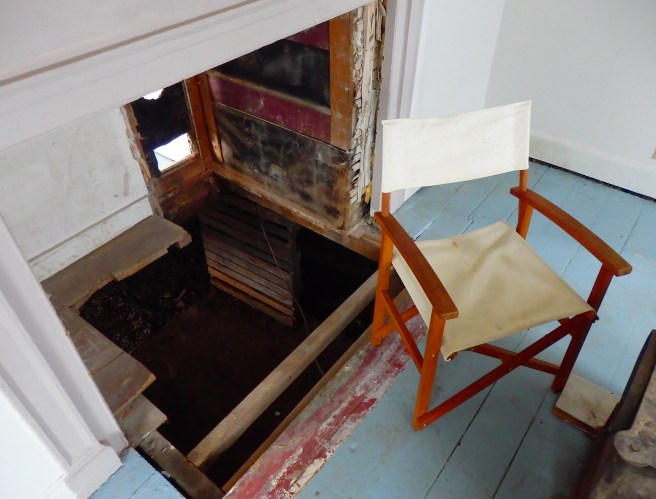
  • First was the removal of a chimney that had lost half of its supportive brick arch in the cellar. The rest looked ready to go at any moment. Many of its bricks above had already collapsed into the Franklin fireplace, presenting a puzzling serpentine pattern. We insisted the chimney be removed before we closed on the house transaction. A temporary patch in the roof then covered the chimney hole.
  • Next was a rusty fuel oil tank. One of its four legs was missing. The tank was replaced.
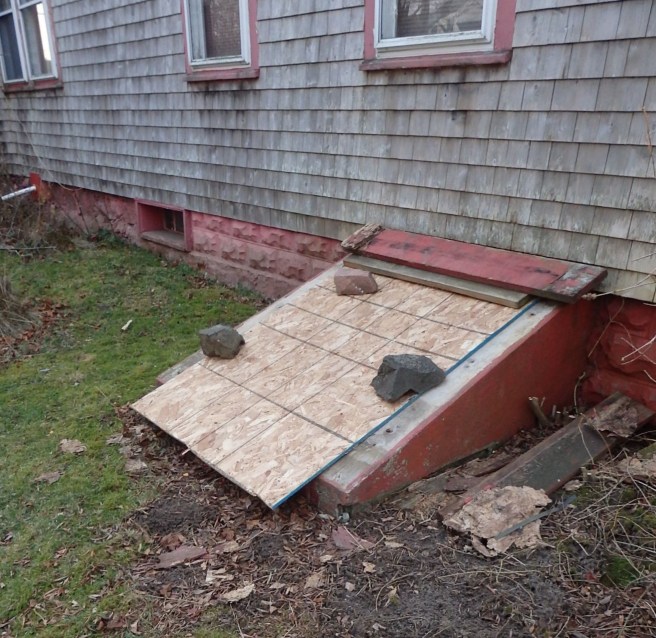
  • Third was a bulkhead door. The previous cover had rotted away and, in its absence, the entry was blocked by stuffed green trash bags, which were removed before we signed off on the deal. When we moved in, that entry was a gaping hole with no cover at all. We couldn’t leave an opening like that. We’re still surprised we didn’t have raccoons or, worse, rats living down below. A strong metal bulkhead door now secures that portal.


A temporary measure to cover the bulkhead.

The major issue needing to be addressed was the condition of the roof, as the insurance company insisted.

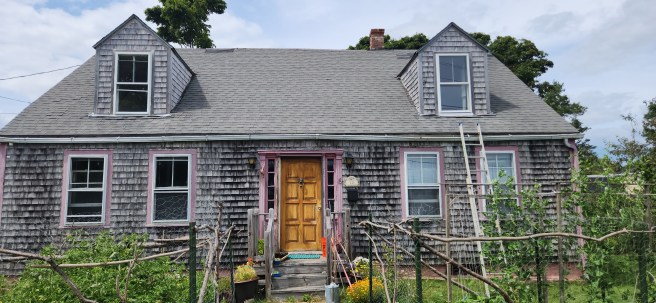
Complicating the situation was our intention of raising the rafters themselves and changing the two dormers to gain more usable and much needed space on the second floor.

The big problem was finding a contractor to take on the project. You’ll hear more on that in later installments of this series.

We simply couldn’t afford to replace the existing roof cover only to rip it off in a year or two. So we were in an anxious limbo, one that intensified with every blustering nor’easter.

In the absence of someone willing to tackle the roof and its restructuring, we did eventually find a carpenter to address the serious floor sloping on the main floor. I do joke about being able to tell through my bare feet that I’m in an old New England house even if I’m blindfolded, so I’m not surprised our floors weren’t dead level. But structural sinking is another concern, and raising portions of the downstairs floor 5½ inches did cost us surgeon’s rates – or “away” pricing, as others told us later. It’s still not perfectly flat, but ours is an old house. For a view of that work, see Now Leveling Our Cape, posted March 8 of last year.

One benefit was that we can now use the washing machine without having it walk during its spin cycles into the cavity where the chimney had been and then crash into the cellar.

Maybe you remember the definition of a sailboat as a hole in the water into which your pour endless amounts of money.

An old house is a hole in the ground into which … as perhaps you already know.


Of course, they’re semi-autobiographical

Most of my literary writing has been done on the fly, amateur work on the side while pursuing a professional career in newspaper journalism. Early on, I was shunted from newspaper reporting to editing, with the advice that writers were more numerous than good editors. Was I really that good?

I can see now that stepping away from reporting allowed me the space to develop as a writer in ways I find more fulfilling.

My dream had been to be a fine arts columnist along the lines of Hub Meeker at the Journal Herald when I was growing up, or even as a more general columnist, as I was my senior year at Indiana University, but the reality was that such openings were few and far between. As I see now, I could have written freelance columns in my free time and offered them to my employers, showing them what I could do, but I needed to grow on other fronts as I worked myself through those early years. Much later, as one of my bosses said somewhat wistfully, “You have a life,” a very full one outside of the newsroom. Or workroom, in a wider perspective.

Besides, had I been writing a column, there would have been no energy for what I poured into the literary efforts instead.

My personal writing arose as an attempt to make sense of what was happening within and around me, often in chaotic times and remote locations. A college English teacher had left me with an appreciation for abstracting a detail to make it more universal, and thus more available for a reader to connect with personally, and I’ve seen that as a challenge for anyone writing literature. Unlike a news reporter, who is required to maintain an anonymous tone even when is or her byline is on the story, a literary writer has to be a more fully human presence.

In revising Quaking Dover, I discovered how difficult inserting myself into the text could be after one early reader suggested I develop the tone of a gently laughing curmudgeon narrator she sensed.

If only that weren’t my last book, one based on historical facts, I might have extended the perspective to my earlier novels.

In retrospect, I must admit that failing to concentrate on one stream of writing rather than many has been a mistake. I don’t lament writing poetry and fiction, but trying to span them can be seen as diluting the energy. Was it mistake, too, to not try breaking through as a columnist on the side when I was laboring as an editor? And ditch all the rest?

Nonetheless, my novels hew closely to what I encountered over a half century at fringes of American society or social consciousness, or how I’ve navigated through that to here. They also reflect my vision that a better way of life is possible, call it the Kingdom of God, if you will, but still more peaceful and just than the clasp of empire slash consumerism today.

In fiction, my stories are not just “me” who’s the protagonist. Sometimes, it’s “her,” instead. And sometimes that “me” is off to the side. As for others in the scene? They’re often composites of folks I’ve known, hopefully so disguised they won’t recognize themselves. How do you protect and respect their privacy, anyway? I’ve never wanted to be one of those authors whose family and friends hate what’s been done to them.

In the long run, you can tell me if that was a smart move or rather chicken.

~*~

Four of my eight novels spring from the first one that was published, though it’s no longer necessarily the starting point for readers, nor the endpoint. Another three are now also interwoven into one sweep. As for the eighth? Despite all the abstractions and switched genders, they’re ultimately semi-autobiographical and originate in an attempt to comprehend and remember what I could of some profound upheavals I’ve experienced. As has America and the rest of the world, in the background.

Here I am, about to reflect on those books over the course of this year and to share with you some of the personal encounters that underpin those stories.

While my poetry was written largely while having a full-time and often demanding job, the fiction came bursting forth largely in a break in Baltimore but then underwent huge revisions during weekends and vacations once I was back out in the workaday world based in New Hampshire.

My work was seen as experimental, though I now retranslate that as experiential. And once the novels appeared in ebook formats, I’ve welcomed the flexibility for revision and evolution, even if nobody else was noticing.

My self-imposed sabbatical in Baltimore was the source of a first-draft lode I revised intensely over the following decades. Hunkered down out in a suburban apartment for a year in my mid-30s … hmmm, a time that felt like midlife crisis or impending defeat … but with some unexpected savings I could live on for a year. (Having a company car turned out to be a huge benefit in the two years leading up to this.) And then?

I was newly divorced and then abandoned by my subsequent fiancée, laid off from a job that had exposed me to the emerging struggles of the American newspaper industry as a whole, and in the midst of a spiritual exploration that was leading me to unexpected frontiers.

Now that the novels have been out there for any who are interested, I’m feeling free to talk about many of the personal experiences that underpin them.  Surprisingly, though, I find the process is far more secretive emotionally than I ever would have admitted.

In memoriam

Last year, a spate of deaths altered my position in a greater hierarchy.

First, a cousin born a few months before my dad, passed, having reached 100. Shortly after his death in 2009, we had a fruitful exchange of correspondence answering many of my questions about my grandparents, which now appear as Dayton’s Leading Republican Plumber on my Orphan George blog.

Also participating in that exchange was my dad’s youngest sister, who was halfway between him and me in age, as it turned out. She, too, died this year, shortly after her husband. They were the last of the generation in my close linage. So I’m now the eldest male in my grandfather’s descendants.

The year also had a series of deaths in Dover Friends Meeting, including a former clerk, a cherished elder (bishop), a fine minister, a very dedicated longtime treasurer, and a prominent social activist. That leaves me as the oldest surviving clerk of the congregation but living a distance away. The collective memory shrinks, in effect.

What I’m left facing is the reality that there’s no longer that umbrella of older, wiser figures over me, sheltering or guiding me. Instead, that’s now my role in reverse. Frankly, I feel inadequate.

It’s a responsibility, all the same. And a debt.

There’s more to the Northern Lights than you see

Living as far north as I do, just a hair below the 45th parallel halfway between the north pole and the equator, I’m starting to keep an eye out for the Northern Lights on clear nights through winter. Moonlight, clouds, precipitation, and pollution all block viewing, but our remote location means that many of our nights can be visually crisp and rewarding for those who bundle up.

  1. More formally, the beautiful, dancing waves of light are known as the aurora borealis, named by the Italian astronomer Galileo Galilei in 1619 in honor of Aurora, the Roman goddess of dawn, and Boreas, the Greek god of the north wind. They most famously resemble giant colorful curtains blown by some cosmic wind, though that’s all a mesmerizing illusion. In fact, where I live, they’re more likely to be detected by time-exposure photography than by the naked eye.
  2. They’re best viewed between September and April, when the night sky is longest and darkest, especially in the “auroral zone,” a cap roughly within a 1,550-mile radius of the North Pole. Places like Fairbanks, Alaska; Tromso, Norway; Lapland, Finland; Orkney, Scotland; and Yellowknife, Canada, are key travel destinations for viewing, but rare sightings have been reported as far south as tropical Honolulu, Hawaii.
  3. While Northern Lights happen 24 hours a day, seven days a week, 365 days a year, they are most intense after a geomagnetic solar storm, which tosses energized particles into Earth’s upper atmosphere at speeds up to 45 million miles an hour. As the Earth’s magnetic field shields the surface by drawing the onslaught toward the poles, the energized particles collide with atmospheric gases, producing vibrant hues of blue, green, pink, violet, and even gold in surreal movement across the night sky.
  4. Solar storm emissions run in 11-year cycles. The last peak of extreme activity was in 2014, and the next is next year. We’re already in the higher-than-usual range.
  5. The strongest geomagnetic storms can disrupt GPS systems and radio signals. One temporarily knocked out electricity across the entire Canadian province of Quebec. The largest solar storm recorded, Carrington Event of 1859, sparked fires on telegraphs. I remember some occasions in 1970-’71 when they turned the overnight teletype news reports from the Associated Press, United Press International, and other wire services into unintelligible jumbles. (Some of my Sun Spot poems are drawn from that outpouring.)
  6. The storms even have the potential to wipe out the Internet for weeks or months unless the technology is “hardened,” , according to some warnings.
  7. The night lights also appear in the Southern Hemisphere as the aurora australis but are more elusive because there’s less land mass, and, thus, fewer suitable spots for viewing the spectacle.
  8. Earth’s not alone. Jupiter, with a magnetic field 20,000 times stronger than Earth’s, has far brighter blazes. Auroras have also been discovered on both Venus and Mars, despite their very weak magnetic fields.
  9. NOAA’s forecasts are available online at NOAA’s Aurora Viewline for Tonight and Tomorrow Night page, mapping the southern-most locations from which you may see the aurora on the northern horizon.
  10. The best time for viewing? One source says mostly just before sunrise or after sunset. Another says between 9 pm and 3 am.

When it comes to a home, how did you settle on the ‘right’ place?

Two dozen years ago, in our previous homebuying round, I created a list of 20 definitive items we could rank on a scale of one-to-five, only to discover that the particularly hot sellers’ market and our price cap rendered the exercise useless. The harsh reality simply didn’t present us choices to evaluate. The best we could do was simply check off Yes or No. If a place passed, we then had to beat other bidders to the punch. Forget quality and personal style. Was it habitable in its current condition? Did it fit our needs?

For the record, we were not, then or now, seeking an idealized suburban house with a white picket fence and an immaculately manicured yard. As you can imagine from this blog, we were open to something funky or organic, what some would even define as “character,” a place that could breathe and grow with our lives.

In the end, we simply lucked out, as you see in the Red Barn postings from New Hampshire.

In our recent downsizing to the other end of Maine, we had a less pressured, more leisurely pace in the market. High on my checklist was walking distance of downtown, the health center, and the arts center, plus a view the ocean, even only a glimpse between neighboring houses, and a workspace for my writing and related projects, though that could be much smaller than before, now that I’ve largely moved away from paper.

Other participants had their own priorities, including a large garden with full sunlight. As for a kitchen? Let’s just say that potential can be a checklist item of its own.

Neighbors and security are largely a wild card.

And, three years later, after several false starts, we made a bid that was accepted.

What we knew was that the place needed a lot of remedial work. And, oh yes, it had lots of potential.

In our recent homebuying round, a right property hadn’t popped up to a consensual acclaim. Some dwellings were closer to demolition than restoration. Others had been renovated in ways that were simply puzzling – a prime memory was the placement of the only bathroom behind a master bedroom. One modest house had four, maybe five, stairwells, enough to leave me lost indoors – I’m still intrigued by the quirkiness though I can’t pick out the place now from the exterior. Let me also admit that passing on an 1820s’ residence I really liked was ultimately the smart decision. The last one had been owned by the publisher of an early newspaper here, though that wasn’t the only thing I liked; once the kitchen deficiencies were made obvious, I understood why I was in the minority in that case.

As for the winner of our quest, I must admit the house didn’t grab my attention, not until the larger vision was shared with me.

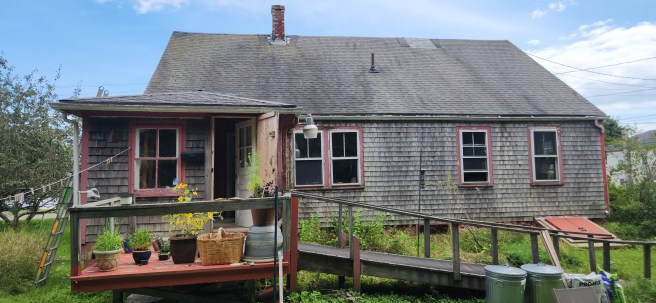
The listing had been on the market for the previous three years or more. It needed work, serious work, but it felt good inside, as others have told me afterward, even though the house is cold through much of the year, as I’ve even read in the archives of the local newspaper. A strong attraction is the natural light throughout the rooms. Our house inspector was impressed that the bones were good, especially the foundation – up to 18 inches thick in places. Were we up to the challenge of reviving the place? Life’s an adventure. I expected our low bid to meet rejection.

Instead, the seller accepted, clearing out most of our cash savings.

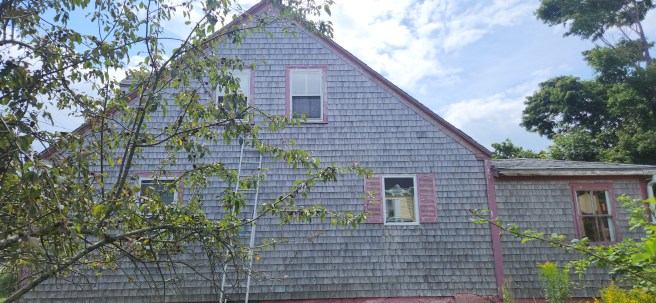
So here we with a classic cedar-shake siding full Cape dating from around 1830, although the real estate blurb placed it in the 1860s.

What has amazed me is the other participants’ envisioning of the renovations for this new venture. Not just the big, bold actions that inhibited my own thinking, but also many details that deliver a pleasurable, significant impact.

And that’s the beginning of this old house renovation story. As it unfolds, I hope you’ll pipe up with ways you’ve made your own dwelling a home a sweet home. Or, for that matter, of how your own projects required three times as much time and money than your best estimates presented.

Whatever the case, please enjoy the upcoming posts over the year. Not that it will be the only series here at the Barn this round.

Write about what you know, but best if it leads into what you don’t know

I’ve spent a lifetime writing – well, from my senior year in high school on.

I rather fell into a career as a newspaper journalist who worked mostly on the copy desk or a few steps beyond, with titles like news editor, lifestyles editor, makeup man (working closely with the production crew in what was called the back shop or, more politely, composing room).

My real dream was to have something more permanent as my legacy – books with my name on the cover and the spine. The fact was that as much as journalism engaged me, I yearned for a bigger picture than the daily deadlines usually reflected.

And so I spent much of my “free time” writing things that would never appear in a newspaper – poetry and fiction, especially, or even lengthy letters to friends and other writers. And, more recently, there’s been the blogging, which I hope you’ve been following.

Many of those years I despaired that my “serious” work would never appear as printed books, especially once I discovered how much effort was required to land even one poem in a small-press literary journal.

The persistence has resulted in eight books of fiction to my credit plus more than a thousand published poems and a few chapbooks.

The most successful entry has been Quaking Dover, a history of one of the oldest Quaker congregations in the New World.

~*~

As my diamond jubilee year wraps up, I’m reflecting especially on those eight books of fiction and the life that’s produced them.

You’ve heard the adage, of course, “Write about what you know.” But I’ve come to see how important it is to also write about what you don’t know, especially where it’s at the edge of your existing knowledge. I am among those who write as an attempt to make sense of something personal, which means being something of an explorer or discoverer or laboratory technician. A good writer, I’m thinking, wears many hats, at least of the proverbial kind. Let me confess I rarely wear a hat of any kind, though I should, considering the balding and sunlight and many skin cancers.

Drafting a story is work, even on those rare and exhilarating flashes when it seems to write itself and you’re flying too fast to worry about spelling or grammar or other details. But it’s not the most difficult part of the practice.

Revisions, I should emphasize, are everything. Or at least the hardest part, and the more essential part of writing in the hope of a readership. I find that in hard revisions I discover more of what I’m coming to know.

With my focus on Quaking Dover for the past three years, I’ve neglected my earlier books. Returning to them this year feels like a good exercise, for you, dear reader, and for me.

One of the regular weekly features here will be on things behind my books. The stories themselves already speak on their own.

Please stay tuned and tune in.

What is ‘home’?

The definition, like that of “family,” can be complex and elusive.

I’m looking at home as someplace much more than where I sleep at night or eat the majority of my meals. It’s more than a house or an apartment or even a tent, for that matter, even though for much of my life, my address has felt more like an encampment before I arrive, well, at what’s truly home.

The Biblical sense of sojourning matches much of what I’ve experienced, pro and con.

Think of a sense of comfort, for one thing, and belonging, for another. Not everyplace I’ve dwelled has measured up there. Rental units have always had limitations on how much you can personalize the space, even to the exclusions on painting the walls. And who knows what happens when the rents or lease go up.

As much as my native geography and its character are imprinted on my soul, the house I grew up in isn’t. How curious. As for family? I’ve now spent the majority of my life on the Eastern Seaboard, mostly New England. Four years in the Pacific Northwest were especially transformative. Yet deep down, I’m still a Midwesterner, though one now amazed almost daily by the movements of an ocean close at hand.

The place I’ve lived longest is Dover, New Hampshire, in an 1890s’ house that’s appeared often in this blog. As “home,” it had shortcomings, but it was where I built my own family, did some very serious writing and revising, ate marvelous food we had raised in our garden, delighted in some extraordinary neighbors (especially Tim and Maggie), delighted in the parties and guests we hosted, and thought I would spend my final moments within. Well, I almost did – but that’s another post or two. As I told the kids when we moved in, I would be in a pine box when I left.

Not that my plotline wound up following that course. It might have, actually, if my elder beloved daughter-slash-stepdaughter hadn’t whisked me off to the emergency room in time for a cardio-stent.

Back to the bigger story. As I retired from the office, it became clear we needed to downsize. I won’t go into details, but my elder daughter/stepdaughter (those distinctions blend for me but not everyone – room for many future blog posts) fell in love with a remote fishing village at the other end of Maine. And then, so did her mother. My introductions to the place were positive, but even though I had begun some intense decollecting and downsizing, and was well ahead of the others on that front, there was still a long way to go. Besides, I was in the midst of a major writing project and knew how long it would take to get back in gear if I packed up in the midst.

Even so, after a few furtive efforts, we bid on a property that had been for sale forever and were accepted. I was promptly dispatched to keep an eye on the place – essentially, as a writer’s retreat.

It needed, to put things succinctly, tons of work. But somehow, it’s felt more like home than anyplace else I’ve dwelled. As you’ll see.