On photographer Francesca Woodman

Is she daring us? To what? Her self-portraits from her intense, brief life burn with some secret hunger. Do her images contain clues for answers? How I wish she could speak or at least listen.

In contrast, she leaves us baffled by her short career, ended when she leaped to her death from an open window at age 22.

She can be seen as fascinated with death itself. A few images, such as those with her arms wrapped in bandages or holding a knife, may be from a suicide attempt that’s mentioned in passing.

Her images are infused with a gothic premonition of death – the Romantic obsession with tragic, youthful demise, and lost opportunity. To speak of an eroticism of death is eerily heightened by knowing of her suicide to come – the images of her holding a knife or extending her bandaged forearms or climbing (sometimes naked) through Victorian gravestones become eerily chilling, leaving the viewer with a morbid fascination.

Her shots appear to surface from the birth of photography itself, an homage enhanced by black-and-white – often scratchy – prints.

And then there’s the matter of her family – both of her parents and her brother were artists, each in a different medium.

Consider the sense of self-entombment in her photographic legacy.

As I delved into the images her family had released (there’s criticism they’re withholding much more), I pondered alternative directions my What’s Left novel could have gone. These photos, to me, could have been by Cassia’s father if he hadn’t taken up the Tibetan Buddhism and then been granted the support he received from his wife’s family.

In contrast, I encounter her after three of my novels followed a hippie-era photographer, and the newest tale picked up on his legacy nearly a half-century later. This time, it’s told by his daughter, Cassia, who’s trying to uncover his essence after he vanished in a Himalayan mountains avalanche when she’s eleven. Her biggest evidence as an investigator stems from his cache of photographic negatives. The way we do with Woodman.

Cassia’s research paradoxically forces her to reconstruct her mother’s side of the family in depth and all of the reasons her father found refuge among its members.

His, I’ll presume, are professionally competent and moving increasingly into color as the technology advances. Woodman’s work turns inward; his ranges outward, through the changing times around him. His death comes unexpectedly, in a period of blissful encounters, among the monks and mountains who expand his vision.

So I return to the darkness of her vision and the imagined brightness of his. Both, in their own ways, tragic.

A nod to famous Maine artists, most of them ‘summer people’

The Pine Tree State has long inspired painters and other visual artists, most of them attracted from elsewhere.

Here’s a sampling:

  1. Marsden Hartley, an American Modernist master born in Lewiston and died in Ellsworth. What the desert was for Georgia O’Keeffe, Maine was for Hartley.
  2. Neil Welliver, a Pennsylvanian who moved permanently to Lincolnville. Renowned for his large, square interior Maine nature studies – and a life of controversy and tragedy.
  3. Three generations of Wyeths – N.C., Andy, and Jamie. The most famous, even as summer residents.
  4. Winslow Homer and Edward Hopper. Led a parade of summer people who made the state’s rugged surf iconic.
  5. Alex Katz, a New Yorker who forged a strong Maine connection from 1954 on in Lincolnville. Best known as a precursor to Pop art.
  6. Frederic Church and Thomas Cole of the Hudson Valley School. Made their way to the Pine Tree State, too.
  7. As a child, sculptor Louise Nevelson came from Russia to Rockland. As an adult, she relocated to New York City, something of a reversal of most artists.
  8. Rockwell Kent. Spent five prolific summers on Monhegan Island.
  9. Charles Herbert Woodbury. Founded the Ogunquit colony.
  10. Lithuanian-born William Zorach. His family bought a farm on Georgetown Island in 1923 where they lived, worked, and entertained guests, juggling between New York City. Daughter Dahlov Ipcar also became a noted artist.


Regarding windows from a personal view

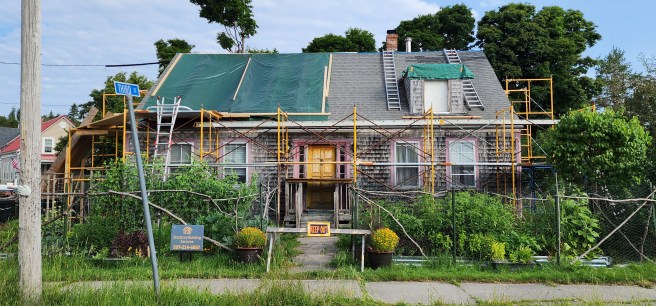
In our big renovation project, I kept returning to the criticism of architecture as “boxes with holes punched in them.” I think the objection was by master Ludwig Mies van der Rohe – and yet I also return to the rigidity of Frank Lloyd Wright, who left nowhere for a building to grow. His houses could be like living in a tomb, or at least a temple to his visionary and snake-oil-charmer ego. And here we were with a classic New England Cape undergoing a bid for survival in the 21st century.

Well, as Mies van der Rohe, a celebrated pioneering 20th century architect, also said, “God is in the details.”  Nowhere, perhaps, is that more apparent than with windows. He created whole walls of them before that style became cliché. Besides, how else, do we admit natural light and its reflection on the passing seasons into our interior existences?

In coastal Maine, where we’re renovating our full Cape, discretion is more the rule, especially considering our frequently fierce winds off the ocean. As I’ve said earlier, we love the light in this house and, for that matter, the whole town that emerged after the American Revolution.

Even so, art as we know it now was nowhere in their conscious thinking.

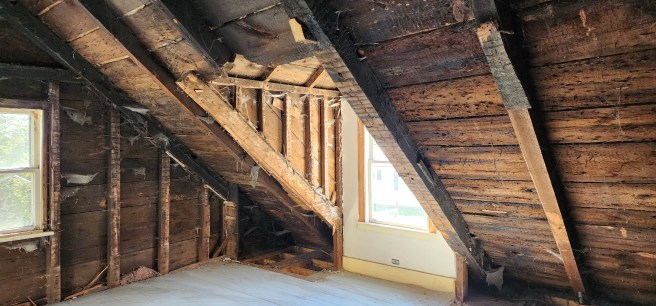
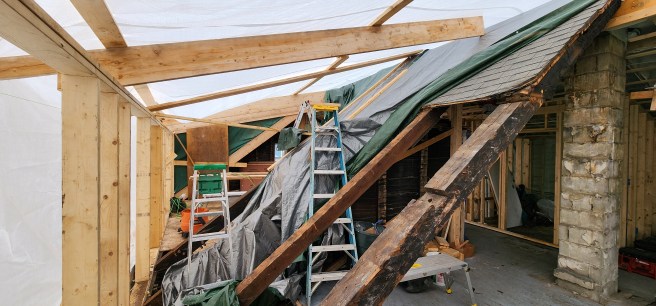
A Cape is a relatively economical house, but it has some drawbacks. The upstairs is cramped, cold in winter, and stuffy in summer. As you’re seeing in this series, the necessity of replacing our roof covering disclosed some serious structural problems that would have required redress even if we weren’t intent on maximizing the usable space on the second floor.

This double-hung sash window is slightly bigger than the one it replaced, something that makes a world of difference in the view.

Now, for the window details.

Upstairs, we could have gone for the same-sized windows that we have downstairs, but the back half of our second floor – facing northwest – also presented additional considerations.

One was the relatively low height of the back wall – 82 inches, just shy of seven feet. The downstairs windows wouldn’t have fit the room quite same here as they did downstairs.

Another was the fact that in the two expanded bedrooms, I wanted to maximize the wall space. I had a lot of books and recordings coming out of storage, so shelving came at a premium. Above that, I was hoping for decent opportunities to display visual art. Eastport is an artists’ mecca, and the natural light is spectacular. Oh, let me apologize for being repetitive.

That led me to consider windows that are horizontally broad but vertically short. You know, a band, rather than a drop. The first ones I found are called transom or shed windows, but, as the details mentioned, they don’t open for ventilation. Eventually, I determined that awning windows would do the trick. You really do have to learn the vocabulary.

The existing gable-end windows would be replaced with larger on the size of the double-hung sashes downstairs. No problem. I’m actually amazed at the expanded view that creates, along with the boldness in contrast to the timid existing windows. Yeah, these look great, from inside and from the street.

The back interior corners, though, promised to be darker (that is, dismal) than I desired. A small diamond window – a common architectural touch around here – would be perfect – the only problem was that those panes would have to be custom-made, and we decided the additional cost wasn’t for us at this time. A small casement window in a conventional flat framing came in at a third of the price. Plus, it would open for additional ventilation.

I would have preferred continuing the awning windows across the back, but the two coconspirators in this project instead convinced me to use two smaller double-hung windows for the bathroom and laundry room.

I’m psyched to see how these parts play out.

The view from the awning window was new to us. It does give you a sense of the village where we dwell.

~*~

The technical aspects of windows can be quite daunting. They could inform another post or more, but let’s skip that.

Our contractor expressed a preference for two brands – one nationally known, the other locally made and reasonably priced. We went with Mathews Brothers’ Spencer Walcott style.

As for sizes? Their lower-end style offers 134 standard sizes of double-hung windows alone. Beyond that, custom sizes are available.

The fun choice will the window that goes over the front doorway, but that was still off in the future.

~*~

By the way, I do love another Mies van der Rohe quote: “Architecture is a language. When you are very good, you get to be a poet.”

Seeing the detailed work going into our old house, I’m coming to see how they fit.

Back to the underground inspiration

As you’ve probably noticed in other posts here this year, I’ve been trying to recall some of the authors and books having an influence on the earliest drafts and later revisions of my novels. As I’m writing this, most of my personal library is still in storage – or other volumes, purged long ago to make room on my shelves for more – and my journals under wraps during the house renovations. I’m having to rely on memory, faulty though it may be.

Look, I don’t want these posts to be about some poor neglected novelist blah-blah-blah, but rather as one account of surviving in a writer’s life, maybe as a bit of advice or even encouragement for the next generation or two.

That said, I can state that my subway project sprang from Richard Brautigan’s Trout Fishing in America as its model. Think short, playful, imaginative with an image slash idea as its central character, like a children’s story for Woodstock reaching young adulthood. William R. Burroughs’ Naked Lunch also cast a spell as a free-floating state of mind.

For me, hitchhiking in subway tunnels was a fantasy symbolizing the hippie experience as I encountered it during my time living in upstate New York. You know, underground with urban roots yet flourishing out in the countryside where you could stick out your thumb and go about anywhere. Yes, though I didn’t fully comprehend it then, that Woodstock crowd was mostly from New York City and its suburbs.

The symbol even implied a degree of freeloading rather than responsibility.

While awaiting publication, the manuscript kept growing from its 1973 first draft, typed while sitting cross-legged at my beloved Olivetti 32 typewriter, through a revision shortly after that and probably another in 1976 before I packed up for the Pacific Northwest, where yet more would be added to the text with quite a backstory in addition to a superstructure out in the foothills somewhere north of Gotham.

This was well beyond the initial Brautigan flash. What I had was, in fact, unwieldy, and nodding toward Brautigan’s other fiction and a lot more. Unlike me, he kept most of his volumes short.

And then, somewhere before reaching my sabbatical in the Baltimore suburb of Owings Mills in 1986, the manuscript was greatly slimmed down, leaving many pages of outtakes I couldn’t trash outright. There was enough to create more novels, or so my inner trash picker insisted.

We’ll look at those as they took shape during my furious year of keyboarding on my new personal computer, however primitive the machine and process appear now.

In that sabbatical, I must say I was highly disciplined, keyboarding for four hours or so before taking a break, eating, even napping, and then returning to the work until two or so in the early morning. I had lived my adult life up to this point awaiting this moment, if it was far from what I had envisioned. Suburbs? Without a wife or soulmate? Heartbroken, in fact?

What drives an artist, anyway?

Beyond the yellow BMW 1600 oil-burning coup I was bopping around in – the one that was older than any of the women I was seeing.

A great deal of material and energy was there to be released, and I sensed this was my make-it-or-lose-it moment. As you’ll see.

Baltimore even had its own subway line under construction, reaching all the way out to where I was encamped.

Not that I would be there when it opened.

~*~

My first hick outpost, the one upstate, wasn’t as small as it seemed. Yes, it was a backwater, but the core was more populous than six of the places I would subsequently live in, if you didn’t count the university students in what I would dub Daffodil.

What my first actual job in journalism did have, though, was proximity to New York City, a mere 3½- to four-hour drive away. Despite the distance, the connection was vital, even vibrant. All of my new friends were from the Big Apple, and many of them were Jewish, as my college girlfriend was, even though she had by now oozed away from my presence, off on what I saw as troubling new places. At least none of them were Jonestown.

Starting with a summer internship before my senior year of college and picking up again after my graduation, a time of great emotional upheaval, exploration, and redirection. As I said, this was in the high hippie outbreak.

I presented the image that flashed before me, the gandy dancer who could have been a hitchhiker, but I should also acknowledge a freaky cartoon a housemate had created and handed me, with a face at a sewer grate mumbling “Duma luma, duma luma.” Those were the two prompts for the manuscript, seriously.

~*~

The inspiration also came from my first jaunts into New York City while living upstate, and later to the west in the Pocono mountains of Pennsylvania. Most of my buds and girlfriends had been from the City, as they called it. My early experiences turned into fascination during a period of great personal upheaval and growth for me.

Hippies seemed to be trying to go in two directions at once: back to the big city while hitchhiking out in the sticks. The original version was, in fact, published as Subway Hitchhikers in 1990 – the worst bookselling season in the memory of many publishers, thanks to the first Iraq war.

As I’ve ready described, in the 17 years between the first draft and the story’s first publication, the manuscript underwent a considerable metamorphosis as I moved across the continent in my day job. While living in the desert of Washington state, I even picked up a 1915 engineering book on the building of the New York subway system while browsing in a very small, small-town bookstore. (How did it ever land there?) Much of my expanding text was backstory on the central character, while the urban transit episodes shifted into something akin to an appendix. The result was an unwieldy epic. But I kept the outtakes, which took on their own life later.

Lobster boats prep for a fast racing season start

Informal racing out on the open waters was already a longstanding tradition when the Maine Lobster Boat Racing Association formed and launched its first races in 1964.

Fishing is a dangerous occupation, one luring a gnarly but dedicated gang into its ranks. It’s said they have salt water in their veins, or as I’ve heard them say of themselves, they’re either crazy or dumb – or both.

It should be no surprise, then, that here in Maine, lobstermen come together on summer weekends to race their boats. They have a pick of at least one every weekend.

Yup, race. Lobster boats don’t exactly look sleek or graceful – they’re built to work in all kinds of weather and take a beating. But they also have powerful engines. I had no idea just how powerful.

Besides, guys being guys, lobstermen have long boasted about their beloved boats – many are named after sweethearts and children, after all. Comparing theirs against their peers’ meant putting their words to the test.

All of that has led to a circuit of races starting in Boothbay and ending in Portland, with ten or so other sites along the way.

With that in mind, here are ten more bits to consider.

  1. Each race is different. Some draw more than 100 boats. The lengths of the races vary by location. Some routes are less than one mile, while others stretch over a few miles. Some courses are straight, while others are loops.
  2. Depending on the location, the winning speeds vary. The fastest boats typically reach 50 to 60 miles an hour, though a record 68.3 mph was recorded in 2022.
  3. The emphasis is on regular lobstermen, not professional racers, and additional events may be scheduled after the summer’s taken off. While prizes are awarded at the end of the season, the racers participate mostly for the thrill and its bragging rights.
  4. Typically, the races are divided into categories by boat type. For example, there may be separate runs for workboats under 24 feet length, gas-powered workboats of more than 24 feet, and diesel-powered workboats of more than 24 feet. There’s even a Class O category for non-working boats, any length, any horsepower – shall we guess these are out-and-out racers?
  5. In 2022, the entries ranged from 30-horsepower outboards to a 1,400-horsepower, 44-foot-long vessel named Bounty Hunter IV.
  6. For the races, they’re stripped of their gear and any other extraneous weight, or so I’m told.
  7. As for boat names? Maria’s Nightmare II and Wild Wild West give you an idea.
  8. While many spectators watch from the shoreline, others head out on the water to get close to the action. Some ferries and boats offer race day trips.
  9. The Moosabec Reach annual races are the closest event to me – and the only one in Washington County. The one-mile course runs between Jonesport and Beals Island, ending just before the bridge that connects Jonesport to the island. The race used to include going under the bridge, but that stopped after lobstermen crashed while trying to navigate under the bridge and around other boats.
  10. Since the Maine lobster boat races are in the summertime, it’s best to bring sunscreen. For distant viewing, binoculars are recommended. Other handy items to pack include refreshments and a sweatshirt in case there’s a cool ocean breeze.

What a relief when spring arrives!

There was a seasonal correspondence with the renovation project and the winter season.

In a clime like ours, weeks pass when everything outdoors seems dead. Outside our vision, though, things are preparing for rebirth. Maple sap starts running, for instance, as the syrup makers know. And then the first flowers pop up.

Something similar was happening with the house work.

I mentioned the wiring. Here’s another look as it developed.

New wiring.

And then the plumbing.

And here I was expecting metal pipes rather than flexible tubing.

Selecting the toilet, tub, shower, and so on took more time than anticipated, especially when two separate trips to Bangor – a full day each – turned up nothing at Lowe’s, Home Depot, or Frank W. Webb.

You can’t always go by the description you find online or in a catalog.

I am looking forward to finally being able to take a bath without feeling like a pretzel. It’s been four years, in fact.

Visible progress was even appearing on the new exterior on the gable ends.

We love the little detail of the upturned notch on these cedar shake shingles. It matches the earlier ones that will remain on the other half of the exterior.

And the dividing walls along the center started coming down.

Do I sound impatient?

Is small really beautiful?

One place I was appearing as a writer was in the small-press realm. Largely unseen and at the fringe of the literary world, its prolific, low-circulation reviews, quarterlies, ‘zines, chapbooks, and even full-sized books reflected a passion for literature, an intense mission, or outright ambition rather than an accountant’s commercial motivation. Many were marginally funded, mimeographed or photocopied, while others had more traditional printers, perhaps even typesetters, and a few of the biggest even had paid staff. Most were edited by dedicated individuals or partnerships; others by an institution or circle; and still others by college English departments, with either students or faculty as the team.

It’s where the action was – and remains.

Among the book publishers, Black Sparrow and Copper Canyon stand out, along with Shambala for a Buddhist focus.

In general, university book presses garnered more respect and financial backing and weren’t open to those of us who weren’t in a professorial track.

In college, I had been told of a widely recognized poet who averaged 20 rejections for every poem he had accepted in one of these journals. That was meant as inspiration to keep us lesser voices from despair.

Well, a few years later, I was getting about 20 rejections for every batch of five poems I mailed out. Still, I got more than a thousand acceptances. They usually paid me with two contributor’s copies, or did before the action shifted online. There are some fine online sites, by the way, if you look.

The track was how you were supposed to build a reputation and even entice an agent or editor. I think they were all too busy to notice.

A newspaper career was usually supposed to grow the same way: start out on a small daily somewhere out in the sticks, one with next to nothing pay, and work your way up. Or as one critic warned publishers, this was a process of eating your young. Or your seed corn, in another version.

(The highest income I ever reached, by the way, was the national median. And that was thanks to our Newspaper Guild contract, unlike most of our rivals.)

~*~

Acceptances created another challenge, drafting a contributor’s note.

I noticed that many of the writers listed their most recent book or two, but I really didn’t have that much. Others went with where they were teaching or working on an advanced degree. With my name distancing myself from the more common tag I used in the newsroom, naming the newspaper wasn’t really an option – and not that wise, anyway, if the content was of a controversial nature, as many still saw the hippie movement.

The solution, then, was to look for some bit that would make me more human. Do try it, if you’re asked to come up with something similar. Even be flip, if you can.

~*~

The World Wide Web has taken all of this in a new dimension, of course.

We bloggers are essentially producing ‘zines or similar small journals. We even have photography as a regular option, not a given back in the day.

I’ve even gathered my published poems along with newer ones and published them as free PDF chapbooks at my own online imprint, Thistle Finch, a sister to this Red Barn. Do look it up.

More crucial has been the growth of ebooks and on-demand print publishing, which I’ll discuss in an upcoming post.

Like speaking to the ghost of my first lover

Let me explain. After showing my tech-savvy elder daughter a few things about Facebook during a visit, I had one of those “whatever happened to?” moments and chanced upon my first lover’s FB site. That led to what we call falling down the rabbit hole, in this instance this one where her photos and posts made me happy to see what appeared to be a good life … at least until getting to the point where she related that her husband had passed. Forty years together? Impressive. How was she holding up after the loss?

As I continued:

A lot has transpired since we last communicated, but I can say on my end much of it wouldn’t have happened had you not been so much a central part of my life way back when. You really did change my direction. Thank you for the positive things that followed because of that.

Should you want to know more or to just chat, fire back. Or peruse my profile or my blog for a sampling of what’s really been – and continues to be – a rich life, maybe more than ever. Yours, of course, is likely to be more fascinating. Best regards, all the same. Peace … 

Of course, I haven’t heard diddly.

A quick look at labor and income changes in America

Some realities and trends I find disturbing, as gleaned from Harper’s Index over the past few years:

  1. Hypothetical median income of full-time U.S. workers [2020] if income were distributed as evenly as it was in 1975: $92,000. Actual median income of full-time U.S. workers: $50,000. (Guess which direction the differential is skewered.)
  2. Percentage of U.S. manufacturing jobs that required a bachelor’s degree in 1983: 14. That required one in 2018: 31.
  3. Percentage of Americans who believe that a four-year college degree is not worth the cost: 56. (Are employers who expect a degree holder for a low-paying job getting a free ride?)
  4. Portion of all U.S. student-loan debt that is held by women: 2/3. (Does that reflect gender pay differences in similar jobs?)
  5. Percentage of unpaid taxes that are owed by the richest one percent of Americans: 70.
  6. Average percentage of their fortunes that the twenty richest Americans gave to charity in 2018: 0.8.
  7. Factor by which the average cost of a home in the United States is higher than the average salary: 8. (And the guidelines I grew up with said don’t go over 25 percent of your income. So now it’s twice that?)
  8. Percentage of Americans aged 18 to 29 who live with one or both of their parents: 52.
  9. Rank of workers 75 or older among the fastest growing demographics in the U.S. workforce: 1.
  10. Percentage increase since 2020 in the amount of work employees are doing outside of the nine-to-five workday: 28.

It wasn’t cabin fever, exactly, but somewhat close

The new year introduced what seemed like slow-motion forever, a superficially sluggish pace that lasted all winter.

The reality was that there were a lot more parts and details to attend to in a project like this than met the eye. As for patience? It’s a skill, as I’m observing.

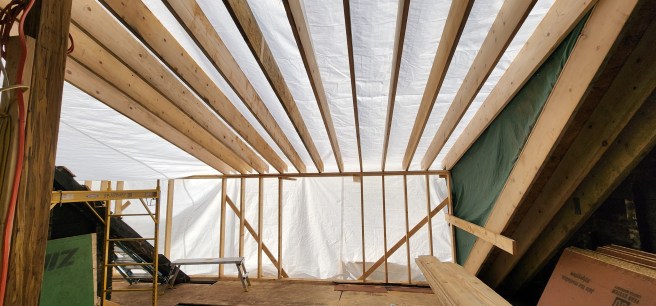
Cutting the openings in the exterior for the new windows and then framing them inside and out was one example. One step required each window to be perfectly leveled and then sealed into place. It wasn’t nearly as smooth-going as you’d imagine. And that was even before Adam uncovered the rot under the north gable window. One more delay for repair.

I have to admit the varied sizes I’d chosen and their emerging views did give me a sense of confirmation and satisfaction, as did looking at the scope of the full back half of the upstairs.

Some of our new casement windows resemble what are called transom or awning windows.

Pulling up flooring to permit rough fitting for the piping in the bathroom and adjoining laundry room was another example, one we’ll cover in an upcoming post.

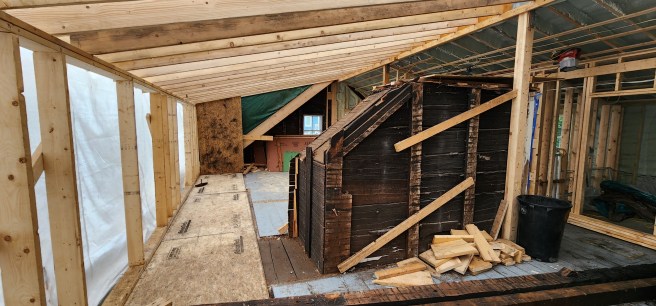
Framing for interior walls.

An unexpected discovery was a spider’s nest of tangled electrical wires, itself a violation of building code, but something that then led to the shock that none of our “modern” wiring on the first floor was grounded. Among other problems. Addressing that situation detoured Adam for more than a week, but it included a redesign of the wiring in the cellar, too.

That project was on our longer agenda, but it wasn’t something to ignore. I am delighted that we can now plug in three-prong wires without having to resort to those crazy converters for the two-prong sockets. As it turned out, none of our surge protectors would have worked when plugged into the old system.

It’s a huge relief knowing that’s all in our past now.

You’ve already seen photos of the knob-and-tube lines we found in the rafters. Some of those then led back to outlets on the first floor – connected by nothing more than stripping the main line and taping over the new wrapping. We already knew from experience that most of the first floor, plus the cellar lights, were on one circuit. Running the bread toaster and another energy hog could easily overload that, sending me flashlight in hand to reset the circuit-breaker in the cellar.

Our carpenter also found a junction box set in the upstairs floor – another violation of today’s building codes.

And here I’d been concerned about our lack of three-prong grounded outlets? Oy vey.

Of course, we’re looking to correct all that. My, are we.

In the end, the whole house was rewired.

Framing for the two bedrooms and the bathroom and laundry room also took time and care, as did the strapping for the drywall on the ceiling to come. For now, there were the electrical lines, outlets, and switches to install, once the holes were routed in the future walls.

The addition was really happening.

Outdoors, the back half of the house was surrounded by scaffolding. Although the first cedar shakes were applied to the new exterior early on, continuing was a random activity based on fair weather. The exterior work had to do more with flashing and the underside of the roof overhang. More details, as you’ll see in coming posts.

How much would have to be more or less finished before tackling the front half of the upstairs? Instead, we were trying to find crannies downstairs to move our possessions still parked overhead, but Adam also needed more workspace. It was amazing how many tools and related equipment he had there. Even his construction lighting was impressive, before we considered the permanent fixtures.

If I was looking for a halfway point, I was sensing the path ahead was more complicated. We still had plans for downstairs, too, if any of our nest egg remained.

Welcome to our learning curve and money jitters.

~*~

One thing we were discovering was that there are far more parts to house than you’d imagine.

All along, we kept hearing mysterious pounding and shaking overhead, the whine of power saws and the thumping of an air compressor, along with falling timber or worse. I learned not to anticipate taking a nap during what other’s consider normal working hours.