Things we still need a can opener for

I don’t eat canned soup anymore – can’t stand it, not after being upgraded at home.

Beer, meanwhile, has a tab or comes in a bottle.

So here are my reasons for not throwing our can opener into the trash:

  1. Tuna fish
  2. Tomato paste, as well as whole and diced tomatoes
  3. Sweet corn
  4. Sweet condensed milk
  5. Garbanzo beans (already softened)
  6. Pumpkin filling, not just for pies
  7. Coconut milk
  8. Chipotle
  9. Pineapple (not fresh)
  10. Baked beans

If we only had a dog or cat and their cans of pet food. 

At last, getting set for the big magic trick

Three weeks into the project, I noted my wonder at how quickly the work was going.

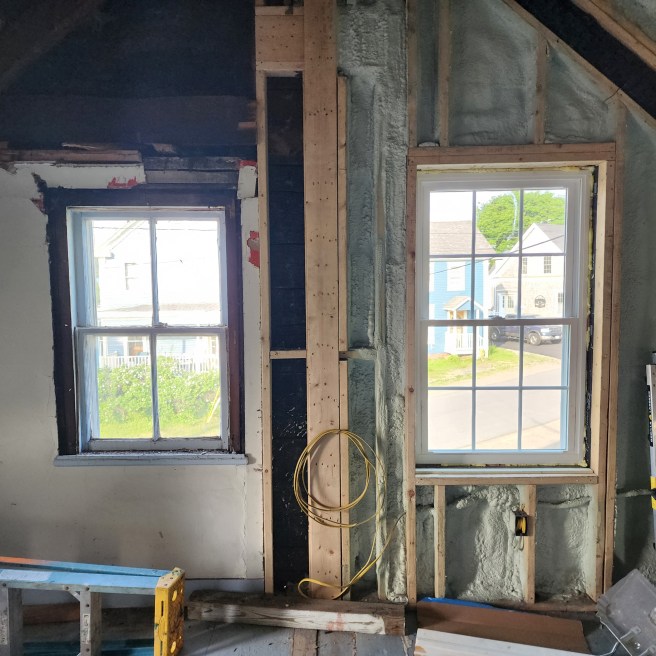
The back half of the upstairs interior was now exposed, giving us a sense of how much flooring and headspace we would be gaining. And we could see all of the rafters. Unobstructed? Adam had set up an impressive indoor workshop on the back half of the second floor, while the front two rooms clustered many of our possessions, now under plastic.

That said, I also noted my concern at how slowly the work was going.

The old roof over the back half of the house was still in place, and the clock was ticking down toward winter.

What dawned on me as I gazed up toward to the peak of the rafters was that the ones from the back – which were about to disappear – secured the ones at the front of the house, the half of the roof that would have to stay well in place into late spring or early summer. A few of those charred rafters would actually be remaining like forever, a nod to history and all that.

In a flash, the urgency of the new laminated ridge pole and supporting columns made sense. Without them, the whole roof would come crashing down and, in turn, there would be nothing to hold up the new one. One earlier contractor’s proposal for premade trusses to create a gambrel roof on both sides now became comprehendible – so that’s what he meant? We weren’t exactly communicating, and his results wouldn’t have been our first choice. As we were hearing, not every carpenter today knows how to frame a roof from scratch.

~*~

The key to achieving this was a recommended custom-made laminated veneer lumber ridge pole running the length of the house. Or more accurately, three pieces that would be joined together once they were inside and raised into position. Each one was 1¾-by-14-inches by 40-feet and weighed 280 pounds.

In addition, another custom-made LVL 3½-by-3½-inches by 26-feet was delivered for the remaining supporting column. That one would run down the cavity where our second chimney had been, the bricks that had been on the verge of collapse when we bought the place.

~*~

The new ridge pole would have to slip in where the rafters from each side were now overlapping. What would hold them up as he sawed them asunder? The answer was temporary framing underneath.

We were really, really glad Adam knew what he was doing, though we suspect he was losing some sleep over it. We do know he was doing his research and some thorough calculations.

had

The electrical line coming into our house had to be moved to one side of the gable to allow for the ridge pole to come into the house. That meant getting the utility to come out for a free service.

Inside, our contractor was making cuts accurate to one-sixteenth of an inch. Sometimes the beam below, cut in the early 19th century, varied by a half-inch within the length of the two-by-sixes they would be supporting.

We were beginning to appreciate the fact that Adam was our contractor and not just our carpenter/electrician. He was making the arrangements and phone calls. Viking Lumber was making nearly daily deliveries from Machias.

After working largely solo, he lined up a crew to manage the pieces into the upstairs floor and then higher once inside. There was also the matter of a rented lift, positioned outside.

A lot of coordination had to come into place, even before discovering the power line coming into the house needed to be moved. Hello, Versant?

He had additionally expertly erected scaffolding by himself.

At that point, it really felt like this was happening.

So here we were, Week Four, the end of October, and the laminates were arriving – all four pieces. Well, make that five – Hammond Lumber had ordered a wrong size for the column and had to rush the corrected order down to our site.

Have you ever done genealogy?

While living in the small industrial city that’s the setting for Hometown News, I began exploring my genetic roots, at least on my father’s side. It involved a lot of correspondence, especially with a cousin of my dad’s generation, as well as probing whatever records we could dig up.

By this time, my spiritual practice had recentered in the Quaker stream, or Society of Friends, where it turned out my ancestors had been active from the early 1660s until my great-grandfather moved from North Carolina to Ohio and “married out” in 1893. I now had access to historic minutes, correspondence, journals, and other resources that proved helpful.

My findings are presented on my Orphan George blog, should you be interested.

What fascinates me in regards to my fiction is the fact that so many of my ancestors were essentially countercultural in regard to the broader society. They were pacifist, for one, and wore distinctive garb and used distinctive language. (Sound hippie?) In North Carolina, their community had the first manumission society in the state, buying freedom for slaves and transporting them to safer lands. This was not the Deep South of popular culture.

These findings, and the research methods, proved quite helpful when I drafted my nonfiction New England history, Quaking Dover.

The techniques and insights also played into my novel What’s Left, where I took Cassia’s lineage on both sides back to her great-grandparents, including their quite different faith traditions.

I am intrigued by the values and practices from one generation to another. What is rejected and what is embraced?

In my case, I discarded the mainstream Christianity and lifestyle of my parents and grandparents only to find myself later reconnecting with much of the radical Christianity and countercultural outlooks of my great-grandparents. Well, most of them on my dad’s side. My mother’s were an entirely different matter.

As I’ve found, genealogy often presents a much different history than we’re taught in the conventional versions, especially when our focus is on everyday people rather than the political and military leaders and the upper class. The lives can go ways we wouldn’t have plotted. For instance, my family in North Carolina had a gold mine.

Big city, big dreams

Who was I to think I could say something fresh about underground public transit? Well, the outsider has long had a place in the arts … and in comedy.

I had expected to wind up living in a big city, where I’d have access to frequent symphony concerts and perhaps opera as well. Foreign films, well-stocked bookstores, kindred souls. All the rest. My life journey and my career went another way, but I still wound up as a subway rider, of sorts. I was far from a private jet or even taxi kind of existence.

My introduction to underground transit probably came in a series of big, cartoonish, wildly rendered Subway Riders canvases that received a special exhibit at the Dayton Art Institute sometime in my high school years. I think they were by a hot New York rising star who was visiting Ohio as an artist-in-residence or an arts school guest instructor, though his identity eludes me now. Flash in the pan? Rubes in the sticks?

I wasn’t exactly wowed, but I was intrigued. He wasn’t Rembrandt.

The furthest east I’d been was Pittsburgh. Perhaps the next year my family got to Toronto and Montreal, though I didn’t venture on the subway in either of those cities.

Do families even take such vacations on the road nowadays? We did have our camping gear in the trunk of our red Buick Roadmaster.

~*~

Writing about subways – becoming fascinated by them, their offensive grit, stench, and loud noises included – was about the last thing I would have expected when I graduated from college or even high school. I was a Midwesterner through and through. The closest I had come to what I saw in those Subway Rider paintings was on the City Transit trolleys at rush hour. We definitely weren’t flashing along a dark tunnel or loading by hoards or packed together like sardines.

But people kept telling me I wasn’t destined for my hometown, no matter how loyal I felt. Or was that defensive? The message they conveyed was that I should look to Manhattan or some equivalent opportunity. Even Cincinnati, an hour away, looked sophisticated.

The hippie outbreak, or Revolution of Peace & Love, was still somewhere in the future, though the Beatles were shaking the status quo and skipping around Elvis in what we’d now call the pop culture scene. Culture was, let me emphasize, concerned with things that would raise our vision and intelligence rather than merely mark social norms as in averages, either mainstream or ethnic.

By the time I actually rode a subway train, I was nine months away from earning an urban studies certificate, thanks to my multi-disciplinary college studies. The journalism career that embraced me would instead lead out in the boonies or an equivalent emotional wilderness.

~*~

My book that sprang from those encounters started out short and flashy as its first draft in ’73. Inspired, in part, by Brautigan’s Trout Fishing in America, I typed away sitting cross-legged before a converted coffee table and my beloved Olivetti Lettra 22 blue typewriter. The very portable one.

Graffiti, wild splashes. This was going to be my wild hippie book, the essence of it all. It had the Midwest – what would emerge as Daffodil – and it had the Big Apple, where so many of the freaks I knew after graduation had grown up. The movement was a confusing clash of youthful excess.

It was too much – way too much, actually.

By the time I distilled it down into what was published as Subway Hitchhikers, it was more of a lacy collage presented in a strobe-light kind of then/now alternation that I came to see was overly ambitious to be effective rather than confusing.

What I did sense was the way big cities draw on the interior landscape, almost like vampires on the innocent. Not that I ever expressed it that openly, but I am now thinking it fit Gotham if only I were usually trying to look at the bright side of life.

Was it even a novel? Short, and perhaps meta-fiction?

Unlike any other.

Among trendy folk

I’m really in the dark about what’s “in” these days, though I do get some glimmers through family.

So let me ask.

  1. Are Carhartt pants continuing to overtake blue jeans?
  2. Is Apple still preferred to Android?
  3. Depop for second-hand clothing. Is it the next eBay or etsy?
  4. Are Gmail addresses still tops? Or is email essentially going over to texts?
  5. Wraparound sunglasses? I’m finally noticing them.
  6. Paypal for online use rather than cards themselves? What about Venmo?
  7. I’m finally aware of Reddit. But what about Twitch?
  8. As for snacks: Doritos chips and salsas? Goldfish crackers? Oreos?
  9. Are Ugg boots and Crocs really making a comeback? As for Vans shoes?
  10. How long can vegan hold on?

Preparing to reframe the top of our house while we still lived below

This was turning into a more serious project than simply raising the roof.

Had we merely replaced the covering itself – either with asphalt shingles or upgrading to metal – without expanding our usable floor space on the second floor, we would have been glossing over serious structural issues. It’s a miracle the roof held as long as it did. One insurance company had cancelled our homeowner’s policy when it saw the photos of the roofing, and another insisted on a replacement within a year. That route would have been a very expensive band-aid in the end.

We had a dream of making better use of that space, as you’ll see. And now, after three years, we finally had someone to pull the project off.

As a starter. Adam needed to address some serious structural issues.

Was anything holding our roof up? It may seem strange to find that concern intensifying as we set out to remove it and its rafters, but we would need something to keep half of it up while the other half got ripped away. As an additional complication, we’d be living in the house rather than gutting it and starting over.

The absence of a ridge pole meant there would be nothing to hold up the front half of the roof when the back half came away for the new. Its lack also meant the existing ridge wasn’t straight but rather serpentine.

Adam had to make room for a ridge pole between the existing rafters. It was tedious and required some precise calculations.

Structurally, all the weight of the roof for nearly 200 years was directed outwardly to the walls – and, as he was finding, they weren’t exactly perpendicular.

Now he needed to have something to support the weight of the ridge pole and roof, too. That meant constructing four columns from the crown of the roof down to the cellar – one on each end of the house, the other two spaced in-between. That required going through two floors as well, plus building concrete pads in the cellar.

This was time-consuming work, and he was racing winter weather. We had reason for concern.

As these findings sank in, we realized our earlier option of just putting new shingles on the existing slope would have done nothing for real issues lingering underneath. Even without raising the back wall or consolidating the dormers in front, we would have had a larger problem waiting to erupt overhead. Living beside the ocean exposes us to many gale-force blasts. It’s a wonder the roof hadn’t gone years ago.

After taking some deep breaths, we appreciated what our contractor was telling us. Now, just exactly where was the center of the roof or the alignment down under? He did have some amazing laser tools to determine that.

We were really glad Adam was a pro, maybe more than the others working in town. He was definitely earning our trust and respect.

It’s not really taboo, is it?

Is a writer really expected to explore deep matters without including the hot subjects of religion and politics? Here I’ve been writing about the hippie movement, which had a strong anti-materialism streak, at least on the surface, as well as a strong anti-war stand, though I’m sensing it wasn’t quite as anti-violence as well. Early drug use was often described in religious terms pointing toward a union with the divine or transcendental wisdom.

For some of us, at least, spirituality and religion (shorn of religiosity) were a big part of the era. Not that that many others wound up there by now, from what I see.

As for politics? What a disaster.

~*~

In my journey, the time in the ashram was the ultimate of hippie. We were a tight-knit community (think of the ideal of tribe), vegetarian, back-to-the-earth (though not off the grid), sitting in meditation twice a day (the best way of getting high). The celibacy ran counter to the broader movement, but we did have a better balance of the sexes than elsewhere. We were focused, after all, on changing ourselves first before trying to change society.

So that’s the basis of my novel Yoga Bootcamp, humor and all.

I tried to walk a line between guru adulation, which I saw in books about various religious leaders of all stripes, and an expose about their shortcomings, mostly sexual and financial. While there were problems after I moved on, I had learned and grown much during my residency. To turn on that for larger readership would have been a betrayal.

~*~

I wasn’t so considerate with the churches in Hometown News. What I saw in the industrial city that modeled Rehoboth was rivalry, and I never got to know the ministers. I was worshiping with Quakers an hour to the south.

~*~

The subject became more nuanced in Nearly Canaan, where Jaya ventures forth to spread yoga-based spirituality along with her progressive social service. Having her become close friends with an evangelical pastor’s wife, which evolved in the final revision, is one of my favorite strands in my fiction, along with the middle novella in the Secret Side of Jaya, with its more primitive Baptists.

~*~

Let’s return to my first book, where a third leg of the original saga was Tibetan Buddhism. Memories of a documentary I’d seen in childhood about the flight of the Dalai Lama had taken root in my psyche, and my yoga ashram residency included teachings about karma and reincarnation. Even my fundamentalist mother had been impressed by some of that. Well, and maybe the fact that they were fighting the evil Communists.

Once the seemingly absurd premise of a lama being reincarnated in Iowa, I was off running. And then, a few years after publishing the book as Subway Hitchhikers, news stories presented claims about such an occurrence actually happening. For me, though, the prompt fit a personal sense of being born into the wrong place and time.

After the book was drafted, I returned to Indiana as a research associate and found myself taking the bus to work some days with the Dalai Lama’s brother as one of the passengers. I was too abashed to try to converse with him, but he was on the university’s faculty and, as another coincidence, a Tibetan Buddhist center took root in Bloomington, something I was already anticipating in the story line that finally jelled as What’s Left, springing from the ending of the subway story.

Drafted a quarter century after Hitchhikers was published, What’s Left picked up with the Greek-American family the lama married into, except that I felt I needed to tone down the reincarnation possibility. Besides, I was exploring dimensions of Greek-American culture and Orthodox faith, which I’ve presented here at the Barn.

This has me thinking about the original scope of my subway novel. What if I had envisioned it as a graphic novel sans the graphics but one where each encounter somehow builds toward his establishing a temple somewhere in the Catskills or Berkshires or other high point near the big city? Instead, I intuitively had him zoom back to Indiana, a reflection, I thought, of how far Manhattan’s tentacles reach.

Tibetan Buddhism was a way of abstracting my Hindu-based yoga training, and my Buddhist tastes leaned toward Zen.

After moving to Dover, though, I got to know a deeply committed woman who was on her way to becoming a Tibetan Buddhist nun slash teacher. Some of her insights have been woven into the revised story as it stands today in Subway Visions.

Chocolate facts, just in time for Valentine’s Day

Remind me that not all candy is chocolate and not all flowers are roses. But you might want to check out just what’s inside those heart-shaped red boxes tomorrow.

Here’s some perspective:

  1. Chocolate accounts for 59 percent of all candy sales in the U.S. The chocolate portion of that comes to an average of $145 a person each year.
  2. The average American eats three chocolate bars a week.
  3. The most popular time of the year to buy candy is the week before Halloween, followed by Easter, and then Valentine’s Day. Not all of that is chocolate. Think of all those little hearts imprinted with pink messages you’ll be facing tomorrow. But chocolate still weighs in big. For Valentine’s Day, it adds up to 58 million pounds – or, including all candy, $2.4 billion. Kaa-ching!
  4. The top day for chocolate sales in the USA is November 1, right after trick or treating.
  5. The most popular time of day to eat chocolate is in the evening.
  6. Most candy is sold after 2 pm, with peak sales between 4 and 5 o’clock.
  7. Online chocolate shopping now accounts for 40 percent of consumer action. What, it’s not the vending machine at the office?
  8. Milk chocolate is preferred by 49 percent of the American public, followed by dark at 34 percent. My favorite, white, has to split the remainder with some other subcategories.
  9. Three of the five biggest chocolate manufacturers are in the U.S. (Hershey’s comes in fifth, Modelez third, and Mars first.) But Europe is the biggest market.
  10. The Covid-19 outbreak led to a sharp rise in the popularity of fine chocolate who turned to it as an emotional comfort. The consumers were generally younger, living in urban areas, and earning above-average incomes.

Thanks especially to Max at Dame Cacao. She just might be worth a Tendril of her own.

Mysteries were lurking behind the walls and above the ceiling

When Adam set about ripping out the drywall upstairs – and immediately filling his first dumpster in the process – the emerging picture soon presented a number of challenging hurdles. I’ve mentioned the lack of a ridge pole and matters regarding rafters, plus the wiring situation. This wasn’t going to be nearly as straightforward a project as I hoped.

The dumpster, by the way, was a new step for me. Back in New Hampshire, our carpenter hauled the debris to the transfer station in his pickup – or I burned what I could in the side yard. We even used a lot of the ripped-out sheetrock and plaster to “sweeten” our garden pH. How much would the alternative cost us, anyway?

I’ll say it was a bargain, especially considering the time that would be lost if Adam were driving that to the trash transfer station an hour away.

Adam’s selective demolition led to a small collections of old wallpaper examples. Meanwhile, a hippie-dippy yellow crab painted under some of the later wallpaper, alas, couldn’t be preserved, not that I quite wanted that. Mine was the minority vote. Still, we’d love to know the story of its creator – a kid? – and its inspiration.

More puzzling were the broken bricks in the walls and joists away from the chimneys. Huh?

Or, more impressive, finding some of the exterior sheathing is more than 18 inches wide. Try buying that today.

The fire damage was more extensive than we had imagined. Not just the historic downtown fire of 1886, charring our rafters but not setting them ablaze, but also a later chimney fire that charred the insulation off electrical wiring that we were still using.

What if the char damage on the beams and rafters wasn’t superficial but went deeper into what we assumed was still solid wood? (We were relieved to find out just how much good lumber remained inside.)

We’re left wondering. Did a fire originate in one of two wings once attached to the house and then spread to the roof? Sounds like an archaeology problem to tackle sometime ahead.

In addition, earlier carpenters here didn’t seem to do much measuring. I had to ask Adam, “So how does it feel to be correcting 200-year-old work?”

He gave me a look.

As I said, Adam set to work with determination and within a day filled the first dumpster.

Beyond the fire damage, he uncovered more knob-and-tube wiring to contend with than we had wished.

But to our surprise, Adam is not only a master carpenter but also a licensed electrician. This was sounding too good to be true.

Love life ups and downs

I promised my first lover I’d never write about her, meaning in my books. And I promised another that no matter what, I’d always leave the door open.

So while neither of them is outwardly present, my novels originate in heartbreak. There, I’ve said it. And also in hope.

Yes, I promised her I would never write about her, even though I’m pretty sure she’s never read anything I’ve written in the past 54 years.

It’s not that she didn’t cast a shadow over the story, but rather that her spot on the stage is abstracted into a more universal figure, perhaps even an archetype. Details from later lovers have also been woven in to the point a composite female emerges.

How could I deny the passionate devotion or yearning? Like so much else of the hippie outbreak, it could be embarrassing today.

I did ceremonially burn the letters I had kept until moving to Dover. It was a long fire.

~*~

It’s unlikely that my life would have gone in the direction it did if she hadn’t appeared in my life.

The hippie side, definitely.

And my yoga, while she veered off with the Sufis.

I didn’t realize just how rich they were or how much of my ancestral farmland they were buying up. Her parents were still quite supportive of me, anyway.

I still needed someone to fill her place in my novel Daffodil Uprising.

~*~

Much of what followed turns up in Pit-a-Pat High Jinks, including my first Summer of Love.

I’m curious to hear their side of the story. Most likely, I was pretty pathetic. I certainly was naïve and not the most savvy romantic. Like what did I really have to offer anyone? In my revisions, I was able to include details from twenty-some years later, my second Summer of Love, but Peace and Love had more grittier aspects than the dippy love songs present. Let’s turn to the blues.

For me, at least, the experiences turned out to be very confusing.

At one stage in the later drafts, as I tried to come to grips with the conflicting accounts of one character’s past she had revealed to me (the real-life person, not the abstracted figure in the story), I actually broke down weeping as I sensed she had been a victim of sexual abuse from at least several directions. No wonder her accounts to me hadn’t added up.

We did reconnect online, but I didn’t dare broach the possibility. Was she even aware of them or was she still in denial. There was no way to ask, though. Besides, she barely recalled me, though she had been a big thing for me.

~*~

The love life definitely came into play with Nearly Canaan, though the abstraction underwent greater transposition. Ages and genders changed, for one thing. Tracking real life, the relationship turned into marriage now mirrored in the marriages around the central couple.

I was really dashed when one literary agent said she didn’t like the character based on my now ex-wife, someone I still saw on a pedestal. Back to the drawing board, along with some therapy sessions for a clearer understanding. My remarriage helped me recast much of this, too.

If only I could have kept this within the bounds of a Romance genre, I might have had a bestseller. Right?