A FEW THOUGHTS WHILE SIFTING COMPOST

Come springtime every year, there’d be a predicable domestic spat. I’d say the compost was ready. She’d look at it and retort, “No, it’s not: you can still see bits and tell what it’s made of.” (Actually, two shes – mother and daughter.) “Then you’ll have to wait another year for it to finish to your specifications,” I’d shoot back, only to be told we couldn’t wait that long. And so on.

Part of this seemed to question my very manhood. I was, after all, the one doing all the work, from collecting the bags of leaves around the neighborhood and dumping the kitchen garbage in the covered bins to changing the rabbit cages, in large part for their precious, nitrogen-intense pellets.

Well, most of the work. The red wigglers would also do a large share.

Still, I suspected that if we waited as long as they wanted, all of our organic matter would evaporate.

At last, I had a flash of genius. I’d slowly sift the pile, trowel by trowel, and whatever came through the screen turned out beautiful. They approved and used buckets of it on the square-foot garden beds as fast as I could provide them. The part that didn’t fit through the screen was also beautiful, along the lines of woodland detritus with flecks of brown eggs.  I put that aside to decay further, perhaps to be spread as mulch in July or August.

100_8405

The motion of sifting itself can become a kind of Zen practice as you admire the material before you and the thoughts flitting through your awareness.

This movement’s like panning for gold, as I found washing my dishes in the glacier-fed river below Mount Shuksan. Back and forth, back and forth, with all that matter getting smaller and sparkling more in each round of swirling.

All the peach stones are tokens from our cheap peach bonanza after Hurricane Irene ruffled nearby orchards.

The squirrels plant a lot of our wild black walnuts.

Listen to all the cardinals and mourning doves.

Plastic, in flecks, is inescapable.

How loud, those geese overhead! Me, I’d be more stealthy.

We eat a lot of eggs.

FLOWERING MEMORIES

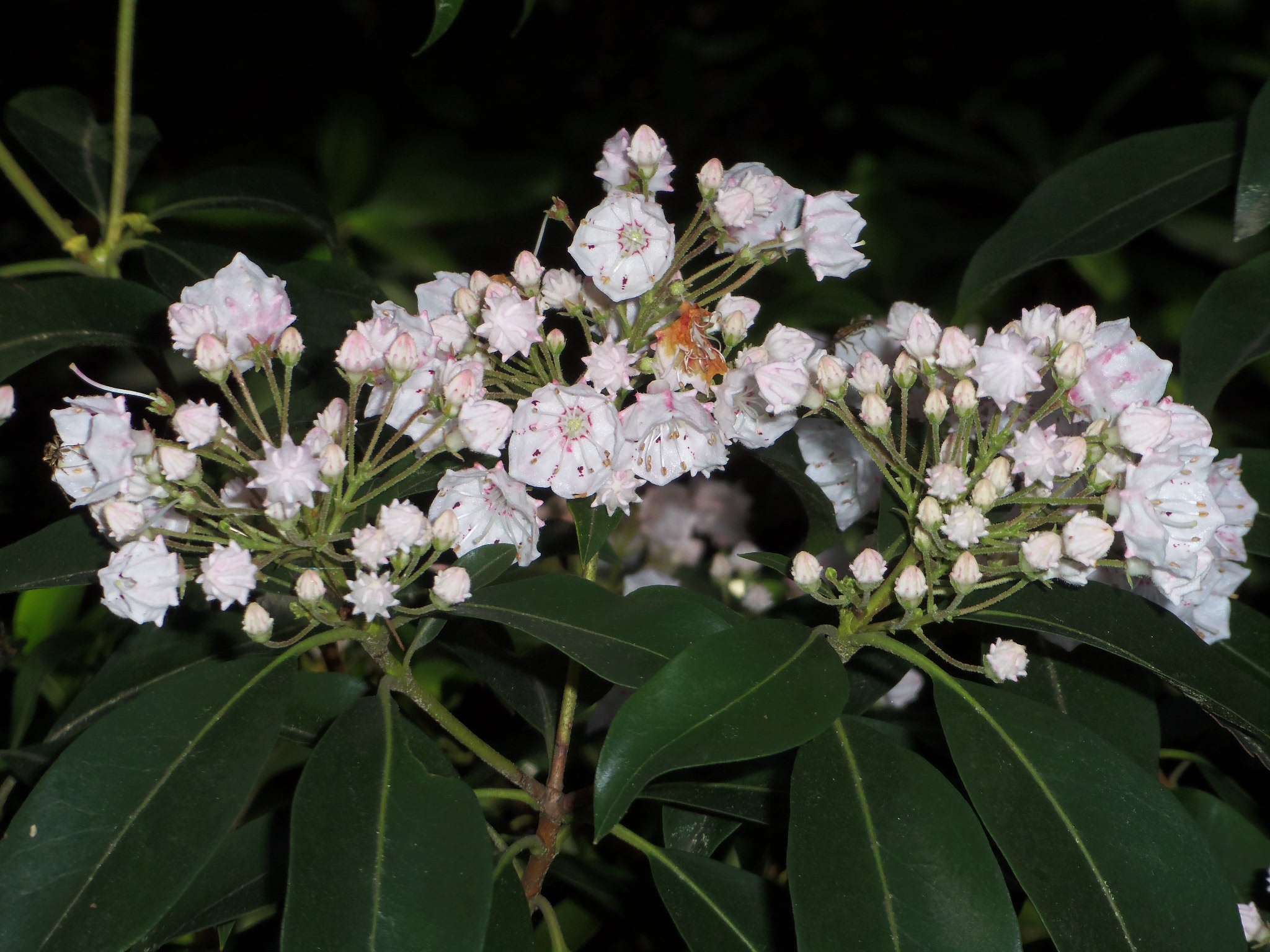
Mountain laurel have taken hold in our Quaker burial ground. Now, if I could only get them to do likewise in our yard.

My fondness for mountain laurel springs from my days in the ashram in the Poconos. Those tiny white clusters like origami that open into tiny teacups are, I was told, the state flower of Pennsylvania, and protected by state law.

My fondness for rhododendron goes back even further, to backpacking a section of the Appalachian Trail as an 11-year-old Boy Scout and coming upon Roan High Knob in full bloom in North Carolina.

Joe Pye weed is something I’ve learned to appreciate here, after we bought our annuals at the Conservation District sale.

Add that, as it thrives, to our azaleas.

Rhododendron and mountain laurel line the lane under tall pine in our undisturbed Friends burial ground.

BRAKE FOR MOOSE, TOO

On a May night five years ago, while driving home from the office, I did something I’d never before done: braked to keep from hitting an owl. Actually, I began braking because of a gray flutter in the foliage on the right side of the road – a deer, perhaps, or moose, because of the shoulder-height of the movement and color. Instead, the owl flew out over the road and continued for a hundred feet or more up Route 155 as I followed, before turning to perch in a tree, where I caught a glimpse of its shape.

Several weeks earlier, in the same stretch of roadway, I saw a smaller owl (or so I’d say) dart across the road, above the pavement by a dozen feet.

Earlier that week, I had two glorious commutes via the Mountain Route. The first, clear sky – brilliant green pointillism set off by sunlight and blue. Two days later, drizzle and fog – quite moody, especially with a matching live broadcast performance of Ravel by the Formosa Quartet, one that looked mostly, as it were, into the soft shadows rather than the usual sunlight. (Renoir, more than Monet or Serrat.)

How easily such glories can be lost in the memory. How wonderful, to revisit them.

WHEN LEADERSHIP GOES WRONG

Leadership is a fascinating subject, not just the source of many intriguing biographies but also corporate case studies and political histories and military campaigns and religious movements and … well, feel free to add to the list. We’ve all been in places where we’ve worked with admirable leaders, as well as places where we’ve suffered – perhaps even leaving in despair.

Outstanding leadership is, of course, a rare and wonderful occurrence. Mediocre is, by definition, the norm. And then there’s the kind that worms itself into position and sets about doing destruction.

Lately, I’ve been reflecting (again) on the last one. Not just inept, but destructive. I can work around one, but the other one makes for an impossible situation. Think Moby Dick.

It doesn’t always start off as badly as I’ve portrayed. Sometimes the individual begins gangbusters, doing everything right, before something goes seriously wrong. The person may simply burn out or lose interest. Conditions may change, so that the fit no longer works to the organization’s advantage. (Corporate organizational consultants have elaborate charts of the qualities needed for a startup versus a maturing company, or one shifting from private ownership to a public stock offering or the reverse.) Sometimes the person is fine for when everything’s going smoothly but has no ability to adjust for necessary – and often painful – restructuring, especially when layoffs and shutdowns are involved. Or there may be a buried demon that is let loose somewhere along the way, perhaps triggered by a divorce or death or temptations such as greed or power-hunger or sheer arrogance or flawed leadership techniques such as bullying and abuse or deep-seated insecurity or an untamed ego or, well, again the list goes on. Feel free to add or amplify. This, too, is a source for many great works of literature, operas, plays, and movies. The dark side comes forth.

My big question is whether an organization reacts in time to save itself, and what steps can be taken before it’s too late.

One of the first signs of trouble is the departure of key personnel, often lower-level individuals on the front line – or at least a failure to hear their complaints without retaliation. Sometimes it’s flight at some of the highest levels. After all, their jobs are at stake.

Usually, however, the awareness comes later.

The New York City Opera, for instance, appointed a new CEO whose brief tenure was disastrous. His flamboyant, extravagant vision for the company sent it straight for the cliffs, and the trustees’ decision to terminate his reign ultimately came too late to prevent the train wreck. This was a company, we should note, founded by visionary leadership that continued through several administrations. RIP.

I’m thinking, too, of situations where one of the top leaders engages in clandestine conflict – often backstage, one-on-one building alliances – that’s ego-based to the detriment of the organization. Commonly, the player lacks an appreciation for the culture and values of the organization and seek to turn it toward his or her own goals, including self-power enhancement, regardless of the trustees’ projections. Removing such a toxic manager, however necessary, produces ill feelings and misunderstanding all around, especially when the others are prevented by legal constraints from speaking openly of their underlying reasons.

Sometimes I think it’s a miracle organizations get anything done, top to bottom or, more accurately, bottom to top. There’s far more to leadership than barking orders, for sure, or undue frugality. I’d put mutual understanding high on my list of leadership qualities.

How about others?

~*~

I looked at something similar – good bosses and bad – back on June 28, 2013. To take a look, just click here.

EAT YOUR WEEDS

OK, the title’s a cross between the classic “Eat your greens,” as grandmothers used to advise, and the once ubiquitous “Eat your Wheaties,” as the Cheerios folks used to advertise. But this time of year, I’m doing something that gives me a sense of being simultaneously virtuous and hedonistic.

Here’s what you do. Pick the dandelions before they blossom, hopefully uprooting them while you’re at it, and then wash the early greens before the plants turn altogether bitter. (Toss the roots aside; that’s the weeding part of the equation.) You then use the tiny leaves as the basis for salads or, I suppose, anything Florentine. Yes, food writer Angelo Pelegrini (a decade before Julia Child) was right in his praises: dandelion greens in season can be glorious. If you like spinach, you’ll understand.

We’ve been delighting on them both as cold salads and as quickly blanched greens, especially with hard-boiled eggs and/or thick, crisp bacon on top. A fried egg works nicely, too, with its runny yolk. Top your dish with grated cheese if you want. Salt and pepper to taste. Can anything be simpler?

And that’s as close as you’re going to get to a recipe on this blog. I’ll let others point to the fancier variations. For that matter, they can even match it with the right wine … or beer.


HIPPIE, HIPSTER, OR WHAT?

An identity debate is raging in some corners over who is or isn’t a hippie versus a hipster. It goes back in part, I suppose, to the defining line between hippie and beatnik, even though I could point to many points where they blur together.

For me, the bigger question invokes the world of those individuals who don’t feel at home in the mainstream but rather gravitate in a bohemian direction. Yes, there have always been those who go out of their way to look the part of the movement … and those who just are. With hippies versus hipsters, I might draw a line in a person’s stance when it comes to non-violence and equality and the like, but there were always degrees when it came down to specific instances. These days, in my reexamination of the hippie movement, I keep arguing that hippies came – and still come – in many varieties.

That’s part of the reason I find myself smiling when I hear the theme for the local arts and technology charter school’s prom: Victorian Steampunk.

Sounds cool to me. And like a lot of fun. Besides, it really is a sweet group.

Sure beats ours back in the mid ’60s.

The hippie era, I might add, had a thing for Victorian style anyway. Even if we didn’t put clocks in our stovepipe hats.


LITERATURE ACCOMPANYING THE HIPPIE EXPERIENCE

A shelf of books was often part of the hippie scene, and I suppose many of the novelists and poets were technically beatniks, but they shaped our journey as well. I think, especially, of Richard Brautigan, Jack Kerouac, Allen Ginsberg, Gary Snyder, Richard Farina, and Gurney Norman, as well as the German Herman Hesse of an earlier era, and Tom Wolfe’s Electric Kool-Aid Test Acid Test. There were also many non-fiction works of influence, including the Whole Earth Catalog, and the Lama Foundation’s Be Here Now.

Which authors and volumes would you add to the shelf if you were trying to give a fuller picture of the experience?

I suspect there are some fine reads that need to be recovered, and blatant self-promotion is also welcome.

This book swap’s open!

COMPOSTING AS PRAYER

One of my annual rituals involves emptying the large compost bin as we prepare to enrich the garden for our new plantings, and then refilling it with layers of collected leaves (bagged by our neighbors, especially, each October), a winter’s worth of kitchen garbage, and bunny-cage hay and its prized pellet-manure. The production of “organic matter” to counter our clay soil is also part of our battle against what my wife calls Dead Dirt Syndrome, and it’s been a wonder to observe progress over the years we’ve been at it.

The Apostle Paul has exhorted Christians to pray without ceasing – an impossibility, as we know – yet as I lift forkfuls from the big bin, reline its sides, load and unload the wheelbarrow, I often find myself entering a prayerful zone of reflection. First, there’s the reminder that humus – the stuff of compost – and humility are words sharing a common root, and that both are nurturing elements for life. Then there’s an awareness of our essential abundance – all the meals we’ve enjoyed; the reality that children in America are familiar with tastes that kings in earlier times would have never imagined. We haven’t gone hungry. In fact, there’s so much waste to lament, a resolution to be more frugal or attentive, and then a sense of contrition knowing that we’re still putting this to work rather than tossing it out to the local landfill. Soon I’m appreciating the stages of transformation as I observe how matter breaks down into something resembling potting soil – rich, dark, soft. But I also know this always requires patience and will go at its own pace, no matter how I might try to rush it.

I’ve learned to watch the stages of change, too. That period when the pile begins steaming and its interior reaches 140 degrees or so. Followed by that period when the red wigglers (or is it wrigglers?) appear and proliferate. My buddies, reducing the leaves and hay and newspaper and cardboard and garbage into finished compost. You could view them as angels, arriving from wherever to bless the home and garden. At least I do. Yes, gratefully.

Already, as the compost pile thaws, the Cadillac of worms is digging into work. A happy sight, indeed.

MOVING TOWARD A NEW PERIOD

This miracle of being allowed to release so much pent-up work is impossible to describe, but it is fostering an incredible change within me. The publication of my novels as ebooks through Smashwords.com and the postings on this blog of so many bits from my archives are allowing me to enter a period of reduction – something I’m calling “decollecting,” when it comes to my books, recordings, manuscripts, extra clothing, and other assemblies. What I’m also finding is an opening to rethink almost everything and, like the layers of an onion being stripped away, of finding myself willing to rely on fewer and fewer answers … and more and more questions. Add to that a growing sense of wonder, in many cases, or of futility and cynicism, when looking at so many of the political and economic policies being followed blindly.

What I am accepting is that I require less and less material support. Maybe it’s the renunciation in my yogic past finally kicking in, or maybe it’s the tightened focus on what remains before me.

One thing I know as I view the trail markers before me: I’m not ready to kick back, for certain. Let’s see where this goes.

ELK, AS AN EMBLEM

Typically, when you first enter a forest, you see very few animals. Maybe a squirrel or two in the shadows, and then flitting birds. It’s mosquitoes or other insects, mostly. You might as well be looking for fish. Even in a desert, where the range is wide open, this happens. Pay attention, though, and they appear, albeit largely second-hand – a snap or cracking branch, the cry of a blue jay or crow, the high-pitched exuberance of peepers in spring, the work of beavers, a feather on the trail, a tuft of fur caught in a snag, the small tunnel opening of a den, a pile of bone, a curl of snakeskin. Tracks and scats, especially. To say nothing of roadkill, along the highway.

Thus it was in my initial forays into the high country west of Yakima, where I was puzzled by deer-like pellets and tracks everywhere in the undergrowth. In time, I learned how widespread elk had become again, after being decimated a century earlier – and how crucial hunting and fishing organizations were to the conservation efforts. Although I neither hunt nor fish, I came to respect those who do so with a sense of humility and admiration. At the office, especially, Jim Gosney and Wayne Klingle told of intimate encounters in the field, while others, speaking of the occasions when they’d eaten the meat, could have been describing a sacramental meal. Heard their derision and disgust, too, regarding others who come only for slaughter. Heard, too, that the best places to observe elk were at the back of the Rez, south of town – an area off-limits to all but tribal members and their guests.

That understanding was only a small step from timeless Amerindian lore, the insights and practices arising where survival or death hung in the balance. Even before my move west, I had begun running across these stories, however haphazardly; by now, the Native American myths directly touched me in ways I found more compelling than the Greek, Roman, and Norse mythologies that fill so much of our literature. More pressing, in fact, than the Hindu and Buddhist stories I’d devoured before heading west. “If a Man Goes Wild” and “True Practice” both draw on this trove, even if some poetic license is applied; besides, the stories themselves no doubt become varied as they pass from one locality and time to another. Here, though, the animals are no longer inferior creatures but can speak and interact in an equality with humans.

From this perspective, whether we’re considering elk, moose, or bear, the reappearance of large wildlife expresses not only a healthy forest or range, but a healthy society as well. I cannot think of elk without also thinking of what’s been lost and is being lost from the North American continent. Recently, returning to my native Ohio in winter, I looked across the shorn corn and soybean fields and realized how impossible it is to imagine the endless forest my ancestors entered, when elk and wolves and Indians were still present – nor the ecological catastrophes that followed in their first years after.

For me, elk are an emblem of what I learned living in the foothills of central Washington state. Here, then, are moments when the intimacy resumes, one way or another. Elk matter, indeed.

The elk farm in Lee offers me reminders of the wilds of the Cascade Range in Washington state, especially.

Kodak10 092