AN ARTS AND LETTERS NIGHT IN THE MEETINGHOUSE

In many Quaker meetings, we have little idea of what other Friends do outside of the meetinghouse. Maybe it’s simply an unfortunate consequence of contemporary life as we live and work at distances from one another and find our schedules anything but simple.

Bridging that gap remains a challenge, especially if we intend, in the words of George Fox, to “know one another in that which is eternal.”

At Dover Monthly Meeting in New Hampshire, we’ve chanced upon what has become an annual event that other members of the Fellowship of Quaker Artists might want to expand on. For four years now, we’ve had an annual Arts and Letters Night – an opportunity for individuals of all ages to share something of their creative lives with the larger faith community. For us, it’s usually come on a Friday or Saturday night in March – a time when we in snowy winter landscapes are ready to start stirring again. (Hopefully, when the worst of the winter weather is behind us.)

While Dover Meeting is large enough to have a number of serious artists of various stripes within its community, other Friends might find the idea to be something more suitable for Quarterly Meeting or a similar occasion. Like Meeting for Worship itself, each gathering has been unique.

Visual artists bring their work into the meetinghouse beforehand. Much of it goes up behind the facing bench (in the “elders’ gallery”), but other pieces have been displayed on easels or even been passed around the gathered circle. Work has ranged from painting to prints to weaving and textile crafts to photography to furniture-making and sculpture – including one child’s Sculpee creations. One year, an attender ran home to bring back examples of commercial designs she was doing for paying customers – and her work was indeed impressive.

We’ve encouraged these pieces to be kept on display through Meeting for Worship the following First-day, so that everyone may have an opportunity to view them – or even revisit them.

The “letters” part of the equation has had Friends reading publicly from their original poems, short stories, or journals – or from pieces they’ve found especially moving.

We’ve also had music – ranging from one violinist’s performance of the “Meditation” from Thais to original songs – as well as children demonstrating their Tae-Kwon-Do martial arts patterns. Lately, we’ve had videos, including one a Friend had made for Public Television showing another Friend doing sculpture – three decades earlier.

Depending on the length of the readings and performances, there may be time to go around the circle, discussing what inspires and motivates us in the work we pursue. Questions seem to arise spontaneously.

And afterward, we’ve enjoyed repairing to the “culinary arts” – a dessert potluck with tea or coffee.

So it’s one idea. An easy program. One Dover Friend has taken on the responsibility for signing others up – and I’ve the pleasure of being emcee and reading a few of my own poems at the end. We arrange it all through our Ministry and Worship Committee, though it could fit under Pastoral Care as well. (We split our Ministry and Counsel several years ago, to lighten the load.) In any event, do what you want with this proposal. As I said, it’s an easy program.

Invite the public. Invite the news media. And then have fun.

Originally published in Types & Shadows:
Journal of the Fellowship of Quakers in the Arts,
No. 34 Fall 2004/Winter 2005


SUNFISH ON A PAPER PLATTER

As I said at the time …

The image is simple enough, and direct: a sunfish transferred to paper, a child’s project in dull red poster paint. The specimen, found on a beach, measures fourteen by seven inches – larger than most of the fish caught back where I’m from, but nothing remarkable here. It has long, prominent spiny dorsal and pelvic fins (the anal fin’s much smaller), and a rather compact caudal, or tail, fin. While much of the scale pattern is apparent, it’s difficult to tell about pectoral fins. The gills and eye, however, are thick paint, and a band of dots runs most of the length of the body to the tail. The mouth, of course, is agape with a small, receding lower jaw. It’s the roundness of the profile that kindles my imagination – at least rounder than the way I would draw a fish or design a machine for the water. As soon as I acknowledge the underlying circle, it becomes drawn out, like a balloon pinched apart by two fingers.

Sometimes I picture a fish encased in a suit of mail armor, though I know that’s hardly the case. Rather, the intricacy of the interlocking exterior – like shingles on a house, rather than brick or stonework – fascinates my landlubber sensibilities. As I stare, the image becomes concave – the fattest part of the body, because of the scales, has the most openness, the least paint. Still, there’s no anticipation the fish will suddenly turn, either in attack or in flight.

I suppose that roasted over open flames or fried in a skillet, a meal might emerge. It’s larger than a typical trout, after all. The child behind the painting, however, now refuses to eat seafood of almost any variety.

The nature of fish is as mysterious to me as the array of the night sky, and to my mind far less mechanical than the knowledge of hooks, bait, spinners, and water depths prized by devoted fishermen. Jesus promised, of course, to make us fish for people, a far more elusive objective than any school underwater.

The paper itself has yellowed and crinkled, as I have.

THE FREEZER IN THE BARN

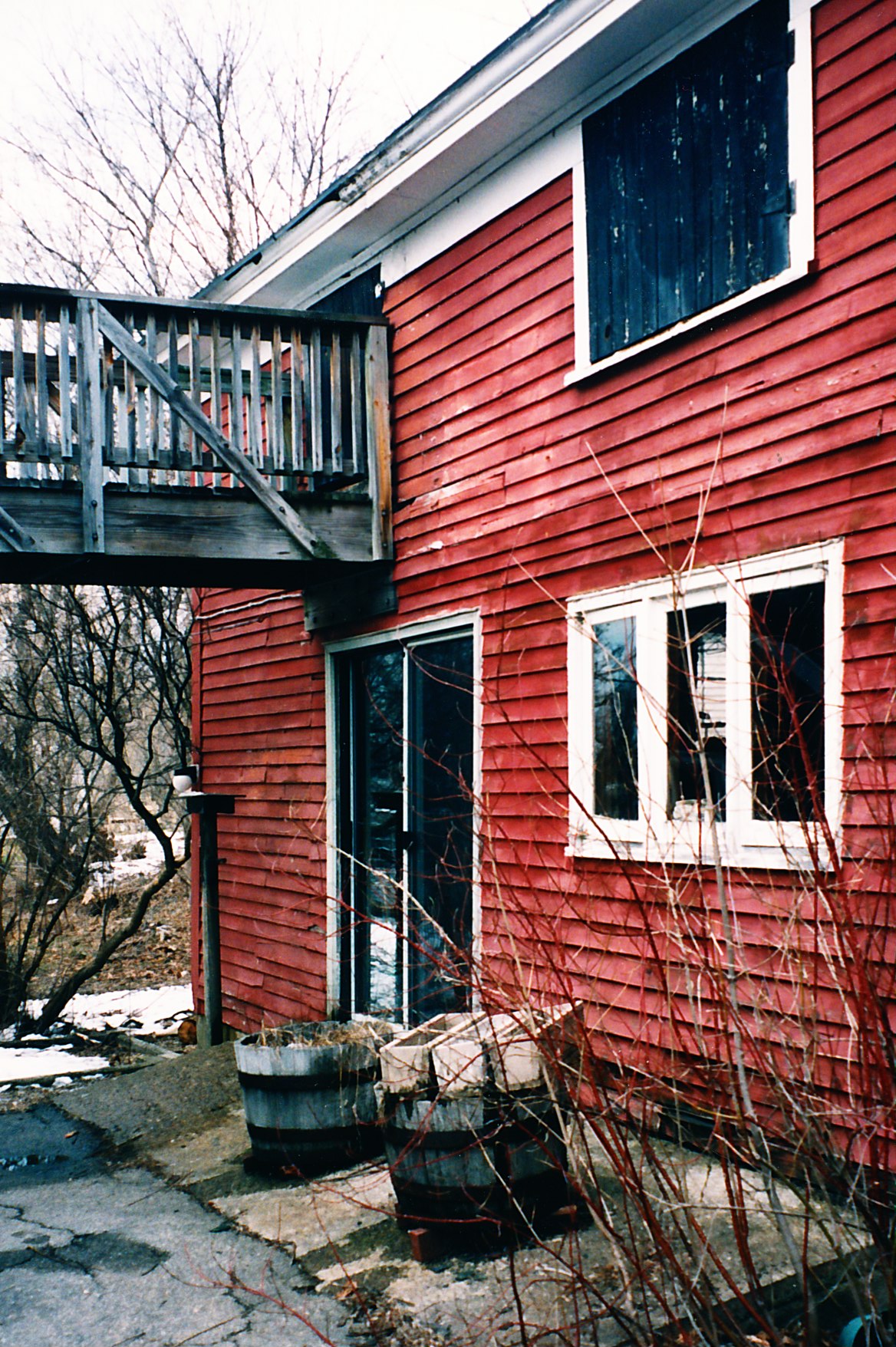
In one of our discussions of feasts and fasting as spiritual practices, a Friend mentioned purchasing a used freezer and how much he and his wife have saved over the years – by purchasing in quantity when supermarkets have sales, especially. It tipped the balance in our own decision to buy one, which we fit into the barn.

My wife’s no slouch in the grocery specials department, but its bigger value has been in preserving our own produce. How wonderful in January to pull out our own peas, or our own strawberries in February, or our own tomato sauce in March (if there’s any left!). Often, while she’s digging around in its drawers, she comes across surprises. Eggplant, anyone, already sauteed? And we never go wrong with a roast chicken bought on sale or, while it lasted, something from the half-pig we met at the farm.

In fact, we wound up buying a second freezer at a yard sale — and both are packed with goodies.


SNOW MUCH SNOW

It’s snowing again, a nor’easter that’s expected to drop up to 15 inches on us before dawn. That’s on top of 5 or so a little over a week ago, plus last Tuesday’s 30-inch blizzard blast and Friday’s 7.5. That’s close to 5 feet of snowfall in a week-and-a-half and we still have two more winter months left – the two that traditionally can get the biggest totals, especially if we settle into a twice-a-week storm pattern as we seem to be.

Admittedly, even with subzero and single-digit lows, some has melted between rounds, but much of that’s also refrozen into compacted snow and ice below the surface. The landscape’s getting wild, even before the next foot or so expected later in the week. Add to that the monster icicles clinging to the eaves – cold claws growing at our windows.

I keep looking out at the falling, windblown flakes and at the driveway and pathways that are already obliterated again. With an overcast sky, half of the landscape appears to be erased from existence.

This is hardly the quaint Currier and Ives stereotype of New England winter. It’s the reason barns and outbuildings were connected to the farmhouse itself. In earlier times, it could prompt madness and a feeling of being buried alive, with or without others.

Nowadays, we usually have recourse to mobility and entertainment throughout all but the worst outbursts – or the increasingly common power outages.

Still, it’s such a relief to not be commuting to and from the newsroom these days, but that’s no cause for smugness as I consider so many workers who must venture forth in public service.

And here comes a city snowplow, making one more pass down our street – and adding to the blockage at the end of our driveway.

Back to the digging, then. Round by round.

A PILLAR OR MILESTONE

When I was asked to write a newspaper column two or three times during my senior year of college, I chose – out of the blue – to call it “A Corinthian Column.” Maybe it was just a quirky play on words, crossing the distinctive Greek architectural element with a then very vague sense of New Testament or even prophecy. At the time, my faith was somewhere between agnostic and logical positivist – and vehemently anti-Vietnam war and, to a milder extent, anti-Christian. Yet when someone asked, “Where do you think you’ll wind up, as far as religion goes?” I blurted, “Probably something like Zen-Quaker” – this, when I had little idea of either practice or, for that matter, the way that becoming a yogi a few years later would lead me here in the radical Christian sphere.

Decades later, being nominated to serve as clerk of our meeting had me feeling a similar sense of embarking anew. I could list a hundred reasons why I shouldn’t be clerk. First confession: my motto tends toward “Just do it,” and I worked under relentless daily newspaper deadlines. Either way, this means my patience easily wears thin in many Quaker business sessions. Process? I also wish we had a better system of upholding of our community than committee work. Even so, here we are, all the same.

In the interim, Corinthian Column abbreviates to “C.C.” – the same as Clerk’s Corner. When I set out, I intended to draft some short pieces for the congregation’s newsletter – holding each to just three paragraphs – for upcoming issues. Collect random thoughts on our practice, especially. Maybe even without much (overt) theology. So here’s what happened, Friends. Rarely did it hold to just three ‘graphs, though I usually kept it under a page of copy.

What has surprised me is the way these became pastoral letters after all, much the way the Apostle Paul did, in his own letters to the Corinthians. Yes, I largely avoided the theology, unlike Paul, though I address it elsewhere. The effort of living as a community of faith is interesting enough, as it is.

~*~

You may have guessed many of those newsletter items have now resurfaced in one guise or another here at the Red Barn. My intent this time is aimed at encouraging your own spiritual exploration and growth and possibly even some mutually enhancing discussion of how one tradition can infuse new life or understanding for another.

I love hearing of similar encounters from other directions.

MISSING IN ACTION

While I wrote this for a Quaker audience, I’m hearing it’s true in many other faith traditions.

~*~

It’s not just teenagers, first, and then small children. Where are the men? Looking at attendance patterns across denominations, one might ask if religion’s becoming a “women’s concern.” (We might contrast this to some Orthodox Jewish traditions, where the women stay home, figuring men need to do the heavy spiritual work or at least some soul-searching, so everyone will benefit; pardon me if I oversimplify in reaching for a point.) It’s bad enough we Friends now expect the teens to disappear, as well as the college-age youths. There are mornings in our worship when women outnumber men three-to-one, or more. I’m calling for some equality here, or we’ll all suffer. (I recall one researcher who pinned the decline of the Shakers to four decades before the actual collapse became apparent; the point came when the number of men joining the movement fell off sharply.)

Admittedly, there are some pretty powerful countercurrents running through American society. Many of the men are working six-day weeks to make ends meet, and Sunday’s the only day for rest – if not a second job itself. Sports has replaced religion and even politics as the male topic of discussion. Some church planners have gone as far as to suggest stadium seating in response, and Starbucks during the sermon is already customary in the trendiest congregations – especially those gathering in rented movie theaters. This doesn’t even begin to address single-parent or two-worker families, soccer leagues, the claustrophobia-inducing Saturday rounds of shopping, parties, or entertainment venues. Something’s deeply out of balance.

Don’t misunderstand me. I’m not calling for any return to patriarchy, and I’m grateful for many of the ways feminist theology has liberated our understanding of Scripture and early church practice. I’m even concerned that women pastors are largely confined to the smaller, lower-paying parishes – or excluded from others. I’m proud of the leadership women have provided in our Quaker Meetings.

I’m simply lamenting the fact that we’re not as diverse and vibrant as we might be. Any suggestions?