NORTHWEST OASIS

Three hundred sunny days a year in a fertile land may seem like Paradise.

But it’s surrounded by desert. And every irrigated ribbon of orchards was a relief.

~*~

In rain on Mount Cleman, sage and conifers become cloud wisps treading updrafts. Black talus glistens. The mountain’s so quiet that what seemed important hardly matters any more. Boulders float past the relics of the lookout, elevation 4,884. Step away. Over the edge, where black scree cascades, the carbon rods and oxidizing metal loops and plates of electrical batteries from some previous decade are now scattered among elk and deer scats. On downed trees and furry branches, too. A battered coyote skull stares up between shellrock. The mountains gasp repeatedly in their wrinkled embrace of limbs stretching out from the forest. Cupping vistas of orchards and rivers, the desert yawns.

~*~

For a free copy of my newest novel, click here.

Kokopelli 1


GARDEN BED

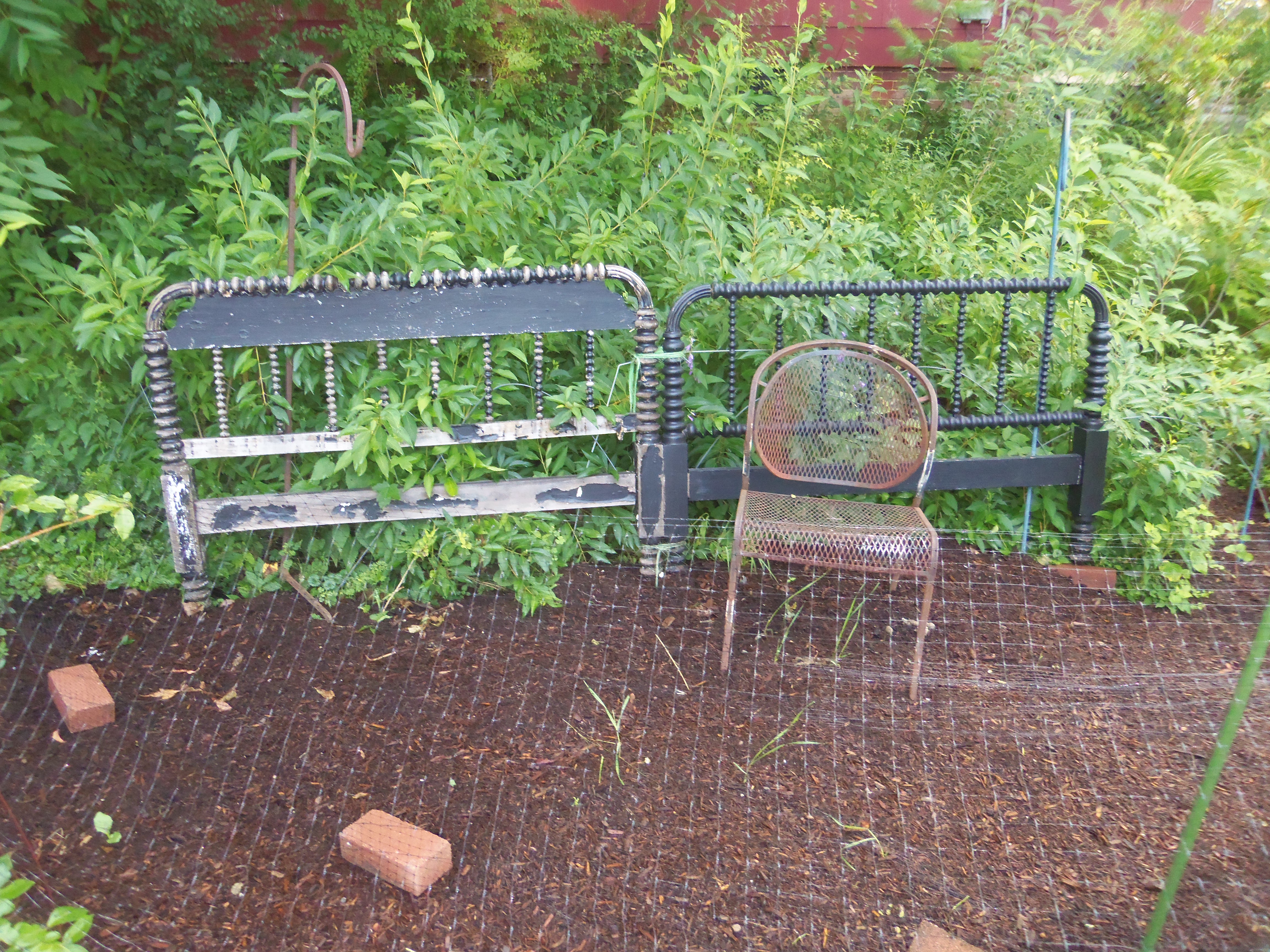
100_8850The bed stand, salvaged from a roadside, holds forsythia back so the blueberry bushes may thrive. The netting in the foreground is actually on the blueberry bushes, to keep birds and squirrels from picking all the berries, rather than on the ground, where the bricks anchor the netting.


OF BIRKENSTOCKS AND USED VOLVOS … OR MORE RECENTLY, PRIUS

As I said at the time …

A rather telling article in Pennsylvania Mennonite Heritage was by a woman who admitted she never felt that she fit in with the others in her home congregation. Never mind she was the preacher’s daughter. I sometimes feel the same way in Quaker circles, especially when everybody else is wearing Birkenstocks or has a used Volvo parked in the lot or carries any number of postgraduate degrees behind her name. Once, addressing a group of about forty Friends in Philadelphia, I mentioned the predominance of blue eyes in our circles – and about six other people nodded vigorously. The six who had brown or hazel eyes, like mine; the rest of the group seemed thoroughly bewildered.

It’s all about this sense of not being fully embraced by the circle.

I wonder how we would react if a soldier in uniform showed up to worship with us, or a woman wearing a great deal of makeup, or a man straight off a lobster boat. Yes, we would tolerate them (I hope). But would we feel awkward – to say nothing of them? Would we be able to truly extend a welcome? How would we all feel, in the end?

Our possessions and style extend subtle signals reflecting our places in a larger society. Dover Friends Meeting is not a blue-collar community. Our vocal ministry often relies on “big words” and metaphors – something we seem to prefer, rather than pointed messages that drive home an unmistakable point. Even so, while we stand apart from the larger society in many ways, perhaps we engage ourselves in it too much. These are ultimately matters to consider when striking a balance between inclusion and identity, nurture and welcome, growth or decline.

To be accurate, Birkenstocks and Volvos aren’t the indicators anymore – they’ve been replaced by Teva and Prius or some other brand name I don’t even recognize. What I do suspect is that whatever the current “humble” status item is, I won’t have it, except by accident. Whatever that means in the context of belonging.

OUT OF THE FLATLANDS AND ONTO THE SEA

Another blast from my past:

I spoke in Meeting about being a flatlander from a landlocked place and my ongoing fascination with the tides and moods of the ocean, leading into my first experience on a sailboat which was also my first experience out on the Atlantic and my first time of seeing a whale, which popped up in front of us.

I then mentioned another trip when my boss asked me to take the till and my surprise at feeling the wind pull the sailboat in one direction while the current tried to turn it in the opposite and how I was trying to steer to a compass point in-between – me, who would rather avoid conflict. On top of it all, it was a day when we could not see our destination, the Isle of Shoals, but had to trust our maps and calculations. Then, too, Peter’s girlfriend laughed, realizing my fear of having the boat be blown over. “Don’t worry,” she said. “If the boat tips that far, the sails will deflate and we’ll right again.” She paused before adding, “Besides, if there’s really a big gust, there’s nothing you can do about it. That’s how I lost my boat.”

As I spoke, I admitted the associations of wind to spirit (inspiration) and, as I’d now add, intellect, and of water to emotions and the unseen, while we are here in our own little vessels steering in the hope of an unseen destination.

Afterward, one Friend told me of the importance of finding that point of critical tension in our lives, where things can be accomplished. I now see this in contrast to the Tao, path of least resistance or way of falling water.

A second round of memories involves an ability to choose the right sail or combination of sails to fit the wind, as well as the lulls. The emerging harmony, too, between the winds and the waves, the lift and fall along the way.

AVOIDING THE CROWDS IN SEASON

At the mouth of the Piscataqua River downstream from where I live, Fort Foster has long guarded the entrance to Portsmouth Harbor. It’s now a town park.

By purchasing a season pass each year, I’ve come to consider it my private patch on the ocean — one shared with some folks who’ve become sunny friends as we swim and then warm in the rays.

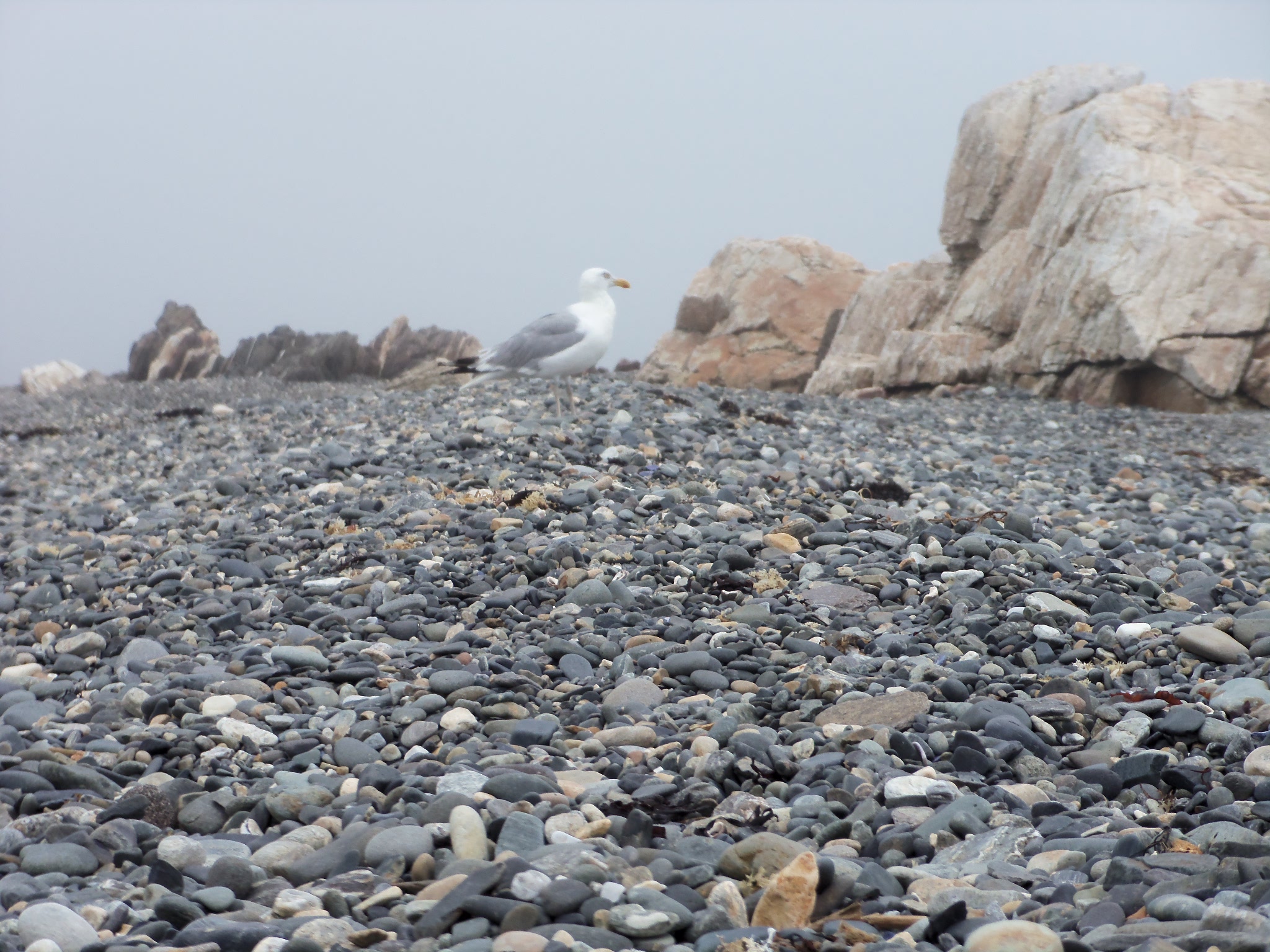
The rocky shoreline allows a fine introduction to tide pool life, while the pebble beaches have their own experience. There are also some sandy pocket beaches and a trail to meander while looking out over the cobalt Atlantic.

About as unspoiled as it gets.
An observation bunker, from World War II, now has a picnic pavilion added for groups to use by reservation.

RUNNING THROUGH CHEATGRASS

The grass grew tall in tawny tufts. One bunch here, another over there. Sometimes in the company of sagebrush.

~*~

Here a man will learn to pace himself more steadily. To watch for the rattlesnake, especially at river’s edge. To recalibrate his vision to the American Far West, where natural beauty assumes such spectacular proportions few notice the thinness at hand. The spider will teach all this. Clarity, like the desert itself, strips away to essentials. Sweeps away clutter. In what appears sparse, the man will gaze for episodes of miniature grace. Even elegance.

~*~

Kokopelli 1For a free copy of my newest novel, click here.

THERE WENT THE WEEK

A call to my cell phone the other Monday threw me for a loop. I was on the way back from my daily swim when I got the news that the first round of three cords of stove wood was on the way.

What it meant was that one end of our driveway would soon be buried in cut and split wood and my plans for the rest of the week would drastically change. Except for one day of thunderstorms and rain, I’d be stacking – always a lesson in the process of writing and revising, actually, including its exercises in structure and observation. Do it right, and it’s solid for seasoning into several winters. Sloppy, and it all falls apart.

Among my other thoughts was the question of how many more years I might be doing this. The wood felt heavier than I remembered. Even with my new routine of daily exercise, achy muscles and joints started appearing. At least I had the perspective of knowing how long you just have to keep plugging away before you notice any progress – and then, somewhere in a sensation of futility, you might experience that flash of realizing you’re making progress. The second half usually seems to go faster than the first half, too, unless you get overly anxious.

Now I sit back and admire that wall of stacked fuel – the one I’ll take down, piece by piece, all too quickly some winter.

NOT MINE

New Hampshire has more than its share of vanity license plates, a practice that often provides amusement in the thick of traffic or parking lots. For a number of years, mine said QUAKER, which spurred some lively conversations — to say nothing of what happened when parked next to Bob McQuillen’s QUACKER plate. (His goes back to his days of teaching high school shop classes — the result of one day when a student I will not name accused him of sounding like a duck when he got angry.)

So we were driving through downtown the other day when we noticed this plate:

We need to talk.
We need to talk.

Only in the photo do I notice the second D rather than O — representing another variant on the root surname Hodgson. Still, it can be unsettling when you have a rather uncommon one to see another around.

A LITTLE TRASH TALK

The SUV pulls out from in front of a neighbor’s house and tosses a plastic iced-coffee cup, straw, and lid onto the elderly woman’s driveway across from me as I’m weeding.

I retrieve it, put it in our recycling bin.

So they want a clean interior?

It’s not their vehicle that needs purging.

Oh, Lord, help us!