NOTTINGHAM SQUARE

Quaker 5 170
The town is proud of the governors who lived here, as well as its role in the Revolutionary War.

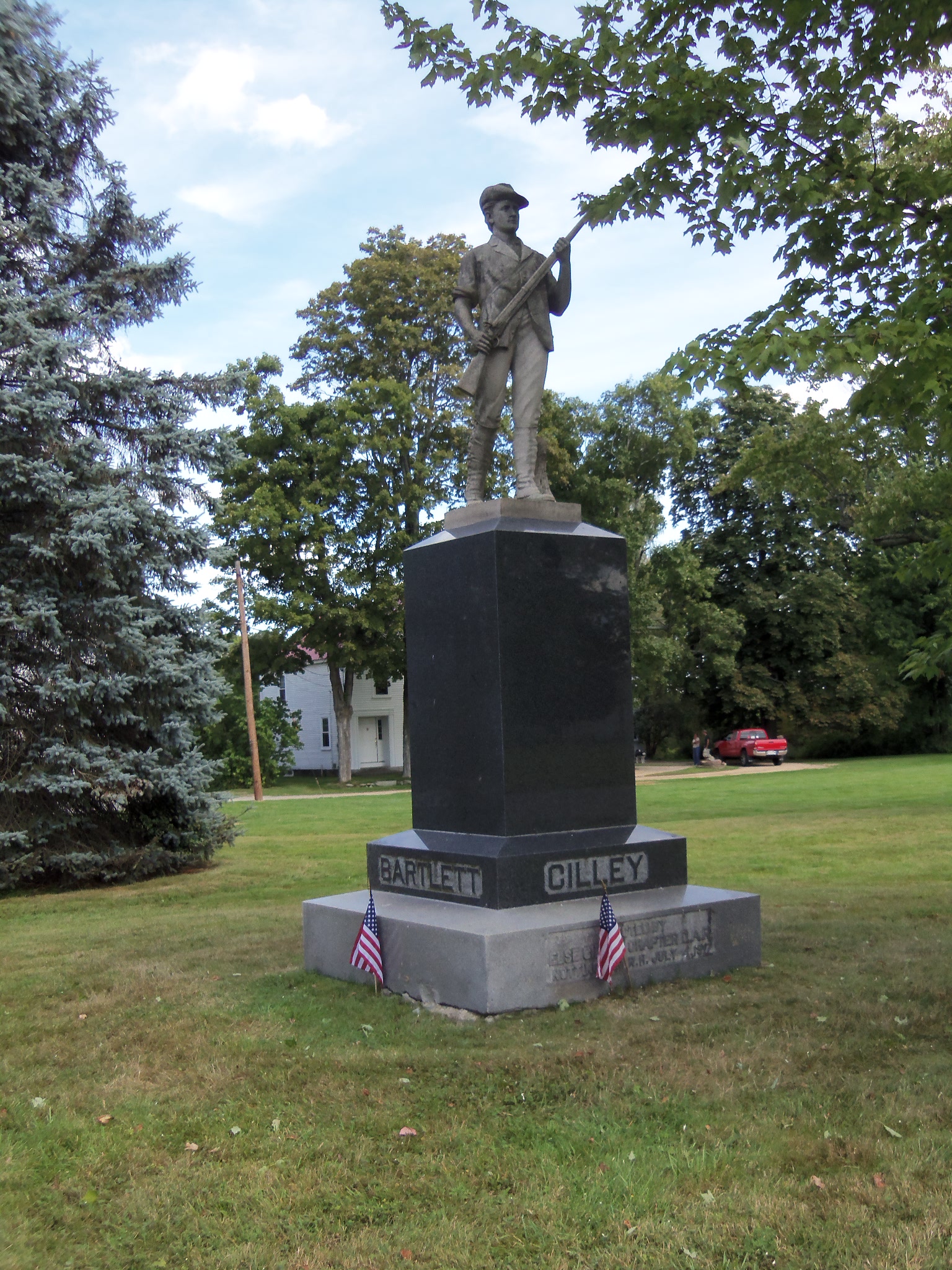
Hearing the distant sounds of cannon at the Battle of Bunker Hill to the south, local militia mustered here on Nottingham Square in New Hampshire and began marching to combat. It’s only an hour-plus drive today.

Quaker 5 176
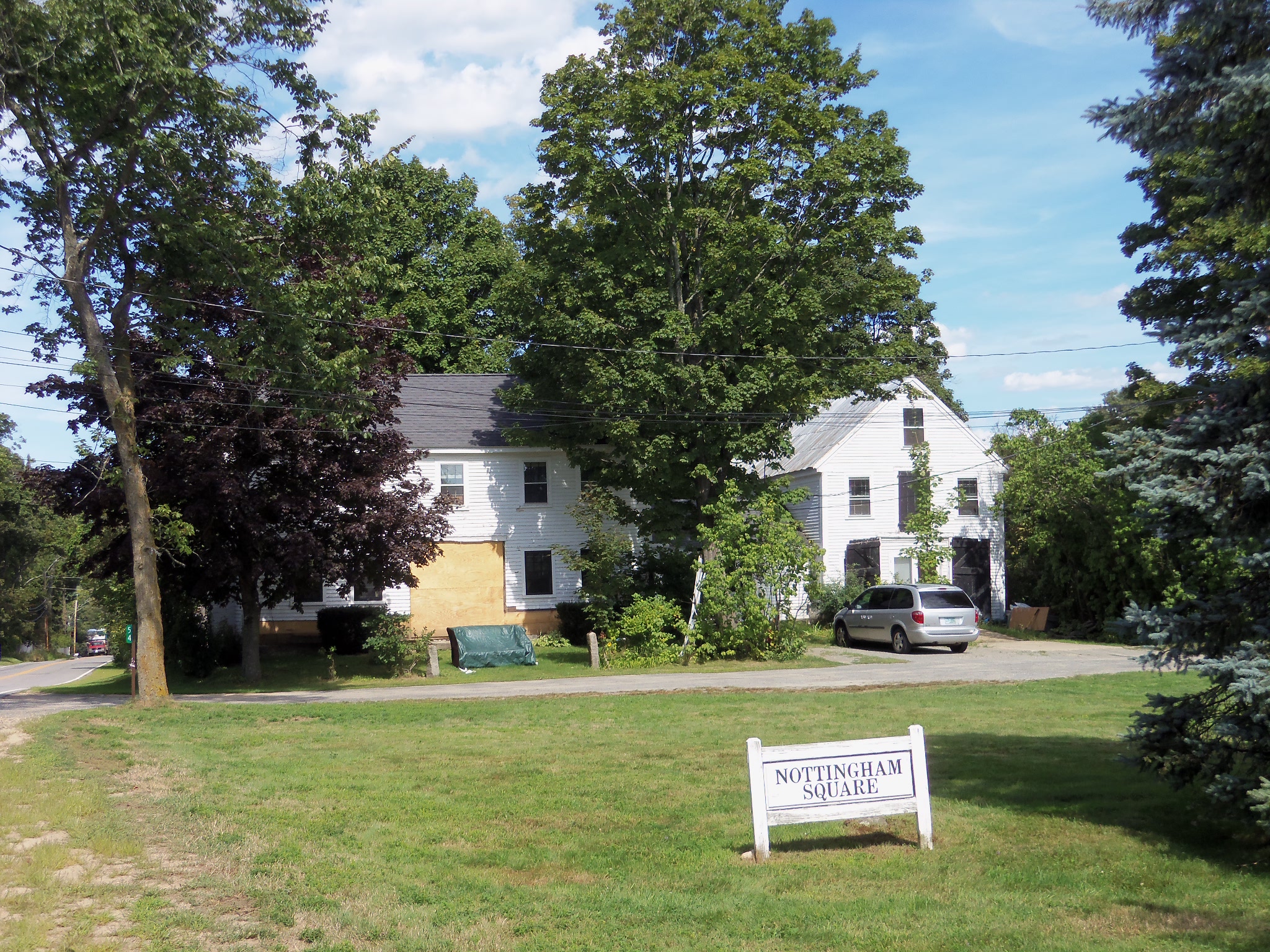
You can easily pass by the square at the top of the hill. Houses line one side; farms line two others.
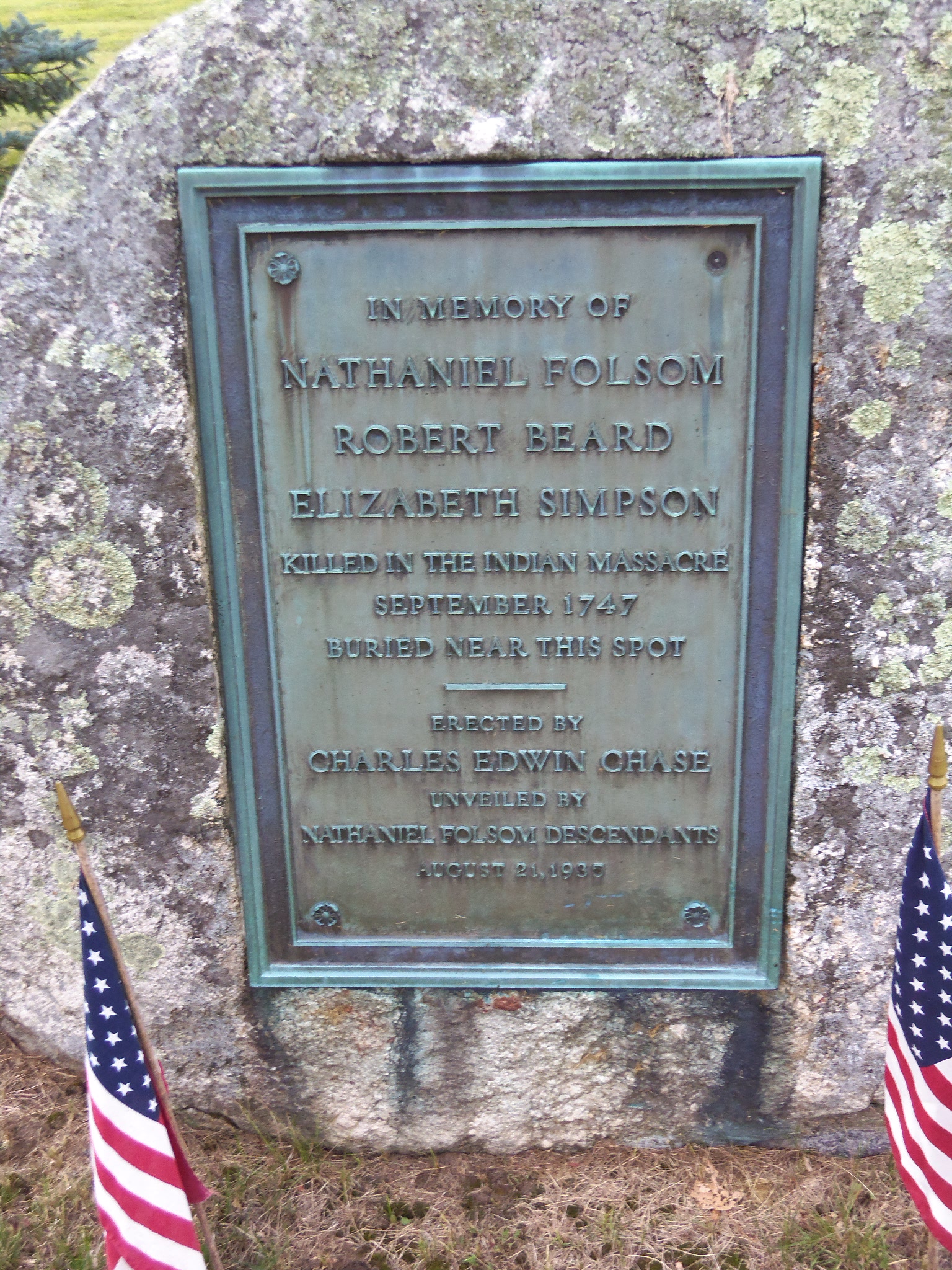
An earlier Indian massacre is also remembered.
An earlier Indian attack is also remembered. In scenes like this, I always wonder about the American flags. Shouldn’t they be the Union Jack?


SNOBBERY, ALL THE SAME

To see the old meetinghouse at China, Maine, as it’s been turned into a Friends Camp arts studio (a messy one, at that) is a pointed symbol of the tensions many of us encounter as we attempt to live out our faith – and not just on the cultural front. (For the record, I am, after all, a published poet and novelist, a professional journalist, an avid contradancer, gallery-goer, foreign film buff, occasional violinist and harmony singer, and a lover of opera and classical music – all of which can raise eyebrows in various spiritual circles, and most of which would have been forbidden in traditional Quaker discipline – all this even before we turn to the struggles of the workplace, families, neighbors, or politics. Call me a snob, if you will.) The fact remains that the Society of Friends today is filled with many artists pursuing every imaginable medium. Dover Meeting is not alone in its range of talent.

A while back, I spoke of practice as something that’s ongoing and never finished, in contrast, say, to a performance or even a rehearsal. Practice as something done more for its own exploration and pursuit of a discipline than for any finished product. Practice as being part of a bigger encounter: the practice of prayer, practice of poetry, practicing musical scales, play practice, football practice, even medical practice. Something done with care, and if freedom follows in critical situations, as we often hear in interviews after a Patriots’ game, then all the better. Weeding and composting, I suppose, are part of the practice of gardening, apart from any harvest.

When I think about qualities that mark Quaker artists, I would tentatively suggest: placing the ongoing work ahead of themselves; “cool” rather than “hot”; a sense of experience and discovery rather than make-believe or escape; honesty rather than pretense; wonder rather than irony; humility rather than egotism or arrogance; candor rather than flamboyance; a preference for simplicity over complexity; directness rather than confusion; economy rather than extravagance; calmness rather than shrillness; curiosity and listening rather than dogma or bombast.

We might also turn the old Quaker views toward a critique of today’s cult of celebrities (almost universally entertainment/professional sports figures) and their exorbitant incomes – a situation that I believe accompanies a lessening of power within our communities. To that we could add the ways the arts are often used as a secular religion to sanctify public occasions. As for the Oscars?

But maybe that’s just another part of our unfolding spiritual awareness.

OH, THE SONG OF THE WEARY

At our yearly meeting sessions each summer, one night features an all-ages coffee house organized by the teens. It’s a great release for the adults, who have been hunkered down in joint business agendas that often run three hours at a shot. Still, in a week filled with those plus organized discussions and workshops, committee reports and tables, social issues documentaries, casual conversations, and much more, the live amateur entertainment can be a bit much, no matter how excellent many of the acts are.

So it was for me one year when I decided to skip the event – perhaps even go to bed early for a switch.

As I wandered down a hallway, I came across a half-dozen or so Friends gathered around an upright piano and singing four-part music. Great! I jumped right in and was delighted when we turned to a Stephen Foster piece that’s also in the repertoire of my choir. We were just getting it down for ourselves when the announcement came: “You’re on in five!”

What?

My plans had just changed.

So there we were, all adults, lining up for the stage, marching up, finding our places in a semi-circle facing the audience, and being introduced by an enthusiastic high school senior. What was supposed to be “the Hard-Timers,” after the piece we were to sing, came out of her mouth as “the Old-Timers.” Instead of being offended, though, I was grateful it hadn’t come out “the Alzheimers.” Ahem.

If you’re not yet there, be warned: This getting older does have a lot of unanticipated turns. Don’t you forget it. And don’t forget to smile.

CANYONS OF DESIRE

Follow the rivers, then. Some lead into the mountains and form the “passes” to the high breaks in the crest line. Others lead out the other way.

You can also follow the currents of your passions.

~*~

Having come to the desert, we now know the fuller value of water. Something simple, essential. No one can live without it. The list of necessities is a short one; the possibilities of embellishment, endless.

There are rivers on every map you rely on. Sometimes when I walk out into the expanse, I encounter one. Sometimes, one deep enough to block my way. And then I turn to the page for a bridge.

Or, better yet, call out for my buddy, Kokopelli.

~*~

Kokopelli 1For a free copy of my newest novel, click here.


OH! WOW!

Gourmet is one of those words I’ve come to detest, in large part because it’s lost any genuine meaning. Well, these days it’s usually an excuse to charge more for an assembly-line product, but that’s about it. As an adjective to suggest quality, it rarely reflects excellence. As for its other definition, as a noun, we have glutton or pig.

So here I am thinking once more of the “wow factor” on our tongue and palate. It’s the surprise that accompanies an amazing first morsel or sip, when our reaction is “Oh! Wow!” in discovering the treasure before us. Often, it’s uttered before we’re fully conscious of doing so.

I know those who take the over-the-top approach here, adding and adding to a dish until it’s simply overwhelming. Or taking a drink to near-lethal alcohol levels for its whammy.

For us, the “wow factor” is more simply direct. It honors the ingredients and makes them shine. It knows there’s no substitute for freshness, and its techniques aim at enhancing that.

If you want to read more of this philosophy, Angelo Pellegrini’s writings, as my wife attests, lay it out delightfully. A generation before Julia Child, he began instructing fellow Americans on the ways of applying homegrown herbs and spices and appreciating the pleasures that follow. His lovely essays are about gardening as much as cooking, along with a few diversions like making your own wine or the joys of being a granddad.

I come back to this each year as our own garden kicks into gear. Forget any argument that gardening is cheaper – it’s not, even before you consider your own labor. It’s the taste that accompanies freshness – sometimes while the strawberry’s still warm from the sun or the lettuce was crisped earlier in the afternoon. Real tomatoes in contrast to the impostors at the grocery are another matter altogether. I’ll go ten months without the latter, if necessary.

We managed an overnight getaway to the Cape recently and decided to try the bakery-bistro combination across the highway. There are good reasons the line’s out the door in the morning. As for the evening, when we decided to stop for drinks and appetizers, we figured we could walk home rather than drive.

As I was saying about Wow? From start to finish. Let me warn you, it wasn’t cheap, not even by today’s average. But it was worth every penny – something I won’t say for any of the chains where I’ve eaten in the past few years. And what they’ve done to the former clam shack in the past six years is amazing – you’d never guess something this charming could come out of something that had been so decrepit.

I’ll try not to go into a restaurant review, but let me say I never imagined corn (fresh, local) could be pureed with (forget the cooking-school terms) the sweat from a baked salmon to produce a cold soup this heavenly. As for the oysters on the half-shell, the presentation was breath-taking – generous in the ice, accompanied by the in-house sauces – but the oysters themselves were fat and succulent, the way they are in November or December, fattened up for winter, rather than this time of year. Responding to that observation when chef/owner Philippe Rispoli stopped by our seats at the bar counter, we heard his pride in working with Richard Blakeley and paying top dollar for the best. I know this was Wellfleet, but I’ve had Maine oysters that have surpassed what I’ve had in other establishments in town – until now. As for their variant on Oysters Rockefeller, we go back to Wow.

We ordered wine by the glass – and our sauvignon blanc was priced reasonably, and the portions were generous. Perfect.

My wife, always a critic when it comes to food, declared her pate to be everything she’d hoped for, even before she got to the accompaniments and salad. The vinaigrette, as she noted, was amazing – whatever measurements he’d worked out, there’d be no changing this recipe.

Curiosity taking priority over any appearance of sophistication, we also ordered a side of pommes frites – or French fries, to most of us. They arrived in a glorious presentation with a red-and-white checkered napkin – and one bite once again went Wow. The chef asked how we liked them, grinned in response, told us he made them himself.

I should explain that we’ve decided fries are often a reliable test of a restaurant’s ability. Are they straight from a supplier’s frozen batch – or made from scratch, like these? Are the outsides hot and crusty and well seasoned, like these? Or limp and flavorless? Are the insides creamy and yummy, like these, or merely whatever?

The test also extends to a restaurant’s attention to its frying oil and batters – fried onion rings are another big litmus test here. Light and fresh? Old and heavy? As we say, “They do cooking oil well.”

OK, if you’re planning a trip to Cape Cod (I first typed that Cape Cook, make of it what you will), I won’t keep the place secret. Just click here.

BOULANGERIES AT THE BASE

Julia Child liked to emphasize technique as the foundation of French cuisine – starting with the ability to create traditional sauces and custards.

But lately I’ve been thinking of something even more basic and yet distinctive – bread. Yes, the transformation of dough into a baguette or croissant. Seemingly simple, yet utterly heavenly when masterfully done – and so often delivered and sold in pale imitations, probably even in France today or more commonly across America. Admittedly, there’s a great deal of technique required in doing these right – along with the unique steam-infused, high temperature ovens designed expressly for the purpose.

Maybe that’s why two of our favorite bakeries – or boulangeries – each share their building with a celebrated New England restaurant, one in Maine, the other in Cape Cod. These restaurants know the importance of bread.

Put simply, let me argue that based on its breads and pastries alone, French cuisine would rank high on any global listing. You can add other categories as you wish – from soups to wines to desserts – but let me return to that moment of sitting on the back porch of the house where we were staying, sipping coffee and white wine and munching on bread and pastries we’d just picked up across the highway before dashing back. We were there, in line, at opening – and when the doors opened a few minutes after the official time, all we got in greeting was cheerful “Bonjour,” sans apologie.

Not that we’re complaining. Definitely not.

We’re both still marveling at the sight we’d caught of a baker transferring the rows of baguette dough from the tray to the rack for the oven. I’ve kneaded hundreds of loaves of bread, and none have ever been so smoothly gorgeous. It was like watching a fisherman with his catch, actually. We can only imagine how each armlike roll feels to the touch or the baker’s gentle caress in lifting it and arranging it anew in its rows for baking.

Coincidentally, my wife’s started reading Bread Alone, Daniel Leader’s eye-opening discoveries as an American who backed into preserving the old ways of French baking artistry. Since then, he’s made a success of it in Upstate New York, of all places. His is a delightful story full of unlikely twists of fate and French characters, along with some definite opinions about flour and approaches and some detailed recipes for the exacting aspirant – or professional baker.

I return to a concept of simplicity as leaving one with no place to hide, no disguises for shoddy workmanship, no excuses. Simplicity instead as a goal of mastery, competence, elegance. In other words, good work.

For now, though, I’ll just savor the delight of what’s fresh, carefully crafted, and unpretentiously good – slices of crusty bread with soft butter and a glass of chilled vinho verde, for instance, to accompany a green salad of lettuce straight from the garden. Well, the homemade vinaigrette might take some finessing.

For me, a perfect summer repast, especially when shared in good company.

CHAUNCY CREEK


A popular lobster restaurant is perched at the bottom of a cliff. Some of its patrons tie up at this dock. Most park in a crowded roadside lot above. Their oysters on the half shell, by the way, are unbeatable.

This lovely tidal channel links Pepperell Cove to a town park called Seapoint and sets Fort Foster off on its own island.

Kodak18 046
At low tide, the rafts can be sitting on the rocks. The tidal changes are impressive.
Just a few hours later ...
Just a few hours later …