Matters of real value

In my novel What’s Left, she has every reason to wonder about what she’s going to do when she grows up. Unlike many of us, Cassia could continue in her family’s business — there’s some security there — but she looks beyond that and sees … well, this is one view I cut from the final version of the novel:

Yet, when we look around, we see everybody doing the exact opposite: most people can’t wait to get away from their office or factory or showroom or classroom. American society these days exalts its leisure and scorns people who aren’t making the big bucks. That’s backward!

~*~

One of the lessons I learned as a cub reporter was the importance of respecting secretaries and janitors. They could give you some of your best story tips, if you listened. Most of them knew far more about the operation than the managers at the top.

Who do you know who’s not highly paid but makes a huge difference for those around her? (Or him.)

~*~
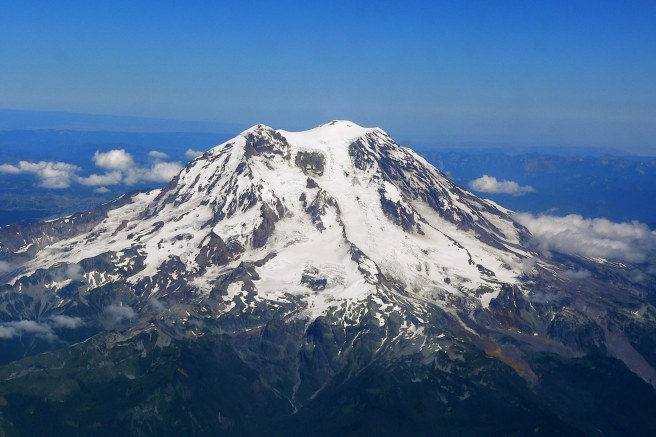
 

How could you not be impressed by Rainier?

I’ve never seen a photograph that captures the breathtaking majesty of Mount Rainier. Even from miles away, it can seem to hover over your head, perhaps even reaching on around for the back of your neck.

Like Joshua and Jaya in my novel Nearly Canaan, I lived in the desert to the east. That meant we usually frequented parts of the national park that the folks from nearby Seattle were least likely to visit.

It’s been 40 years since I was forced to move elsewhere. Here are ten things that still impress me.

~*~

  1. The park: Established March 2, 1899, Rainier is America’s fifth oldest national park. It covers 369 square miles, making it the 21st largest in the continental U.S. and the third largest in Washington state.
  2. The central mountain: Also known as Tahoma, Rainier rises to 14,411 feet above sea level, making it the second tallest peak in the continental U.S. Unlike its rivals, its base is only miles inland from sea level. Measured from base to summit, or by its topographic prominence, that’s 13,210 feet – more than K2 in the Himalayas. It’s the most heavily glaciated mountain in the continental U.S.
  3. It’s a stratovolcano: Rainier is an active volcano, with sulfur-fuming pits in the ice at its summit. Considered one of the most dangerous volcanoes in the world, it leaves about 80,000 people and their homes at risk of an eruption.
  4. Distance from the summit to downtown Seattle: 59 miles, if you’re a crow.
  5. Diversity of ecosystems: About 58 percent of the park is forested, ranging from dense evergreen forest to open ponderosa. The tall Douglas firs and western red cedars are nearly as impressive as the sequoias further to the south. Another 23 percent of the park is subalpine, above the forests but having evergreens at distances. In season, this is wildflower heaven, with orange paintbrushes, lupines, and white-starred avalanche lilies in profusion. Above that, half of the remainder is alpine, having unique vegetation, while the other half is permanent snow and ice.
  6. Year-round ice and snow: Depending on your source, 26 or 27 major glaciers cling to the mountain. They release thunderous booms of breaking ice during the summer. Combined with permanent snow patches, they cover about 35 square miles.
  7. Ice caves: By late summer, the mouths of some of the glaciers melt away to form mystical blue caverns. They’re dangerous to enter but unforgettable if you’ve ever been in one.
  8. Reaching the summit: Climbers are required to register for permits before setting out. They must possess technical skills regarding ice axes, harnesses, and ropes and be in good physical condition. They face a 9,000-foot elevation gain over eight or more rugged miles. And then they repeat it in reverse. For most, it’s a two-day trek. About 10,000 people set out for the summit each year, with half of them succeeding. The mountain claims an average of two lives a year.
  9. Thermal hot springs: Furthest away from Seattle is the Ohanapecosh Hot Springs. Once a resort, it now features trails that are delightful to hike in winter.
  10. Two lodges: Situated at 5,100 feet elevation in the subalpine terrain, Paradise receives an average of 53 feet of snow a year. Sunrise, at 6,400 feet elevation, is the highest point the roads reach. The lodges are often snowed in till the Fourth of July.

~*~

If you’ve ever been there, what would you add?

Mount Rainier from the air. Notice the clouds are below the summit. And much of the white covering is glaciers.

And then there are Cassia’s two older brothers

In the early versions of my novel What’s Left, her brothers stayed off in the background. But Gyatso and Billy moved far forward in the eighth and ninth revisions, especially when I discovered they didn’t require a lot of narrative development to be present. Sometimes a single short detail now pops their activity into fullness.

One thing about Cassia’s extended close-knit family is that her cousins are practically her siblings, too. Cassia’s cousin Sandra, for instance, could well be her sister, and both Gyatso and Billy line up well with some of their boy cousins.

It’s a fine line to walk, keeping the story moving without bogging down in too much detail, but it’s a rich matrix all the same.

~*~

I once had a coworker who grew up in a family where the way they showed affection for one another was by exchanging truly negative words and phrases. As far as I could tell, physical harm wasn’t part of it. Even so, maybe they understood what it meant and felt affirmed and included, but when he did the same thing with those of us in the office, many of my colleagues felt deeply insulted, even wounded. Maybe you know of writers capable of re-creating the domestic scene, but I’m not one of them. I’m still largely baffled.

The dynamics of siblings can make for endless intrigue. I’d love to know more — much more — of how they work in our lives.

Are you from a large family? Do you have brothers or sisters? Do you ever “borrow” their clothes? (Or anything else?) Does your household make you different from your friends or classmates? How would you describe your siblings — and your feelings for them — in a few words? Go ahead, vent, if you must.

~*~

In my novel, the family restaurant could have been like this. Cornelius Pass Roadhouse, Hillsboro, Oregon, by M.O. Stevens via Wikimedia Commons.

~*~


You don’t always have to eat those apples

In my novel Nearly Canaan, Joshua and Jaya find themselves surrounded by orchards. They quickly appreciate apples as much more than an orb to eat daily.

Here are ten unexpected uses.

~*~

  1. Headache relief. Cut a green apple open and start sniffing. It’s supposed to work faster than some pain pills.
  2. Christmas decorations. Slice an apple, then carve out the core. The rounds can be hung individually or as a garland on the tree or window. They’re fragrant, too, as they dry.
  3. Shrucken heads for Halloween. Bake them on low for three hours or so, then carve out a mouth and nose, maybe the eyes too. Add buttons or other small objects for the eyeballs. Quite spooky and yet funny.
  4. Kiddie craft stamper. Cut one open, then carve out a design for imprinting with ink on paper or fabric.
  5. Candleholder. Carve the core from an apple, then insert a votive or tea candle. It makes for a romantic glow.
  6. Hair rinse. Dilute cider in water, then rinse after shampoo and conditioner rounds. Removes excess oil.
  7. Salt reduction. Ever put too much salt in something you’re cooking? A few wedges of apple or potato added to the pot can turn the trick. Remove them after ten minutes. Don’t see this helping on the table, though. Any suggestions there?
  8. Green tomato ripener. Place an already ripe apple in a paper bag for a couple of days. We’ll have to remember this in the fall, when we harvest everything we can before the first big frost.
  9. Potpourri. Stud an apple with cloves stems and let it dry in a clothes drawer. I remember that from childhood.
  10. As a bow-and-arrow target. Especially if you’re William Tell.

~*~

Gee, aren’t we feeling like Martha Do-it!

What else do you suggest?

What I see looking at a few more hippie novels

As I’ve previously posted, social critic Tom Wolfe was perplexed that the hippie era didn’t produce any great novels. He’s wrong, of course, starting with Norman Gurney’s deceptively modest Divine Right’s Trip.

Reactions to earlier Red Barn posts suggested that many of the most influential books were nonfiction, including Wolfe’s own Electric Acid Kool-Aid Test but extending to Zen and the Art of Motorcycle Maintenance and the Whole Earth Catalogs and a whole lot more.

But there was notable fiction, beginning with Edward Abbey, John Nichols, and Richard Brautigan.

More recently I’ve come across ebooks at Smashwords that attempt to reflect the wide variations in experiences of the era.

One, for instance, takes a hermit’s perspective in retreating to the mountains outside Los Angeles. Another, the trials of being an activist. Yet another, the life of sex and drugs. And then there’s the spiritual trip. We even have descriptions of living the life in the deep South. You get the picture. Hippies came (and still come) in many varieties. No one size fits all, and I doubt any one novel could cover the range.

Naturally, I have my own fiction entries yet to be considered.

To get a taste of what I’ve been reading, see the book reviews at my Jnana Hodson at Smashwords page.

Got any related books to recommend?

Envisioning your reader

One of the basic bits of advice given to a writer is to envision your reader. It’s one that’s always troubled me, though. Could it be because I carry multiple identities as a writer? Poet, novelist, Quaker, retired journalist, with overlapping interests?

As a poet, I can’t describe the audience that shows up for a reading — the individuals seem to represent all types. Picture my readers? They could be anywhere in the subway car I’m riding!

OK, maybe it’s a younger, or at least more hip, crowd, but not entirely.

Continue reading “Envisioning your reader”

There aren’t many big metro areas in the Pacific Northwest

Like Joshua and Jaya in my novel Nearly Canaan, I was surprised by the relative importance of smaller urban areas in the Pacific Northwest. Look how quickly the population figures drop.

Looking at the states of Washington, Oregon, and Idaho, here are the ten largest cities by metropolitan area population. These figures have mushroomed since I lived in the region four decades ago and even desert communities have been deemed desirable destinations for retirees. As for geographic perspective, remember that the Seattle standard statistical metropolitan area includes the wilderness of Mount Rainier National Park. Anyplace else have an active volcano?

~*~

  1. Seattle, 3.9 million. Ranked 20th in the U.S. Feels more like Boston, Chicago, or Atlanta in its impact.
  2. Portland, 2.4 million. Ranked 30th in the U.S.
  3. Boise, Idaho, 730,426
  4. Spokane, Washington, 559,891
  5. Salem, Oregon, 432,102
  6. Eugene-Springfield, Oregon, 379,611
  7. Olympia, Washington, 286,419
  8. Tri-Cities, Washington, 296,224
  9. Bremerton, Washington, 269,805
  10. Yakima, Washington, 251,446. The major metropolis for the middle third of a large state.

~*~

Note that six of the ten are west of the Cascade range. None are in the eastern half of Oregon.

Just to the north, Vancouver, British Columbia, has 2.4 million population, making it Canada’s third largest metropolis.

~*~

What would your community match on the list?

Are you sure you’d want your parents to see this?

In What’s Left, Cassia spends hour after hour organizing the chaotic mess of her father’s photo studio after he vanishes in an avalanche halfway around the globe.

He was something of a hippie, too, as she sees in some of his excesses from the period. Here’s something that popped up for her in a conversation with her aunt Nita. You won’t find it in the final version of the novel, though — some things just got toned down.

And? You ever see the movie he made about the courthouse?

The one with the dome turning into his girlfriend’s breast? Diz’s?

You remember he made that while he was still an undergraduate? Before all the really freaky stuff that followed?

Yes, and that reminds me. We need to have to get that reel converted to digital from Super 16. Before it starts disintegrating or fading. 

You know what a hit that was in some circles? How he was on the verge of notoriety or celebrity?

So why didn’t he continue in that vein?

How would he have paid the bills? The big bills? Where were his introductions? Producers, distributors, even actors? Or his confidence,

~*~

I’ve been trying to think if there’s anything in my past quite that outrageous, but it all seems to be included in my Freakin’ Free Spirits series. My kids would likely be disappointed, but I’m glad my parents never knew the details. I hate to think, though, of some of the things my two girls are hiding from me. My, the times have changed!

What’s something you or your friends are hiding from your parents? What’s most shocked or surprised you about them? What other directions might their lives have taken? What might you hope your own kids never ask you about?

~*~

The vibe lives on, one way or another.

~*~


Lasting impressions from deep in the recesses of childhood

Some of my novel What’s Left, has her revisiting her memories of early childhood.

Later revisions made this passage redundant, and so it’s been scratched out:

By then even Papou Ilias and Yiayia Maria are long gone. Only the wisp of Yiayia Athina remained. But we still had our own little gang — Barney and Pia’s kids, and Tito and Yin’s, plus my brothers. By then we even have Rinpoche and his presence.

~*~

The final version of the novel has many sharp details, including some prompted by the photos she turns up. It is surprising, though, how powerful some of these memories can be, sometimes triggered unexpectedly from deep recesses. When I was 12, I ran into two brothers from my old neighborhood, my pals up to my fifth birthday. I hadn’t seen them in over seven years, and people do change a lot in that time. Still, I recognized them immediately at the Boy Scout event where we were.

Tell me one of your earliest memories from childhood, good or bad.

~*~

Cassia’s roots included inspiration like this. Church of St. Pantaleon in the village of Siána on the Greek island of Rhodes. Photo by Karelj via Wikimedia Commons.

~*~