TEACHING OR PREACHING

One of the criticisms that Evangelical Friends level at quietist Meetings like ours is that we are short on teaching. “Silent worship, for those who are well-instructed in divine truth, has real benefits,” they write, before cautioning: “upon those who have neither read the Bible nor hear it expounded the effect may be very different.” The passage I quote continues: “As a result, the Friends Church became victim to a group of erroneous teachers, among whom Elias Hicks was most prominent.” The section also points to some very deep misunderstandings among Friends, including Job Scott’s decision to remain silent in sessions called on his behalf during his traveling ministry; he sensed too many people had come with “itchy ears” primed for novelty rather than an open heart.

Ideally, vocal ministry arises as a prophetic voice, as William Taber describes in his Pendle Hill pamphlet, The Prophetic Stream. From this perspective, pastoral sermons can be criticized as arising too much as a matter of teaching and too little as an outpouring of the Holy Spirit.

Walter Wangerin Jr.’s novel, Miz Lil and the Chronicles of Grace, also addresses this, though from a different perspective. There, the young Lutheran pastor realizes that in greeting parishioners after the service, he cannot tell whether one woman is telling him he offered good teaching or good preaching on any given morning. One Sunday, however, it becomes quite clear she has been making a distinction: “’Pastor?’ All at once, Miz Lillian Leander. She took my hand and we exchanged a handshake, and I let go, but she did not. … Her voice was both soft and civil. It was the sweetness that pierced me. I think its tones reached me alone, so that it produced a casement of silence around us … there was Miz Lil, gazing up at me. There was her shrewd eye, soft and sorry.

“’You preached today,’ she said, and I thought of our past conversation. ‘God was in this place,’ she said, keeping my hand in hers. I almost smiled for pride at the compliment. But Miz Lil said, ‘He was not smiling.’ Neither was she. Nor would she let me go. … The old woman spoke in velvet and severity, and I began to be afraid.” Then she gently rebukes her pastor for unintentional consequences, after he has prided himself for being frugal by cutting off the water to an outdoor faucet.

“’God was in your preaching,’ she whispered. “Did you hear him, Pastor? It was powerful. Powerful. You preach a mightier stroke than you know. Oh, God was bending his black brow down on our little church today, and yesterday, and many a day before. Watching. ‘Cause brother Jesus – he was in that child Marie, begging a drink of water from my pastor.”

I love the way that passage illustrates how the prophetic voice flowing through an individual can be larger than its vessel. “Did you hear him, Pastor?” I love, too, the way it illustrates an elder laboring with a minister: “Miz Lillian Leander fell silent then. But she did not smile. And she would not let me go. For a lifetime, for a Sunday and a season the woman remained immovable. She held my hand in a steadfast grip, and she did not let it go.”

WHAT A SHOW!

As much as I keep the outdoors Christmas lighting around our place to a minimum — usually strands around the bay window and entryway — we also keep ours going through most of January, as does a much more elaborate neighbor two doors down the street.

But that doesn’t keep us from appreciating those who go all out on this front, especially folks with an artistic flair.

This year, though, we’ve learned of a teenager who’s been doing something remarkable at his home for the past five years — something so remarkable he’s also done City Hall this year, which we’re anticipating viewing this week as soon as the glitches are ironed out and it’s back running. The bit I saw Thursday night was jaw-dropping.

But we did drive on to see what he’s up to. Trust me, there’s no way to describe what this kid does with a computer and 8,000 LED lights. He’s set it all to music and a seemingly infinite number of variations on motion, coloring, and timing. It’s quite mesmerizing, although I think I’m getting a headache from the afterglow in my head. Still, to get a faint idea of what he’s up to, you’ll just have to click here.

You just might find it worth a trip to Dover.

ENGAGING THE POWERS AND PRINCIPALITIES

Like it or not, practicing an art means wrestling with power, including, in St. Paul’s phrase, the “powers and principalities.” Powers of destruction, on one hand, and sustenance, on the other. Destruction that can, as we’ve seen too many times, include the artist. Hence, the fascination with Faust. With madness. Alcoholism. And on. Self-absorption and inflated self-importance rather than humble service.

We hazard much, often without the slightest awareness of the risks afoot. For the Christian, these involve Satan’s dominion over “the world,” which includes the realm of the arts; in Asian teachings, we can turn to the traps of Maya, that spider web of worldly attraction and deadly illusion. Either way, cause to be wary. Need for disciplined faith. Yes, let’s introduce something we’ll call Satan, just to thicken the drama.

Which raises an ancient point of conflict for a Christian artist: I’m not at all sure art is a proper activity for a Quaker. Through much of Friends’ history, most of the arts were considered superfluous and dishonest engagements taking our attention away from true worship. “We Quakers only read true things” is the way one expressed it while returning an unread novel to a neighbor.

Yes, “we Quakers read only true things,” or used to. The exclusion of not just fiction but theater and paintings and sports as distractions from worship. Traps of the flesh?

And yet: discipline is essential in spiritual growth. Self-discipline, route to true freedom. And where is the mind without imagination? I continue to read and write fiction and poetry. I love symphonies, string quartets, and opera. I’m a baritone or occasional tenor in four-part a cappella singing. When I practice my art, I am fed by this love/compulsion/infusion.

So we’re back to the ways and spirit in which we engage the powers and principalities, and the ways we order our lives.

CHURCH WINDOWS

I’ve long joked that our Quaker meetinghouse has the prettiest stained-glass windows in town. That’s because they’re clear, looking out to the hardwood trees surrounding the grounds and all of the seasonal changes. The colors are those of snow and ice, spring greening, fog, mist, rainfall, autumn foliage. Admittedly, the new synagogue, with its view over a hillside to forest beyond, and the Methodists, at the edge of a millpond, can make rival cases. I’ll plead to being partial.

Crucially, though, transparent windows remind us of the world beyond the house where we sit in worship, a reflection of our awareness that our faith is a constant part of our various daily life activities. They remind us as well of the powerful rhythms of nature and God’s creation.

On the other hand, most congregations – including the Evangelical United Brethren of my childhood – gather within rooms of filtered light cast by stained-glass designs. I was puzzled by it then, and remain so today. Yes, I know the colored windows of the great medieval cathedrals were illustrated storybooks for the illiterate populace, but what I encountered always felt second-rate and often mildewed. Few individuals, I suspect, could say much of anything about the event being depicted or express any understanding of the decorative filling. Pointedly, the translucent windows cut off any view beyond the room. Perhaps the intention is to create a holy space – one set apart from normal life; perhaps, too, this hints at eternity as a departure from the landscape we know. But a shady or even creepy quality always seemed to lurk in the shadows. This is, I will note, quite different from the icon-based frescoes of Eastern Orthodox custom.

Apart from a few December afternoons at the National Cathedral in Washington, when I finally experienced the dazzling sunlight through the windows and recognized how Rose windows earned their esteem, my encounters with stained glass were few and fleeting. That is, until late one afternoon last year when I arrived early for our weekly chorus session and stepped from the room where we rehearse, crossing into the sanctuary on the other side of the sliding shutters. The square vaulted room is dominated by two imposing displays in traditional style – painting, essentially on pieces of colored glass that are then leaded together. Something about these, though, suggests quality sustained by wealthy donors. The impressive room has demanded closer investigation.

If the late 19th century brought about a flowering of stained glass in America, it was also a time before the spread of public art museums. Windows like these, then, would have been art made available to all for their wonderment.

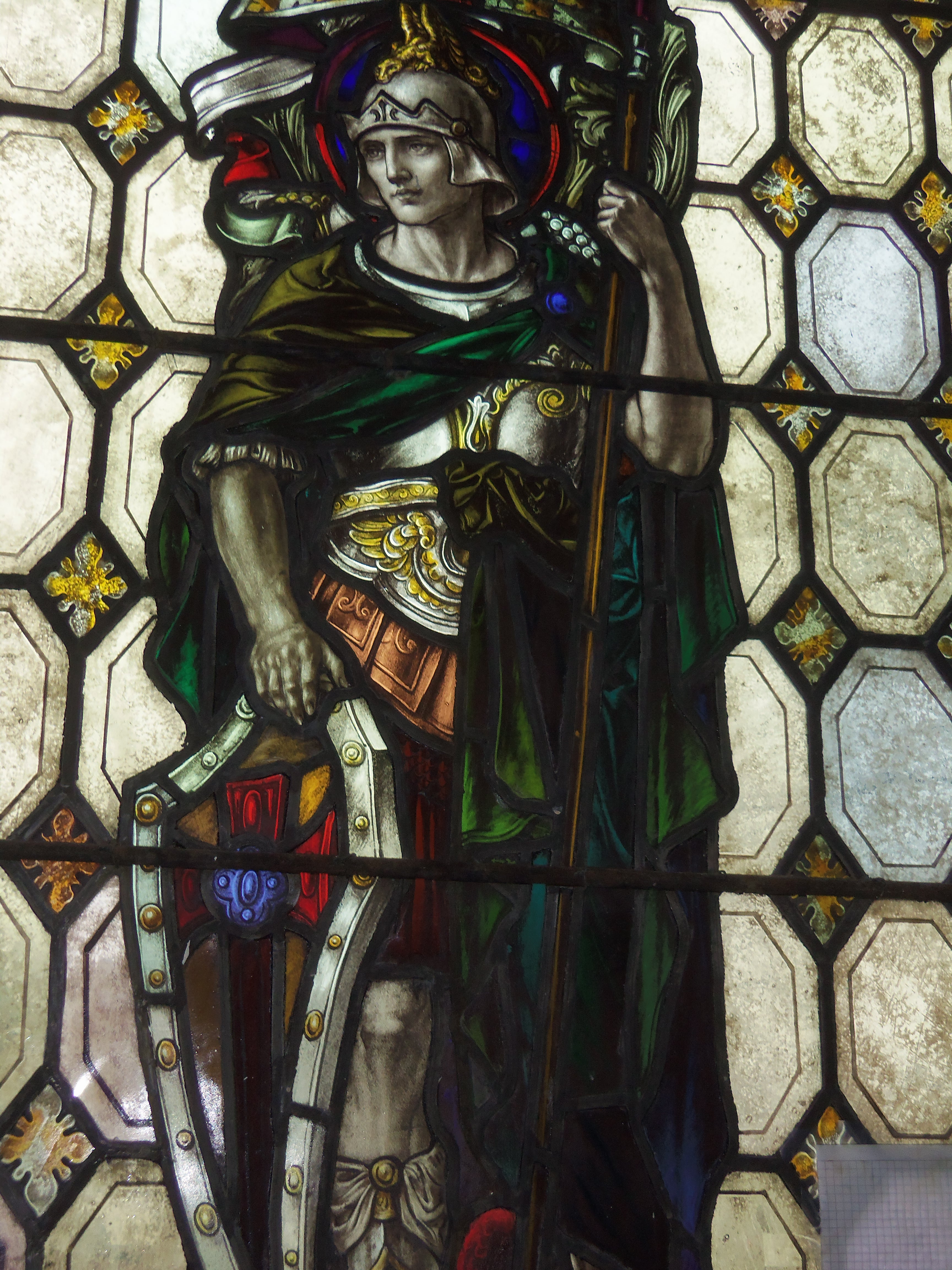
The south wall of the sanctuary is dominated by this traditional design, which includes a row of named angels along the bottom.
A detail of one of the angels.
A detail of one of the south windows.
Traditional stained-glass style using cut pieces painted with enamel.
A decorative window in a social hall where our chorus rehearses.

ART GLASS PIECES

When it comes to art museums, I head straight for the paintings. The other displays, including art glass, come later.

Actually, glassworks as art rather than craft came to my attention largely through the glass-blowing compatriots of my now ex-wife (we’d save clear bottles for her circle to melt down and reform as fine-art creations) and her grandmother, a knowledgeable antiques dealer who specialized in glass collecting, which was quite appropriate considering our location in a former glassmaking mecca that included Toledo, Tiffin, and Fostoria, Ohio. (At the end of the 19th century, an oil boom meant plenty of cheap natural gas, allowing affordable conversion of sand into glass.)

These days the Henry Melville Fuller Paperweight Collection at the Currier Art Museum in Manchester has expanding my regard for glass artifacts, even if I do head first to the paintings.

My favorite paperweight has a cobalt-colored core enveloped by clear glass. How they ever produced the swirls of bubbles remains mystifying.
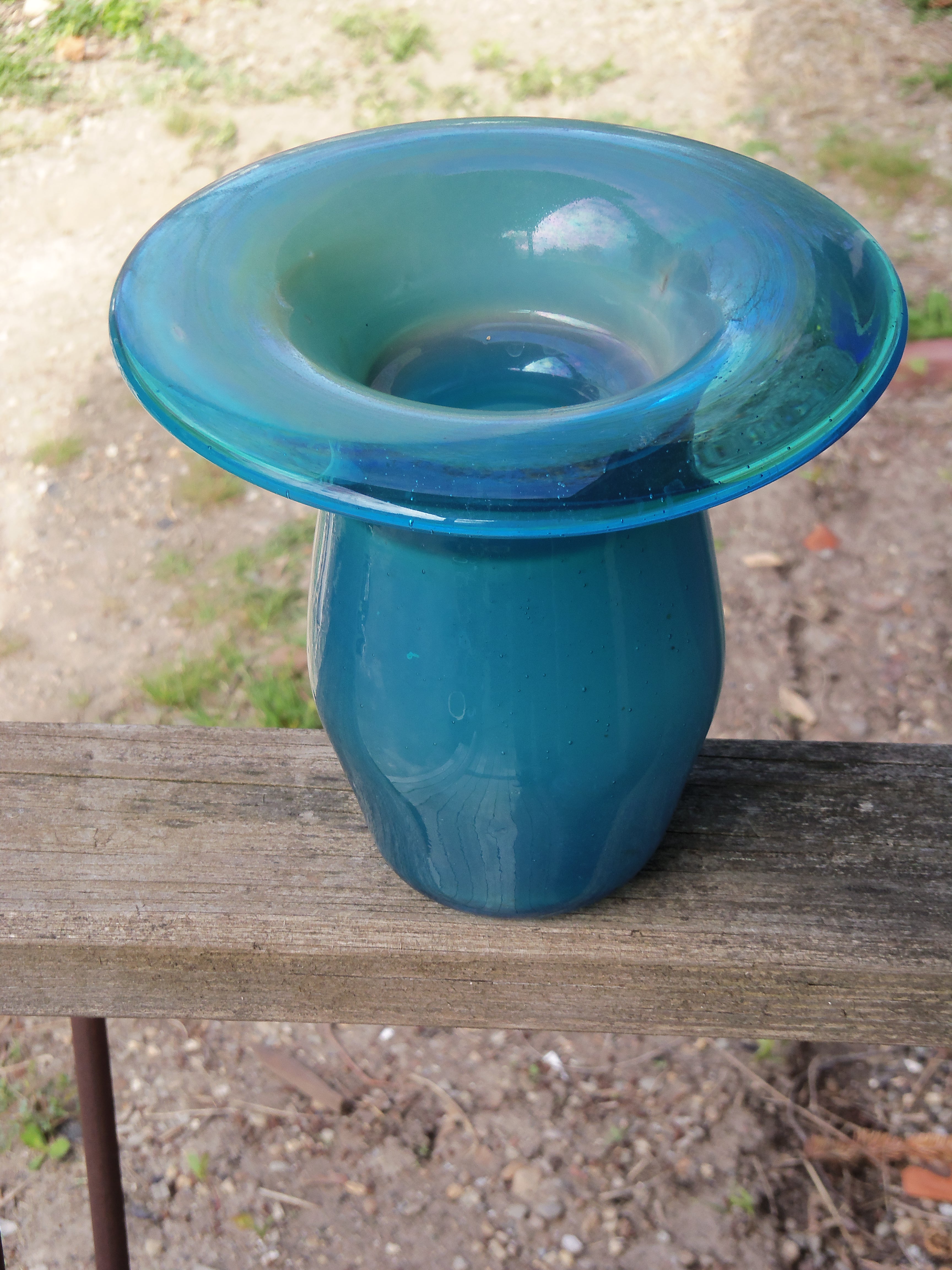
A blown-glass vase created by an art student. We saved clear beer bottles for the cause.


PIPE ORGANS

Waiting in silence.
Waiting in silence.

For a classical music enthusiast like me, one of the great things about living in New England is the plethora of fine pipe organs. They’re found not just in many of the historic steeplehouses, but also in places like the city hall in Portland, Maine, or the music hall in Methuen, Massachusetts, built especially for the massive Wurlitzer, and, of course, Symphony Hall in Boston.

(They’re not, however, found in our Quaker meetinghouses, except for the occasional harmonium or a modest electronic organ in a corner. I could even point to my quibbles about the expense of building and maintaining great instruments in a house of worship, but let me add how much I appreciate listening when they’re played in good hands.)

Their very variety can be remarkable. Locally, we have an 1876 Hutchings instrument that two Eagle Scouts rescued in unplayable condition from the old Methodist chapel, carefully dismantling, numbering and cataloguing the pipes, storing them in a barn, and eventually seeing their restoration in the congregation’s new building. (Hutchings, by the way, created the original part of the organ at Boston’s Symphony Hall in 1900.) Hook and Hastings, meanwhile, is credited with an 1850 one-manual instrument at First Baptist, a 1908 two-manual at St. Charles Roman Catholic, and a 1911 two-manual at St. Thomas Episcopal. First Parish (U.C.C.) has an impressive 1995 Faucher hybrid that incorporates the building’s earlier Goodrich and Hutchings instruments. Expanding the circle a bit adds a wonderful 1975 two-manual baroque-style instrument at Durham Community Church and the oldest playable organ in America, the circa 1665 Brattle, now at St. John Episcopal in Portsmouth. (Manuals, for the uninitiated, are the number of keyboards, one atop another. And don’t overlook the incredible bass notes played by the pedals under the feet!)

Maybe I shouldn’t have been surprised, then, when I stumbled upon a four-manual keyboard in Watertown, Massachusetts. “Is it still playable,” I asked. “Oh, yes. I sit down to it from time to time,” I was told. “It has a lovely, soft sound. It was built by Aeolian-Skinner but never made leaner,” meaning the E. Power Biggs’ influence in the ‘60s, especially through his performances and recordings on the Flentrop organ at Harvard’s Busch-Reisenger Museum and his advice – or misguided advice, depending – to organ owners in that era.

I love the soft, late afternoon light in the chancel.


A NOTE ON PATRON SAINTS

My girlfriend in college dreamed of creating a private language all our own. In those days, I thought creativity came down like lightning bolts with something absolutely original.

What I’ve come to see instead is the fact that true creativity happens at the frontier of what’s come before. It builds within and upon a tradition and a culture. For that matter, I’ve recognized how difficult dealing with our own marvelous language can be – and how vast its resources.

The practice also reminds me how easy it is to go slack. When I’m working, I like to keep the work of another at hand, as a sharpening stone. Sometimes it’s another poet, sometimes a painter or photographer. As guiding lights. As reminders. Companions on the trail.

Of course, it’s fair to ask. Where do you turn for inspiration and models? Any places or names in particular? How do we keep going deeper or higher, or keep our instruments sharp and shiny?

THE NOVELIST STRIKES ANOTHER POSE

100_9850Dear Reader:  Are you aware that this is a social protest novel? Have you delineated the symbolism running through construction? Can you guess the antecedent novels that most influenced the Author in his quest of the Muse? What form will his next opus assume? Will he learn from his mistakes? Does he even perceive them? Will he renounce writing? Who will turn this into his next movie? What music will be selected to amplify it?

Please clip and mail to the Author. Your comments are always appreciated.

Thank you.

The Author.

~*~

To learn more about my novels, go to my page at Smashwords.com.

THE RELIGIOUS TWIST

While my personal struggle bobbled between practicality and art for its own sake, the yoga and Quaker teachings introduced new tensions. Consider:

Creativity? No, God creates. Man discovers. Man cultivates and brings culture and learning, nurtures, softens, establishes coherence. This is the difference between the artist who submits to a greater power and the one who tries to use it for his own ends. The first desires to serve God, by whatever name or description; the second, his or her own ego.

Which leads to: Problems of the ego. Gertie Stein: Every writer wants to be told how good he is, how good he is, how good he is. Insecurities!

Yet in yoga, all for God: the sacrifice, the labor gifted to generate good karma. (As if your boss is another deity, rather than bottom-line motivated and conscious. Here’s a letter of commendation plus your pink slip.)

Early church father Tertullian warned, in De Spectaculis, Latin circa 200 C.E. Essentially: “The Author of truth loves no falsehood: all that is feigned is adultery in His sight. The man who counterfeits voice, sex or age, who makes a show of false love, anger, sighs and tears He will not approve, for He condemns all hypocrisy. . . . Why should it be lawful to see what it is a crime to do?” (Translation by Kenneth Morse).

These are hard charges, along with the seduction of “preaching for sin,” as George Fox warned.

So to examine the multiplicity of personality / goals / desires. Just who am I? Who are you? Empathy. Anger. Bliss. All the rest.

Honesty. Our dark sides. Do we really express our weakest aspect in our art? (In vocal ministry, how often the message comes from that area of our current conflict!)

Versus becoming so rarified we lose all sense of joy and delight. The danger of Plainness or strictness, that it suffocates personality, makes us so humbled we cannot move forward in the Holy Spirit to perform bold action. Crushes or stifles the imagination.

So how do we make a living without violating our beliefs? (Military-industrial extensive penetration of all facets of American society: not even the universities immune.)

Or how do you practice your art to the fullest, without undue restraint, while still being faithful?