A lifetime of Quaker practice and inquiry comes to play in the reflections of Stillwater. The essays are submitted in all due humility, even as reminders to myself. Still, they’re open to all as an invitation.
Being mindful of what’s right in front of us can always be a challenge. Here are 10 new items from my end.
~*~
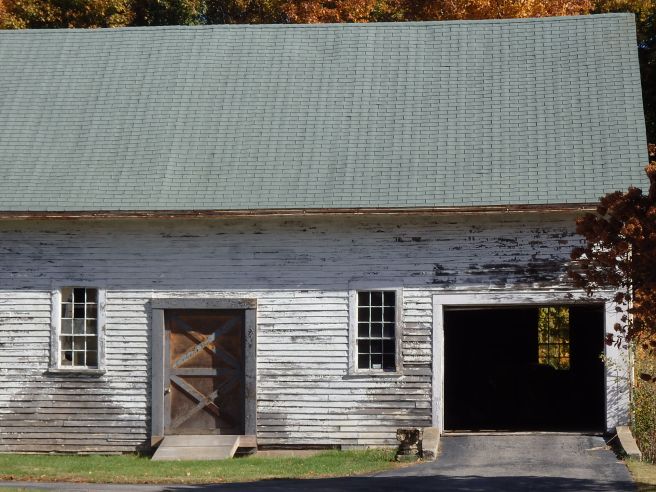
Been collecting bags of fallen leaves from the neighbors, urban farmer that I am. These days, a couple dozen bags are sufficient, unlike the 200-plus I gathered in many of our first years together. They get stacked against one side of the barn to break the sharp blasts of cold wind that otherwise freeze the pipes to the mother-in-law apartment on the other side of the barn. It’s another of my winter-prep rounds. Come spring, the leaves get moved to the big compost bin.
I carry a sense of being responsible for making everything better – me, alone. Except I have insufficient resources. Which takes us back to my deeply ingrained fear of poverty. No wonder I always want everything to work just right – and get so upset when it doesn’t! And that twists back to my fear of conflict.
All of my writing (as I’m venturing) assumes an experience, if only an out-of-nowhere phrase (exploring the subconscious, then), demanding discovery as some unity of the cosmos. Even when I’m writing about what I don’t know.
My appreciation of raw oysters on the half-shell goes back to my girlfriend in college, who insisted I eat (real) seafood while visiting in Florida. (And here we were, staying on a cattle ranch.) Up till then, it had been frozen fish sticks or canned salmon. Flash forward, to New England, where these days just before winter provide some of the fattest, juiciest oysters imaginable. These bivalves have stocked up for their version of hibernation. And, as one Mainer points out, you can count their age on their shells, just like rings in a tree.
Gotta brace again for the end of Daylight Savings, the day our winter begins. Really begins.
Of course location affects my writing and sensibility. The slums of a small city can be as urban as anything in a big metropolis, if you look and listen.
Turn up an old Gohn Brothers catalogue – Amish clothes etc. Realize that’s no longer me, either.
Ever so messy, the girl with the Lord & Taylor shopping bag.
Somehow, even my Quaker practice and theory break free from some past.
Taking the bus to Boston, I look out to see a field of big trucks just before the state line. Then remember, from a detour, it’s the truck spa. Seriously, that’s what it’s called. Keep wondering if there’s something on the side for the drivers.
~*~
In a solidly residential neighborhood these days, an echo of a more rural past.
near the waterline, someone’s hammering
throughout the day, someone’s always
hammering
a staccato telegraph
of winter’s approach or gratitude
so little demands repair
or just some old goat’s survived
though when the hammering ceases
he may be eating a sandwich
or sawing a board to be hammered
yes, two taps secure its position
in the quiet, he’s
gone off to the supply house
for a another box of nails, another size
a door slams from another direction
where new hammering erupts
before the man puts his hammer down
on a leather tool belt
and then orders a beer
you’ll find boxes of hammering
in the tool shed, brown paper bags
of hammering in the mud room
old jars of hammering
on his truck bed
open any one
and his arm and shoulder
begin moving
the whole world as his anvil
Poem copyright 2016 by Jnana Hodson
To see the full set of seacoast poems, click here.
How many years ago did I write this? What’s come along since could fill a book!
One of the most exciting developments in New England Yearly Meeting is the Puente de Amigos – the Bridge of Love with Cuba Friends. Agamenticus Quarterly Meeting finally accepted the invitation to affiliate with Holguin Monthly Meeting, a pastoral congregation in the easternmost part of Cuba, a relationship that will force us to reexamine many of our own diversity of notions. The visiting Cubans have been gently reevangelizing New England, and when Wellesley’s teens were asked by their Cuban counterparts to “tell us about your conversion experiences,” a dialogue ensued that would have been difficult if not impossible to instigate otherwise: “our what?” Let us tell you!
People typically listen with their heads, attentive to logic and thought, or with their hearts, to feeling and insinuation. But there is also a frequently untapped ability to listen with one’s hands, as I recognized at a Susan Stark concert in Brunswick, Maine. There, two Quaker pastors from Kenya (themselves excellent, forceful singers) sat with arms flexed out before them, as if each held an invisible beach ball squeezed slowly. They were appraising the vibration of the room, the presence of Holy Spirit moving. This time, the current was plentiful and active. Try it, in public – at a governmental hearing, a poetry reading, a concert or play, a sporting event – and you, too, may observe how the sense of each occasion may differ. Watch a master carpenter or a first-rate baker, as well, to see how hands ponder a task, running ahead of mental comprehension. A musician often seems to hear music through the fingers, as if playing, even when no instrument is present. Perhaps a surgeon does the same with medicine.
These poems celebrate the movement of Spirit perceived through a Third Ear, between the hands. The tactile response. Here’s one:
~*~
TO USE TOOLS
Connect
four fingers and thumb
sometimes, double
into the fire, and out
a pot, a pan, or a skillet
with or without a lid
and its handle
extending to a blade
or straw, depending:
All the wonder of the work at hand
cooking, keeping house,
gardening, splitting wood –
to say nothing of the factory,
farm, boat, or mine –
hunting or warring –
Even basic parts we touch
with each other
Poem copyright 2017 by Jnana Hodson For more, click here.
At least they’re not commandments. Holy Moses! Ten more from my end of the universe.
~*~
Sometimes I enjoy being in the front passenger seat the entire trip. Get to see more, for one thing. It’s an opportunity not to be in charge, not to be fully responsible – just let go and observe. What a relief!
All the waterfowl, the tip of the wing nearly touching the surface they fly over: how do they do it?
As Richard Brown Lethem says of his work, “For my entire life I’ve been trying to mine the subconscious.” No wonder I’m drawn to his paintings, inexplicable as so much remains to me.
I feel myself to be from another planet, looking at a world I once wanted to inhabit.
The grief men carry. Could it simply be the passage of time? Or something more fundamental to Eden?
As the news story reported, a neck-slasher to his stepdad: “I’m going to kill you and your life is going to end.” (The redundancy is emphatic.)
The Isabella Stewart Gardner museum in Boston’s Bay Back really is a magpie’s nest, an egocentric collection of bright and shiny objects. I do wish the curators were at liberty to give its masterpieces better display, contrary to Isabella’s directives. My, there’s so much clutter in the way!
Rather than heading back to Maine, she’s spending the night here. Thus, it’s NO YORK.
Pockets in a room that aren’t doing anything: that hold, in effect, dead energy. What’s the better usage?
Who am I, at the core? What do I really want? (That, for someone she accuses of being self-centered.)
~*~
Right downtown, a great blue heron watching the tide.
The kids raise a valid point when they notice how much we teach them about Quakers back then – but what about now?
Yes, what about NOW!
We need to get our act more together and acknowledge many of the remarkable ways we continue to witness today, usually in individual callings that deserve more support from the rest of us. So maybe the kids’ question can help us better focus on our greater purpose.
I’d like us to proclaim more of the courageous work of Friends internationally, too – I can think of examples in Cuba and Kenya in our own time.
Not all of the action involves peace and forgiveness issues, either.
Consider, too, two points from a visit to an Evangelical Friends Church on the other end of the Quaker spectrum from my own Meeting:
“Is Jesus Christ going to be exalted and praised?”
Her shocked look haunts me, considering the big Quaker gathering where I’m headed. I think, Yes, but in ways you wouldn’t recognize.
Also, humbly, as another realizes from one difficult exchange with a customer at her business previously that week: “I may be the only Jesus they’ll see.”
Just a taste of what’s popping up. In case you were looking for a prompt.
~*~
Anyone else hate raking leaves? Find bagging them’s even worse? A reminder, too, of the tons of snow to be shoveled, all too soon around the corner. Will this be the year we cave in and buy a snow blower, rather than continue by hand?
Commuting to choir each week requires driving through Belmont. That is, the one in Massachusetts. When folks mention the name, it could as easily refer to the one here in New Hampshire, up in the Lakes Region. Or, in my past, the neighborhood where I grew up in Ohio, going all the way through Belmont Elementary and High.
Sometimes on that commute, the GPS sends us through some exclusive neighborhoods. We note the tonier neighborhoods are dominated by slate roofs.
As a midday meal, it’s hard to beat fresh mussels and a baguette.
So many things have to be taken at a leisurely pace, doled out over time.
Would love to hit weekend morning dim sum in Boston’s Chinatown again. The restaurant basement function rooms fill with 250 or more diners as a dozen carts of delicacies pass your table. Pick something, if you wish, or wait for the next. Nothing in English, and no prices in sight. Just what’s in that steamed bamboo dish? The total for this “Chinese fast-food tapas” turns out to be about what we’d pay for breakfast at McDonald’s.
Another unanticipated side of my Motets: the close connection between religion and politics, or at least social responsibility.
Did Quaker culture essentially fail to address the earthy side of life? Could we have become all too refined?
Guiding and teaching a new generation – a swami at last. Or whatever you want to call the guru or elder or abbot.
What are we really afraid of? Really afraid of?
~*~
An expression of timeless grieving. Gone was that Puritan constraint.
Master intricate knots. Trout flies, for example. Especially in your dreams.
Be astounded by what any feather can do.
~*~
Mice, even snakes, leave their tracks in the dust.
Follow them, to their hideaway.
Knock at the entrance and enter.
Come home, explaining, “Last night my mind blossomed.”
~*~
Pulling into the barnyard, I find another paradox of spiritual discipline: the practitioner becomes simultaneously rooted in flight.
~*~
By now, I’ve been away so long I no longer feel the memory.
How large was that spider?
If we had looked at each other, I would have seen. I was free to go home, even if it took another forty years to get here. March straight into that horizon? And then?
~*~
In cloud wisps two soaring ravens turn about.
They wheel from great land in the sky.
The black rings under my eyes are gone.
~*~
For more insights from the American Far West and Kokopelli, click here.