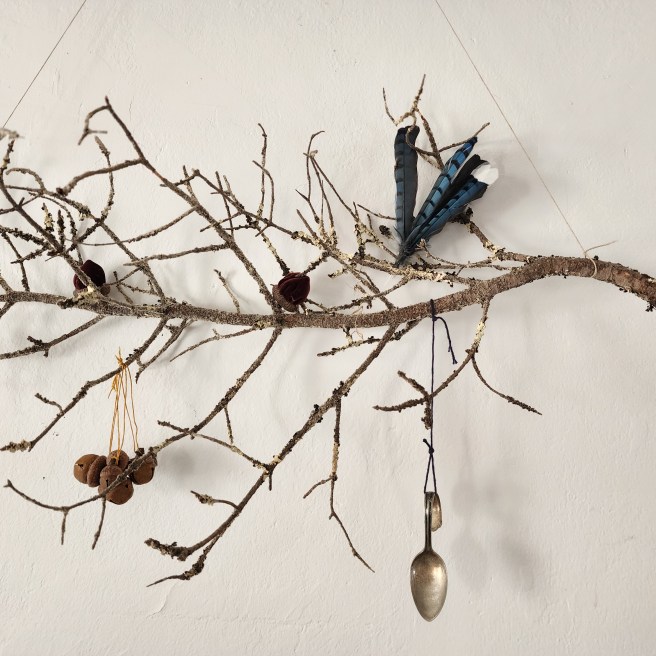
You never know what we'll churn up in cleaning a stall



Greek temple revival style house along U.S. 1 in Robbinston.
I love big cities, even have a certificate in Urban Studies, but can’t afford them, not for long.
Internet, at least, allows me some important virtual connections that way, not that it includes strolling into ethnic restaurants or great museums.
On the other hand, I’m living in a place others consider ideal for a vacation.
And for me, it’s an ideal writer’s retreat or de facto arts colony.
The ability to walk to so much of what I want in daily life is a huge consideration.
His sympathy was much appreciated while I worked with one around the garden.
So here’s why I hate using a weed whacker.
Would herbicides, which we don’t use, do the job better? (Satan, get thee behind me.)
When I was rescheduled to the night shift, I wasn’t home for as many meals together, for one thing. Or evenings.
It took a toll on the relationship, especially when she was working a day shift.
It was a favorite breakfast when I was growing up in Ohio, but not an everyday offering.
First, it would be served as a hot cereal, and afterward, after hardening in bread pans, it would be fried in slices and served in melted butter and syrup.
I still remember the reaction when I was head chef (briefly) at the ashram and served it for brunch. It was vegetarian and fit into that part of our yoga practice. But half of the staff and guests were openly baffled. What is this stuff? It wasn’t anything like the buckwheat kasha they’d introduced me to. The other half, though, delighted in it.
It’s still not an everyday dish in my household, but I still relish the moments when it comes up.
My wife, of Southern roots, is more familiar with grits – a variant – and also the Italian polenta, which is much more expensive for no understandable reason.
The one place I’ve seen it on the menu is at the Bob Evans restaurants, where it’s deep fried and typically sells out early in the day.
Cornmeal does show up in my novel The Secret Side of Jaya and on many supermarket shelves, especially under the Hodgson Mill label, reflecting some distant relations of mine who went back to inserting the “g” into our surname.
So where, if at all, do you use or eat cornmeal? It was a basic foodstuff of much of early America.
Are you ever caught up when you own an old house? Or is it like a personal sailboat, where you pour copious amount of money into a hole in the ground or the water?
The latest item to join our home maintenance to-do list is the front storm door, which detached from the frame a few weeks ago. It was too heavy and awkward to go back in, and apparently some shifting had warped the angles. It hadn’t been closing completely, and the last time I tried, bingo! We were in trouble.
It wound up, as I said, coming off altogether.
Oops!
We do want to get that fixed before winter hits, though. The front door itself is rather leaky.
Yet part of me is thinking maybe that can wait till I’m dead.
Damn, I do miss being able to call maintenance back when I was living on Yuppieville on the Hill. Back before I so deliriously remarried.
People used to walk down our street in Dover just to admire our garden. They told us how much pleasure and peace it gave them. It also attracted a range of wildlife, including hummingbirds, butterflies, or the occasional turkey or fox.
Throughout the year, the garden also led to many photos you can still find here at the Red Barn.
It was, by many standards, funky. The weeds were never completely controlled, but it was prolific and made good use of what we sometimes called the Swamp, after its mucky clay soil in late spring and early summer. Our pet rabbits delighted in much of what we picked there, too.
The new owners, alas, have bulldozed all that. The strawberries, raspberries, blueberries, currants as well as the raised beds and shrubbery screens – gone. Twenty-years of reclaiming the once tired soil and then dining well as a result – gone. Naturally, we’re lamenting, knowing how much more they must be spending on groceries that won’t be as fresh or tasty.
We have to recognize, of course, that we’ve left all that behind and no longer have a say in the matter.
But we still feel sad or even a tad angry. Ahhh!
So far, so good. The deer haven’t yet pushed the garden fence over or managed to get in despite the chicken wire.
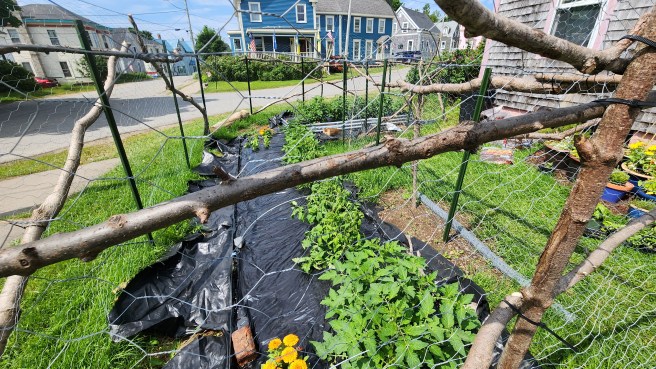
That, in itself, gets a lot of the locals coming by to take a look at my fortifications and then talk, as well as a number of summer folk. Eastport is a pedestrian-friendly village. Others are in vehicles that slow down and roll down their windows.
Beyond that, many are also avid gardeners who admire what’s growing and then advise us while introducing themselves. Some have even left packets of seeds on our front-door steps.
Strangers have also come up to me downtown to say how much they like what we’re doing. As I acknowledge, my wife deserves most of the credit.
Either way, it’s one more positive small-town aspect of living here. You’re simply engaged with life all around you.
Nor have I mentioned how heavenly the buttery fresh lettuce tastes or how much a sugar-snap pea vine can grow in a day.
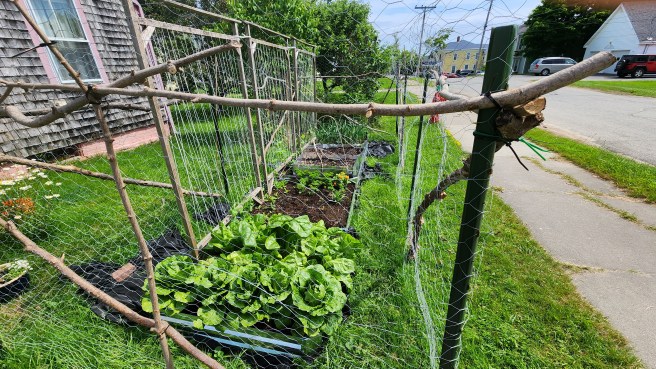
The fact that all this is in our front yard does, no doubt, make the garden more public, but it is where our best sunlight falls. Folks around here are practical and take that all in stride.
Speaking of practical? It’s that much less lawn I need to mow.
 Jnana's Red Barn