Our first steps were bottom up

Back in New Hampshire, our veteran carpenter/electrician had proclaimed how fascinating he found the underpinnings of an old house – what people usually call a basement, though in New England, it’s more likely to be a cellar. I’ll explain the difference someday, if I haven’t already in an early blog post. Rick said probing around the underbelly gave him insights into the soul of the residence.

He would have been impressed by our new residence at the other end of Maine, a post-and-beam full Cape with a mostly stone foundation up to 18 inches thick.

From our previous homebuying experience, which landed us in an 1890s three-story New Englander, we knew we’d face some immediate issues. At our new address, the ones that we able to address all involved the cellar.

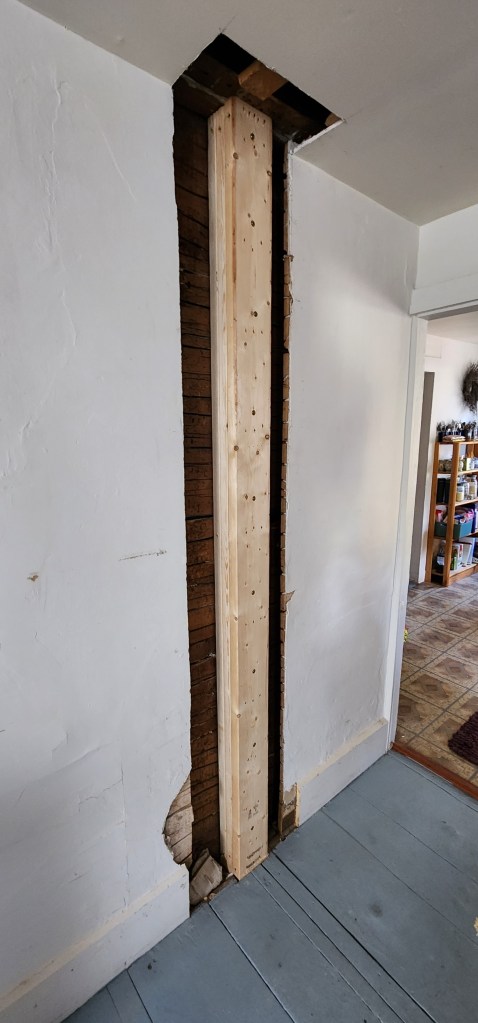
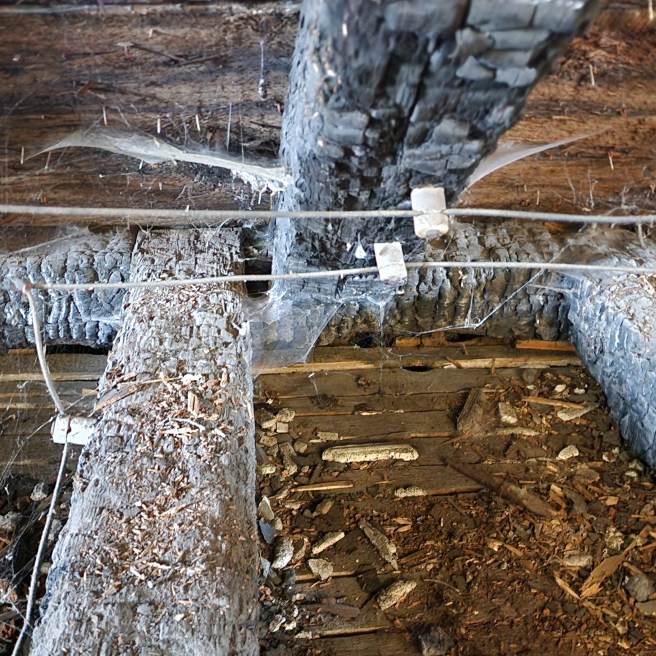
  • First was the removal of a chimney that had lost half of its supportive brick arch in the cellar. The rest looked ready to go at any moment. Many of its bricks above had already collapsed into the Franklin fireplace, presenting a puzzling serpentine pattern. We insisted the chimney be removed before we closed on the house transaction. A temporary patch in the roof then covered the chimney hole.
  • Next was a rusty fuel oil tank. One of its four legs was missing. The tank was replaced.
  • Third was a bulkhead door. The previous cover had rotted away and, in its absence, the entry was blocked by stuffed green trash bags, which were removed before we signed off on the deal. When we moved in, that entry was a gaping hole with no cover at all. We couldn’t leave an opening like that. We’re still surprised we didn’t have raccoons or, worse, rats living down below. A strong metal bulkhead door now secures that portal.


A temporary measure to cover the bulkhead.

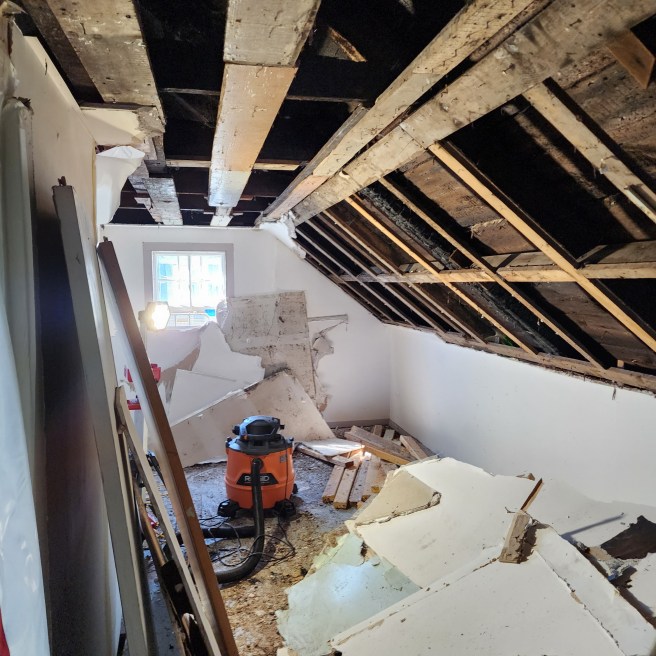
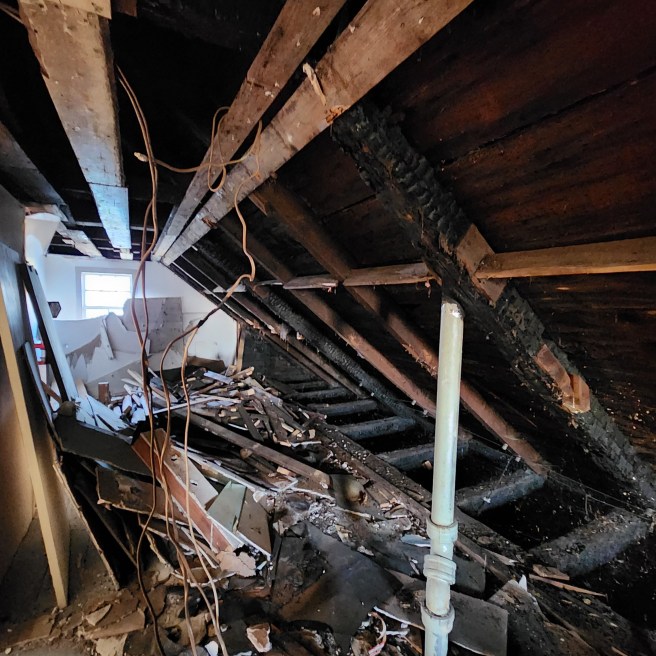
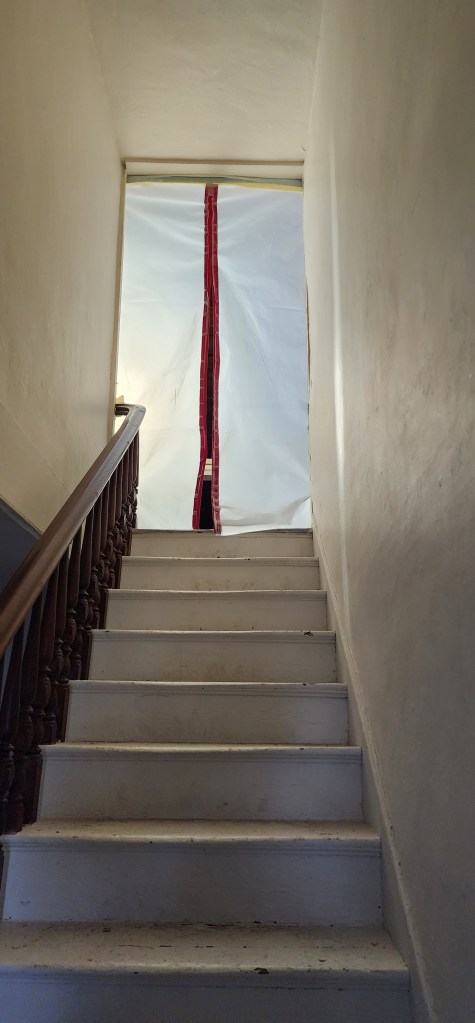
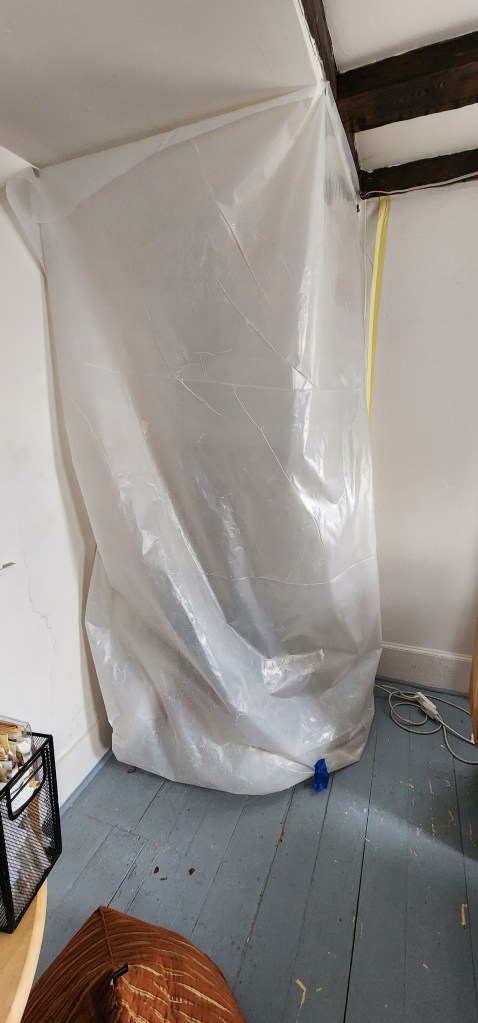
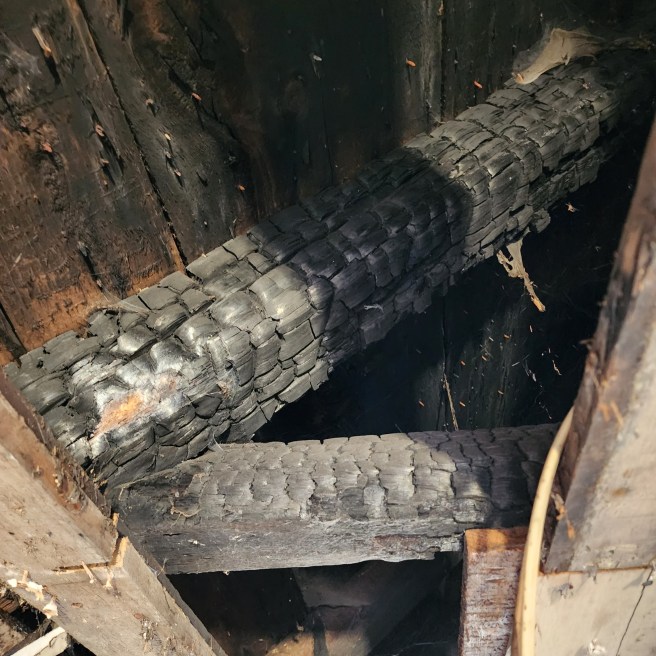
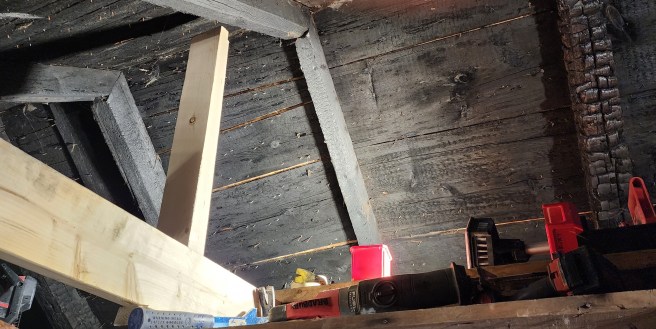
The major issue needing to be addressed was the condition of the roof, as the insurance company insisted.

Complicating the situation was our intention of raising the rafters themselves and changing the two dormers to gain more usable and much needed space on the second floor.

The big problem was finding a contractor to take on the project. You’ll hear more on that in later installments of this series.

We simply couldn’t afford to replace the existing roof cover only to rip it off in a year or two. So we were in an anxious limbo, one that intensified with every blustering nor’easter.

In the absence of someone willing to tackle the roof and its restructuring, we did eventually find a carpenter to address the serious floor sloping on the main floor. I do joke about being able to tell through my bare feet that I’m in an old New England house even if I’m blindfolded, so I’m not surprised our floors weren’t dead level. But structural sinking is another concern, and raising portions of the downstairs floor 5½ inches did cost us surgeon’s rates – or “away” pricing, as others told us later. It’s still not perfectly flat, but ours is an old house. For a view of that work, see Now Leveling Our Cape, posted March 8 of last year.

One benefit was that we can now use the washing machine without having it walk during its spin cycles into the cavity where the chimney had been and then crash into the cellar.

Maybe you remember the definition of a sailboat as a hole in the water into which your pour endless amounts of money.

An old house is a hole in the ground into which … as perhaps you already know.


When it comes to a home, how did you settle on the ‘right’ place?

Two dozen years ago, in our previous homebuying round, I created a list of 20 definitive items we could rank on a scale of one-to-five, only to discover that the particularly hot sellers’ market and our price cap rendered the exercise useless. The harsh reality simply didn’t present us choices to evaluate. The best we could do was simply check off Yes or No. If a place passed, we then had to beat other bidders to the punch. Forget quality and personal style. Was it habitable in its current condition? Did it fit our needs?

For the record, we were not, then or now, seeking an idealized suburban house with a white picket fence and an immaculately manicured yard. As you can imagine from this blog, we were open to something funky or organic, what some would even define as “character,” a place that could breathe and grow with our lives.

In the end, we simply lucked out, as you see in the Red Barn postings from New Hampshire.

In our recent downsizing to the other end of Maine, we had a less pressured, more leisurely pace in the market. High on my checklist was walking distance of downtown, the health center, and the arts center, plus a view the ocean, even only a glimpse between neighboring houses, and a workspace for my writing and related projects, though that could be much smaller than before, now that I’ve largely moved away from paper.

Other participants had their own priorities, including a large garden with full sunlight. As for a kitchen? Let’s just say that potential can be a checklist item of its own.

Neighbors and security are largely a wild card.

And, three years later, after several false starts, we made a bid that was accepted.

What we knew was that the place needed a lot of remedial work. And, oh yes, it had lots of potential.

In our recent homebuying round, a right property hadn’t popped up to a consensual acclaim. Some dwellings were closer to demolition than restoration. Others had been renovated in ways that were simply puzzling – a prime memory was the placement of the only bathroom behind a master bedroom. One modest house had four, maybe five, stairwells, enough to leave me lost indoors – I’m still intrigued by the quirkiness though I can’t pick out the place now from the exterior. Let me also admit that passing on an 1820s’ residence I really liked was ultimately the smart decision. The last one had been owned by the publisher of an early newspaper here, though that wasn’t the only thing I liked; once the kitchen deficiencies were made obvious, I understood why I was in the minority in that case.

As for the winner of our quest, I must admit the house didn’t grab my attention, not until the larger vision was shared with me.

The listing had been on the market for the previous three years or more. It needed work, serious work, but it felt good inside, as others have told me afterward, even though the house is cold through much of the year, as I’ve even read in the archives of the local newspaper. A strong attraction is the natural light throughout the rooms. Our house inspector was impressed that the bones were good, especially the foundation – up to 18 inches thick in places. Were we up to the challenge of reviving the place? Life’s an adventure. I expected our low bid to meet rejection.

Instead, the seller accepted, clearing out most of our cash savings.

So here we with a classic cedar-shake siding full Cape dating from around 1830, although the real estate blurb placed it in the 1860s.

What has amazed me is the other participants’ envisioning of the renovations for this new venture. Not just the big, bold actions that inhibited my own thinking, but also many details that deliver a pleasurable, significant impact.

And that’s the beginning of this old house renovation story. As it unfolds, I hope you’ll pipe up with ways you’ve made your own dwelling a home a sweet home. Or, for that matter, of how your own projects required three times as much time and money than your best estimates presented.

Whatever the case, please enjoy the upcoming posts over the year. Not that it will be the only series here at the Barn this round.

What is ‘home’?

The definition, like that of “family,” can be complex and elusive.

I’m looking at home as someplace much more than where I sleep at night or eat the majority of my meals. It’s more than a house or an apartment or even a tent, for that matter, even though for much of my life, my address has felt more like an encampment before I arrive, well, at what’s truly home.

The Biblical sense of sojourning matches much of what I’ve experienced, pro and con.

Think of a sense of comfort, for one thing, and belonging, for another. Not everyplace I’ve dwelled has measured up there. Rental units have always had limitations on how much you can personalize the space, even to the exclusions on painting the walls. And who knows what happens when the rents or lease go up.

As much as my native geography and its character are imprinted on my soul, the house I grew up in isn’t. How curious. As for family? I’ve now spent the majority of my life on the Eastern Seaboard, mostly New England. Four years in the Pacific Northwest were especially transformative. Yet deep down, I’m still a Midwesterner, though one now amazed almost daily by the movements of an ocean close at hand.

The place I’ve lived longest is Dover, New Hampshire, in an 1890s’ house that’s appeared often in this blog. As “home,” it had shortcomings, but it was where I built my own family, did some very serious writing and revising, ate marvelous food we had raised in our garden, delighted in some extraordinary neighbors (especially Tim and Maggie), delighted in the parties and guests we hosted, and thought I would spend my final moments within. Well, I almost did – but that’s another post or two. As I told the kids when we moved in, I would be in a pine box when I left.

Not that my plotline wound up following that course. It might have, actually, if my elder beloved daughter-slash-stepdaughter hadn’t whisked me off to the emergency room in time for a cardio-stent.

Back to the bigger story. As I retired from the office, it became clear we needed to downsize. I won’t go into details, but my elder daughter/stepdaughter (those distinctions blend for me but not everyone – room for many future blog posts) fell in love with a remote fishing village at the other end of Maine. And then, so did her mother. My introductions to the place were positive, but even though I had begun some intense decollecting and downsizing, and was well ahead of the others on that front, there was still a long way to go. Besides, I was in the midst of a major writing project and knew how long it would take to get back in gear if I packed up in the midst.

Even so, after a few furtive efforts, we bid on a property that had been for sale forever and were accepted. I was promptly dispatched to keep an eye on the place – essentially, as a writer’s retreat.

It needed, to put things succinctly, tons of work. But somehow, it’s felt more like home than anyplace else I’ve dwelled. As you’ll see.

Like those Christmas shopping receipts piling up

Now that our house renovation has begun in earnest (you’ll be reading about that in upcoming posts), the delivery order invoices are creating a file.

I do wonder if I’ll be able to make sense of them at some future time. They’re more cryptic than many of my poems.

Consider “¾ T&G Advantech 4×8.” What? That’s tongue-and-groove plywood. Forget the price, per unit or all together. They do make those martinis in Manhattan look cheap. Not that I’m going there.

The one place I’ve never wanted to live was the suburbs

I love big cities, even have a certificate in Urban Studies, but can’t afford them, not for long.

Internet, at least, allows me some important virtual connections that way, not that it includes strolling into ethnic restaurants or great museums.

On the other hand, I’m living in a place others consider ideal for a vacation.

And for me, it’s an ideal writer’s retreat or de facto arts colony.

The ability to walk to so much of what I want in daily life is a huge consideration.

As one neighbor says, ‘It’s my least favorite job’

His sympathy was much appreciated while I worked with one around the garden.

So here’s why I hate using a weed whacker.

  1. My shoes and legs or pants get splattered in green juice.
  2. As do my hair, eyes, and lips. (I don’t like slurpies.)
  3. Stems and blades of tall grasses and weeds often twist into a knot around the connection of the driveshaft to trimmer spool. Their tangling soon chokes the high-speed revolutions. Even with a razor blade, they’re hard to extract. I can spend more time clearing this than actually cutting the tall grasses and weeds.
  4. The two plastic trimmer cords – the part that actually cuts the greens – are hard to extend to the desired length or to replace when the spool’s empty. The procedures feel counterintuitive. And they quickly fray in actual usage.
  5. The “trimming” isn’t nearly as precise in its surgery as my wife presumes. It’s more like using a chainsaw than a scalpel.
  6. That means there’s collateral damage. Domestic flowers and vegetable plants are at risk, especially if I bump into something I can’t see behind me. Oops! Sorry.
  7. I have an electric battery-driven version, a huge advance over the gasoline alternative. Just the thought of having to deal with the fuel mixture, rip-cord starter, or other maintenance is enough to put on my to-hate list.
  8. The battery in mine is difficult to remove for recharging. It’s just too tight to get out without an extra set of hands. Help!
  9. It’s top-heavy, meaning that when I’m trying to clear those tangles in No. 3 or am trying to store it in the shed, it wants to roll over inconveniently or just fall over.
  10. They’re noisy, even the electric-battery versions like ours.

Would herbicides, which we don’t use, do the job better? (Satan, get thee behind me.)