INDUSTRIAL AGE BIRTHPLACE

This is where it began.
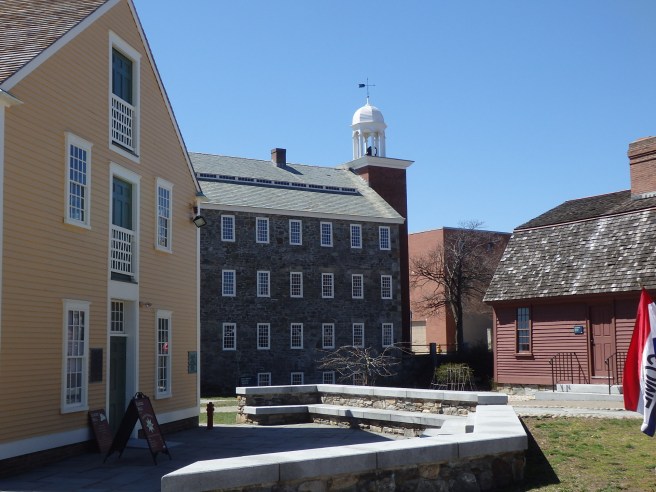
This is where it began, starting with the Slater Mill on the left and building into the Wilkinson Mill, center.

The modest Slater Mill complex in Pawtucket, Rhode Island, is honored as the birthplace of the American Industrial Revolution.

The operation originated when apprentice Samuel Slater slipped through British security with secrets for textiles manufacturing and was hired by Moses Brown to replicate them in America, with the mill opening in 1793.

The fact that Brown, a Quaker, and his partners advertised for what was essentially stolen information troubles me – I do wonder how they justified their actions when questioned by their Friends meetings. The English, meanwhile, had long before enacted barriers that penalized fellow citizens in Ireland and America. Perhaps that was sufficient inspiration, even before the American Revolutionary War. Perhaps one action apologized for the other.

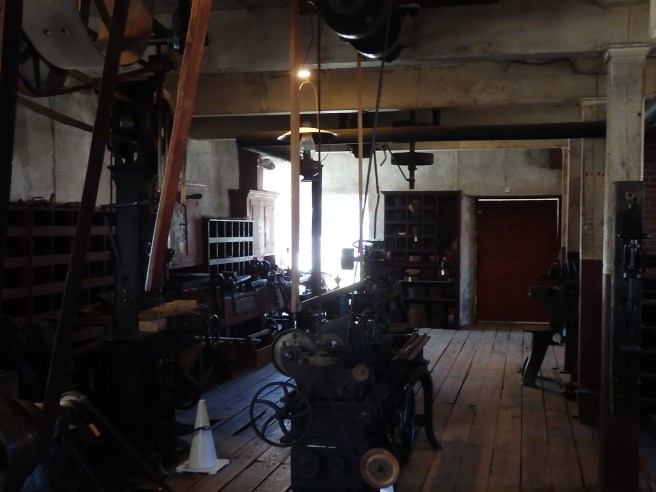
I was resting my finguers on this waterpowered lathe when I realized it was the origin of mass-production.
I was resting my fingers on this water-powered lathe when I realized it was the origin of mass-production. Without uniform parts, each item would have to be handcrafted from scratch.


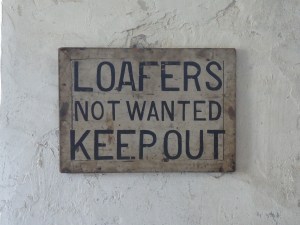
There were differences between the Quaker Work Ethic and the Puritan Work Ethic, but they would have agreed on this sign.

More remarkably, though, Slater’s assistant, David Wilkinson, then provided the next leap – a lathe that produced large screws that were far more uniform than those painstakingly made by hand. Whether he or Henry Maudslay in England was the first to produce such precise work can be argued, but the results were the foundation for the innovative precision toolmakers who would transform industry. This was, in effect, the foundation for mass production. The thinking behind Wilkinson’s model inspired a league of New Englanders to advance the technology in applications across the region.

I doubt this was the origin of the phrase “Yankee ingenuity,” though it certainly fits.

My fondness for old mills, by the way, did prompt a novel, Big Inca.

WHO INVITED INCA INTO MY NARRATIVE, ANYWAY?

Why Inca, anyway? For starters, when it came to conceiving my novel Big Inca versus a New Pony Express Rider, I seem to recall an attraction to the wordplay, Inca for Inc., befitting a story about corporate intrigue.

Maybe there was even a sense of llama and alpaca wool as raw materials for the abandoned waterpower textile mills that instead become the front for covert business activity.

I was already aware of how much indigenous lore remained lost or buried in the American inheritance and wondered how much more might be festering somewhere. Even before issues of illegal immigration entered the picture, I was curious about the alternatives lurking in the imagined jungles of Latin America. Maya and Aztec, for example, also had rich imperial cultures that contrasted with the Spanish invaders.

The novel takes on its own meandering along the edges of consciousness and subconscious currents. Just what are we doing in our careers, anyway, at least in the face of ultimate existential purpose? And what is the allure of corporate politics, strategy, and gamesmanship, at least in the higher offices? Bill may be out in the sticks, but he is a puppet of sorts for the Boss. A player. Or maybe just his apprentice. Either way, he’s green and supple.

Here we encounter, however dimly, a darkness conquered by another darkness, perhaps crueler under its Christian veneer. Yet a New World Native undercurrent runs counter the peasantry of Old Europe, and pagan influences infuse both sides in the millpond of Bill’s labors. As for the company paying his Bill’s bills? It’s at least as mysterious as the Inca itself.

OH, SUCH PLEASURE IN THE SPRAY!

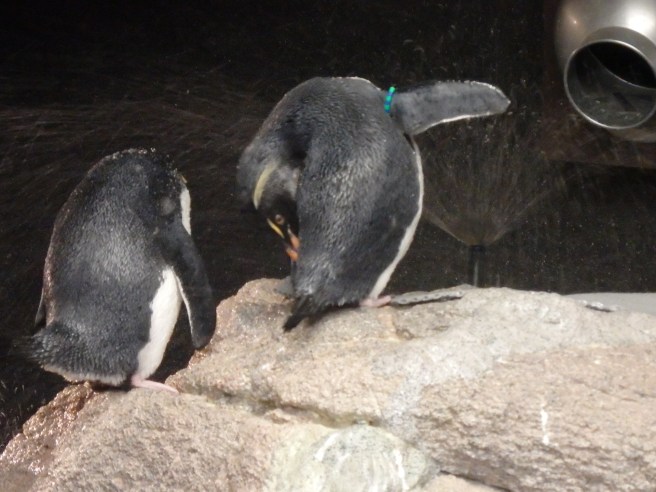
Penguins at the New England Aquarium take utter delight in the periodic rounds of spray around their pool.

The New England Aquarium at the edge of Boston Harbor is a fascinating destination. And penguins can be endlessly amusing.

Boston is a rich and varied destination – the Hub of New England, or the Universe, as they used to say. Living a little more than an hour to the north, we’re well within its orb.


MAPPING MORE THAN GEOGRAPHY

I had no knowledge of the streams of quiet rebels who experience divinity directly, thanks, in part, to the map of their heritage as they work with the soil and their own bodies. These days, they resist as best they can the manufactured desires beaming from satellites or television airwaves, even while they watch many of their children succumb to these temptations. They could tell us about Elijah or Jeremiah, the Babylonian captivity, or the Maccabees’ war of independence, in addition to my own ancestors’ sufferings recorded in The Bloody Theater or Martyrs Mirror of the Defenseless Christians or Joseph Besse’s A Collection of the Sufferings of the People Called Quakers, for the Testimony of a Good Conscience. When, at last, I reclaim this legacy, piecemeal, I ask, “So whose story are you telling, anyhow? Which grandparents are yours?” Opening their maps, I follow their footsteps, even in a strange land. Well made cartography includes supplications and blessings, as well as warnings.

My own homeland once included many woodlands well into my grandfather’s childhood. A balance of forest, with its firewood and construction timber, and farm fields and pastures. So much so, in fact, that people could travel dozens of miles on roads that never left forest between cities. By my own childhood, however, most of the trees had been leveled, and even the woodlot on an uncle’s farm doubled as pasture for hogs and cattle. In winter, the countryside was a stubble wasteland.

Similarly, a prairie denuded of buffalo is impoverished. How much poorer is a suburban lot occupied by restless greed? Here I am, dwelling in desert I consider healthier and more vibrant than the construction I see overrunning the lands around cities and towns. “Rebuild at the core,” I urge the wind. “Repent!” Turn about! Bring back the buffalo and the buffalo nickel, as well as amicable urban neighborhoods. There are all kinds of communities, and humans are only part of the equation. There is land, there is sky, there is water and flowing. To say nothing of what exists beneath them.

A person who comprehends maps will appreciate history as well. Perhaps even musical scores, as another kind of map with a dimension of time.

I listen to my wife and learn of the mental maps many women carry. The ones of kitchens or gardens. Others leading to childbirth and parenting, or even away.

I, meanwhile, come here for a taste of primeval wilderness — a hope to experience a timeless reality that holds humanity in a state of awe rather than arrogance. Just look to the mountains for salvation. Look as well to dreams, each one having one foot in your past and the other in your present.

Carried to an intelligence that daylight conceals, I sense that within many rapidly fading distinctions I’ve scorned are important markers; these ranged from where to harvest wild berries and their uses as food and medicine to my own ancestors’ hymns and religious teachings. To be creative means building on what’s come before, rather than entering a new universe. The path on the map goes from one place to another. Respect is essential — another way of honoring one’s fathers and mothers. There’s still time to cultivate individuality and character in the field. Sometimes, even where homogeneity is perceived, a people can differ as sharply among themselves as they do from others. Ponder Polish Catholics in Chicago, Congregationalists in Ohio’s once-Yankee Western Reserve, and fire-breathing Baptists and Pentecostals in Detroit and what they might do to enhance each other’s heritage, rather than striving for some common denominator. That’s another way of lifting up mountains, rather than leveling. Even on flat land, each body leaves a hidden stamp on its soil. Learn to read vibrations of an environment, and you identify communities dwelling therein, sometimes a century or two after their departure. Through the news and entertainment media, I grew up knowing more of Manhattan and Capitol Hill, though they were only incidentally closer geographically than Kansas City or Minneapolis, supposedly within my Midwestern realm. I knew more, too, of Hollywood back lots and Beverly Hills. Indeed, not until much later had I recognized the Midwest I’d considered so conservative and culturally backward was, at the beginning of the twentieth century, a hotbed of radical politics and organized labor. Many of its cities elected Socialist mayors only to replace them with Ku Klux Klan within the decade. Talk about upheaval! In the front parlors of homes in many small towns across the Plains, the latest wave of European high culture was performed; three of the nation’s oldest handful of symphony orchestras were organized (St. Louis, Chicago, Cincinnati). In the machine shops of isolated barns and backyard stables of small-town entrepreneurs, curious Midwestern farm boys tinkered perfecting the automobile and a thousand other industrial marvels. Kite-flying bicycle-building brothers put men in the air.

Much of this I did not understand or appreciate when dreaming only of escape. Only now did I come to see what remains of a once rich and varied heritage. In those days I looked off to the limits of a world; fixes like Boston and Seattle as strands of Utopia. What I encountered instead was a step beyond the anticipated. Of the neighborhoods I would come to call home, none quite fit what people expect of East Coast, Midwest, or Pacific Northwest, either.

For more insights from the American Far West and Kokopelli, click here.

A BACK BAY FLOURISH


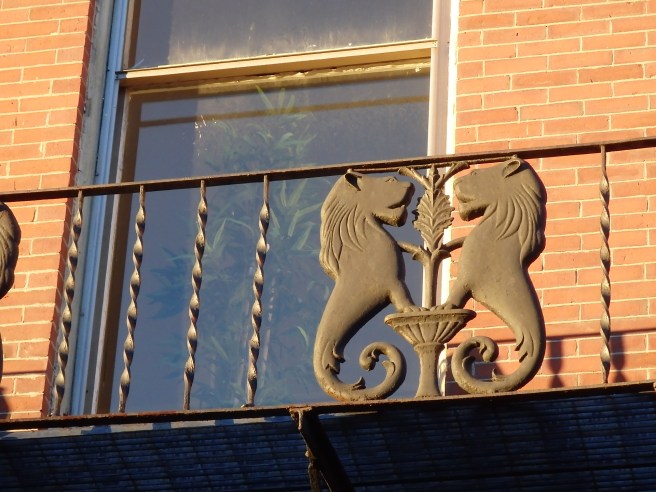
In the second-floor railing ...
In the second-floor railing, they strike me as a cross between lions and seahorses.

A distinctive railing adorning a Beacon Hill house somehow fits in with the district’s predominantly federalist style.

Boston is a rich and varied destination – the Hub of New England, or the Universe, as they used to say. Living a little more than an hour to the north, we’re well within its orb.

MULTIPLE MAPPING

Knowing how far to go — and when to turn back, to the best effect — are difficult matters. The wise traveler relies on those who have gone there already and returned. You hope they speak truthfully. Often your life will depend on their directions. Even knowing what to pack and what to omit may be based on their counsel. Mountains and rivers are only the beginning.

When there’s too much to remember, a map begins forming. That or a guidebook. But the map presents more possibilities than the book, with its linear narrative confined to one route at a time — even maps with vast portions blank or missing. Take two points on a map and connect them, this way or that. Add a third. And then a fourth.

I never would have arrived in this desert without maps. The airliner’s navigation charts, of course. And then the highway atlas. Many others, as well, become useful. Those that show back roads. Others, topography. Still others, property divisions — including the Indian reservation and Army artillery range, both declared off-limits. Maps of emotions, economies, explorations. Maps of oceans, weather, the heavens.

Disembark and you go to work filling in details and then connecting points like a spider. What’s around that corner? What’s over that ridge? Where will we stay, and what’s the best way to get there? A single map is only an blueprint. The particulars never quite fit. Especially in two dimensions. A breeze lifts the web. Coyote walks through it.

Each one distorts — some far more than others, and rarely by intention. Who made the map in your hands? And to what purpose? Some were mathematicians of few words. Others were empire builders or real estate developers. Some weave the directions into the stories they tell beside the campfire. Some ignore shadows. Fail to repent, ask forgiveness, extend blessing. Others know survival, as well as play, requires definition and decision. Obligates searching within, as well as around, in fullest candor. Some even deceptively point you away from your destination (why should they reveal their secrets?).

Those who were born and raised here know it in a different way from those who have migrated. Magpie will tell you one thing; a Canada goose, another. Same goes for where they’re positioned. Jackrabbit and dragonfly take separate pathways, as does beaver. You simply log where they cross and hope to find meaning.

I had thought maps were the essence of geography. Now the definitions spill over into history, geology, meteorology, political science, psychology, and much more. Because many misunderstandings afflict each life, there are bound to be collisions. Sometimes you move into a thorn that pierces consciousness, but even that rarely brings clarity. You see there’s endless discord among individuals, clans, tribes, nations, denominations — all to be traversed and mapped in the search for ways out and back safely. In this knowledge, jobs, aspirations, faiths, possessions, social standing are merely reflections of fundamental conflicts between human consumption and the good earth itself. No one can dwell anywhere without disturbing the whole; individuals and collectivities distort and contort to their own ends, some more benignly than others. The lines on the page do not hold their place. Without a divinity as a guide knowing these connecting pathways, then, there’s no return to full measure and health. The breath people exhale, fires they build, grains and flesh they devour are diverted to their chosen applications. “Tell us something better,” I implore. “Teach us the highest way.” Where anyone takes it from here is another matter.

Sadly, whether this transformation’s harmonious and renewing, guiding individuals as merciful stewards and co-creators with the divine, or self-centered and destructive as thieves, is rarely considered. Just observe how communities rationalize, arguing that the welfare of their women and children comes first, even as they bankrupt the farm to support worldwide armies or strip timberlands in a rutting for coal and iron.

You could perceive many aspects of this in these orchards within desert. While the choice of irrigating and producing fruit sustains many more humans than the arid range would, also ponder the long-term impact of the poisons applied through each season. Kill harmful insects and molds, but what else? And how soon before it seeps into the groundwater and household wells? It’s all an interplay of good and evil, which I observed through a giant spider web. As a practice within my spiritual discipline, the Dedicated Laborious Quest, I place maps atop other maps and find they are drawn to different scales. Many of the words require translation, which introduces its own misunderstandings. Some of the maps are even of places far from here, landscapes in memory.

Too many details and the sheet becomes a scribble. Maybe that’s why here, at an extremity of the continental United States, I now comprehend the American Midwest of my childhood and early adult years as something other than a uniformly Protestant corn belt. Even overlooking ecological differences between woodlands and prairies, or between the Great Lakes and the Missouri or Ohio river valleys, I reconsider its varied ethnic traditions and the hidden cost of the melting-pot focus. Speaking with other exiles like myself, I become aware of unique distinctions some of our ancestors resolutely upheld, at the cost of their own lives, if necessary. There were strains of Scandinavian Lutherans in the Dakotas, Russian Mennonites in Kansas, and Scottish Presbyterians in Iowa, whose distinct cultures were eroding like the topsoil itself. You would hear, too, why so many had fled. Some, desperately hoping to forget forever their terrors or shame, buried the evidence as best they could. Others, however, defiantly kept it aloft as a reminder of their liberation and a warning.

For more insights from the American Far West and Kokopelli, click here.
THE MYSTERY OF MOZART

In the annuals of genius, today marks a special observation, the birth of Wolfgang Amadeus Mozart in 1756.

The traditional biography reads something like an extended fairy tale, starting with the child prodigy who charms European royalty in the flowering of the Enlightenment. Yes, there are emotional conflicts with his taskmaster father, who nevertheless deserves much of the credit for those early successes as a performer, improviser, and composer. That doesn’t stop the son who dashes off masterpiece after masterpiece in lively company or en route on stagecoaches rather than in deep solitude with a keyboard. Later tales of poverty and domestic desperation, however, mask his inability to handle money or patrons. You could say he was a tad spoiled but, oh my, unbelievably talented. Besides, it turns out he was the second-highest paid musician in the world, after Franz Joseph Haydn, who lived in conditions offering much less freedom. You could also say that in his prime, nobody wrote with more spontaneity, perfection, or elegance. So much for the standard version.

The fact is that Mozart set a standard that, on its own terms, could not be matched. much less surpassed. In the world of opera, his are among the very best, even without considering how he lifted the genre to new heights. As an opera composer alone, he would have been among the top handful. He essentially created the piano concerto. And the symphonies, alongside Haydn’s, are models of an evolution leading to a final culmination rivaled only by Haydn’s two London series.

I must confess that my deep passion for classical music began in fifth grade, age 10 or 11, with an encounter with the 29th symphony, in A major. Its infectious, joyous outburst, order, and underlying idealism struck a deep chord in my young soul, spurring a hunger for much more, which I found in his work and those of other symphonic and, later, operatic masters.

The prolific legacy Mozart left at his death at age 35 is prodigious, even before we get to the chamber music, choral compositions, or instrumental offerings.

With him, sooner or later, we come face to face with the tragedy of a life cut short, in the fullest blooming of genius – like his fellow Aquarians and composers Schubert and Mendelssohn, especially. The question then turns on the what-if of whether he could have advanced in the artistic challenge of Beethoven and a torn-apart social order to ever greater heights or whether he would have failed to adapt and, thus, withered.

Which leads us to the biggest mystery regarding Mozart. What if he had lived a longer life, say one as long as Beethoven’s? There’s the inevitable comparison, Beethoven. Not Bach, curiously – maybe it’s the matter of those symphonies. Put another way, had Beethoven died at the age of Mozart, his reputation would have been as a second-tier composer, one resting largely on 23 piano sonatas, culminating in the “Appassionata,” plus three classical-style piano concertos and three symphonies – including what would have remained the enigmatic “Eroica,” one that would likely not make much historical sense without the Fifth, Seventh, and Ninth for perspective. There wouldn’t even be his tortured venture into opera. Oh yes, we’d also have the six string quartets, Opus 18, in their homage to Haydn. Had he died at 35, Beethoven would have not been regarded in the same league as Mozart or, for that matter, Bach. I was about to add Brahms and Dvorak, but hesitate since they were so beholden to Beethoven’s challenge and model.

Within the Mozart-Beethoven dichotomy is another deeply intriguing consideration. The conventional interpretation is that Mozart would not have adapted to the artistic and social revolutions ahead, that he had simply gone as far as anyone could in what we call the Classical period and its dimensions or that he would have been baffled and outmoded by the changes to come. More and more, though, what I hear in the last four symphonies and the unfinished requiem suggests something quite different. Mozart was yearning for wider horizons and expressive possibilities. Yes, we have a surfeit of his work as it is, how can we truly desire more when there’s so much already, but what may be lacking is that singular, definitive great gesture along the lines of Beethoven’s Missa Solemnis or late quartets or late piano sonatas or even the Choral Symphony’s final ecstatic outburst or perhaps Bach’s Chaconne from the Second Partita for solo violin.

Alas. Remind me of that when I’m immersed in one of Mozart’s extraordinary opera arias or a slow movement from a piano concerto.

I could recast the consideration, then, into a question of whether Mozart had moved to Prague, which adored him, rather than stay in Vienna, or even on to London, which had so embraced Handel and would later welcome Haydn. Suppose Mozart had lived another decade – or three or four – in fresh, more supportive surroundings? We’re back to genius and its nurture.

In the end, we have what we have, filled with delight and such promise. Let’s see what we choose to play today in that honor.

OLD STATE HOUSE

Dwarfed by contemporary office towers, the Old State House stands in stark witness to the earlier roots of New England’s enterprising prowess.

Built in 1713 — long before the American Revolution and statehood — the Georgian-style structure originally served the General Court of Massachusetts. In New England, General Court and state Legislature are synonymous.

From colony to statehood.

Boston is a rich and varied destination – the Hub of New England, or the Universe, as they used to say. Living a little more than an hour to the north, we’re well within its orb.

ROOTS THROUGH THE SKY

Ours was not the journey of Ulysses. There had been no dramatic battle. No obvious defeat or shipwreck, either. We weren’t accompanied by our own troops. I intended to make my home here, at the edge of wilderness, and venture into its realms, rather than circle back toward some faraway but faithful woman or goddess.

With the exception of my spouse, who also traveled with me, I was fleeing my own people and hoping that strangers would be better, or at least different. Crucially, I would continue to enter the back country to be reminded of some mystery, as if on this edge of the continent some faithful remnant was making a final stand in defense of Old Ways handed down through practice from antiquity. Still, you could look at the ground and be disgusted here, too, to find white fibrous butts, the thimbles of broken cylinders left behind wherever man goes, along with the larger, inescapable debris. Look up and see contrails of airliners and military aircraft. You could scoff that in vapor-lighted cities, where cancer is the predominate cause of dying, few inhabitants are aware of the flickering stars or the planets in their orbits; the populace is ignorant of the very lunar phases you will so closely follow here. Taunt them, arguing that Jesus is the only bum welcome on their streets and parking lots, and accepted in their midst only because he’s conveniently dead. Maybe he’s not all that welcome, either, if you look closer. Meanwhile, vandals spray-paint his name on forest boulders alongside highways, as though a word alone can distribute clear-cut salvation. Ponder the contempt for both creation and creator. The Old Orders dismiss superficial religion. There’s fasting, and then there’s starvation. The soul knows a hunger, one that comes at the beginning of prayer. Some practitioners know this opens a furrow their horses help plow. For now, I would venture into high places to be reminded of the ancient interplay of dualities. Not just good and bad, but the overlapping harmonies as well. Make my rounds, however quickly at first, acknowledging the slower nomadic practice.

When I packed for this move, I preferred boxes over baskets. Something squared, for paper and recordings, especially. Typewriter. Electronics. We weren’t transporting dried berries or salmon. Blankets cushioned furniture and china. The cardboard presented fewer overlapping harmonies. Learn to weave baskets and I might learn something of the Cross. Especially in its curving.

Handle with care, all the same. Let go of one, something shatters. Or the other, something bounces. Baskets stack differently than boxes. See which one fits a squared room better. Which one, a hogan, wickiup, tipi, or kiva.

Step outside. Turn to the four directions. Then name them.

MALE / SUN
FEMALE / MOON.

Turn again.

AIR / FIRE
EARTH / WATER.

Once more.

SPIRIT / LIGHT
FLESH / SHADOW.

Draw out their colors according to tradition or your own intuition.

Soon the divisions break down, into Yin/Yang swirling.

This is where prayer begins its dancing, even without Kokopelli’s piping.

In such turning I was brought to the edge of my intellect. Facing the expanse toward the horizon, my knowledge of geography, geology, botany, zoology, astronomy, and survival itself proved defective. The edge and depth of my emotions, too. Return to my religious texts and I’d find a different story. Not the one taught to children, but more sinister dimensions. Walk far enough away from the village or highway into open fear, admitting this experience might break me. This Dedicated Laborious Quest draws on all my ability — mental, physical, and psychic — until I’m forced to pull strength from some kernel of infinity within myself. As you pull, roots come forth. Draw them from the emptiness within the basket. The emptiness waiting on the horizon’s circle, as well. More roots, reaching out like cosmic rays through the sky, are visible only to the spider — these beads on a rickety filament.

For more insights from the American Far West and Kokopelli, click here.
HONORING THE MARITIME LEGACY


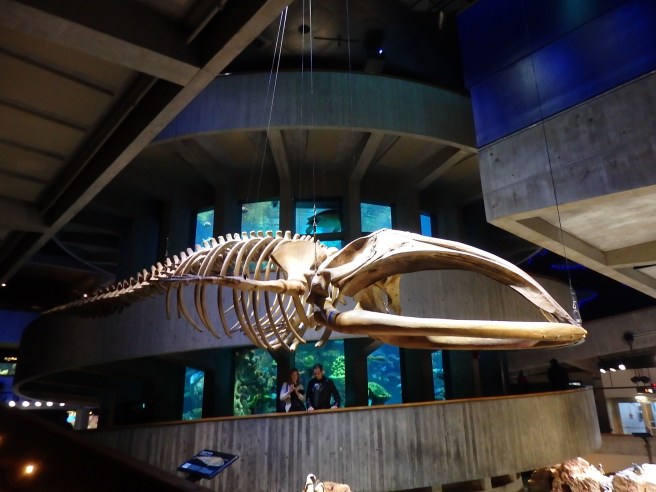
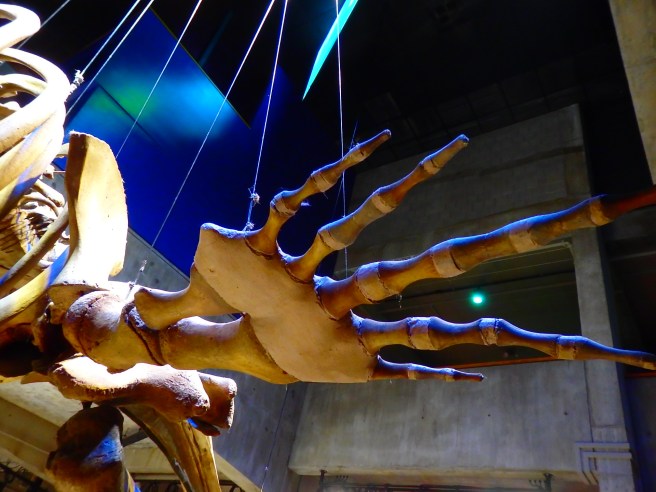
Suspended overhead.
Suspended overhead.

A reconstructed whale skeleton suspended in the New England Aquarium pays homage to the region’s close relationship to the sea. For generations, whaling was a major industry that provided essential oil to illuminate the night. The aquarium sits on a wharf in Boston Harbor.

The city is a rich and varied destination – the Hub of New England, or the Universe, as they used to say. Living a little more than an hour to the north, we’re well within its orb.

And you knew all along it was a flipper, right?