REAL DEVELOPMENTS IN THE YEARS SINCE I DRAFTED THAT NOVEL

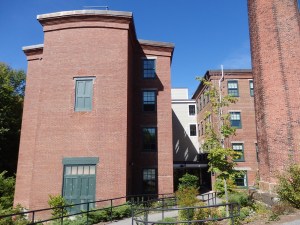
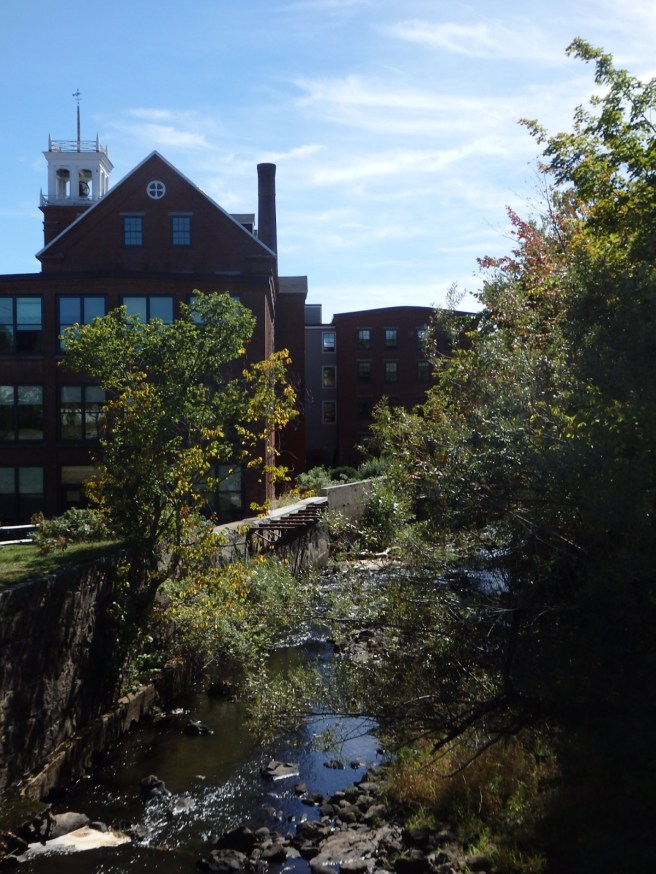
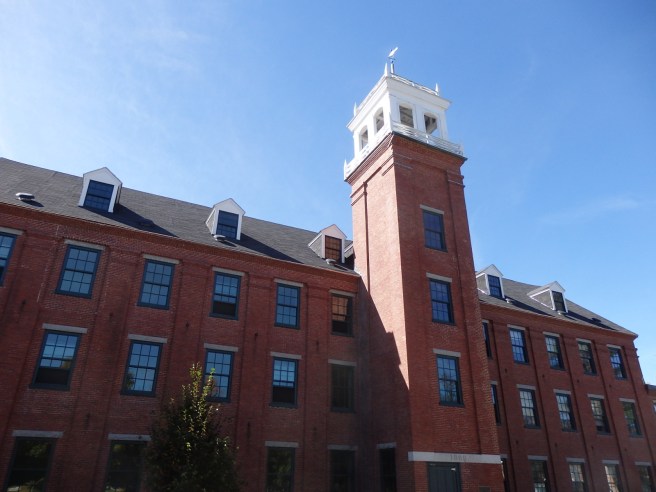
The years since I drafted Big Inca versus a New Pony Express Rider have brought significant, often dramatic, restoration and redevelopment to long neglected historic mills like the ones at the heart of my novel.

One impetus for the renewal appeared in a handful of towns in Maine, where credit-card giant MBNA transformed old mills into attractive call centers that in turn revitalized local economies. Even after being shut down in a later buyout, the benefits linger, and other developers had concrete models to follow.

Visionary entrepreneurs like the late Joseph Sawtelle here in New Hampshire as well as nonprofit agencies or local government-backed councils entered the picture, making mills in other towns emerge as small-business incubators or readily adaptable buildings for new arrivals, especially enterprises growing rapidly.

And, if the location’s right, they can attract artists of all stripes – painters, sculptors, printers, dancers, musicians, craftsmen, bakers and caterers – as an affordable alternative with natural light and high ceilings. (We love the annual studio tours and open houses in the mills in one nearby town.)

Sometimes the downtown locations lend themselves to conversion into residential condos as well. And then there are universities, health-care organizations, and museums that move in for convenience. (Well, one mill in downtown Manchester, New Hampshire, does have a helicopter pad on the roof.)

In other words, there are some fascinating case studies just about everywhere I turn.  But I still haven’t found any where the top of the tower is turned into a tiny penthouse, not the way Bill did at one point in the novel. I’m still quite fond of that touch.

RIDGES AND RIVERS

Someday I’ll learn the identities of clouds. Buy the chart, memorize their qualities and forms, and then watch the flowing sky afresh. This is, after all, yet another strand of mapping.

From childhood, I’ve absorbed maps. Mind travel. Concepts augmented by photographs and writings, which have often furnished a sense a such familiarity that when I arrive in a new place, strangers stop me to ask directions, even on my inaugural visit. Foliage, waters, buildings, and people fill in the lines of his maps as they stretch toward some new border. But this move, with its desert, has been an exception. Nothing’s been predictable or particularly comforting. Besides, I experience a vague agitation when venturing to the edge of my known universe. If possible, when visiting new locale, I push out a few miles further, to determine what’s over the next ridge or river — or at least down the road — as if to anchor myself within some context, rather than remain at its periphery. Curiously, I feel more secure when placing that border at some shoreline or rise — countryside, at the least — rather than within seemingly endless tracts of housing, factories, stores, and pavement. Even a round earth has places where monsters may lurk. Gaps exist in any map. Consider the clouds. Everything is, after all, changing. Even that rock, where Kokopelli is sitting.

For more insights from the American Far West and Kokopelli, click here.
A CHIP OFF THE OLD PLYMOUTH ROCK

If you delve into genealogy or even read obituaries, you may run across references to someone as a “Mayflower descendant.” The assumption is that at least one of their ancestors arrived (and survived) the 1620 voyage to Plymouth Bay. Their lines have been carefully detailed.

More broadly, though, you’ll come across those who consider all Plymouth arrivals of the first decade as Mayflower ancestors, not that I’m finding that online at the moment. So I’ll leave it as a hearsay argument. Still, after all, the Mayflower itself made a second crossing in 1629 – one of 10 vessels to arrive there in that period – and this is where things can get confusing.

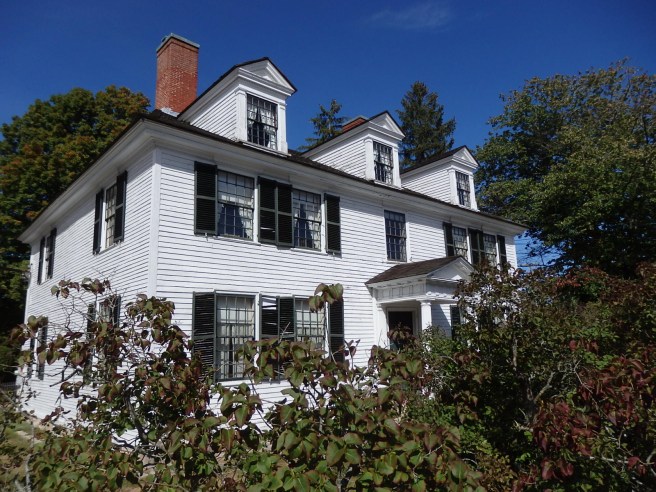
Add to that many others landing to the north in this period – at Salem, especially, and then Boston, plus a scattering at other New England ports. The region was quickly filled with settlers, including the Hiltons at Dover, where I live in New Hampshire.

These can all be long lines, some much better recorded than others.

IN THE DIMENSIONS OF DAILY EMPLOYMENT

Any workplace holds confidences you can never reveal. Not that you don’t want to expose company secrets. Then, considering the office computers, fax machines, and photocopiers, you realize they’re incapable of guilt. They simply do their job — and you might find that unsettling.

Whenever I do manage to tap genuine emotions regarding this employment, no one’s more shocked than myself. Take something as simple as a pane of glass between my desk and the trees outdoors. Even on my job in Appalachian mountains, I wanted a window. One the size of a book would suffice, although a picture view would be preferred. I’ve always appreciated a panorama, a sense of precisely where I fit into the weather of a particular day. Instead, I feel trapped underground, half-buried in regulations and routine. Only a band of natural light at the far end of the fluorescent-and-steel expanse hints of sun, moon, sky, or clouds — and even that aperture is tinted. Why are my hours on the job so cut off from the rest of life? “We may as well be coal miners in carbonized veins or muscular razorbacks sweltering in midnight foundries. Is it only the sun we miss? Examine the calendar. Check on the moon’s phase.”

I could just plot my escape. I am surrounded by desert. Trek there alone. Right to the heart.

He recall the words of another friend who spoke of the paradox of Zen Buddhist freedom: the very limitations the practice imposes also lead to an extraordinary freedom. An individual who’s free in the Spirit can be placed in prison and yet not be captive — persecuted and yet unbowed — denounced and still spotless.

The Dedicated Laborious Quest, as my Teacher taught, is a truly free way.

Free, yes, with the labor.

I pick up the phone and hear Kokopelli’s whistle. He wants us to get going. Then tells me of the dance where we’ll be playing.

For more insights from the American Far West and Kokopelli, click here.
MAYBE IT STILL COMES DOWN TO MEANS VERSUS ENDS

In the aftermath of the recent national elections, trying to make sense of the American scene today is, well, downright scary. The fact we have one party so willing to risk constitutional crisis rather than work cooperatively on solutions to common problems strikes at the very heart of democracy. And that’s before we get to the divisions revealed geographically, demographically, and economically.

Several of the phrases floating around the campaigns continue to ring in my ears. Describing one party, we have an “echo chamber” of “misfits,” which begins to look far larger than would be healthy for any society. And for the other party, the race came down to a “technocrat” versus “activist,” in itself suggesting a division between an appeal to the brain versus the heart.

Much of this situation, I’ll contend, springs from a lingering state of denial involving the encounters of those of us who came of age during the 1960s and ’70s. Coming across a summary of William Clark Roof’s 1993 A Generation of Seekers: The Spiritual Journeys of the Baby Boom Generation, I had to sit up and take notice when he noted that a low level of community involvement accompanied our search for personal meaning. It’s something that’s certainly happened across American society over recent decades, although I’d say increasing demands on our careers and suburban family lifestyles have taken their toll, too.

As Douglas Gwyn comments in Seekers Found: Atonement in Early Quaker Experience:

Roof’s study confirms many impressions of baby boomers in the ’60s, but adds a new perspective. Many tried drugs, were sexually active, and went to rock concerts and political protests. But many did not. Half of those surveyed say they did not try drugs; a third never attended a rock concert; and 80% were not politically active in that period. On the whole, Roof finds boomers to be nearly evenly divided between traditionalist and countercultural affinities.

A conventional view might look at this split along the lines of the Vietnam war issue, with the traditionalists joining the military and the hippie side in full opposition. But Roof’s criteria turn the angle: more than a few servicemen experimented with pot and other drugs in ‘Nam, along with free love, and moved easily into hippie circles on their return. Meanwhile, I sense more than a few hippies never did drugs, out-of-wedlock sex, or political protests. For them, maybe it was all about the music?

As Gwyn continues his reflections on Roof’s study, he prophetically notes:

But in subsequent decades, with a tightening of the American economy, the assumption of abundance often turned from utopian to belligerent, as Americans vented their frustration over lowered or failed expectations. Given their expanded subjective and expressive registers, boomers are already more likely to consider themselves wounded by defects in their religious upbringing. When religious institutions or leaders fail their expectations today, boomers are all the more likely to feel cheated, wounded, or even victimized.

It’s not just religion, let’s be honest. This cuts across the entire society.

Gwyn makes one other argument that lingers, one that involves the kind of association each seeker is drawn to. One is process driven, and the ways we can become captive to the mechanics of a particular system. (He names capitalist democracy as an example.) Here, the procedures outweigh results. I love his observation, “If civility is too strongly identified with democratic processes, then true seeking and conversation to one’s neighbor will tend to be subverted. Caucus politics or the contest of interests may usurp the conversation.”

The alternative, goal driven identity, can override the process altogether, in which the ends justify any means of getting there.

The vital tension Gwyn encourages “requires a disciplined and sustained dialogue between seriously considered and passionately held positions,” a “drama of faith, which is played out upon a level civic stage of public concern.”

Quite simply, where is that dialogue today? And where is the open exchange in questioning and refining the factual essence of the positions? An “echo chamber,” on either side, simply cannot do the job.

~*~

More of my own reflections on alternative Christianity are found at Religion Turned Upside Down.

REST IN THE AGES

Tucked away in a corner of the park, this gate.

The burial ground in Boston Common is the resting place of early patriots, among them the composer William Billings – the latter, by assumption rather than documentation. Historians will note that the headstones in the city’s oldest graveyards no longer stand over their intended bodies, but were moved around by convenience.

Boston is a rich and varied destination – the Hub of New England, or the Universe, as they used to say. Living a little more than an hour to the north, we’re well within its orb.

It's a classic New England scene, in cities, towns, and isolated countryside.
It’s a classic New England scene, in cities, towns, and isolated countryside.


BACK TO BACH

This time of year, the world makes a special nod to the genius of Johann Sebastian Bach, who was born on March 21, 1685, in Eisenach, Germany.

When I first explored classical music, in the late ’50s and early ’60s, Bach was a much more distant figure than we encounter today. Yes, he was considered one of the three greatest composers ever, but largely in a scholarly consideration. Rare performances of his music itself largely focused on the organ works – infrequent events outside of their application in religious services in churches having both outstanding instruments and musicians – or came about through a few soloists who championed his instrumental compositions. Think of E. Power Biggs, Pablo Casals, Wanda Landowski, Rosalyn Turek, or the Bach Aria Group.

Harpsichords, for that matter, were a novelty, and the Brandenburg Concertos were typically performed with a piano as a substitute in the ensemble. How strange that sounds today, when these once exotic pieces are among the most frequently played works on classical radio stations, and commonly in period-instrument bands at that.

For one thing, the repertoire is not as defined by symphony orchestras as it was then – a break for Bach, who wrote little that would fit into their programs, even in a scaled-down mode. Today, we have chamber orchestras, community choruses, and period-performers to champion other avenues of composition.

Seems strange to consider how much the classical music scene has changed during my lifetime. For perspective, Vivaldi and Mahler were even greater rarities. And for many of us, the jazz-influenced Swingle Singers gave us the first clue of just what Bach’s scores might unleash.

We’ve been liberated from the heavy-handed, smoky, Romantic-era, Victorian approach I first encountered. What’s happened parallels the breakthroughs in painting restoration, where old masterpieces were finally stripped of the layers of dark varnish that we’d assumed were part of their intended appearance. What a brilliant, startling, controversial revelation that was! How garish rather than reverential we found much that was finally released to the light. How playful, how scandalous! What joy!

Thus it’s been with Bach, too. In the right hands, the mathematical purity of Bach’s inventions is utterly heavenly, intimate, sensual. To sing the parts with others is a marvelous balancing act of hearts and minds dancing in spirit together. Gone is any sense of a sermon in sound – this comes closer to prayer.

Add to that the demands of daily craftsmanship imposed on Bach, meaning that he created work after work more or less on deadline, with little time for major revisions, and the results can be seen as all the more impressive. No wonder we’re left agog in the face of what we discover in what he timeless wonder he discovered and embraced.

HOME TO ENLIGHTENMENT STYLE

A prime location in the big city.

Beacon Hill’s narrow streets and closely set homes invite pedestrians to enter a timeless order and grace. It’s hard for us not to imagine living here early in the 19th century as American ideas took hold.

Boston is a rich and varied destination – the Hub of New England, or the Universe, as they used to say. Living a little more than an hour to the north, we’re well within its orb.

A quiet break in a crowded neighborhood.


Beacon Hill is, after all, hilly.

MOUNTAINS AS A RELATIVE MEASURE

As I listen, I realize the locals don’t consider the surrounding ridges to be mountains. Although these “foothills” or just plain “hills” are as tall as Pennsylvania’s Alleghenies, shorn of trees, to speak of “mountains” signifies that one must drive away into forest. The time comes to hike in unfamiliar high country.

I drive west, into a mountain pass, and park at the trail head.

Climbing through clouds on Sheep Lake Trail, I identify snow lilies, phlox, two whistling marmots I mistake for groundhogs, and a ptarmigan. In these topless mountains, snow and rocks glimmer atop jagged white threads that twist, plunge, and roar over miles. In this clarity I recount a friend’s determination to perceive the important task to perform each day — a focus she achieved in the sunset of her young death. Go on.

The next outing, I follow another friend’s favorite trail. My valley of orchards and meadows stretches behind in a twilight of small-city lights and barren blue ridges. In golden splay dusk, I learn to fear glaciers atop volcanic spines and in their grooved depths, too. So much depends on which way you turn. Clouds, one moment pink, shift into slate-blue. Think of a great-uncle’s farm in Ohio flatlands when green-wood ringed the fields and autos were novelties; and how, when the United Brethren in Christ build their new sanctuary, one tree furnishes enough lumber for all the pews. Such timber is long gone from most of the Midwest, and nearly gone here, as well.

Strangely, adjusting to such disorientation can allow one to see more than the landscape with fresh eyes. I begin reckoning my birthplace afresh, too. I perceive a native poetry now vanished: in flat terrain they coined Sweet Potato Ridge Road when they became sensitive to what had been called Nigger Pike, after work crews that came out from the workhouse jail in the city; Diamond Mill Road was made of limestone gravel flecked with quartz or mica, but named for the distillery beside the rails. What could be in those rural lanes I had sped along on the way to the farm to cause their ghosts to arise out here? I think, too, of the hayloft I had delighted climbing in, even though the old folks feared I’d fall through and be trampled by cattle; more ominously, some shed rafters I walked like a high-wire artist had hogs rummaging below, with razor snouts and teeth and a latent taste for blood. That farm acreage is scarcely like these Western orchards or open ranges, yet something echoes. It’s earth and air. Sunshine and clouds. My days in the mountains are airy conifers. I could be a pioneer, in spirit, at least. My ancestors settled those Ohio tracts. Another line, a bit earlier, settled North Carolina Piedmont. Here, I find unspoiled corners.

Perhaps bears do drink beer. Rocks, leap from mountaintops into oceans. Naked breasts, swell from snowmelt pool to sky.

Against this wall, between his desert and the frigid sea current, I declare my vast ignorance: left to myself, I’d likely starve, soon sicken of berries, and have never caught fish properly or gutted a rabbit. Somehow, I wait to be fed. Thus, one point of my Dedicated Laborious Quest involves learning to be wholly myself — embracing flaws as well as talents, as I search out my own boundaries.

Away from the office and encircled by an ever-renewing earth — even an apparently lifeless desert that restores his sanity and a brand of insanity, too — you may find that every trail you follow brings you closer to your own attainment, your emerging sense of place and mission within the universe. As for looniness — ah, loco! — you soon appreciate how all are in some way at least un poco, indeed.

For more insights from the American Far West and Kokopelli, click here.
IN THE SHADOW OF THE BLACK SPREAD EAGLE ON LUDGATE HILL

Sometimes in exploring a niche of history, you come across an unexpected incidental detail that significantly alters your previous perception. For example, many of the earliest Quaker tracts and books bear the imprint of Giles Calvert, a publisher and bookseller at the Black Spread Eagle on Ludgate Hill near St. Paul Cathedral in London.

So extensive is his Quaker role that I’d assumed Calvert (1612-1663) was a member of the Society of Friends. For one thing, he was the elder brother of Martha Simmonds, an early Quaker convert and a central character in the notorious Bristol Controversy of 1656 that led to the blasphemy trial and conviction in Parliament of a leading Friends’ minister, James Nayler. The connection intensifies when you discover that two years earlier she had joined with Friends and the next year married Thomas Simmonds, who (according to one account) took over the shop from Calvert, by then the leading publisher of Quaker literature. And Martha Simmonds (1624-1665) was hardly shy about public protest and witness on behalf of her faith. She’s a controversial figure in her own right as she challenged much of the male leadership of the emerging Quaker movement.

One earlier connection I’d come across was Calvert’s role as publisher of Gerrard Winstanley’s True Leveller (or Digger) writings from 1648 to 1652, the year the Quaker works begin appearing. Winstanley was a radical religious and political thinker and leader, one who later had an influential role among Friends even if he drifted away for a while – his life leaves many questions and holes for the curious.

Still, it’s enough to strengthen Calvert’s position as a Quaker vanguard.

In my recent reading of Douglas Gwyn’s Seekers Found: Atonement in Early Quaker Experience (Pendle Hill Books, 2000), a broader portrait emerges.

Gwyn makes a critical connection that begins with Parliament’s attempt to impose Presbyterianism on the Church of England. “One factor that doomed the project to failure was the suspension of censorship of the press,” itself a parallel to the suspension of mandatory church attendance amid the waves of civil war. “Religious ideas that before 1642 had circulated only below the surface, if at all, now reeled off presses in exponentially expanding numbers. Propaganda pieces, ranging from one-sheet ‘broadsides’ to tomes hundreds of pages long were printed and sold at low cost.”

This had my mind leaping backward to the sense that many underground religious and spiritual streams had somehow survived in Britain for centuries, in part because of valiant efforts that kept the Roman Catholic Inquisition at bay. Queen Mother Joan of Kent’s influence at the trial of John Wycliffe and the Lollards in 1378 remains a pivotal moment in the history of freedom of religion. We were a long way from tolerance, but it was far superior to the terrors of the papal machine.

Gwyn, though, introduces Calvert at this later point beginning in 1642, “One of the most notorious publishers of dissenting literature … among the first publishers in England who was not also a printer.” (That, in itself, is a fascinating detail. I had assumed he handset the type himself, placed the paper and ink of the flat press, and collated and bound the pages. Instead, he served as a go-between.) “Over the course of his career,” which began in 1643, “he published more than 600 of the most radical tracts and books written in England during that period. … Calvert was questioned, fined, and imprisoned briefly on various occasions for his publishing activities, but he was never really silenced. Once the door was opened for a free press, it was never to be effectively closed again.”

It was enough to send me back to Christopher Hill’s classic The World Turned Upside Down (Penguin, 1975), where Calvert gets two mentions, the first for his Quaker service. In the other, a longer overview, Hill observes, “The printer Giles Calvert’s shop perhaps came the closest to uniting the radicals in spite of themselves – ‘that forge of the devil from whence so many blasphemous, lying scandalous pamphlets for many years past have spread over the land,'” as one critic put it. Hill then notes that A.L. Morton, the leading scholar on the Ranter movement, “stresses the importance of Calvert as a unifying force.” Hill has Calvert working as late as 1662 “still inciting the publication of seditious literature, and after his death in 1663 his widow continued his policy.” Unclear is whether Calvert was still with the Black Spread Eagle or working more independently; either way, he was a force who’s largely unknown today.

It’s heady stuff, of course. Here we have a champion in the history of freedom of the press and the circulation of revolutionary ideas itself. At the moment, Giles Calvert gets a single sentence as his Wikipedia entry – and that notes his publication of John Saltmarsh, another important influence on Quaker thought, as Gwyn delineates.

As a writer and editor, I am as fascinated by the idea of a bookstore that also showcases its own line of books and pamphlets as I am by the existence of a bold publisher of revolution, political, spiritual, or even literary. Think of City Lights Books in San Francisco in our own time, with its line of poetry from the Beat and Hippie years. No doubt there are many others over the centuries.

I wonder, too, about the bookstore itself. Was it more like a newsstand, with the latest blast hot-off-the-press as must-have material? (That has me thinking of record stores back in the Beatles era!) Think, too, of the audience hungry for the most recent release – in contrast to our surfeit of information today. What were the discussions like, too, in deciding whether to publish a piece or edit it or, perhaps, in gathering customers around a table to debate the merits of the most current issues? Who frequented the shop, for that matter?

Imagine, if you will, the movie version. I want the key characters to be ink-stained, for starters, and maybe tobacco smokers.

Actually, I’m beginning to wonder. Would this be more like a porn shop? At least before the Internet took over? Customers entering surreptitiously, hoping not to be seen? And then slip away again?

Well, Quaker was a term of derision. As well as one of scandal. Bear it as we may.