So William Shakespeare wasn’t the writer?

The range of the bard’s vocabulary and situations long appeared to be beyond the possibilities of the man’s background and training.

Long ago I came to a sense that he might have simply been the recorder and editor of a more free-form ensemble, an improv troupe, if you will.

Now I’ve come across arguments that the real playwright was Amelia Bassano, and it’s far more convincing.

A digital search will point you to the arguments, pro and con.

Anyone else like the idea that the most important writer in the English canon was a woman? One of Italian and Jewish descent, at that?

A regrettable turning point in counterculture evolution

In reading others’ fiction about the late ’60s and early ’70s, my awareness of the span of hippie identity has only intensified. Each one seems to focus on a different identity. As I’ve long argued, hippies came in all varieties and styles, and still do. But these also show how little overlap there often was.

So much so that I no longer find the label useful. Period. It fails to convey the extent to which we differed within the rainbow.

As one friend insists, “I was never a hippie. I was a freak!”

To the straight world, of course, there was no difference.

For many, political activism was a central component, though not for all. And I’m thinking the evolution of that activism needs more exploration. It’s where we really failed the most.

For starters, too many saw protests as the route to pursue, rather than undertaking the hard work of holding office or attending meetings.

For another, we failed to clearly articulate our vision, other than tending to be left, as in what we called radical, rather than liberal, which seemed to support the Vietnam quagmire. We were reactionary, actually, at least against the military-industrial-financial-racist complex. The ’68 Democratic national convention in Chicago didn’t help anything, either.

Looking back, it seems that too much of our political expression was being domineered by the egotistical theatrics of Abbie Hoffman and Jerry Rubin and the like. (Correct me if I’m wrong.)

Woodstock seemed to shift everything. Yes, we had the Jackson State and Kent State shootings the following spring, along with the shutdown of college campuses and some big marches. But who were our avatars?

Or, put another way, why is the experience remembered more by the music than by the speeches?

~*~

Back to Woodstock.

Seems Hoffman wanted to be part of it, naturally, and demanded – get this – $10,000, 200 free tickets, tables for distributing literature, and the right to leaflet the audience. The event’s organizer, Michael Lang, initially refused but later relented.

But that wasn’t enough. High on acid, Hoffman took to the stage and started ranting. Never mind that it was in the wee hours of Sunday morning. After 20 minutes or so, he knocked over Peter Townshend’s microphone as The Who was coming onstage, and a miffed Townshend responded by whacking Hoffman with his guitar and shouting obscenities about getting “off of my fucking stage.”

That part’s well known.

The message, intentional or not, was that politics were not to interrupt the sanctity of art.

I sense the rift only grew after that.

The protest music I remember was by folksingers-songwriters, not rockers.

Well, maybe John Lennon proved the exception.

Help me, please.

Waking up to political reality

While the upcoming national election campaigns appear to be hold, or at least on simmer, a political firestorm is nevertheless brewing.

For starters, many of us are not pleased that the choice for chief executive is coming down to two white males in their 70s, but the differences between them are vast. As in HUGE. (I’ll save that rant for later, if necessary.)

We weren’t happy that the other remaining alternative was also a white male in his 70s, but the scarier part was the rabid stance of some of his followers that if he’s not on the ballot, they won’t bother voting. They say they’ll vote only for the Revolution, and some even say that it will rise from the ruins of what’s falling around us. I wish they’d see it’s not that simple or natural. When Rome fell, it was gone.

Another revolution has been taking root in the past four years, one that’s not yet completed but definitely threatening everything the Founding Fathers established. Not all revolutions end on a positive note, after all. Look at history and you’ll see how many have ended in dictatorships and/or social destruction.

~*~

So our political quandary is not all about Covid-19, either, or at least not directly, though the epidemic has been exposing some longstanding stress points in society.

Health care is one, though it still has a long way to go to work efficiently and equitably. Covid-19 is exposing many of its weaknesses and heroic strengths.

Education and student loan debt is another frontier, going back to the shortcomings of No Child Left Behind and a comprehensive understanding of just what education means, especially when we’re dealing with children born with a laptop or smartphone in their fingers. Those kids face the world in a whole new way. What on earth can play even mean for them? And a public school system designed to train them to work in factories that have long since left the USA is another obstacle. Is anybody talking about this in the public arena?

And then there’s the broader economy, beginning with the disconnect between investors and labor. More crucially, the disturbing awakening some conservative analysts are seeing between the gains of digital advances and the devastating losses of lowest level labor. This is going to be HUGE when the bills start amassing.

This shouldn’t be an arcane discussion.

Still, let’s look at the more pressing aspect. The biggest depression in a century? Combined with the makeshift payout, with one with the Donald’s signature on the checks.

Who’s paying for all this? Yes, we had to go back to get his unauthorized fricking egotistical name of the bills we’re paying.

Look, we’re lending free money to big banks, which in turn charge HUGE usury rates on their credit cards. WTF? No wonder we’re getting next to zero on our return on any savings. Real conservatives used to advocate personal savings. Far from that any more. The faux/Fox pseudo-conservatives are on that public-treasury gravy train. Besides, many if not all HUGE corporations aren’t paying federal taxes. Ditto for many of the super-rich who benefited from the so-called trickle-down tax reforms starting in the Ronald Reagan posturing.

Let us all eat cake, then. Does anyone else remember where that led? (Whack! Whack! Whack!)

By the way, whatever happened to antitrust actions? I ponder that every time I get my online server bill, which inches by dollars up every month. Not that this corporations has any real competition. This household is about to bolt to the only other alternative and swallow the quality difference.

‘Revolution or else’ from the fringe and other political lunacy

Maybe it’s all those years I’ve lived in places where I’ve been represented at the state and federal levels by some truly embarrassing public officials.

The ones I dutifully voted against, as a point of moral witness.

Note that I still voted, even when it often felt like a losing cause.

You can imagine my elation on those rare occasions when my candidate actually won office.

The U.S. representative who proved most satisfying was Kweisi Mfume, who was elected from my district in Baltimore shortly before I headed to New England. He was about as unlike me as you could imagine, apart from his voting record, and then he and I were in delicious harmony.

What I’m getting at is about my exasperation with those who insist they won’t vote unless it’s for somebody they agree with 100 percent.

At the moment, that means those in the Bernie camp who can’t accept anything less, except maybe Elizabeth Warren. Some of these are people I love dearly and respect, apart from their belief that it’s time for the entire system to crash and burn so it can magically resurrect in what they call “revolution or else.”

I hate to tell them this, but crash and burn rarely if ever leads to something better. There’s no Phoenix or Firebird. Look at Rome after the Visgoths and Huns. It was never again the same without the full Roman Empire, not that I’m a big backer of Caesar in any form. My sentiments are more in line with the Jewish resistance, not that it matters.

And, no, I definitely don’t believe in unicorns.

I know how hard it is to start an enterprise from scratch or even to turn an existing one in a new direction.

I heard a similar crash-and-burn argument from some who voted for Trump the last time around. Yes, they hated the way things were at that point, but they weren’t differentiating between crucial differences. One wanted something other than an entry-level job. I doubt she has even that now.

Me? I knew I’d much rather have someone in office whose positions meet me half of the time than one opposed to mine 90 percent of the time … or more. Take environmental protections or the independence of the Internet as current two examples.

I also knew I want someone who’s a problem solver, working with verifiable facts, than a problem maker, spouting off lies and superstitious gossip.

And I want someone who’s not in the pocket of the lustfully super-rich and their lobbyists. You know, money-sex-power, those who have it want more of it all … now.

I remember all too well Ralph Nader’s role in giving us the eight years of W that were so detrimental to progressive legislation in this country and its judicial benches, and also how Nader refused to acknowledge his part in undermining those positions. I’m also among those who chide Bernie for undercutting Hillary Clinton’s campaign as well, especially as we look at the devastation that’s followed. Look, I voted for him in the primary and have come to regret it.

The reality is that like dating and courtship, we’ll never find someone who can fit into everything we desire. As I’ve learned, a clone of myself is a very imperfect match. A successful working relationship is something quite different. A candidate who fully matches my stands would never, ever, get elected, not even if I lived in a lefty outpost like Cambridge, Massachusetts, or Berkeley.

Yes, I’m all for a revolution, but that’s within existing realities and resources, the way the call of ’76 turned out to be.

Anyone else have a soundtrack of “Hamilton” to play now?
For the first time since 1661, we won’t be gathering face-to-face

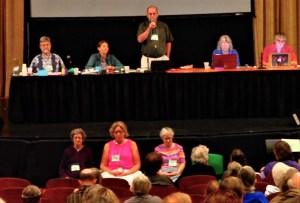
The clerks’ table in a previous year in Vermont. The presiding clerk, standing, is flanked by reading clerks and recording clerks as he attempts to summarize the “sense of the meeting” and recognize Friends in the auditorium who wish to speak to the item at hand.

The top level of governance in the Society of Friends is the yearly meeting, so-named because it gathers once a year in decision-making sessions. The constituent local congregations, in contrast, are termed monthly meetings, since they gather in business sessions once a month. (Yes, it’s confusing, since we sit together in worship at least once a week as well.) Everyone active at the local level is welcome to participate in the annual sessions.

Rather than having a single overarching yearly meeting, ours exist independently, originally on a regional basis. Something like the various strands of Eastern Orthodox, for that matter, with the Greek Orthodox and Russian Orthodox the best known of many.

Among Quakers, New England Yearly Meeting is the world’s oldest, founded in 1661, and was held in Newport, Rhode Island, until 1903. Since then we’ve gathered for a week each August on college campuses or other residential sites around the six-state region. In my time here, that’s been Hampshire in Massachusetts, Bowdoin in Maine, and Castleton in Vermont, and I’ve heard tales of the years the event was held in a camp on Lake Winnipesaukee in New Hampshire.

It’s a solemn and joyous occasion, one that many participants – and many families – schedule their work vacation time around. It’s something like a huge class reunion, too, where you reconnect with many people you hold dear. And living in a college dorm, as most of us do, it’s not uncommon to find that random pairings among those of us who go solo turn into regular roommates, year after year.

So I’m still stunned by the announcement a few weeks ago that we will not be meeting in person this summer, due to the coronavirus. Yes, we will be attempting something online, but it won’t be the same.

Among the faces and late-night conversations I’ll be missing.

Just as jarring is the more recent cancellation of summer sessions at Friends Camp in Maine. For many of our kids, it’s a highlight of their year, and friendships they form there sustain them through high school and college. As one of our neighbors says, a camper who became a counselor, the news is a bummer.

Amen.


Religion and the global backlash

Have you ever heard someone blame religion for all the armed conflicts in the world? It’s an easy accusation to make, at least until you look deeper to see the financial, ethnic, even racial motivations underlying the violent and oppressive actions throughout history.

Karl Marx may have called religion the opiate of the people, but he also saw economic inequalities as the real oppressor. Labor inequities were only the tip of that iceberg. For once, you can call me a Marxist, at least on that count.

As a member of a historic Peace Church denomination (a grouping that also includes Mennonites, Brethren, and Amish), I can view the wider Christian stream from a critical perspective that acknowledges the many ways faith communities get co-opted by what is often called the World in earlier pronouncements or Empire in corners of our own – even seduced by the vast range of secular idols. What emerges is corrupted and even false religion, not even of a godly scope.

That perspective can provide for a long examination, one far too broad for a mere blog post.

Nevertheless, in the face of the rising stream of intolerant and often violent social and political backlash across America and Europe, especially, I sense that the anger and hatred are fueled by a post-Christian mindset, one that is ultimately materialistic, divisive, and nihilistic.

In contrast, what I’ve often found in radical faith across traditions is an alternative of hope, humility, justice, and love. Repeatedly, progressive social, political, and economic reformers have had religious roots and support. It’s not an even history, and one that is too often countered by reactionary forces, but I wonder how else the world might turn back the growing darkness without people drawn together in deep spiritual faith and discipline.

The continuing marginalization of religion – especially radical religion, like that I espouse – is one more means of inhibiting any challenge to the few who are reaping the vast benefits of the ongoing social breakdown for their own personal gain.

Where do you find refuge, renewal, and opportunities for social progress?


Colleges closed down 50 years ago this spring

With all of the college students furloughed home to study online, it’s hard to believe the last time American campuses shut down was springtime a half century ago. Make that the ONLY time.

It was different, though, in several key ways.

The kids weren’t told to pack up and go home. No, we stayed together rather than scattered.

The strikes came from the students and then faculty as a protest against administrators and national events, rather than orders from the top-down.

They were triggered by the slayings of unarmed students at Jackson State in Mississippi and Kent State in Ohio by police and national guardsmen. (Sorry about the pun.)

There were other factors as well.

For those who are interested, my novel Daffodil Uprising covers much of that experience.

~*~

What’s happening today reflects a much different generational divide.

We shared a dream, and our career options appeared wide-open, though they chilled greatly in an economic downturn later that spring. We felt a hippie kinship across much of the nation. And we were angry.

By the way, we weren’t burdened by tuition debt, much less one we’d likely never be able to pay off over our working lifetime.

~*~

At the moment, the generational divide I’m watching is an attitude many have that Covid-19 is just for old folks (like me) or those with preexisting conditions (like some younger people I’m worrying about). Some of them think they’re immune or won’t get truly sick. As one I overheard saying, “I’d take a coronavirus for the team.” Oh, dear.

Let’s get real. I’ll go back to that report from France, where half of the intensive care beds were occupied by people under 30.

Still, there’s much more in this generational divide that’s simply festering. We ignore it at our own peril. What’s your take?

A new kind of doctor’s house call

When I was a rug rat, family physicians would still visit patients in their homes. The docs even carried little black bags, as I remember, along with a different demeanor than we see today.

And then all of that became history. The front-line medical personnel even became referred to as primary caregivers or physician assistants or nurse practitioners rather than docs.

The Covid-19 outbreak, though, has it returning with a twist. The medico in question, even a specialist, is now calling some patients at home. Yup, on the phone. Voice, not texting. I’d say dialing them up, except nobody has a dial phone anymore.

And that’s what’s happening with my latest cardiologist checkup.

OK, I did have the echocardiogram at the hospital lab, so he has those results to work with. I’m wondering if he’s going to want my latest weight and blood pressure readings. I do have the home kit for that. There will be no listening to my breathing and other internal sounds.

Well, I’m also told of psychotherapists who are conducting their sessions over the phone, though I have trouble imagining that going very deep. Dunno. There are just certain things that come up in face-to-face interactions that don’t happen by telephone.

Now for the real estate hit

A few months back, I was reading an analysis by one business columnist who argued that in the upcoming recession, which at the time looked about a year away, real estate prices would be little impacted.

Hah! Despite his numbers and the curves on his charts, I thought he was badly mistaken. I felt – and still do – that he was leaving an important factor out of his calculations. So much of what I saw in the 1990 real estate collapse was a consequence of households where one of the two working adults had been laid off. With housing prices as high as they were, one income was dedicated solely for the mortgage payment while the other was left to cover the remaining living expenses. Nonexistent savings weren’t going to be part of that calculus.

An old rule-of-thumb was that the purchase price of the home should be no more than 2½ times the annual household income Looking around here, I’ve been puzzled that anyone can afford a home at all, especially considering the declining wages we’ve been seeing across the board or the difficulty of younger workers trying to land full-time jobs with benefits.

Quite simply, we couldn’t afford to buy our own house if we were in the market again. And many of the people we talk to admit the same thing, nodding their heads in sad agreement.

As for single-adult households? The odds are even worse.

Flash to the present, with its record layoffs already. History sometimes does repeat itself.

~*~

In the past week, two stories have pushed the developing Covid-19 situation along these lines.

One noted that real estate transactions have essentially gone dormant. Nobody’s out looking to buy and move up, forget an open house, and sellers are reluctant to have strangers traipsing through their dwelling and touching their stuff. We’re all more or less hunkered down.

And now we’re hearing dire warnings that the mortgage industry is on the verge of collapse or meltdown as homeowners (and presumably many businesses as well) are already falling behind in their payments.

Let’s see how the stock market reacts when it wakes up to these turns.

There’s a lot more to the economy than Wall Street, for sure.

~*~

By the way, the U.S. is now the epicenter of the pandemic, and the numbers are just beginning to soar. Nate Silver, the statistics guru at FiveThirtyEight, reports that the cases and fatalities are rising faster in the Trump-leaning red states than in the blue states, where more of the testing has occurred. Within a month, he says, the per capital rate of new coronavirus cases in Trump country should outstrip those in the rest of the nation.

Let’s see what that does to public discourse and opinion.