Tag: History
When adventure called
In my novel What’s Left, there’s one big subject Cassia couldn’t ignore — not if she truly wanted to understand her father. It’s the whole hippie thing.
As he noted, in a sentence no longer in the text:
Will any of our inner music — our desires and activity — ever come into a reliably ongoing harmony?
As was this tidbit:
This is all new to him. The language, unfamiliar, even after the sporadic trips of his youth. The music, profoundly moving.
Take his hitchhiking. As her aunt Nita explained in yet another deleted text:
As for your body, well, you could go about anywhere on your thumb. Maybe not the Deep South or some of the big cities. But adventure called. Out in the countryside. And in the heart of the metropolis. There were moments when everything turned utterly surreal. It was a wild time, wasn’t it? You’re forgetting Nixon got reelected to the White House? If you were a freak — a hippie — you were part of a stream of kindred souls. You saw the world askew. You wanted to explore and discover new vistas, many of them psychedelic. You knew there was more — much more — than what your parents had ever imagined. The entire world was spiraling, about to go out of control, or so it seemed. And what difference does any veracity of hitchhiking in the subways make? Aren’t those some wild stories? Where does the line fall between what’s real and what’s imaginary? Didn’t your Baba land here after all? Return to build on earlier connections? Who cares how he got here as long as he did? You believe this is where he was destined, don’t you?
Admittedly, it’s a lot to take in. More than we needed, in fact. Even this flash:
Angels as hitchhikers! As subway riders! As candy store clerks!
~*~
These days, I’m left with mixed feelings.
Where do you think the hippie movement missed the boat? And what do you think it got right?
~*~

Some things to consider about Pentecostals
When Jaya meets Joshua and his family in my novel Nearly Canaan, she’s introduced to their Pentecostal faith. It’s not like most Christianity.
Here are some points to consider.
- It’s more emotional than most churches, for one thing. Shouting, dancing, praying out loud during the service are common, along with applause, praise songs, and a rock band.
- The term comes from the Day of Pentecost in the second chapter of Acts and its events 50 days after the Resurrection of Christ.
- Pentecostalism’s principal defining trait is speaking in tongues as “Bible evidence” for the baptism of the Holy Spirit. The vocal utterances are rarely in a foreign language the speaker doesn’t know, unlike the Day of Pentecost, but in a stylized babbling known as glossolalia. The proclamations are usually translated by another into the language of the congregants – typically English, though the movement is rapidly spreading worldwide.
- In Brazil, an estimated 12 percent of the populace is Pentecostal and rising.
- The movement started at the 1906 Azusa Street revival in Los Angeles, led by African-American preacher William J. Seymour, or maybe as early as 1896 with the Apostolic Faith movement or maybe 1901 in Kansas when Agnes Ozman, a Holiness Methodist, was publicly recognized for speaking in tongues. It’s had more recent incarnations, such as the Charismatic strand among Roman Catholics and Episcopalians.
- Among Pentecostal churches, theological beliefs can vary widely. But the majority interpret the Bible literally.
- Women were ordained to leadership roles from the beginning of the movement.
- Some denominations place strict limits on personal conduct and attire, even forbidding sports and movies.
- Many Pentecostals are found as active members in non-Pentecostal congregations.
- Pentecostal denominations include Assemblies of God, Foursquare Gospel, United Pentecostal, Church of God in Christ, and Universal Church of the Kingdom of God, but there’s a raft of smaller ones, too. Congregations range from small storefronts to mega-churches.
Truly subversive
After his conversion in prison, Charles Colson held aloft Francis of Assisi and the early Quaker George Fox as his two examples of what happens when a person devotes his whole life to Christ.
Earlier, when Colson was in the White House, he oversaw the FBI creating subversives’ files for Fox and fellow Quaker William Penn, founder of Pennsylvania, and anybody else whose name they found on public Quaker Meeting newsletters.
Yes, beware of true religion.
The American dilemma
(Not just the Protestant or blended Catholic.)
Scratch an American and find a farmer.
(Lenny Bruce’s goy.)
Or the desire to be one with hills and corn in an industrial society.
And, as we know, family farming doesn’t pay diddly.
Why Wycliffe and Tyndale matter
John Wycliffe, who introduced the Bible into English back in the 14th century, shows up as a major character in the opening novella in my book, The Secret Side of Jaya, only he’s taking refuge out on the American prairie.
And a century-and-a-half later, William Tyndale picked up the mission in England, though he didn’t move on to my fiction.
Could they be the most important translators in history? Apart, maybe, from Martin Luther, who could be the basis of his own Tendril, one with 95 points rather than ten, and his German rather than English?
Here, then, we go.
- Wycliffe (1328-1384) was a dissident priest highly critical of the Papacy and much of Catholic teaching and practice. With his emphasis on scriptural authority, he is now seen as an important predecessor to Protestantism.
- He translated at least all four gospels and perhaps the entire New Testament from the Latin Vulgate into Middle English, while associates translated the Old Testament into what became known as Wycliffe’s Bible.
- His followers, known as Lollards, were a major underground radical movement leading up to the Protestant Reformation, despite being highly persecuted.
- His writings in Latin highly influenced Czech reformer Jan Hus, whose execution in 1415 sparked the bloody Hussite Wars.
- Wycliffe was declared a heretic and his books, burned. His corpse was later exhumed and burned, and the ashes, thrown in a river.
- About 150 manuscript copies, in part or complete, survive.
- William Tyndale (1494-1536) was a scholar influenced by Erasmus and Martin Luther.
- In translating the Bible, he drew directly on Hebrew and Greek texts. He was the first to rely on them in translating to English, and his was the first English translation to make use of the printing press. He introduced the word Jehovah in English.
- Many consider him the father of modern English, more than Shakespeare a generation later. His translations were widely plagiarized by others, including the committee of scholars who composed their authorized version for King James, where perhaps 83 percent of the New Testament and 76 percent of the Old Testament are lifted from Tyndale. The Bible was certainly much more widely heard and read throughout Britain than was the Bard.
- He was convicted of heresy and burned at the stake in Belgium after his criticism of King Henry VIII in divorce matters only aggravated the situation.
~*~
There we go, politics AND religion. In this case, both of a radical nature.
Cocheco or Cochecho?
That is, one h or two? Even before we get to COCHECAW / COCHECOW amid a host of other Colonial spellings.
A 1771 map of New England has no Dover (settled in 1623) but Rochester and Durham, later offshoots, as well as the KOCHECKA RIVER.
Also, that map shows Cape Neddick, Maine, as Bald Point, and Winnipesauke Lake, the the north, as Winipissionket Pond.
There’s so much to untangle in such evidence.
The widely used one-h spelling, by the way, is traced to a clerk’s error in 1827 in the founding of the Cocheco Manufacturing Company, building on the cotton mills started in 1812 at the waterfalls downtown.
On that day
The meek shall obtain fresh joy in the LORD, and the neediest people shall exult in the Holy One of Israel,
For the tyrant shall be no more, and the scoffer shall cease to be; and all those alert to do evil shall be cut off – those who cause a person to lose a lawsuit, who set a trap for the arbiter in the gate, and without grounds deny justice to the one in the right. …
And those who err in spirit will come to understanding, and those who grumble will accept instruction.
Isaiah 29:19-21, 29 (NRSV)
Hey, Figaro!
How is it the young Figaro, in “The Barber of Seville,” is so worldly-wise, especially in the ways of attracting women, while a few years later, in the “Marriage of Figaro,” he’s so confounded by the Count’s moves toward his own beloved? And, oh, yes – what happened to all that business savvy?
Well, it was a French theater comedy series originally. One obviously without a continuity editor.
I’ll give the author, Beaumarchais, some slack, since he was busy on many other fronts. And give him lots of credit for knowing how to cut satirically to the quick.
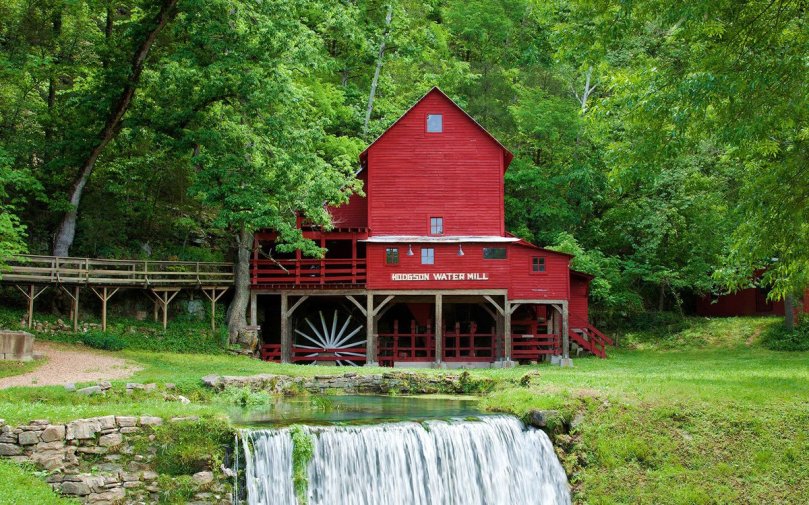
Ten things about the Hodgson Mill
In my novel The Secret Side of Jaya, she encounters an old-fashioned, water-powered gristmill when she and Joshua relocate to the Ozarks.
Turns out that the best-known mill in the Ozarks is named after some of my kinsmen who settled near Sycamore, Missouri.
Here are some facts.
~*~
- The Hodgsons were Quaker millers in Guilford County, North Carolina, before heading north in the 1820s. At one time two cousins, both named William, had mills there. The Missouri line descends from one. I descend from the other. (For the family line before that, see my Orphan George blog.)
- For a while after leaving the Piedmont region, that line of the family briefly spelled the surname the way I do. Then they reverted to the original, with the “g” in the middle.
- A grain mill has graced the site at the foot of a bluff on Bryant Creek, Missouri, since 1837. The current three-story mill was built in 1897 by Alva Hodgson, who mostly worked alone on its construction.
- After 1909, Alva imported top-of-the-line French buhrstones from the Pyrenees Mountains and installed a turbine to provide electrical power to light the mill and surrounding buildings. The electricity also ran a half-dozen sewing machines producing overalls in a neighboring general store.
- Alva Hodgson also purchased the site of the Dawt Mill near Tecumseh, Arkansas, in 1901 and rebuilt that mill in 1909. Today it continues to grind grain. It’s also a full-time resort with three restaurants, a concert venue, and float trips.
- The Hodgson Mill left Hodgson hands in 1927.
- Until its purchase by Hudson River Foods in Castleton, New York, last year, the Hodgson label was still a family-owned operation.
- At the time of the purchase, the company’s headquarters and production facilities were in Effingham, Illinois. The milling was still done in the Ozark Mountains of Missouri.
- In addition to its signature cornmeal and unbleached flour, products include whole wheat pastas, breakfast cereals, bread mixes, pancake mixes, wheat bran, and pure cornstarch.
- Principal competitors include Bob’s Red Mill Natural Foods, Nature’s Path Foods, and Spectrum Foods.
~*~
Do you ever see your name on a product?