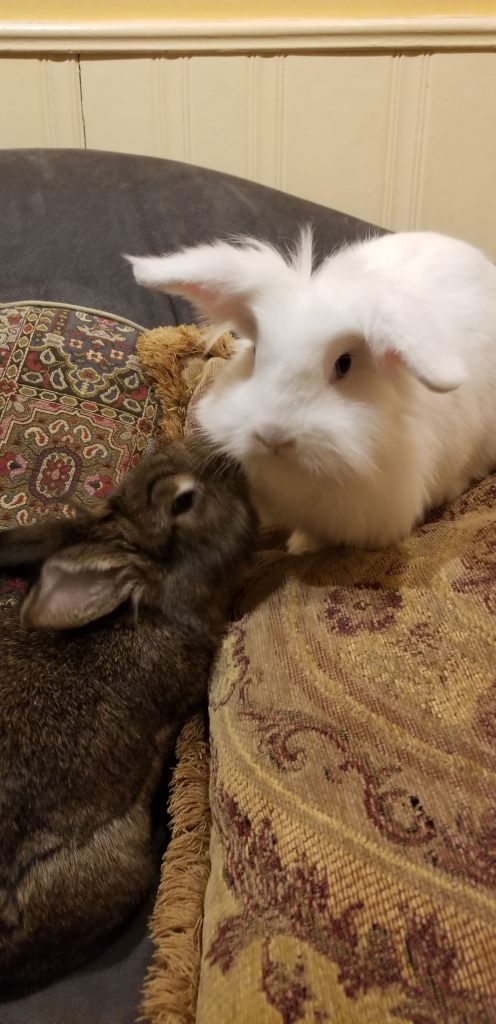
How about some remarkable couples?

Sometimes the sum is greater than the parts. Helps when each of the parts is already sterling.

Here are ten examples.

~*~

  1. My best friend’s parents: Hap and Pauline. Among other things, they nurtured my love of classical music.
  2. Our drip-line neighbors: Tim and Maggie. Warm, welcoming, generous, helpful, social justice activists, great parents. The list could go on.
  3. Political science mentors: Vincent and Elinor. They taught me how to read analytically and how to dissect public policy proposals. As professors, they never used textbooks but relied on real books, like the Federalist Papers or Democracy in America. Their goal was to train independent scholars and fellow practitioners.
  4. My ex in-laws: Sam and Jeanice. Losing them was the hardest part of the divorce.
  5. Can you identify them in the novel? Phyllis and Ivar.
  6. Memorable ministers: Myrtle and Howard at Winona Friends Meeting. She had the entire Bible memorized. And the dynamics were multiplied when they were joined by their best friends and neighbors, Rose and Harold.
  7. Faithful Mennonites: Bob and Ruby. I learned to sing harmony through Bob, who was also a beloved physics teacher and an avid Orioles fan. Ruby had taught in a one-room schoolhouse before moving on to the big city of Baltimore. She packed the most amazing dinners in her small tote bag, which she shared with all of us at the ballgames.
  8. Fellow Quakers: Jeremiah and Beth. Now that they’ve moved to Dover, we’re getting to know them even better. Lucky us.
  9. An ex-girlfriend’s parents: Gene and Doris. They welcomed me to a whole new world and were surprisingly liberal when it came to their daughter. Guess they really liked me.
  10. Cornerstones of the Meeting: Silas and Connie. Wish I could show you the video. And then, just up the road at Gonic, we had Shirley and Eddie.

~*~

Who would you nominate from your own circles?
Ten random notes in no particular order

  1. Honestly. Our dark sides. Do we really express our weakest aspect in our art?
  2. Big goals versus daily tasks, when in balance, an organized life.
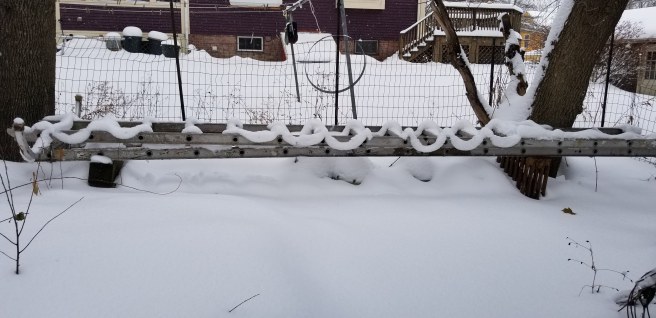
  3. Another overnight snowstorm, I wake up chanting: I’M RETIRED! I’M RETIRED! Meaning no need to spend an hour or more digging out before spending two hours commuting to the office (twice the usual duration). What a huge relief. So nice not to have to scrape frost off the car windows before driving to work. Both parts of that equation, actually. As long as I can delay having to go anywhere.
  4. Some amazing French Baroque fanfares: “Les caracters de la guerre” by Jean-Francoise Dandrieu.
  5. My internal shift from writing to being an author.
  6. The experience of being “clergy” at the ecumenical service.
  7. How was I ever able to do so much while working full-time?
  8. All those years I worked the Vampire Shift came at a price.
  9. Blogging reminds me of a poet back in Indiana who would photocopy batches of his poems – not quite chapbooks – and hand them out or sell them for pennies at readings. Here, take one!
  10. Nobody understands me.

~*~

How about you? Ever feel misunderstood?

Ten things about Duolingo

For the past 3½ years, I’ve been doing a half-hour or so of Spanish early every morning using the free Duolingo online curriculum. I also started Greek but ran into a wall when I was supposed to type what I heard – an impossibility, considering my keyboard isn’t equipped for a Greek alphabet. I’m assuming that’s a problem with many other tongues, too.

Here are ten things about the service:

  1. Originated at Carnegie Mellon University in Pittsburgh in 2009 and launched to the general public in 2012, it’s become the world’s largest foreign-language instructor.
  2. Offers programs in 40 languages – 38 in English.
  3. Has 300 million registered users worldwide.
  4. Employs 200, mostly in Pittsburgh, and has been recognized as a best workplace.
  5. Is criticized for simplistic level of instruction. Much of the grammar is presented piecemeal in an optional Tips tab at each button on its learning tree or in users’ comments on each of the exercises, usually 20 in a set.
  6. Garners highest course enrollment with 27.5 million English users in Latin American Spanish, followed by 24.2 million Spanish users in English. Jointly, that’s a sixth of the users.
  7. Gains next highest English-user enrollments of 10.8 million in Portuguese, 5.72 million in Russian, 4.52 million in Arabic, 4.43 million in French, 3.19 million in Chinese, and 3 million in Turkish. So much for German or Latin.
  8. Offers the constructed and fictional languages of Esperanto (285,000 users), High Valyrian (584,000), and Klingon (304,000).
  9. Awards “lingots” for accomplishments, which can be “spent” on perks or “donated” to fellow users. Often, the number awarded at any time seems arbitrary, and the number presented for reading a story selection is highly out of line with the points granted for finishing regular lessons. Other silly motivational devices include Leagues, where you can be promoted or demoted each week. If you manage to get to the top level, Diamond, there’s no retirement or reprieve – you’re stuck facing some really competitive geeks who have nothing else to do but spend their waking hours playing with languages; expect to be quickly bounced down to a more regular life.
  10. The program is meant to be fun, as Duo the owl mascot suggests, but the dinging sound when you get an answer wrong is annoying, especially when it makes anyone else nearby laugh. Which it does. I’m especially irked when the laughter comes from Chinese guests in our house.

Oh, yes, the lessons work best on my screen when I set the size for 90 percent to eliminate scrolling. And remember to type what you’re supposed to hear rather than what actually crosses your ears when commanded, “Type what you hear.” And I really wish they’d change their typeface so that I can actually see the accent over the lower-case “i” – they sure count it against me when I fail to use one.


Does a journey really have to go anywhere?

Here are ten of my personal favorite journeys.

  1. Sitting in meditation on the way to bliss.
  2. Riding Amtrak’s Downeaster, south or north from Dover.
  3. Following a well-crafted novel, opera, movie, or play.
  4. Moving up and down a contradance line or around in a Greek circle.
  5. Exploring an archive.
  6. Meandering through an art museum.
  7. Pursuing the bass line while performing in a chorus.
  8. Probing the glassy world of a tide pool each summer.
  9. Entering a lover’s arms.
  10. Staying submerged in peaceful dreams or good memories.

~*~

Where do yours go?

In my dreams for 2021

Here’s to restoring civil discourse to public places. Here are a few ways to begin.

  1. Real analyses rather than tweets and insults. A respect for facts rather than fabrications or superstitions. Yes, empirical science balanced by intuition and empathy. And historical perspective as well.
  2. Ethics and spirituality voiced from personal practice as essential points within a wider community rather than kept to the margins of polite discussion. Faith really matters and touches on our highest aspirations. Let’s not bury it.
  3. An embrace of high culture as enriching human awareness and feeling.
  4. Financial and artistic recovery for musicians and actors and others whose livelihoods depend on public performance. Covid-19 has been especially devastating.
  5. A renaissance in reading and literature as well as lively conversation thereupon. Even at the reopened coffee house on the corner or local bookstore.
  6. Lengthening attention spans and a recognition that “fun” is not a destination in itself but at best a way of living and working playfully.
  7. A Second Amendment firearms stance requiring membership in and supervision by a well-regulated militia. Anything less is on the road to anarchy and slaughter.
  8. A celebration of work ethic rather than gambling. And an admission that CEO compensation is way out of line, any way you dice it.
  9. Reframing corporate existence, starting with its legal basis (not as a fictional “person”) and extending to size, global spans, and taxation. We’ve been socializing capitalist risk too long, while privatizing the public.
  10. A day of Sabbath for all. Not necessarily Sunday, but one that could float through the week. Does any company really have to be open 24/7? Much less, any one worker be on constant call?

~*~

Gee, this almost starts pointing me in the direction of a set of Ten Commandments.

What would you add to the list?