The world’s most glorious sauerkraut

For most of my life, I never would have thought sauerkraut could rise any higher than maybe a gag-inducing edible in an obligatory sort of way. You know, like liver. Something in some households you might be required to eat on New Year’s Eve to assure a good 12 months ahead. Think of lutefisk (lye fish) in Nordic cultures as a parallel.

Well, my best friend’s parents, of good German Lutheran stock, made their own, but they also composted for their garden, and back in the ‘50s, that seemed pretty weird.

I am convinced that there are certain dishes that will never become acquired tastes to some or even many tongues. (Feel free to make nominations here.)

That said, imagine my surprise in recent decades in discovering the joys of fine Chinese cuisine, along with the shock of learning that the filling on those snappy eggrolls and spring rolls was essentially sauerkraut, just by another name.

Maybe that set up the moment of revelation.

Morse’s in Waldoboro.

First came some nibbles after an old Mainer made his annual pilgrimage, returning with 20 or 30 pounds or so.

The taste was sweet and tangy, even refreshing. I do like pickles, but these are in a class all their own. I mean, they’re glorious. OK, I had come to prefer coleslaw with a vinegar dressing more than the conventional creamy one, so maybe that had prepared me. (Not that I turn down either.)

That’s set up our own trips in the family, including one with me in the depths of a very snowy February. The road out of the village to the store seemed to take forever, I was sure we had taken a wrong turn somewhere, but then the small store appeared, and it offered more crocks of pickled traditions than just kraut. It also had a small but very tasty German restaurant, which appears to have fallen victim to Covid restrictions. All in all, a delight.

Upshot is, it’s a dish I’ve come to anticipate each winter from our own ten-pound or so purchase.

Morse’s is, in itself, a fascinating story of a family business that’s undergone some transformations but maintains a small niche in an increasingly monolithic food industry. I have no idea if you can find it anywhere near where you live, but then maybe that might inspire another entrepreneur to rise to the challenge. Bigger is not always better.

Where the local beer’s listed as ‘Imported,’ not ‘Domestic’

Welcome to the Hansom House in Dennysville, which is sometimes open on weekends. The stained glass is by the owner.


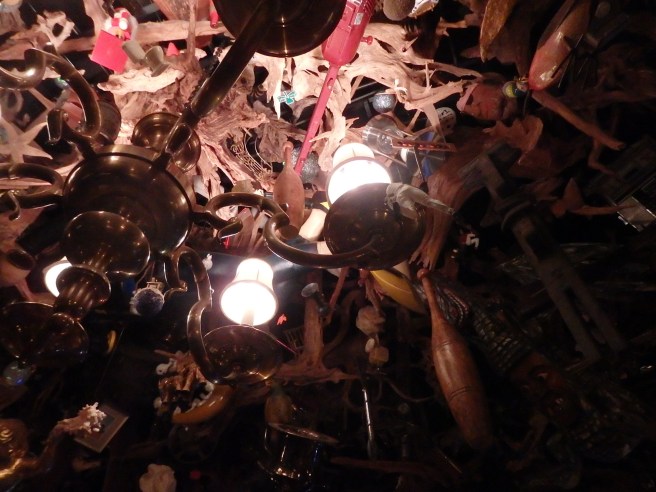
This is some of what’s over your head.


And this is some more. The shark’s not on the menu.


The red shoes belong to the stool, not the patron sitting on it.


Well, they do promote themselves as the World’s Most Absurd Bar.

And we’ve concluded the reference isn’t just to the décor.

In case you’d rather have your drink and nibbles by the fireplace.

A few great regrets in my life

Maybe it’s just the end of the year and looking ahead, but let’s be honest.

There are things we’ve all done that we wished had gone differently.

Here are some of mine.

  1. Not knowing the realities of boy-girl relationships back as a teen. I missed out on a lot of fun and companionship. Maybe I should even add learning to dance, and not that four-square stuff they tried to stuff us into back as sixth-graders. No, New England contras and Greek circles were both epiphanies, much later.
  2. The big dream that turned out to be false. Along with all the promises I believed.
  3. Blowups and inadequacies in parenting.
  4. Divorce. And an inability to confront her long before that. Ancient history now, but even so.
  5. Hurting others.
  6. Failing to make a bestsellers list.
  7. Leaving the Pacific Northwest with my tail tucked ‘tween my legs. Even though I finally wound up living in a couple of places that suit me even better.
  8. Not being able to see a big research project through to completion. Not our fault, but I still believe it would have made a huge difference in an awareness of how politics and public services really work.
  9. All the missed social cues and opportunities that went with that. Yes, post high school. It may have even meant my professional career would have gone more Big Time.
  10. All those years of little to no physical exercise, even if I am in pretty good shape for my age.

Scalloping in the dead of winter

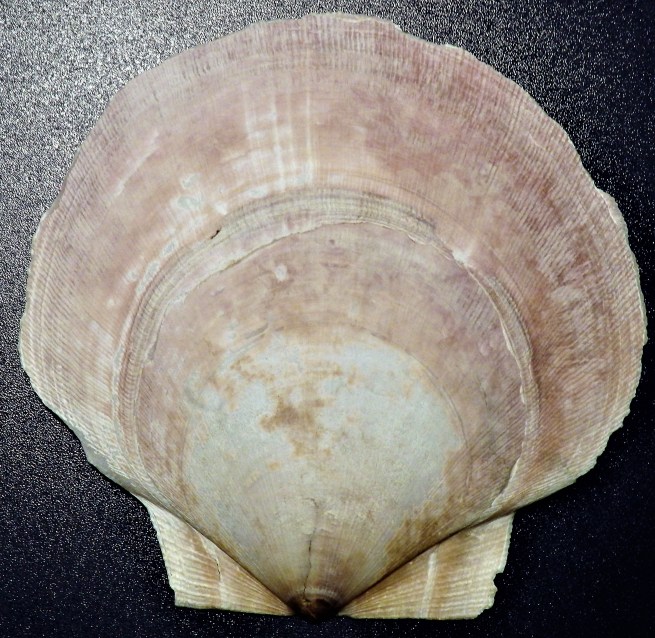
There’s not a lot of meat in one of these, but what there is will be treasured by many seafood lovers.

This time of year, I hear the puttering motors in the chill air before the sun’s even up as the fishing boats head out to drag the depths for scallops. No matter how low the thermometer reading or how bad the weather, the vessels venture by, or attempt to, intent on catching their daily limit of ten or 15 gallons a day in a season that runs no more than 50 or 70 days but may close earlier, depending on the sustainable harvest in each of the regulated zones.

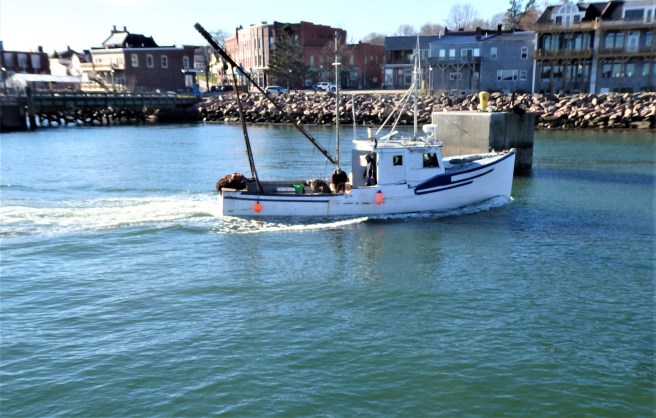
Rigged with a boom for the heavy chain net that drags the seafloor for scallops, this vessel returns to port with its harvest.

A day not out on the water of the bays around Eastport is a day’s income that’s lost for the season. The economics of fishing are precarious enough.

These intrepid fishermen shuck their catch onboard, tossing the shells overboard, which provides grounding for the breeding of more, and then return to port with their precious harvest, often well before noon.

A shell flies toward the water as these fishermen quickly shuck the precious bivalves onboard.

The licenses are coveted and even the size of crews is limited by state law.

Come summer, many of the boats, with their rigging reconfigured, and their crews will have turned their attention to lobster.

Other important harvests here are urchins and clams.

What workers impress you the most when they’re out in bad weather?


A half gallon of fresh scallops

Or about 4½ pounds, purchased from a dragger docked at the Breakwater pier, where the crew of three was busy shucking the morsels from their shells. After dining on these two days straight last Christmas, we agreed we have a new holiday tradition. Unlike ones you would purchase at a market, these have no water added, and that means you can get a lovely sear when sauteing them in a bit of olive oil and butter. Do I need to add they taste heavenly?

Some of my favorite dishes the leading lady in my life creates

As I’ve said, she’s one of the world’s great cooks. Middle-Eastern, Italian, Mexican, French, German, even Vietnamese, Thai, and Indian, she does them all and with flair. Me? Let’s look at some of the more regular things I’ve delighted in.

  1. Anything over charcoal – lamb, peppers, flatbreads, steaks and chops. It never really figured in my life before her. Usually, they were more like sacrificed offerings.
  2. Roast chicken any number of ways – thyme or rosemary lead my list, but Thai and even Indian now come close behind.
  3. Asparagus under a poached egg – ditto for spring dandelion.
  4. Strawberry or blueberry clafoutis. It’s just one of her many creamy desserts that wow me, often with our own berries.
  5. My annual birthday bash of prime rib and Yorkshire pudding, which she says is one of the easiest things ever.
  6. She’s quite fond of pork. One year we even had a whole half-pig to play with, cut up to her specifications. I think I’ve already told that story.
  7. Homemade yogurt. It’s almost like ice cream.
  8. Pho or banh. Vietnamese staples.
  9. Chowders. Sometimes using lobster stock from leftover shells.
  10. Souffles. They taste as heavenly as they look. Even after they deflate.

Now that I’m done bragging, what’s some of your favorite home cooking?


When and what do you eat?

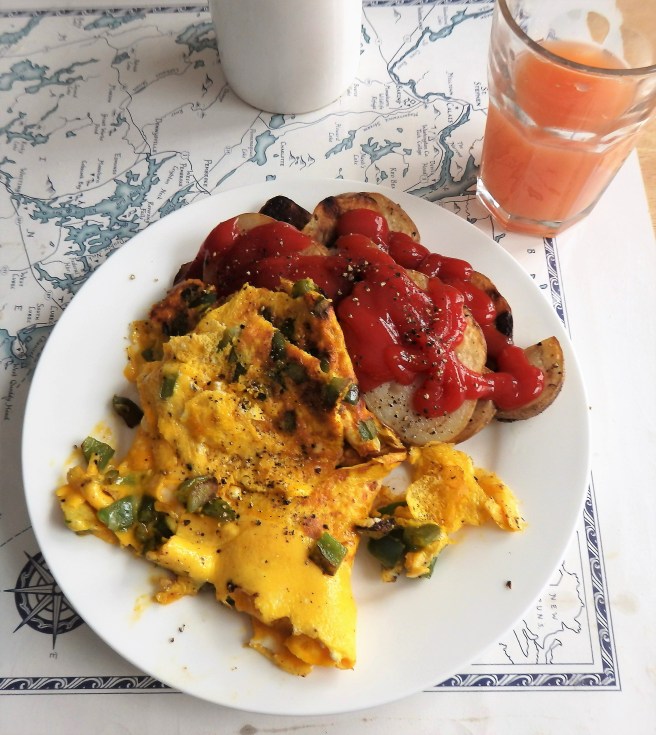
A cheese, green pepper, and mushroom omelet using eggs from our next-door neighbor’s hens is served with home fries made of potatoes I purchased in Aroostook County. Notice there’s no need for ham or bacon. I do love grapefruit juice, by the way. Brunch like this remains a favorite Saturday tradition for me.

My eating habits were one of the places my residency at the ashram changed my life (see my novel Yoga Bootcamp for a taste of the experience).

The lacto-vegetarian cuisine was one, leading to three extended periods “on the outside” when I continued it. Even when I haven’t, the amount of meat in my menus has remained much less than many Americans’. I rarely use bacon, for instance, and when I do, it’s likely to be as a garnish, say on a spinach salad. Hamburger is more likely to be in a meatball or meatloaf rather than in a bun.

Gravy, curiously, has become more heavenly than ever as an extension of the rue family.

And lamb, a recent addition, is simply glorious, especially grilled.

Grilling, I should add, is something I’ve come to treasure through my wife and the space we dubbed the Smoking Garden. There’s no substitute, as far as I can tell, and it makes for some great social gatherings.

What I gained through the ashram was a delight in vegetables and fruits, especially in season, as well as dried beans, nuts, and mushrooms.

The other lasting change was in my dining habits.

Our first food of the day came after morning meditation, community scripture reading, and perhaps physical exercise, and then it was light food – coffee and toast, maybe with yogurt or fruit, and that after we’d already been up three hours. The real meals were a late brunch or early lunch, around 11, and an evening meal around 4 or a little later.

I’ve continued a similar schedule, foodwise. Well, my caffeine intake is down, per doctor’s orders, but what I have is top-notch. Quality over quantity, right? When I was working the “vampire shift,” till midnight or so, the hours were adjusted accordingly, often with a melty cheese sandwich before bed or a martini. (Alcohol was strictly forbidden on the yoga diet.)

In retirement, I find myself often down to one major meal of the day, and holding steady.

What are some of your food traditions?

Pickled Wrinkle?

Saw a small, weathered sign at the side of the road.

A restaurant, it turns out: Pickled Wrinkle.

While that particular location is long gone, not so over at Birch Harbor, near Acadia National Park.

“Wrinkle,” as I’ve learned, is a diminutive of “periwinkle,” which are commercially harvested around here. In the old days, pickling them was perfect for packing and shipping. And they are an invasive species, FYI.

As for today, you can look up the recipes yourself.

So much for local flavor. Or maybe French.