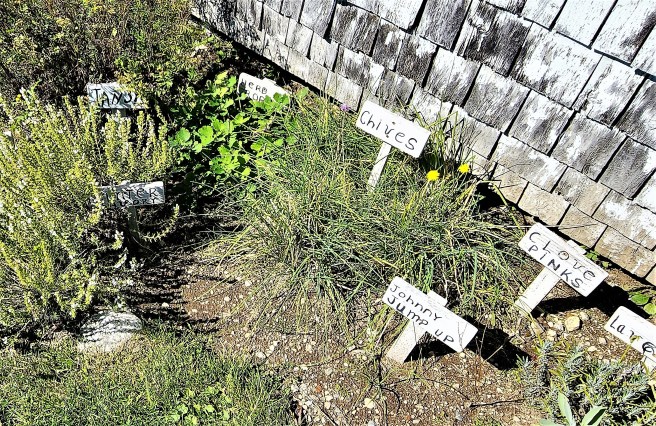
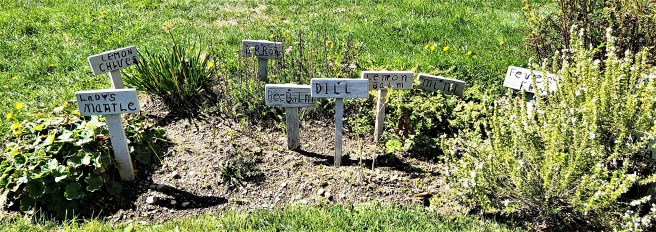
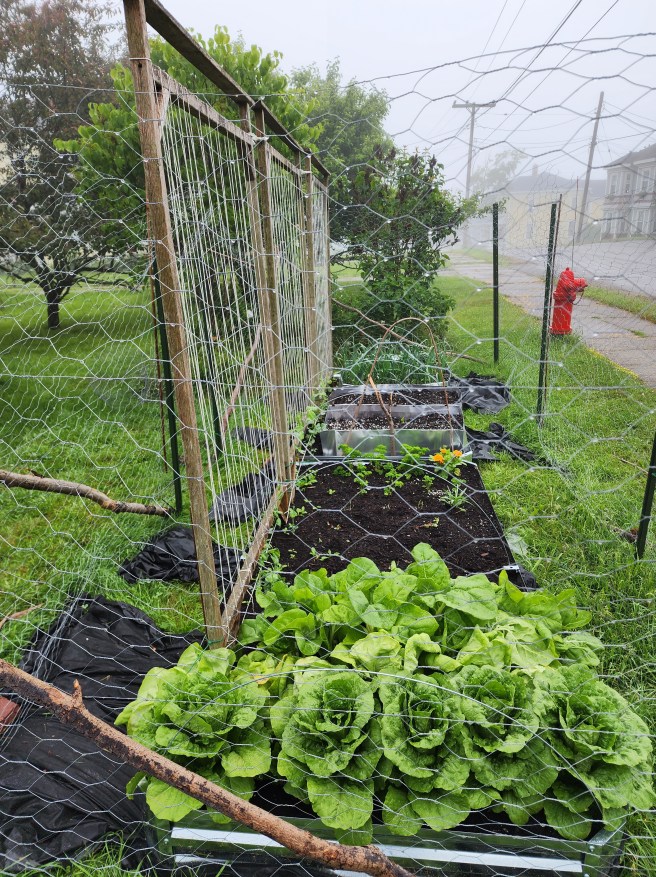
Filling the new beds with clean soil atop a landscape fabric and cardboard barrier against weeds and the tainted ground below takes shape. Our planting season here naturally runs late – early June still had overnight low temperatures in the 40s. So transplanting seedlings is running on schedule.
The plastic is to help warm the soil.
The upright frames are for peas, which will probably continue to produce through the summer, thanks to the cooler temperatures. Tomatoes, though, will be tricky.
The biggest challenge will be deer, as you’ll see.
Warning! Don’t get your soil tested. Ignorance can be bliss, until you discover you’re being poisoned.
Well, others in town told us we really should submit the samples. And then, when we opened the envelope with the results from the dirt we sent to Orono, we had to face the reality that the lead levels here are way off the charts.
It’s not just old paint, either, but decades of pesticides used on the apple trees all over the island, even before we get to the long-gone canneries. Maybe even the pearlescence factory, too.
Flowers are one thing, but what we plan on eating is another. And my wife is not only a devoted gardener but also a fabulous cook. Meaning fresh food from the garden is essential.
Contrary to the website blurb, these cannot be put together in five minutes. An hour and a half per bed is more accurate. The front yard, do note, has the best sunlight.
So here’s what’s happening. New raised beds, using kits ordered online. We went with metal, which prices out roughly about the same as wood these days and will definitely last longer. My experiences maintaining wooden frames in Dover had me leaning toward change here.
Set atop a layer of landscape fabric and cardboard to suppress grass and weeds, we then filled these with (ugh) purchased bags of soil and compost. As we were counseled, there was no guarantee local loam had been tested. We want to be safe.
Well, as she says, it’s cheaper than therapy.
Besides, we’re finding it’s generating a lot of talk around town and the conversations from the sidewalk are lively.
Now, if we can only keep the deer at bay. As they used to say on TV, please stay tuned.
I’ve come a long way from the frozen fish sticks of my Midwestern youth, OK. Seafood’s a favorite part of my cuisine, which is one more reason I love living in coastal Maine. But I still have trouble telling one species from another.
So here are some starting points.
Most fish fall under the taxonomic group Osteichthyes, or bony fish, meaning they have skeletons composed of bone tissue. With a diverse range of 20,000 or so species, it’s the largest group of vertebrates today and is comprised of both freshwater and saltwater members.
That contrasts with the Chondrichthyes, which have skeletons composed primarily of cartilage. This group includes sharks, rays, skates, and sawfish – saltwater species of saltwater vertebrates with jaws, paired fins, and other distinctions.
Jaws on fishes, by the way, are not connected to their skulls. Instead, they can shoot their mouths forward to capture prey, like a kind of spring.
Fish breathe oxygen, not air. The fine blood vessels of their gills diffuse the oxygen to the fish’s membranes. In contrast, mammals rely on lungs.
Since fish don’t have eyelids, except for sharks, you can’t say they sleep, but most of them do rest, either floating motionless, wedging themselves into a safe place, or even building a nest. But they do remain alert to danger.
Tunas, billfish, and certain sharks are the speed champions, reaching 50 miles an hour in short bursts. In contrast, some strong swimmers maintain five to ten mph in cruising.
Fish would suffocate if they tried to chew their food. So some, like sharks, have sharp teeth to hold their prey until they can swallow bits or parts whole. Bottom dwellers have large flat teeth to grind the shellfish they consume. And the herbivorous grazers lack jaw teeth but have tooth-like grinding mills in their throats.
The organs of some fish are poisonous to man, while others become toxic because of compounds in their diets. Most of what fishermen catch, however, can be considered edible. I suspect that doesn’t always translate, though, as tasty.
Truly fresh fish is odorless. The “fishy” smell comes from deterioration, typically when they’re not stored or preserved correctly.
To hold their place in a school, fish use their eyes and a row of pores along their sides running from head to tail, called a lateral line. Special hairs in the pores sense changes in water pressure from other fish or predators. And some schools contain millions of individuals. So far, I’ve heard of no teacher at the head of the class. Do fish even have leaders?
For the record, neither starfish nor jellyfish are fishes.
Best wishes to the owners of Café Nostimo in Portsmouth, New Hampshire, who have just announced that they’re closing their Greek restaurant at the end of today after 16 years in business. Time to retire. We can understand that, especially the part about working nights and weekends.
Theirs had become a must-stop on my return trips to the Seacoast region, and I was looking forward to indulging myself next Wednesday, before my Quaking Dover presentation at the Dover Public Library.
Wish I’d known about the place pre-Covid, when I lived in nearby Dover. I had heard that some nights even had Greek dancing. The restaurant did have a large tent pavilion beside it for summer dining and more.
Lamb shank was top-of-the-line, but their gyro wrap was heavenly. I could argue about some details elsewhere, especially in comparison to a favorite version in Watertown, Massachusetts, but their desserts lineup was unbeatable.
I’m viewing this like a great dinner and the time you look at the empty plate while you’re full of happy memories.
As the translations on their wall proclaim, Yamos! And: Epharisto!
As we New Englanders call the latter for a malted milk, not a shake.
Now I’m finding malt’s even an elusive ingredient in Worcestershire sauce. Along with the anchovy, which can spur a second “fond of the flavor” response.
It was fairly common in the wild when I was growing up in the Midwest, and its red roots and polymorphic leaves of one, two, and three lobes all on one tree made it distinctive. But the tree is rather rare where I’m now living.
It does, however, play into my Quaking Dover story, as I’ll explain.
Here are ten things of note about sassafras.
Found in the eastern North America and East Asia, the tree can grow to somewhere between 60 to 100 feet in height (the maximum keeps growing in the versions I’m encountering), though I associate it mostly with shrubs in the forest undergrowth. For others, it was seen as an aggressive plant quickly cluttering old fields.
Traditionally, it was famed as spring tonic in the form of tea boiled from its dark red, aromatic roots, although the leaves and bark can also be used. More recent research cautions not taking it for more than a week, and it was pulled from commercial markets after experiments in 1960 found that safrole, a compound prominent in its volatile oils, caused liver cancer in rats and mice.
Commercial oils used today in foods, cosmetics, and soaps are safrole-free and safe for consumption.
Root beer, a popular soft drink, was traditionally made from sassafras roots, often cooked with molasses. Charles Elmer Hires, the first to successfully market the brew, was a teetotaler who wanted to call his extract “root tea” but found it sold better among Pennsylvania miners as “root beer.” And, for the record, it was long used to brew a backwoods beer.
French Acadians relocating to Louisiana discovered its spice qualities from the Native Choctaws. Its dried lemony-scent leaves are ground to create filé powder, a green aromatic dust that thickens Cajun gumbos or is later sprinkled atop the dish.
Its blue berries on red stems, forming early in the fall foliage season, provide a high-energy food for migratory birds on their long southward flight. The birds are attracted to the color.
The tree’s leaves turn a spectacular variety of purple, orange, yellow, and red. That alone earns it consideration in landscape design.
The straight-grained, durable wood was commonly used to make horse-drawn sleighs, though the runners were usually hickory, a harder substance. Sassafras has also been popular in making buckets, cabinets, cradles and other furnature, woodwork, and even utensils such as spoons.
Native Americans valued sassafras in a range of medicinal uses, including a poultice for open wounds. Fascinated by the applications, Europeans soon attributed the exotic plant with supernatural qualities, including the retardation of age, making sassafras a rival to tobacco in importance as an export from America.
How medicinal? It was the reason 23-year-old Captain Martin Pring, in 1603, became the first European to lead an exploration of the Piscataqua River. Sassafras was valued as a cure for the French pox, which you may recognize as the name the English and others called what we refer to as syphilis. (If only it had actually worked.) Failing to find many of the trees in today’s Dover and vicinity, he sailed on to encamp at Truro on Cape Cod, where he indeed harvested sassafras but was interrupted when his rude behavior greatly upset the Natives, making for one of the first sour episodes in English relations with the New World locals.
This very sharp two-blade knife, designed for use on grapefruit, has become a favorite of mine. As a Christmas present however many years ago it was intended as something of a joke. We didn’t have tons of extra room in the old place, and since the move, we’ve been seriously downsizing from that.
But it does the job so well it has made the cut, as they say.