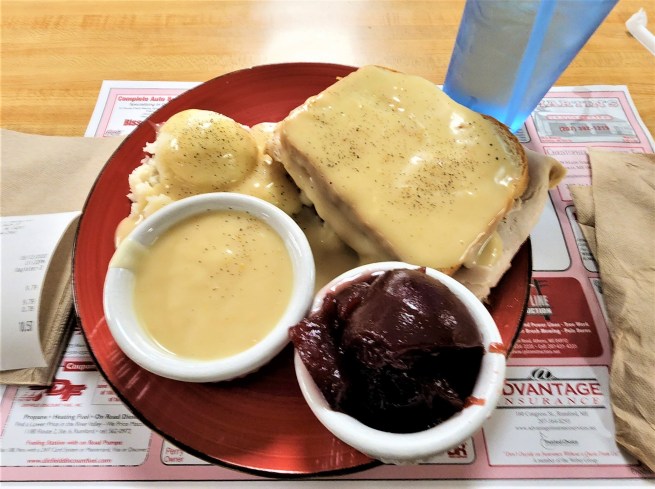
Open-face hot turkey sandwich at a great diner-style eatery in Mexico, Maine.
What’s high on your comfort food list?
You never know what we'll churn up in cleaning a stall
Open-face hot turkey sandwich at a great diner-style eatery in Mexico, Maine.
What’s high on your comfort food list?


Best wishes to the owners of Café Nostimo in Portsmouth, New Hampshire, who have just announced that they’re closing their Greek restaurant at the end of today after 16 years in business. Time to retire. We can understand that, especially the part about working nights and weekends.
Theirs had become a must-stop on my return trips to the Seacoast region, and I was looking forward to indulging myself next Wednesday, before my Quaking Dover presentation at the Dover Public Library.
Wish I’d known about the place pre-Covid, when I lived in nearby Dover. I had heard that some nights even had Greek dancing. The restaurant did have a large tent pavilion beside it for summer dining and more.
Lamb shank was top-of-the-line, but their gyro wrap was heavenly. I could argue about some details elsewhere, especially in comparison to a favorite version in Watertown, Massachusetts, but their desserts lineup was unbeatable.
I’m viewing this like a great dinner and the time you look at the empty plate while you’re full of happy memories.
As the translations on their wall proclaim, Yamos! And: Epharisto!
Perhaps in ale, lager, or a frappe?
As we New Englanders call the latter for a malted milk, not a shake.
Now I’m finding malt’s even an elusive ingredient in Worcestershire sauce. Along with the anchovy, which can spur a second “fond of the flavor” response.
It was fairly common in the wild when I was growing up in the Midwest, and its red roots and polymorphic leaves of one, two, and three lobes all on one tree made it distinctive. But the tree is rather rare where I’m now living.
It does, however, play into my Quaking Dover story, as I’ll explain.
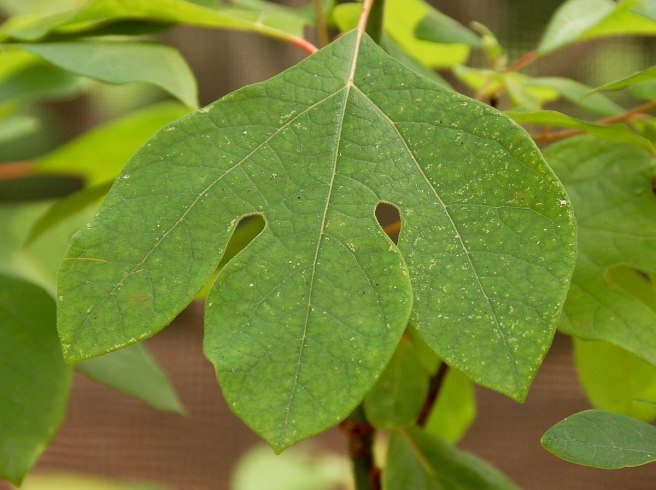
Here are ten things of note about sassafras.
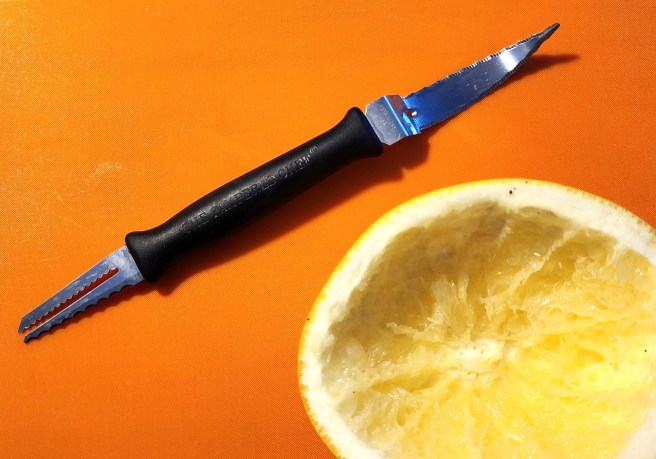
This very sharp two-blade knife, designed for use on grapefruit, has become a favorite of mine. As a Christmas present however many years ago it was intended as something of a joke. We didn’t have tons of extra room in the old place, and since the move, we’ve been seriously downsizing from that.
But it does the job so well it has made the cut, as they say.

Eastport was once the sardine capital of the world.
I’m wondering if I’m supposed to eat these with Raye’s mustard sauce.

It’s really elegant thin glass that turns iridescent when light strikes through it, with or without the martini.
It and a set of metal olive skewers came wrapped at Christmas and have been duly admired and enjoyed since.

Love their fresh rye bread, if I can get down there in time on the weekend.
It makes great toast and croutons, in addition to marvelous sandwiches.
For most of my life, I never would have thought sauerkraut could rise any higher than maybe a gag-inducing edible in an obligatory sort of way. You know, like liver. Something in some households you might be required to eat on New Year’s Eve to assure a good 12 months ahead. Think of lutefisk (lye fish) in Nordic cultures as a parallel.
Well, my best friend’s parents, of good German Lutheran stock, made their own, but they also composted for their garden, and back in the ‘50s, that seemed pretty weird.
I am convinced that there are certain dishes that will never become acquired tastes to some or even many tongues. (Feel free to make nominations here.)
That said, imagine my surprise in recent decades in discovering the joys of fine Chinese cuisine, along with the shock of learning that the filling on those snappy eggrolls and spring rolls was essentially sauerkraut, just by another name.
Maybe that set up the moment of revelation.
Morse’s in Waldoboro.
First came some nibbles after an old Mainer made his annual pilgrimage, returning with 20 or 30 pounds or so.
The taste was sweet and tangy, even refreshing. I do like pickles, but these are in a class all their own. I mean, they’re glorious. OK, I had come to prefer coleslaw with a vinegar dressing more than the conventional creamy one, so maybe that had prepared me. (Not that I turn down either.)
That’s set up our own trips in the family, including one with me in the depths of a very snowy February. The road out of the village to the store seemed to take forever, I was sure we had taken a wrong turn somewhere, but then the small store appeared, and it offered more crocks of pickled traditions than just kraut. It also had a small but very tasty German restaurant, which appears to have fallen victim to Covid restrictions. All in all, a delight.
Upshot is, it’s a dish I’ve come to anticipate each winter from our own ten-pound or so purchase.
Morse’s is, in itself, a fascinating story of a family business that’s undergone some transformations but maintains a small niche in an increasingly monolithic food industry. I have no idea if you can find it anywhere near where you live, but then maybe that might inspire another entrepreneur to rise to the challenge. Bigger is not always better.

