How the Cocheco Mills reshaped Dover

My history of Dover, focused on its Quaker Meeting, begins trailing off about the time the textiles mills prosper at the Lower Falls in the Cochecho River. There’s no escaping the fact that the mills completely reshaped the direction of the emerging city, then and now.

  1. The complex began with the Dover Cotton Factory in 1812, but the surviving buildings were constructed between the 1880s and early 20th century. The downtown is built around them. The mills even span the river below the falls.
  2. A clerical error in the company’s 1827 reorganization, as the Cocheco Manufacturing Company, dropped the second h from Cochecho, leading to ongoing confusing about the proper spelling of the river’s name.
  3. In 1828, the mill was the site of one of the earliest labor strikes in the nation, the first to be conducted entirely by women. They were protesting a pay cut.
  4. The mills brought waves of immigrants to the city, especially from Ireland, Quebec, and Greece. The complex eventually employed 1,200 workers, most of them women.
  5. At its height in the 1880s, the mills shipped 65 million yards of printed calico worldwide annually, with esteemed designs from the associated printing operation on the site of today’s Henry Law Park.
  6. The buildings were subject to disastrous fires and floods. They were also noisy and cold in winter, hot in summer.
  7. The company owned lakes upstream to ensure water power through the year.
  8. The mills operated as the Cocheco Manufacturing Company and then the Cocheco Mill Company until 1908, when the operation was bought by the Pacific Mill Works of Lawrence, Massachusetts, which shuttered everything in 1937. The buildings were then bought at auction by the city.
  9. In the early 1980s, entrepreneur Joseph Sawtelle purchased the largest vacant building in the county and began a visionary restoration that uncovered the boarded windows and led to offices, entrepreneurial incubators, and retail stores in the heart of the city. After his death in 2000, Eric Chinburg acquired the properties and added trendy apartments to the mix.
  10. The mills were placed on the National Register of Historic Places in 2014.

Check out my new book, Quaking Dover, available in an iBook edition at the Apple Store.
Even in a housing shortage

Yup, home prices went through the roof in most of the country – but not here.

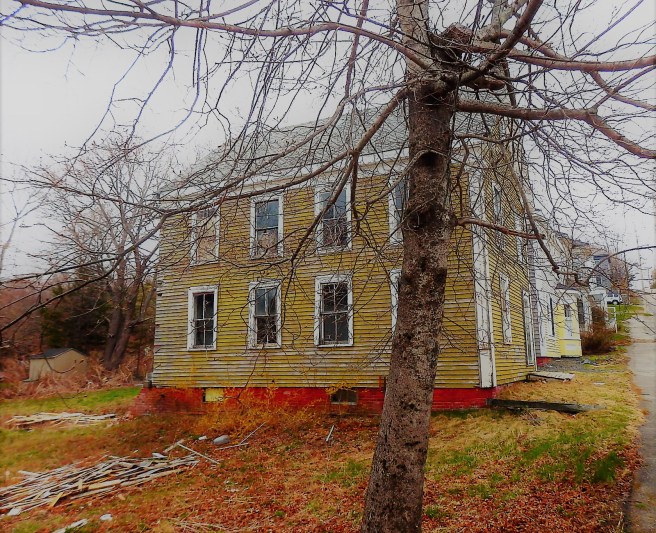
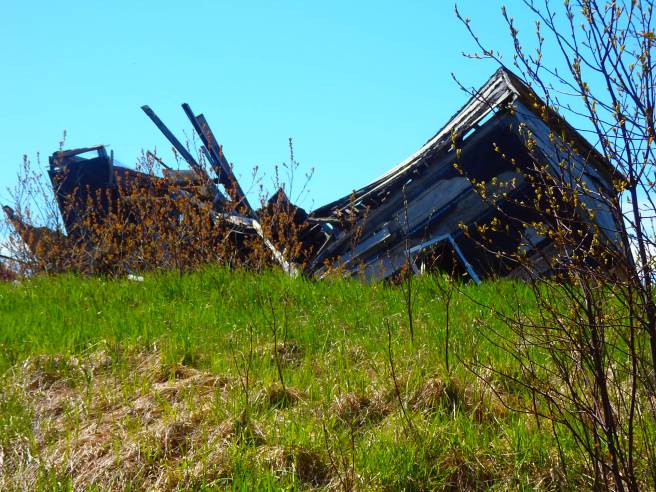
A common sight throughout Downeast Maine is abandoned housing in varying stages of decay. Seeing an old dwelling like that, your initial impulse is that somebody, somewhere, ought to save it. You know, live out in the woods, free from hassles, and all that. It’s gotta have a charming history, right?  (Rusting trailers and mobile homes somehow get less sympathy, if any.)

Abandoned housing comes in varying stages of collapse.

Then reality kicks in. Most of these would cost a ton to renovate – and many are tiny. Insulation, plumbing, and wiring are only the beginning. It’s cheaper to start fresh, if you can. Jobs are scarce, often towns away, if you can find work, so unless you’re retired, that’s another strike. And if you are retired, you might check out far to the nearest doc or clinic. I have to wonder, too, why anyone would want to live that close to the highway and its noisy traffic, other than maybe getting priority plowing after a snowfall. As for the mosquitos and black flies?

Others might tell you it gets boring. No malls or big-box stores, much less neighbors or a real supermarket.

Even as a summer home, then, there are drawbacks. Wouldn’t you rather be on a lake or the ocean?

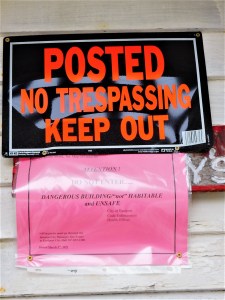
It’s not all out in the wilds, either. Eastport has three in a row here.
Each with this notice attached, declaring a building dangerous, unsafe, and not habitable.

How can anyone ever read all of what’s pouring in?

There’s just so much out there, in print and especially online, and it keeps proliferating daily, even hourly, and I don’t know about you, but I’m in the camp that finds it truly overwhelming.

Everywhere, each minute, make that second, we’re expanding outward, away, from any notion of a renaissance man, and woman, who could possibly be well informed on every facet of a civilized society.

Even in science – or maybe, especially in science – it’s become impossible to keep abreast of the flood.

Interdisciplinary collaboration has become more essential than ever, but also more elusive.

Is this leading toward disintegration?

Is this, in fact, the root of the reactionary backlash around the globe, not just the Trumpian cultists?

Yeah, the folks who rely on Fox TV biased “news” in the USA.

I look at the crises facing our children and grandchildren, and these are critical, but there are so many it’s mindboggling trying to decide where to pitch in taking a stand. Climate change, population explosion, racism, corrupt politics, the one percent and injustice, environmental protection, medical systems, education … Hey, I’m back to hippie era causes on steroids.

How are we supposed to preserve our sanity and still press toward a better future?

We still have to be informed, right? And thinking clearly?

Is there a dry cleaner in the county?

Geographically, Sunrise County is one of the largest in New England – the county line is an hour-and-a-half drive away from where I live, unless you’re going to Canada – but there are a lot of things we don’t have.

There are only three traffic lights, for instance – all in Calais en route to the busy international border crossing.

So I was wondering, just in case, where the closest dry cleaner is. We have two laundromats, but say, what if I wanted to send my dress shirts out to be washed and pressed, as I did back when working in an office?

The answer, it turns out, is forget it.

This really is a do-it-yourself kind of place.

If you’re planning on visiting, be prepared.


What’s the future of retail after Covid?

We all know the boost the Covid shutdown gave to online shopping and delivery. Ordering from the comfort of home, when everything went well, could be a pleasure. For some of us, it even meant being able to find exactly what we wanted, even after we had tried without success to find the item in a bricks-and-mortar store.

Of course, it could also be exasperating, as I discovered when a promised item failed to arrive before Christmas, even though it had been ordered more than a month before, and cancellation and refund weren’t available, due to the fine print that the product was being shipped from an independent source rather than the classy brand name. It was finally delivered in February, even after I had finally got the retailer to cancel the purchase.

As we also know, not every website is easily navigated, either.

~*~

I think about that when I look at the vacant storefronts in Eastport’s historic and charming downtown. Just what would fit in here efficaciously? Retail, of course, is the heart of it, along with a mix of offices and studios.

It’s a situation we share with many other communities, where the pleasures of being able to stroll from one option to another are countered by the expectation of easy parking. Just what do we really want or need, actually? More possessions? Services? Treats for the eyes or taste buds?

If you open a store, you’re not going to get rich at it, even though retailing requires a special insight and savvy. To be successful, you’ll also need value-added lines in ways the online rivals can’t compare. Think of the personal touch as a shopper when you’re not quite sure what you’re looking for to fix a particular problem.

Eastport has the additional complications of a small year-round population that swells in the summer, meaning the retail season can boil down to half-dozen prime weeks with a long slowdown in between.

~*~

You’ll hear people talk fondly of the old Woolworth’s or Newberry’s, with their lunch counters and swivel chairs or their extensive fabric selection or whatever, or the way these emporiums anchored the block. Not so for the dollar stores or Walmart.

I’m well into a stage of de-collection and downsizing, so I hesitate to add more possessions. Still, when I walk into a place like the Rock & Art store in Ellsworth or Bangor, I can be tempted.

Obviously, I don’t have the answer for what will revitalize the district, but my guess is that it will be an array of things not currently in our vision. Who would have thought of brewpubs a decade or two ago, for instance?

Or, as they used to say in the days of black-and-white television, “Please stay tuned.”

Murder capital of Maine

With a population of only 31,121, Washington County is essentially rural and small town. It’s 90 percent white, five percent Native American, and has a fourth of its residents over age 65.

At first glance, then, it’s not the kind of place you would expect to be suffering a homicide in each of the past six months.

The entire state reported only 22 in 2021 – two of them in Washington County, starting the six-month count. Quite simply, the county can currently be seen as the murder capital of the state.

Back in November, the victim in Machias was a 17-year-old male from New York. We could shake our heads and assume drugs had something to do with the case.

The rest, however, have been unmistakably local.

Several were domestic violence. One of those, the death of a valued employee, resulted in a family decision not to reopen a popular lobster pound in downtown Eastport, so we see these events having public consequences.

The latest instance had a 43-year-old Passamaquoddy woman as the victim and two of her neighbors arrested on homicide charges. Investigators have been unusually tight-lipped, leading to widespread speculation. Happening within a community of about 600, this takes a hard toll, ripping through at least three extended families.

The news, coming on the heels of a heavier than usual number of funerals in the tribe, adds to the grieving.

We can ask what is prompting this wave of violence and death.

Poverty is no doubt a factor. Individual and household incomes are only two-thirds of the national average, but probably skewer sharply down on one side or up the other, creating a gulch in real practice. The Covid-related closures of the international border to and from Canada have taken a toll on businesses, employment, and families, too.

The despair leads to drug abuse, as is related in everyday conversations around here.

As much as this region can be a paradise, it’s not problem-free. Not by any means.

‘Congratulations! You are qualified to get better services and a better rate.’

This is what I got in the mail from our cable company, a month or so after it had hiked our broadband fees by 30 percent. He they were now, returning with a pitch to cut the monthly bill to $5 under what we were paying earlier but with television channels included.

The first problem? We don’t have TV and don’t want it!

“Redeem your upgrade today.”

Who are they kidding? You can bet that a year from now that monthly bill will skyrocket. Trying to scale that back to where we were would be with just the broadband becomes the second, and bigger, problem.

Of course, the third problem overshadowing all of this is the inefficiency of unchecked monopoly. Where are the Teddy Roosevelt Republicans when we need them?

How do these companies justify their rates, anyway?

Imagine what Marx would have said about Putin

Or even Stalin.

The revolution was supposed to be about liberating the people, not obliterating them. Well, we have seen more than a few of them run amuck. The guillotine was one example.

As for wealth being the cause of war and class oppression?

It’s time for a devoted Marxist to stand up and expose the old spymaster. I was going to say “from the left,” but that distinction loses all meaning in our time. He’s going to brush off any criticism from capitalist countries, in part because of his Communist roots.

The tyrant’s grounding and career, let’s be clear, were largely party-line Communist, which claimed to be based on the teachings of Karl Marx. So somewhere in that philosopher’s matrix imprinted in Putin’s mindset may be the key to turning him around. Maybe even call him to repentance.

Just what manifesto is today’s czar wannabe following, anyhoo? Does anyone want to remind him what happened to the last one?

The cruise ships are coming!

As our City in the Bay has been redefining itself, in part thanks to its lively arts scene and surrounding natural wonder, tourism has been ticking up, even in the face of Covid-19.

Part of Eastport’s appeal is the deepest natural harbor in the continental U.S., a port that at one time, back when there was a lot of smuggling, was the second-busiest in the nation – something a shift in federal tax laws and heightened enforcement soon curbed.

Still, we have a long history of steamship travel, right up to the auto age.

And now, this year, hooray, we’re even anticipating the return of passenger vessels, albeit of the increasingly popular “small” ship variety rather than the floating cities that can overrun a seaport.

First, the 210-passenger, 325-foot Pearl Mist is scheduled for five visits, most of them 3½ hours ashore, as part of a seven-night round-trip out of Portland. Other stops on its Fundy Bay circuit include Rockland and Bar Harbor in Maine, and St. Andrews, St. John, and Grand Manan Island in New Brunswick. Fares run from about $4,000 and up.

Second, in September we host the innovative 530-passenger, 459-foot Roald Amundsen expedition ship on a 10-hour stopover. Originally, this was to be part of an adventurous 44-day navigation across the Arctic Ocean in a Northwest Passage venture from Vancouver, British Columbia, an ultimate bucket-list voyage. But the fares, starting around $57,000, may have been too pricy for the Covid-antsy market, causing it to be broken up into segments – the first ending at Nome, Alaska, and the second continuing from there on to Greenland and ending at Halifax, Nova Scotia. Eastport is now tucked in as the cherry in a shorter, more affordable, New England dessert.

More exciting is the news that the Amundsen is now scheduled to return next year as part of an even more audacious 94-day cruise – a Pole-to-Pole adventure that will originate in Vancouver, British Columbia, and traverse the Northwest passage before coming to Eastport and then continue on to equatorial warmth, the Panama Canal, the Pacific coast of South America, and finally shore visits on Antarctica. Think of going from icy summer to the edge of autumn in New England to the tropics and on to spring while exploring three continents. The lowest fares figure out around $600 a day.

And little Eastport will be part of that.

In Maine, the bulk of the cruise action hits Bar Harbor, at the edge of popular Acadia National Park, where frequently two ships a day debark during the summer season, and in Portland, which gets especially busy during the fall foliage season.

We’re really not set up for the mega-cruise vessels that have dominated the industry. Let’s see how our emerging niche shapes up.


Ways American democracy is increasingly at risk

Spoiler alert. This is a rant. Here are some of the places I see us as American society being in deep doodah.

  1. Out-and-out lies, delusions, and false expectations “Making America great again” has done the exact opposite. And ideological preconceptions block any reality of what needs to be done. It’s a great sales pitch, but if you’re promising to fix something, you better master the details. Think about making your car or computer or anything else run better and who you’d trust doing the job.
  2. The center is coming apart, along with the breakdown of face-to-face community. Who belongs to a lodge or bowling league or even a church anymore? Without those, just how are our opinions tested and refined? It’s part of a decline of civic awareness and participation.
  3. Refusal to give and take, i.e. compromise, to work out solutions for the common good. Health care is a prime example. Any faults with “Obama-care” can be laid at the feet of those opposed to any health insurance for Americans who didn’t have union jobs or the like. And we know who’s opposed those unions.
  4. Disproportionate representation by rural states. Not just the Senate, either, but especially the Electoral College, which was a faulty way of accommodating Southern slaveholders to begin with.
  5. Disenfranchisement of voters, one way or another. Want to talk about “stealing elections”?
  6. PACs and other big-money corruption, leading to the undermining of the middle class. It’s why the rich are getting richer.
  7. An uninformed electorate, along with the economic collapse of responsible journalism coupled with the tainting of “liberal media” by certain self-interests. Where on earth have the left-wing editorial page columnists been in the past half-century, anyway?
  8. Blaming the victims rather than the super-rich. Talk about “entitlement”? Add to that the myth of the “self-made man.”
  9. The collapse of the tax system. I’m no fan of the Internal Revenue Service, but it’s been gutted to let those with the most to get away scot-free.
  10. Without excusing the left for its too-often sanctimonious airs, I’d say the real threats are coming from an increasingly barbarian right-wing. Or should that be “anarchists”? They’re not conservatives or patriots, OK?

Look, unlike many, I’ve read the Federalist Papers closely, the arguments behind the American Constitution. I can say definitively that MAGA is dead-set against its principles.

Your turn to weigh in. Just be polite.