Now, for some ‘Bodoni-Bodoni’

Hometown News is the one novel Cassia from What’s Left didn’t press me to revise, but it got the treatment anyway. At least the title stayed the same, though the subtitle “Reports from Trump country” was added.

Political novels rarely work, so I’ve heard. And I didn’t pitch this was as dystopia, though casting the book more along those lines might have been more successful.

The book still stands apart from my others.

In the time since its first draft and my big round of deep revision, much that I had investigated only worsened. The once powerful newspaper industry was a ghost of itself, and many of the once legendary nameplates were owned by hedge funds whose owners or managers were among the world’s top billionaires. The Rust Belt communities like Rehoboth still hadn’t rebounded – their lucrative unionized manufacturing jobs were never coming back, either.

~*~

Unlike my previous newspapers, the final one I served had job security and decent wages, thanks to our Newspaper Guild representation. I finally made it to median income, even.

Socially, its newsroom broke down into three distinct circles with little overlap. There was the daytime staff, an echo from the days when we still had an afternoon edition; it was the crew that did the features and opinion pages. The nightside staff produced the next day’s daily editions right up to 1 a.m. And the Sunday News staff worked a four-day week culminating in a double shift on Saturday. We got to know each other the most through union meetings revolving around contract time.

At my first paper, where we worked into the night, the staff usually gathered at the bar next door after their shifts and stayed till closing time.

At another, where we were mostly young and without kids, it was on Friday afternoon – the POETS society, as our divorced city editor dubbed it: Piss On Everything, Tomorrow’s Saturday.

Usually, everybody lived at a distance from the newspaper plant. Few could afford the rents or mortgages in the city of publication.

I can’t speak for other office situations or professions, but I did find that close friendships were rare. You knew your coworkers more by a phrase or two they repeated or a favored style of clothing they wore or, as some of the guys seemed to do, by the kind of car they owned.

Still, things came up at parties. Consider the quip from one generally naïve woman regarding the allegator-skin cowboy boots one of the sportswriters once appeared in: “Hey, you look like a pimp. What’s up?” And then the shock we felt a month or two later when he was arrested, having procured women and motel rooms for men in the car racing circles he covered.

At these gatherings we usually huddled around the share our war stories and talk what one spouse dubbed “Bodoni-Bodoni,” after a widely used headline typeface.

Most of the papers I worked at were the smaller operation in a broader market. And I usually was part of a news team with a competitive, aggressive mindset. That part was exciting.

In the revisions, I did have a new paper to draw on, not that it was of the progressive mold I was pursing in the book. The daily interactions, though, could be just as rich.

~*~

From what I’ve seen, the situation of low-level, “shirt-sleeves” managers has only worsened across the board. Perhaps the Covid pandemic work-from-home option has eased the pressures on white-collar jobs, but that happened after my final revision.

There was little job security in working for mass-media companies. When I was with the features syndicate, I’d spend a year nurturing a relationship with the top editor, who promised to buy a certain comic strip or opinion-page columnist or weekly business report from me when the next annual budget was approved – only he was gone by then. Turnover was high, often blamed on “bad numbers” like shrinking circulation or advertising revenue. Or, in one case, because the company headquarters decided to buy a radio and TV broadcast chain.

I do wonder what happened to several of the family-owned papers I called on. They’re top editors didn’t feel a need to attend the usual annual conventions where networking occurred.

I should also mention that several of the papers I worked for did bring in management consultants, giving rise to the team in my novel. Give credit to the one that threw up its hands halfway into the projected year of monthly meetings, declaring that the news business just didn’t fit any of their models.

The Dilbert comic strip touched on many of the office realities, but at a superficial level.

Best-selling management books – Tom Peters’ In Search of Excellence, for example – were exciting but didn’t reflect the everyday realities we faced meeting hourly deadlines leading up to the big, final deadlines. The ones you didn’t dare miss by more than a few minutes.

~*~

So I made tweaks to strengthen the focus on central characters and acknowledge the big hit from the Internet.

~*~

I should say something about public misconceptions of journalists and their papers.

One colleague, who lived a block from me in the town I call Rehoboth, told of a neighbor who complained to him every time the met around the driveway. There was always something wrong with something we’d done. Finally, my buddy fired back. “What do you think the reporter of that story is paid?” The man, a steelworker, fired off a figure. “Less than half of that,” my buddy said, “and she has a Master’s degree.” The man was shocked. After that, he always had something good to say.

As for the right-wing perception of liberal bias, the reality was that many of the biggest papers were unabashedly conservative: Chicago Tribune, Los Angeles Times, Phoenix Republic, Boston Herald, Cincinnati Enquirer, Columbus Dispatch, Indianapolis Star, and probably the majority in the smaller markets. And that was before Fox.

If there’s a bias, it’s for facts rather than presumptions. The Louisville Courier Journal’s Pat Siddons, who covered Bloomington, once said. “I know I have a controversial issue right when I get complaints from both sides of a story I’m covering.”

The fact that journalists are largely low-paid, working nights, weekends, and holidays, did nothing to incline them toward big business, though. One thing we hated was injustice. Another was the lies that accompany it.

~*~

Trying to locate Rehoboth?

It was a composite, drawn mostly from the Rust Belt that extended from Philadelphia and Baltimore west to the Mississippi or so. While my book describes the steel mill that dominated the town, similar communities may have had auto assembly plants, appliance manufacturers, parts makers – the list would be long, like the empty factories they left behind. I observed large swaths of devastated industrial zones in Youngstown, around Pittsburgh and greater Philadelphia or upstate New York or Detroit – places that resembled arial bombing scenes from World War II Germany and Japan. Similar scenes existed along the Lake Michigan shoreline of Indiana, and across Wisconsin and Michigan.

I could now add to that the former papermill towns of Maine.

The fact that there’s personal breakdown as well, as I present in the story, is more than symbolic.

~*~

As for authors and books percolating through me during the final revision and later, the culture J.D. Vance describes in Hillbilly Elegy is one I knew well. Our high school basketball team played his, for one thing, and I had toured its steel mill twice as a Boy Scout. His Middletown could be one more nominee for my Rehoboth.

Add to that Ben Hamper’s Rivethead: Tales from the assembly line, David Foster Wallace’s The Broom of the System, Charles Bukowski’s fiction, a shelf of business case-studies, Kenneth Patchen’s poetry, E.F. Schumacher’s Small Is Beautiful. And Brian Alexander’s Glass House: the 1% economy and the shattering of the all-American town is high on my TBR pile.

~*~

Seeing the loss of status and influence of an independent press has been personally painful, as has the breakdown of communities despite the opportunities of small is beautiful, especially in the Midwest.

Since the final revision, one of the figures in my book, the major scumbag, really, died in a horrific late-night car crash. And pneumonia took out Major Bohroh a little over a year ago.

If I were to tweak Hometown News yet one more time, I’d intensify their evil nature.

Things that define a viable downtown

No matter how large or small a community, there’s something about having a place we know as downtown that makes a difference. It’s like a center of gravity.

Forget the big banks, jewelry stores, or medical offices that are empty at night.

Here are some elements to consider.

  1. Functioning post office. Once it moves to the outskirts, it’s curtains for many towns. Or at least did, back before email and Amazon. Well, we still need somewhere to send off those return items or to get our passports.
  2. A brewpub or microbrewery. Think about it. A social place to gather casually that doesn’t feel like a stinky dark bar.   
  3. A decent diner or coffee house. Ditto.
  4. Distinctive restaurant. Doesn’t have to be fancy but definitely worthy of a dinner date. Ethnic certainly fits here.   
  5. Hardware store, pharmacy, and grocery. Meet real-life needs.
  6. Residents: They’re what keeps the place from becoming a desert at night.  
  7. Pedestrian friendly. Keep parking at the fringe, please, or in some kind of balance.   
  8. Library. It’s not all about books.
  9. Arts opportunities. Galleries, theaters, concert venues all add vitality.
  10. Waterfront. Once scorned and polluted, a cleaned-up stream or coastline is a mesmerizing attraction. We can sit and watch the motion for hours and then feel rested.

A quick look at labor and income changes in America

Some realities and trends I find disturbing, as gleaned from Harper’s Index over the past few years:

  1. Hypothetical median income of full-time U.S. workers [2020] if income were distributed as evenly as it was in 1975: $92,000. Actual median income of full-time U.S. workers: $50,000. (Guess which direction the differential is skewered.)
  2. Percentage of U.S. manufacturing jobs that required a bachelor’s degree in 1983: 14. That required one in 2018: 31.
  3. Percentage of Americans who believe that a four-year college degree is not worth the cost: 56. (Are employers who expect a degree holder for a low-paying job getting a free ride?)
  4. Portion of all U.S. student-loan debt that is held by women: 2/3. (Does that reflect gender pay differences in similar jobs?)
  5. Percentage of unpaid taxes that are owed by the richest one percent of Americans: 70.
  6. Average percentage of their fortunes that the twenty richest Americans gave to charity in 2018: 0.8.
  7. Factor by which the average cost of a home in the United States is higher than the average salary: 8. (And the guidelines I grew up with said don’t go over 25 percent of your income. So now it’s twice that?)
  8. Percentage of Americans aged 18 to 29 who live with one or both of their parents: 52.
  9. Rank of workers 75 or older among the fastest growing demographics in the U.S. workforce: 1.
  10. Percentage increase since 2020 in the amount of work employees are doing outside of the nine-to-five workday: 28.

How are you feeling about the trial’s revelations?

You know the one I’m talking about. Even before getting to the others just ahead.

Let’s just say I’ve been watching this building up, step by step, for decades. The corruption by big money and trickery, the erosion of the middle class, the polarization, the sleaze, the breakdown of the checks and balances or a loyal opposition.

Working in the newsroom, I was bound to give both sides their voice, though one was doing everything it could to discredit us and those distortions went unchallenged. There was more, of course, going on in the dark, things we sensed but couldn’t prove outright.

Let’s just say I was outraged but had to keep it bottled up. But then, after retiring, I let it out by indulging in a stream of poetry I usually steered clear of – the polemic rant akin to Dr. Bronner’s Moral ABC or Allen Ginsberg’s The Fall of America collection or Phil Ochs’ protest folksongs.

The result is Trumpet of the Coming Storm.

While the pieces that spewed forth in my collection may look like history from the Reagan years through the Bushes, they do reflect the origins of what’s coming to a head today. Even the poems that can be considered sophomoric seem prescient.

There are good reasons I subtitled it Blasts of Alarm and Rage, 1976-2008.

Do take a look.

It’s available in the digital platform of your choice at Smashwords, the Apple Store, Barnes & Noble’s Nook, Scribd, Sony’s Kobo, and other fine ebook retailers. You can also ask your public library to obtain it.

Remembering the student strikes of ‘70

News reports of protesting students seizing administration buildings on college campuses do bring back memories, and I know I’m not alone.

While there had been earlier seizures of campus facilities in the late ‘60s at schools like Berkeley, Columbia, and Ann Arbor, Michigan, the killing of four protesters at Kent State on May 4, 1970, and two more at Jackson State on May 14 triggered student strikes across the country.

The causes ran deeper than just the ongoing warfare in Vietnam and surrounding countries, do note. My novel, Daffodil Uprising, reflects my experiences in Indiana.

The making of a hippie

While I’m not about to engage in comparisons of today and back then, I am fascinated in the focus on university funding in the current protests. My novel saw that as a crucial factor back then, too – it wasn’t just Dow Chemical, either.

Of special concern, now and back then, is the depth of frustration that finally erupts as rage and revolt. We can assume there are elements in the current actions that go back well before the current Gaza crisis, and not just in the Middle East.  They need to be addressed.

I believe that many of the problems in contemporary America can be traced back to unresolved issues from the late ‘60s For now, I’ll leave it at that.

For any of you interested, my book is available at the Apple Store, Barnes & Noble’s Nook, Scribd, Smashwords, Sony’s Kobo, and other fine ebook retailers, and at Amazon in both Kindle and paperback.

Just in time for the new political season

My series of polemic political poems – they’re not exactly protest songs, but I wouldn’t complain if they were – has moved from Thistle Finch editions to Smashwords.com, where they’re now available in a range of ebook formats, hopefully for a wider readership.

In the transition, the poems are now presented in a single volume rather than six shorter chapbooks.

These blasts of alarm and rage, 1976-2008, are an emotional mirror of events leading up to today, a not-so-distant past that’s been intensifying toward devastation. Let them stand as a call for personal honesty and engagement, too.

Take heed, if you will.

For me, this also presents the excitement of my first book release since September/October ’22, when Quaking Dover appeared. It comes with an admission that these poems are largely spontaneous, as in combustion, and sometimes sophomoric. I’ll ride with that, considering the fervor of adolescence, including ambitions.

While the poems are rooted in recent history and its headlines, they’re more pertinent than ever.

Having originally appeared as six short chapbooks, this collection is now available on your choice of ebook platforms at Smashwords.com and its affiliated digital retailers. Those outlets include the Apple Store, Barnes & Noble’s Nook, Scribd, and Sony’s Kobo. You may also request the ebook from your local public library.

Please take a look.

We’ve come to appreciate the cruise ship visits

While Eastport has the deepest natural port in the continental U.S., that’s not often led to a lot of big-ship landings.

Cargo shipments, especially, have suffered over the past decade.

Last month, though, the city saw a record number of cruise ship visits, sometimes running one every other day over two weeks.

We’re getting what’s often termed mid-sized cruises, up to a thousand passengers, in contrast to the floating cities that might deliver five times that. Frankly, mid-size fits us fine.

One factor has been Bar Harbor’s reaction to being overwhelmed, down at the edge of Acadia National Park. And Portland, further down the coast, is a big city in contrast.

As a result, Eastport is being discovered as a place that offers a taste of a quintessential Maine fishing village without the hype.

As one younger woman said while walking past our home, “Today was AMAZING!” Imagine that, in a small town seemingly so far away from anything.
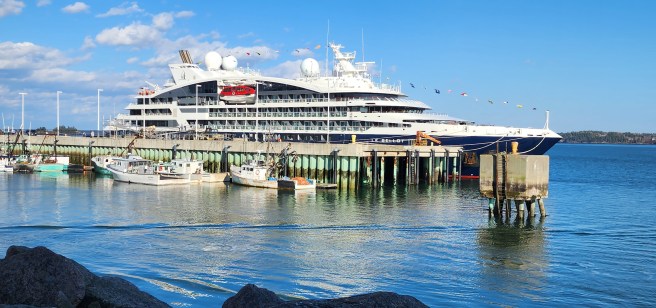
French liner Le Bellot, docked at Eastport’s Breakwater, visited town last week.

So far, these arrivals during the fall foliage season have extended our tourist season. The place typically shuts down by mid-September but these arrivals have extended that into early November. They’ve even given some, but not all, of our galleries and stores their best business days of the year. That’s a huge impact on a fragile, marginal downtown.

The landings also benefit the Breakwater and its workers, and let’s not sleight the purchases of junk food snacks at the IGA and Family Dollar by ships’ crews – sometimes up to another 600 people. They do load up.

We do enjoy seeing happy couples walking around our neighborhood with cameras in hand. Our conversations with them have been upbeat. Others have enjoyed bus tours to the Roosevelt compound on Campobello Island and the West Quoddy Light in Lubec or autumn foliage.

Economically, it’s an alternative to the Airbnb purchases that have been pulling housing away from working families, the very culture that’s a big part of the draw to our city. We do need more jobs that provide benefits, too, though that’s another big issue, one basically at the national level. I’ll save that for another time.

For now, let’s acknowledge what I’m seeing as a positive step, one that might even extend our spring shoulder season.

The one place I’ve never wanted to live was the suburbs

I love big cities, even have a certificate in Urban Studies, but can’t afford them, not for long.

Internet, at least, allows me some important virtual connections that way, not that it includes strolling into ethnic restaurants or great museums.

On the other hand, I’m living in a place others consider ideal for a vacation.

And for me, it’s an ideal writer’s retreat or de facto arts colony.

The ability to walk to so much of what I want in daily life is a huge consideration.

Our fair little city has its tribulations, too

Heaven forbid I give anyone a false impression of the place I’m now residing. With all of its isolation from much of the rest of the nation, Eastport can be way too small for many people, though for a few others that adds to the appeal, even in the depths of a very long winter, which for some of us has a charm all its own.

For a sense of our life, find and then stream the Northern Exposure television series, and throw in a demographic that skewers heavily toward retirees and too many summer people, many of whom we’d love to have year-round. We’re not even as faraway as Cicely’s Alaska, either.

One of the unanticipated dramas is at the local government level. While Eastport is organized as a city, our ruling council has had more than its share of friction going, well, far back, as reflected in the ongoing turnover of our city managers and police chiefs. Last I heard, the assessor/building code inspector was also open.

Pay scale is only part of the problem.

Council meetings are often reported, in print and by word of mouth, as contentious, so much so that one member was forced off the council altogether after obscenity-laced outbursts, another fine councilor resigned in utter exhaustion, and one resident once again started recall petitions after being cut off in public discussion.

There are good reasons a popular bumper sticker does say “Don’t New York My Eastport.” However you want to interpret it. I hope it doesn’t include poetry in our monthly open mic sessions.

Not only is there a tension between the born-and-raised here locals and those of us who are from away (PFAs), or those who pinch pennies and those who see investing in the future, the tension can be seen between paying the bills now versus long-term vision.

~*~

One bit of contention that came up since my moving here has been the painting of a downtown crosswalk by a volunteer group. Their color scheme was a rainbow, emblematic of their identity. I thought it was great, in part because drivers wouldn’t be able to overlook it. Safety first, right?

But then the blowback came, and the council backtracked.

I can understand the opposition, which saw the colors as a partisan statement, something I would resent if someone were in turn to paint a crosswalk in some kind of Trump support. Perhaps, more neutrally, a sexual abstinence outside of marriage stance? These were, in other words, gut-level issues that led to a slippery slope or the proverbial can of worms.

Not that there are easy solutions.

~*~

I’m not about to run for city council or the school board – we need younger blood than I’d offer, and someone more focused on detail than I’d muster these days.

But I’ll certainly back others who are willing to embrace the challenges openly.

How long did wooden ships last?

In one recent historical society presentation looking at locally constructed ships, we learned that a working span of 50 years or so “was a long time” for such vessels.

Many went down at sea, of course, and captains routinely expected to lose a proportion of their crew to death on each extended voyage.

I suspect hard numbers are hard to find, though I’m curious.

Besides, are there really as many retired boats propped up in yards and boatyards around here as there are people? Sometimes it seems that way.

And I can think of the remains of three sailing vessels that are visible at low tide.

So here I am, out on the waters for the better part of the week on a 152-year-old schooner, assuming that the odds are in our favor.