At Cocheco Falls

Cocheco Falls sits at the center of my small city. The tide rises and falls eight to ten feet at its base twice a day, connecting the downtown to the Atlantic Ocean 15 or so miles downstream. The river once provided the power to run textile mills that turned out world-famous calico in the 19th century. Dramatically, the river itself runs through an arch in the long building before turning sharply into an extended oxbow on its way to the sea.

Recently, the retaining wall on one side of the falls and a dam on top began to sag. The wall had once been overshadowed by another large mill that fell to fire years ago and is now a bank parking lot. Something had to be done before a cavein.

What’s going in is a whole new design, one that apparently will give people closer views of the cascading waters and the fish ladder beside it.

It’s a dramatic touch, one that reflects the magical attraction of waters in motion through the shifting seasons. Sometimes merely a trickle comes over the flashboards on the dam. Other times it’s so gushing so forcefully the entire mill building shakes.

In winter, deer have even had to be rescued from the rocks, or we’ve watched otters swimming in openings above the dam.

Who wouldn’t want to stop here for a moment?

What helps is having a vision of what a downtown can be. What’s unique to each place?

Dover’s been fortunate to have an economic development director and a city planner who find ways to get things done – often small things – as well Kiwanis and Rotary clubs and a Main Street organization that keep stepping up with improvements.

Crucially, the planning has the concept of pedestrian friendly. Or, as my wife likes to say, “civilized.” We can walk to downtown for a drink or a snack.

Not every town has a waterfall, after all. Let’s make the best of it, then.

Gone is the retaining wall that gave passersby a view of the falls from above. I’m hoping the new walkway will follow the fish ladder to the tide below.

The changing face of downtown Dover

The Robbins Block storefronts are now gone and a five-story Orpheum is rising in their place. The hardware store, lower right, is still there. From the top left are the library, community center, and district court.

When I moved to New Hampshire 32 years ago, downtown Dover – like many other city centers across northern New England – had definitely seen better days. The old textile mill dominating the heart of the city was largely boarded up, and the retail stores that remained did so out of faith and loyalty and family tradition. How could they hold out against the big-box stores at the mall?

And then along came some visionary developers like the late Joseph Sawtelle and David Bamford, as a turnaround slowly took hold. Sawtelle restored the mill as it welcomed offices and incubated entrepreneurial businesses, while Bamford rebuilt mixed-use retail and housing on Central Avenue – some of it tastefully looking more natively New England than what it replaced.

Now that I’ve been a Dover resident the past 19 years, let me say it’s wonderful living within walking distance of a living downtown, one with a small-town feel. As I tell my wife, when we venture out for a weekday brunch, many people drive halfway across the continent for this.

Big change is in the air, though. That center is shifting from being primarily a financial, retail, and office center to more of a residential destination, presumably for young adults, child-free couples, singles, and retirees – people looking for an urban setting close to the ocean and mountains.

Part of the shift has already happened with the top floors of the two biggest mills being converted to apartments, a reflection of soaring residential demand in our part of the state. But now it’s getting serious.

For a city of 30,000, having four significant and mostly residential buildings going up in the central business district is exciting, even before we get to the waterfront development about to unfold across the Washington Street bridge. (Admittedly, some of us do miss the quaint covered bridge for children and other pedestrians that was there when I moved to town 19 years ago, but I’ll go with the tradeoff – landing the children’s museum was a definite coup.)

This doesn’t just happen by accident. A lot of incremental steps over the past two decades have made this a more desirable place to live. And now it’s kicking in big time.

The former Strafford Bank building sits at the corner of Lower Square. The Barley Pub is gone, replaced by the Thirsty Moose.

KEEPING THE COMPANY IN CHECK

Across New England, the spire on city hall typically had prominent clock. Its purpose, I’m told, wasn’t just civic pride.

No, it was to keep the mill owners in check, just in case they were tinkering with their own clocks to squeeze unpaid time out of their workers.

It’s comforting to know the town fathers could stand up to corporate powers. Most of the owners, by the way, lived far from these sources of their wealth. Many of them were Boston Brahmins clustered around Harvard.

In honor of the workers and those who stand up for them, Happy Labor Day.

ALWAYS ROOM FOR IMPROVEMENT

Earlier this year, I updated the cover and tweaked the contents of my novel Hometown News.

I liked the new image, of a house on fire rather than one of a girl in autumn leaves. The story is, after all, about a community in crisis rather than the delights of living in idyllic repose.

The new image, however, challenged the use of placing the book title and author. The colors jump all over the place, and I just couldn’t figure out a way to drop the words in effectively. Well, you can see what I did. Still, I felt ambivalent about the results.

And then, a few weeks ago, I was looking at my revised lineup at Smashwords and sensed this one just didn’t quite match the style or tone of the others. Time for a few tweaks.

So here’s what we have now:

Hometown News

After this:

Hometown News

Which replaced this one:

Hometown News

The covers of my Smashwords editions originally paid homage to Richard Brautigan’s classic books of the ’60s, each of which had a portrait of a pretty young woman.

Any reactions?

SOMETHING MORE COMPELLING

Looking at my new lineup at Smashwords, I felt one cover just didn’t match.

The first round of my editions there had covers that were an homage to Richard Brautigan’s classic books of the ’60s, each of which had a portrait of a pretty young woman.

As I looked at the cover image, though, it felt dated. Looking closer, I realized it also didn’t reflect the edginess of the contents. I wanted something more compelling than a woman in quiet reflection.

So here’s what we have now:

Blue Rock

Rather than this:

Blue Rock

Whaddya think? For more, go to Blue Rock.

TWO TWEAKS IN THE DESIGN

As I moved from the Advance Reading Copy to the First Edition of my new novel, I decided to make two tweaks in the cover design.

The photo itself remains unchanged. It’s the typeface that altered.

When I lined the original cover up beside the covers for the related books in the cycle of Cassia’s discoveries, I realized it’s serif typeface was out of step with the sans serif on the other three volumes. As much as I love serifs (they have more character, for one thing), I also saw that a sans would have more punch on the thumbnail size used to display most ebooks. OK, so that changed.

Again, as I considered the four books together, I saw something else happening. The next book in line, Daffodil Uprising, features a prominent daffodil bloom in a bright yellow antique-style drawing. The contrast between its artwork and the photo on What’s Left works, I think, but the white title somehow felt out of step.

That’s when the thought flashed, “You idiot! It has to be yellow! Like the yolk! Like the daffodil, too!”

Here’s the progression. First, the ARC:

What’s Left

Then the sans serif:

And finally color:

What’s Left

So here you have it. Any reactions?


THE TOWER VIEW

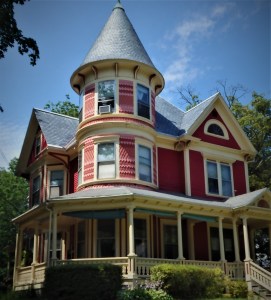
A large Queen Anne-style house with a distinctive witch’s hat tower something like this is the headquarters for Cassia’s extended family in my new novel, What’s Left. If only this one were pink, like hers.

As I viewed photographs of the kind of Victorian house her family would gravitate toward, having a round tower at one corner seemed natural – especially one capped by a pointy roof commonly called a witch’s hat. The idea of living in a tall-ceilinged attic, with its air of private retreat, holds romantic appeal anyway, but having it open out into a circle room with views overlooking the street in both directions strikes me as a plus. How about you?

Continue reading “THE TOWER VIEW”