Ten facts about the Jenny Thompson outdoor pool

Since my indoor pool pass is good year-’round, I don’t spring for an extra pass to use the city’s outdoor pool each summer. Instead, I get to go there for free during the final two weeks of the season, when the indoor pool is closed for annual maintenance and upgrades.

The outdoor pool, though, can be a glorious experience. Here are ten points to consider.

  1. Though a Massachusetts native, Jenny Thompson calls Dover her hometown. She’s among the most decorated athletes in Olympic history, having won eight gold medals among her 12 despite numerous setbacks. On top of that, she became an anesthesiologist is Boston and now works as a pediatric anesthesiologist up the road in Portland, Maine.
  2. It’s the only 50-meter swimming pool for miles around. The closest neighbor is the Raco Theodore pool in Manchester, New Hampshire, an hour to our west. The only one to our east is at Colby College in Waterville, Maine, three hours up the Interstate. And to our south, it’s the Beverly, Massachusetts, YMCA on Boston’s North Shore or, further south, at the Massachusetts Institute of Technology in Cambridge or at Hanscom in Lincoln. In other words, ain’t many of ’em around.
  3. It feels endless. A half-mile is eight laps, meaning round-trips up and back. I love hearing the rippling banners overhead in the distance, meaning I’m getting close to turning back in the other direction.
  4. It has a 10-foot-high diving board. Kids love it. Insurance companies hate anything so risky.
  5. It’s heated, except on the hottest days. Evaporation cools the water. Somehow, though, it seems to warm enough once I’m in it but still refreshingly brisk. Talk about a fine balance.
  6. Overhead, contrails of jetliners heading into Boston’s Logan airport often come a minute apart. That’s in addition to some gorgeous clouds I love to watch on my backstroke, along with the occasional bald eagles in the distance.
  7. As I just said, keep an eye open for bald eagles soaring in the distance.
  8. The Seacoast Swimming Association, which drew Thompson and her mother to Dover in the first place, is its biggest supporter – as they also do for the city’s smaller indoor pool through the rest of the year.
  9. Big swim meets take place here. Why not? From a distance, it always looks like a mob scene.
  10. The pool is 41 years old and has maintenance issues. Which leads to the next matter. Efforts are under way to replace it with a 10- to 22-lane indoor 50-meter pool. Dr. Thompson is solidly behind the effort and promises to come down often to test its waters.
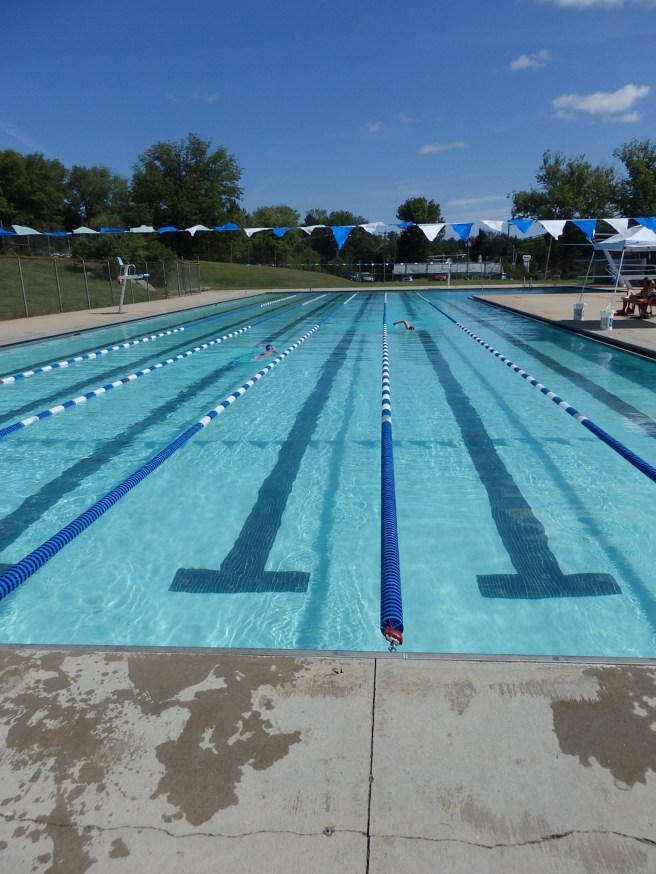
It’s longer than it looks. See the swimmers?


Dover’s new riverfront appearance and hilltop park access

Downtown Dover grew around the falls on the Cocheco River, where the mills could channel the current to produce world-famous calico and much more.

Below the falls and the dam atop them, tides from the Atlantic Ocean downstream rise and fall eight to ten feet every six hours or so. Boats from the ocean made their way the 14 miles upstream to pick up or deliver goods.

As pollution in the river has been cleaned up and the city itself become more of a center of the Seacoast Region, planners have been looking to develop an open stretch of unpaved parking lot and weeds across the water from downtown.

For years, the site was the public works yard – not the best use of potentially valuable real estate. That has since been relocated elsewhere. I’m guessing it was tannery and warehouses before that.

A proposal to build anew there fell through in the real estate collapse of the great recession at the end of the George W. Bush administration but now, a decade later, it’s emerging in new form.

Key to the design is the extension of Henry Law park along the river as a walkway with added attractions such as kayak and canoe landings. A hillside has already been carved back to allow moving an existing street away from the river to open the space for more pleasant picnicking or the strolling public.

Further on there will be room for new housing and small stores or offices. Done right, it should be quite welcoming and attractive.

Just as important, in my eyes, is the way this will open up access to an existing city park at the top of the hill. Rather than running into a dead end as it does now, Washington Street will rise up the slope to become the entrance to Maglaras Park. It will be an easy walk from downtown, rather than the convoluted route it’s replacing. Even for drivers, it’s a huge improvement.

Continue reading “Dover’s new riverfront appearance and hilltop park access” →

The changing face of downtown Dover

My small city is the seventh oldest settlement in the continental United States, not that there’s a lot left from its first century, when the place was largely on the sometimes troubled frontier of English dominion.

As a working-class mill town, it developed more modestly than more prosperous harbor towns like Portsmouth to the south or Portland to the northeast or Newburyport to the southwest.

Our downtown is catching up, though. A small but significant building boom is under way.

Continue reading “The changing face of downtown Dover” →

Bradley Commons

Not all of the development around our downtown is aimed at luxury housing.

Back in the sixties and seventies, apartments for subsidized renters were erected along the river and a steep slope on Central Avenue. A few years ago, the Woodbury Mills transformed a boarded-up warehouse into a lovely affordable housing apartment a few blocks from where I live, and a mill along the Bellamy River also underwent similar rebirth.

More recently, the three Roman Catholic churches in town were merged into one parish headed by a single priest, and one of the houses of worship, St. Charles, was facing serious structural water damage. It was sold and demolished, making room for the newest entry, Bradley Commons, about six blocks from the waterfalls downtown.

Most of this site was a parking lot, a stretch that could feel intimidating to pedestrians at night. The new Bradley Commons attempts to break up the sense of being a single building.
I am curious to see how the red facade weathers.

Polycentric community adds up

With the release of Subway Visions, I’ve been returning to considerations of urban affairs. It’s not all New York City, either, even though the novel takes place there.

For me, the big city these days is Boston. I live an hour to the north – or northeast, more technically. I can even take the train in, as well as the hourly bus, which is quite comfortable and also links us to the airport. (You’d be surprised at the number of pilots and other airline personnel who are boarding from here.)

So we can go in for concerts or museums or dim sum on weekday mornings. We’re not exactly stuck in the sticks.

On the other hand, I live in a city of nearly 30,000 – the largest of a cluster of small cities that together form a larger population base to sustain our varied interests.

Portsmouth, 15 minutes to our south, is wealthier and more fashionable. It has probably as many restaurants per capita as Manhattan as well as several theater companies, the Music Hall, and art galleries.

The state university is ten minutes to our west, and about a third of its students rent apartments in our city. The school runs its own buses to serve them and anyone else who wants to pay to ride. Its library, of course, is a marvelous resource for independent writers and scholars.

In other words, I have no reason to feel deprived. Well, sometimes I wish the Harvard Book Store were closer or Symphony Hall. But I still have my choir in Watertown.

Looking at this has me recalling my mentor in political science, Vincent Ostrom, who coined the concept of “polycentric” to describe the overlapping jurisdictions that govern American polity. A city typically falls within a county, for instance, as well as a state and then the nation. Nowadays there may also be special districts to address things like water, pollution, or transportation needs.

As mayor of Baltimore, William Donald Schaefer took the concept in another direction by enhancing neighborhood identity and decision-making to revitalize a big city. Adjustments could be made in neighborhood settings even while having a central tax base, police and fire services, water and sewer system, and so on.

So my city has a much different identity and feel from Portsmouth or Durham or Rochester or Somersworth or the Berwicks over the state line in Maine. And yet we’re all conscious, even proud, of our identity as the Seacoast Region.

Do you see how these many circles begin to overlap, each adding to the richness we enjoy?

As the hippie phrase used to go, “Small is beautiful.” But, in this universe I’m describing, it doesn’t have to be confining or impoverishing, either.

For now, I do feel I have the best of both worlds.

Ten things we miss in Portsmouth

When I say “we” here, I’m acknowledging a widespread sense of loss voiced by friends and neighbors. Some of these places I know by reputation only, though I still see signs where they were. And others are places I valued.

When I first came to New Hampshire more than 30 years ago, Portsmouth still had a funky feel through much of its downtown. But real estate prices have been soaring, and that’s taken a toll. Ouch!

  1. The J.J. Newberry’s store. A real old-fashioned five-and-dime emporium with its classic soda fountain, knickknacks, and distinctive aroma downtown. Its closure meant many items could no longer be purchased within walking distance.
  2. Seavey’s Hardware. This was one of those family-owned hardware stores where you could find just about anything you’d need if you owned an old house. They could find old fixtures in original packaging and offer it to you for a fraction of what you’d have to pay, if you could locate it at all anywhere else. Alas, when a new generation failed to step up, the buildings were sold … for a constantly changing lineup of boutiques.
  3. Ciabatta bakery and café. Yes, real bakers rising way before dawn to create artisanal breads, pastries, and cakes. And great coffee long before Starbucks was anywhere near our corner of New England. Again, owning its own building helped. But the toll of long hours with few breaks finally led its owner to move on. Boo-hoo. I see it as an emblem of many other dearly departed eateries. Sakura, a small Japanese spot, and the inexpensive Stock Pot overlooking the harbor (great pies, by the way) are two I especially miss.
  4. A real downtown grocery. I don’t remember its name, but it was handy, especially if you were about to go out on the water or wanted an impromptu picnic in the park.
  5. The Pick’n Pay. Within walking distance of downtown, this family-run grocery built a loyal following for all of its special little touches and its personal sense of a social gathering spot. Everybody seemed to know everybody, so I’m told. Many still lament its sale in 1999 to the Hannaford chain after five decades of independence.
  6. Funky, cheap stores. The storefronts have almost all gone upscale now. How many pricy clothes do people need, anyway? How many souvenirs and gifts? How many real estate brokers?
  7. The old Prescott Park arts festival. Yes, the programs continue but they just don’t seem the same. Is it the lineups? Or just us?
  8. Community spirit. Something in the laissez-faire bohemian air I recall has turned bourgeois, even puritanical. The children’s museum had outgrown its original space but was rebuffed repeatedly before leaving town altogether for Dover a few years ago (Hallelujah!), but the pattern continues. We hear story after story of sourpusses and grumblers who are upset by the ice skating rink at Strawbery Banke (it’s pure Currier and Ives, for goodness sake) or the self-deputized posse searching brown paper bags at the Prescott Park concerts and calling police. It’s the old “we got ours, now get out” attitude that will soon make the town unwelcoming even to itself.
  9. A small-town scale. One historic neighborhood, just north of downtown, that didn’t escape urban renewal long sat as a bizarre quasi mall in the middle of a big parking lot. The houses it replaced had been, I’ve heard, elaborate Victorians whose craftsmen builders had filled with stone carvings, fantastical woodwork, and fanciful windows. What was left, admittedly, was an eyesore. Initially, nobody seemed to object when plans were announced to redevelop the site. What’s gone up, though, is a few square blocks of relentless four- or five-story rectangular structures befitting a big city but alien to the architectural character it borders. These monoliths with national chain retailers and eateries on the ground floor and residential condos above just don’t fit in. Well, considering that the city also banned buses from downtown – to get one to Boston, for instance, you have to take a “cute” trolley out to the transportation beside Interstate 95 – you just might start wondering how long it will be before someone tries to convert the whole place to a gated compound.
  10. Easy parking. Yes, the parking garage has long been a sanctuary, considering the shortage of street parking downtown, but now even that’s usually overflowing, especially in tourist season.

~*~

What do you miss in a place you’ve frequented?

~*~

Well, the vibe’s right …
… even if the shots were taken on a Sunday afternoon in Tamworth, New Hampshire.


A few miles downstream

The Seacoast region of New Hampshire is dominated by a large estuary, collectively referred to as Great Bay. The waters include Little Bay and eight municipalities all pouring into the Piscataqua River with a continual strong tidal current. If you could harness that energy, you’d be a billionaire.

The bay essentially creates a peninsula with Portsmouth on the ocean side and Dover closer to the mainland. Population growth and the thriving Pease Industrial Tradeport have made the bridge linking the two sides quite congested at peak hours, especially when ski traffic or vacationers are added. One Friday afternoon in February, we got stuck in what’s too often normal these days. It took us an hour to go five miles. Look, we’re not big city. That chokes real life.

The bridge, which carries the Spaulding Turnpike and U.S. 4 before they split just beyond the northern end, is being doubled from four lanes to eight. The approaches are also being raised up to six feet as a precaution against climatic instability. Yes, storms are getting more turbulent, no matter the naysayers occupying the White House.

The bridge will make Dover more accessible to Interstate 95 in peak hours, and thus more attractive to people who hold jobs at Pease or in Portsmouth or in Massachusetts just to our south. In other words, it’s a factor in the city’s booming downtown construction to address a pressing housing demand.

Transportation, after all, is a major element in community existence.

The newly expanded bridge at Dover Point, seen at low tide from the Pisacataqua River. 
Four lanes in each direction.


Soft voices in the air

While working in the driveway, I hear a faint “Hello.” I look around and it’s repeated until I see that it’s coming from a second-floor neighboring window. It’s repeated again.

I look up and see two round faces pressed to the window screen. They resemble two little owls.

Not too long ago the two girls had been too shy to respond to my waves. But now?

Just listen. “Hello, hello.”

We’re making progress.

The breakthrough came the other morning when I waved and the older child waved back. I switched hands and waved. So did she. I used both hands. Ditto. We exchanged some other arm motions and finally a thumbs up.

Well, it brightened my day.

Ten things we still like in Portsmouth

Nearly all traffic to Maine passes through Portsmouth, a smaller but more affluent city to our south – and much of the traffic stops off for a meal or shopping break. It’s a picturesque place bordering the ocean, which makes it both a vacation destination on its own or chic place to retire. For years, it was the heart of New Hampshire’s seacoast region, although that’s shifting more and more to Dover as Portsmouth loses its blue-collar base and state university students at nearby Durham are priced out of its rental market.

Still, we heart it. Here are some reasons:

  1. The Music Hall. Within its unpretentious exterior, this restored 1878 auditorium is jewel of 895 seats and a horseshoe shaped balcony that’s become the principal venue for live music, classic and art films, lectures, and more in the seacoast region of New Hampshire. Simply stepped into the hall feels like stepping back in history.
  2. A vibrant theater scene. Despite its modest population, the Port City is home to an unexpected number of live stage companies. Our favorite is the Pontine Theater, founded by a duo in 1977. They do just about everything from writing the scripts to designing and building the sets and costumes to performing most of the shows each season.
  3. The harbor. Situated at the mouth of the Piscataqua River (with its treacherous currents), Portsmouth and Newington just upstream form the principal port of New Hampshire. The historic downtown wraps around Portsmouth Harbor, and overlooks its clutch of tugboats, commercial fishermen, ocean-going freighters, sailboats, motorboats, even yachts, plus cruises down the river and out to the Isles of Shoals or upstream to Dover (the latter limited to September and October). It’s a gorgeous view from many angles.
  4. Historic houses and neighborhoods. Like many other New England ports, Portsmouth was home to wealthy merchants and traders, and they built homes to match. A living history museum, Strawbery Banke, offers tours and programs featuring a selection of homes and small businesses from the mid-1600s to the beginning of the 1900s. The site, once scheduled for urban renewal demolition, is itself a miracle. It’s not alone, though. Spread throughout town are other historic houses open for public inspection, including the 1664 Jackson House, governor’s mansions, signers of the Declaration of Independence, the John Paul Jones House, and others. Strolling some of the side streets can feel just as impressive.
  5. Prescott Park. Set along the river adjacent to Strawbery Banke, this park is scene to a summer music and theater series, an All-America selection floral display, a lush public garden, sculpture, and dramatic views of vessels as well as the U.S. Navy shipyard and its nuclear submarines on the opposite shore. Next to the park is a small Colonial-era burial ground well worth examining.
  6. Tons of restaurants and nightlife. Downtown probably has as many eateries per capita as Manhattan, many of them veering toward upscale. It’s a constantly changing list.
  7. The new Memorial Bridge and new Sarah Long Bridge. The two drawbridges between New Hampshire and Maine have been recently rebuilt to handle more vehicular traffic and to better accommodate the oceanic freighters and barges. The new structures are pretty impressive.
  8. Third of July fireworks. With its annual pyrotechnics show the night before Independence Day, this city offers a great example of an artistic, well-planned visual production. Maybe it helps to have a central site like the park along the South Mill Pond, but this crew knows how to use the entire sky as a canvas.
  9. The Water Monkey. About the last surviving funky retail outlet downtown, which was once filled with hippie action. Lots of fun in a small space.
  10. The Brattle Organ. Said to be the oldest playable set of pipes in the country, this circa 1665 instrument was imported before 1708 for King’s Chapel in Boston. It now sits in a corner of the balcony at St. John Episcopal on a knoll downtown and is played on rare occasions. It’s a small instrument, fewer than 200 pipes. It must have been thought quite exotic at one time.

~*~

Think of a place near your home that you like to visit. Tell us one of things you find appealing.

~*~

Just to be contrarian, here’s a view of the Cocheco River just above the dam and falls in downtown Dover. The river flows right through the arch in the mill, where the tide rises and falls about eight feet every six hours. Portsmouth has nothing like this. (Photo taken from Thompson’s deck.)


On the waterfront itself

The bluff has been carved back to make room for a riverfront park by moving a road back.

After leaving the waterfall, the Cocheco River makes a sharp loop around the Washington Mill. Henry Law Park borders part of that sweep, but its public frontage is about to become three times longer.

Environmental cleanup of the river itself gave the city one more reason to move the public works department’s yard, which was around the bend, to another site, opening a choice piece of real estate at the Knuckle, where the river turns again. A marina sits on the opposite bank. Get the idea? You can sail to the ocean from here.

However, until the Tommy Makem traffic bridge was built a few years ago (any Irish music fans reading this?), the site was pretty isolated, connected by a narrow lane at the foot of a wooded bluff. The new bridge has allowed a bypass around a stretch of busy Central Avenue, but the sidewalk along the river feels pinched. That’s about to change.

The bluff has been removed. Yup. It’s been carved away to allow the street to be moved back away from the river to make room for a more pedestrian-friendly Waterfront Park at Dover Landing. Think of casually strolling or walking your dog or taking a stroller and a toddler for a walk. Maybe even just going out to sit with a book or catch a few rays on a blanket.

At the far end, down by the Knuckle, a mostly residential development will go in – behind the end of the new riverfront park. Say hi to your neighbors, that kind of thing.

The project has an additional touch. Our 29-acre Maglaras Park sits atop the slope, but getting there has required a circuitous route. That will change with the extension of Washington Street, directly linking that park to the waterfront and downtown across the river.

It will all redefine the city. Think what Central Park is for Manhattan or, closer to us, Piscataqua Park is for Portsmouth.

I’m impressed. What does your location have to offer?

Washington Street passes between two large mill buildings on its way to the new park. The stone building, upper center, is on Lower Square, where the Foster’s Place and Orpheum are rising.