Third Street

Three blocks northwest from the Cocheco waterfalls, this development is arising on a former narrow, triangular parking lot sitting between active railroad tracks and the downtown.

Having stores on both sides of the street should be more inviting to pedestrians and definitively anchor the north end of the downtown. The two buildings already make the street look more urban rather than fading away to one side.

It also gives the central business district more width than the Central Avenue spine alone. I am curious to see how it will appear fully clothed.

The Amtrak station is a block to the left, just out of sight, across from St. Mary church.

The walkway between the two buildings suggest a narrow European street to me. It does break up what might otherwise feel like a monolithic wall.
The view along Third Street.


First Street

A block upstream from the waterfall, Riparia went up a few years ago touting luxury apartments beside the Cocheco River. The project’s still looking for the right tenant on the ground floor, a restaurant or function room, most likely. These things take patience.

Riparia rises from what had been a parking lot along the river that bisects the downtown. I suppose it’s supposed to resemble an old mill – I’ve seen several in Maine that could be inspiration – but a vital downtown requires a critical population mass, and this is one more step in the right direction.

For the most part, Dover’s downtown sticks to Central Avenue parallel to the historic textile mill straddling the river. With its waterfront pathways, Riparia gives some pedestrian-friendly dimension to a sidestreet.

There were times when this would have been the ideal location for me to reside in. Just imagine, sitting on the deck on a summer evening and then stepping out on the town, for some live music or conversation, just a few blocks away. Back when I was single.

As seen from the Central Avenue bridge crossing the Cocheco River.

At Cocheco Falls

Cocheco Falls sits at the center of my small city. The tide rises and falls eight to ten feet at its base twice a day, connecting the downtown to the Atlantic Ocean 15 or so miles downstream. The river once provided the power to run textile mills that turned out world-famous calico in the 19th century. Dramatically, the river itself runs through an arch in the long building before turning sharply into an extended oxbow on its way to the sea.

Recently, the retaining wall on one side of the falls and a dam on top began to sag. The wall had once been overshadowed by another large mill that fell to fire years ago and is now a bank parking lot. Something had to be done before a cavein.

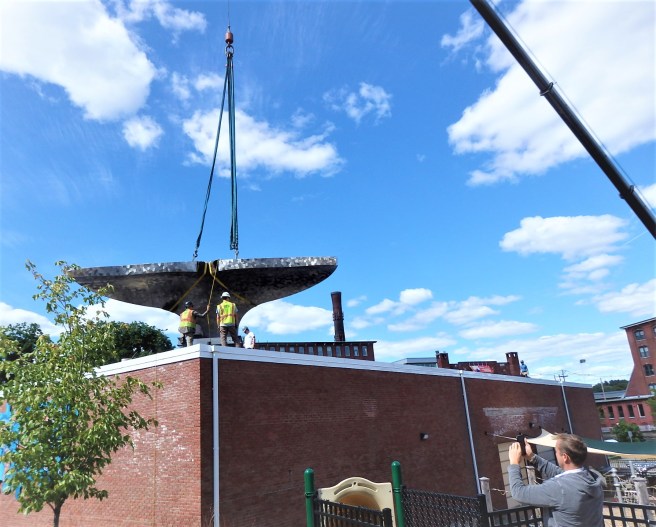
What’s going in is a whole new design, one that apparently will give people closer views of the cascading waters and the fish ladder beside it.

It’s a dramatic touch, one that reflects the magical attraction of waters in motion through the shifting seasons. Sometimes merely a trickle comes over the flashboards on the dam. Other times it’s so gushing so forcefully the entire mill building shakes.

In winter, deer have even had to be rescued from the rocks, or we’ve watched otters swimming in openings above the dam.

Who wouldn’t want to stop here for a moment?

What helps is having a vision of what a downtown can be. What’s unique to each place?

Dover’s been fortunate to have an economic development director and a city planner who find ways to get things done – often small things – as well Kiwanis and Rotary clubs and a Main Street organization that keep stepping up with improvements.

Crucially, the planning has the concept of pedestrian friendly. Or, as my wife likes to say, “civilized.” We can walk to downtown for a drink or a snack.

Not every town has a waterfall, after all. Let’s make the best of it, then.

Gone is the retaining wall that gave passersby a view of the falls from above. I’m hoping the new walkway will follow the fish ladder to the tide below.

The changing face of downtown Dover

The Robbins Block storefronts are now gone and a five-story Orpheum is rising in their place. The hardware store, lower right, is still there. From the top left are the library, community center, and district court.

When I moved to New Hampshire 32 years ago, downtown Dover – like many other city centers across northern New England – had definitely seen better days. The old textile mill dominating the heart of the city was largely boarded up, and the retail stores that remained did so out of faith and loyalty and family tradition. How could they hold out against the big-box stores at the mall?

And then along came some visionary developers like the late Joseph Sawtelle and David Bamford, as a turnaround slowly took hold. Sawtelle restored the mill as it welcomed offices and incubated entrepreneurial businesses, while Bamford rebuilt mixed-use retail and housing on Central Avenue – some of it tastefully looking more natively New England than what it replaced.

Now that I’ve been a Dover resident the past 19 years, let me say it’s wonderful living within walking distance of a living downtown, one with a small-town feel. As I tell my wife, when we venture out for a weekday brunch, many people drive halfway across the continent for this.

Big change is in the air, though. That center is shifting from being primarily a financial, retail, and office center to more of a residential destination, presumably for young adults, child-free couples, singles, and retirees – people looking for an urban setting close to the ocean and mountains.

Part of the shift has already happened with the top floors of the two biggest mills being converted to apartments, a reflection of soaring residential demand in our part of the state. But now it’s getting serious.

For a city of 30,000, having four significant and mostly residential buildings going up in the central business district is exciting, even before we get to the waterfront development about to unfold across the Washington Street bridge. (Admittedly, some of us do miss the quaint covered bridge for children and other pedestrians that was there when I moved to town 19 years ago, but I’ll go with the tradeoff – landing the children’s museum was a definite coup.)

This doesn’t just happen by accident. A lot of incremental steps over the past two decades have made this a more desirable place to live. And now it’s kicking in big time.

The former Strafford Bank building sits at the corner of Lower Square. The Barley Pub is gone, replaced by the Thirsty Moose.

Ten random bits revolving around Greek-American families

My novel What’s Left has me thinking about families – especially like Cassia’s Greek-American household in Indiana.

  1. Number of single-parent families in the U.S.: 13.7 million (27 percent).
  2. Number of Greek-Americans: 1.3 million to 3 million of full Greek ancestry estimated. (With her mixed ancestry, Cassia wound not be counted here.)
  3. Number of Greeks in Indianapolis area, 1900: 29.
  4. Number of Greek-Americans (full ancestry) in Indiana: 23,993 (2010).
  5. Number of family businesses in U.S.: 5.5 million.
  6. Greek diners: More than 600 founded in New York area between 1950 and 1970 alone.
  7. Number of diners in New Jersey: about 525 (the leading state).
  8. Greek-menu restaurants in U.S.: 3,100.
  9. First Greek Orthodox church in the U.S.: New Orleans, by 1866
  10. First Greek Orthodox church in Indiana: Holy Trinity, Indianapolis, 1910.

TEN THINGS I LIKE ABOUT REVELS

Boston Revels is an organization – maybe I should say institution – devoted to keeping community tradition alive through music, storytelling, dance, and the like. It has affiliates in nine other cities.

Here are 10 examples of its activity:

  1. The annual Christmas production. Revels packs Harvard’s historic Sanders Theatre for 17 performances of its holiday show. Each year, there’s a new theme – Renaissance Italy, Wales, Spain’s Camino de Santiago, Victorian England, Canada’s Acadians combined with Louisiana’s Cajuns, for instance – along with some crowd pleasers that can never, ever, be omitted. It’s a great way to introduce children to theater and live music and dance, but adults are all enthralled by the action. These shows sell out quickly. And one thing I value especially, there’s no mention of Santa Claus.
  2. The CDs. Revels recordings become quite a library of world music.
  3. George Emlen. The now retired music director of 34 years seemed to know all of his musicians by name – and something about their families, too. He was a wonderful, caring conductor, composer, pianist, organist, and arranger building on a unique sound for the company and helping shape the annual productions. Working in his chorus was a lot of fun. I remember hearing him converse in Mandarin with one of our altos after one rehearsal. And to think, he’d once earned his living as a blacksmith!
  4. George founded the Revels Singers, a community chorus that includes a lot of people who’ve performed in the Christmas productions. (That part’s by highly competitive auditions – thank goodness we’re open to all.) We sing quite a range, from the earliest written harmony in its Eastern European roots to South African and American shape-note and Shaker to, well, recently we were immersed in Gospel music. Our repertoire spans nearly 30 languages, and we sound incredible.
  5. Megan Henderson. Amazingly, we found a new music director who could be a reincarnation of George. As she says, We all love George.
  6. The friendships that emerge. It’s an incredible group. Sometime I might even tell you about Mike, whom I join for half of my weekly commute. He drives the Boston traffic part.
  7. Our gigs. Among Revels other events throughout the year are some for our chorus. Performances are always a revelation for me, music-making quite different from rehearsals. Each one has been memorable.
  8. Our rehearsal space. We meet in the social hall of an 1895 church in Watertown, a room with bright acoustics. The adjacent sanctuary has marvelous stained glass, including five windows by the Louis Tiffany studio, and a four-manual Aeolian-Skinner pipe organ that was left untouched in the ’60s and ’70s, when many others were reworked to match a change in tonal tastes. This one’s still mellow and sweet.
  9. Patrick Swanson. The artistic director of the operation, he developed the theatrical dimension, taking the Christmas shows from the hodge-podge of the earliest day into the sophisticated themes they now develop. It’s amazing what he and his team can do within the confines of the open Sanders stage, which was built more for lectures and maybe chamber music than for theater or dance. He has a sharp eye for detail and watches over all like a hawk.
  10. The children’s chorus. Performing with them is a delight.

~*~

What’s one of your own special group activities?

~*~

Where I live, we’ve already had our earliest sunsets. Revels celebrates the solstices and equinoxes each year.


BOTH NOVELS TAKE PLACE IN THE SAME TOWN MANY YEARS APART

My newest novels are both set in the same college town, but each one focuses on a different locale within it.

Daffodil Uprising takes place largely on the campus, and even when three of the characters move off into a shabby apartment, their focus is on college. It’s an outpost in more ways than one.

What’s Left, in contrast, settles into a neighborhood between the school and the courthouse square. The town and its university aren’t even named in this account. Instead, Cassia’s family’s restaurant is the center of attention, along with their surrounding properties. This story has a strong sense of the town itself, including the river, and the family’s impact on the community.

One thing I’ll confess is that in abstracting the location, I’ve created a place that doesn’t actually exist in the state. There’s nowhere along the Ohio River that’s just an hour from Indianapolis. Consider it as something like the visual tricks Edward Hopper performed in his paintings. Things feel right, despite the realities.

Southern Indiana, with its hills and forests, really is defined in large part by its relationship to the river. I hope I’ve heightened that sense.

CELEBRATING 50 YEARS ON A SINGLE PODIUM

Okay, I know churches don’t have podiums for their music directors, but Rick Gremlitz at First Parish Church (UCC) in our town does conduct with a short white baton. What’s amazing is that he’s been doing this, in that venue, for a half century.

Among other things, the house of worship – serving the oldest congregation in the state – has its Belknap concert series where world-renowned organists perform on a remarkable hybrid organ. Parts of it are historic, as it Hastings and Hutchins, and part are state-of-the-art electronics, probably installed during Rick’s tenure. Any doubts in my mind about the sound itself vanished when bete-noir Cameron Carpenter did one unforgettable, amazing workout on the machine one afternoon a few years ago. It survived. The audience was left in a swoon.

Look, I’m a purist and lean toward the E. Power Biggs line of thinking that contrasts sharply with the Virgil Fox excesses that Rick adores. He addresses the man as the great Virgil Fox. I forgive him. We all have our icons.

So be it.

In his ministry, Rick’s led a number of Handel Messiah performances in the sanctuary. Last year it became an open sing with prepared soloists and two guest conductors. Seated between two seasoned voices, I discovered that the choruses are easier than they sound, not that I was anywhere near perfect. It was a most exhilarating event.

Today, though, Rick’s acclaimed friend Hector Olivera returns to the console, with a twist.

An ecumenical community choir, including yours truly, has been rehearsing to join in the performance.

We’ll be performing the world premiere of an anthem composed by Kevin Siegfried for the occasion, and we’ve been rehearsing weekly since mid-September at the Methodist church. How can you possibly keep something like this a surprise?

We’ll see. It’s still a special occasion. And, I might add, one of the joys of living in a relatively small community.

I’m hoping it comes off well. Especially if I don’t miss a cue while we’re singing.