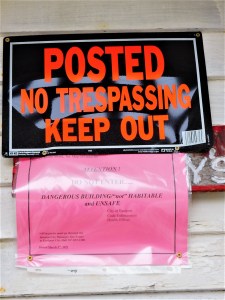
“I knew whose shirt that was“
(back when she was still living)
(as for the person who would wear it?)
You never know what we'll churn up in cleaning a stall
(back when she was still living)
(as for the person who would wear it?)
Eastport is smaller – much smaller – than the model for my fictional Prairie Depot was, and I thought that place was small. Yet somehow Eastport feels more vibrant and whole.
At least in summer.
For a little perspective, the entire winter population could ride a single New York City subway train.
It’s edged out by Vermont and is a hair ahead of New Hampshire, according to 2014 figures from Pew.
It also has the oldest population in the nation and not much in the way of other civic associations and social clubs these days, from what I see. Are people even getting together anymore? What’s been happening with traditions like hunting and fishing or the Grange?
When I say “unchurched,” I’m referring here to active attendance and membership, not the buildings, institutions, or hierarchies. It’s the interactions of a body of believers.
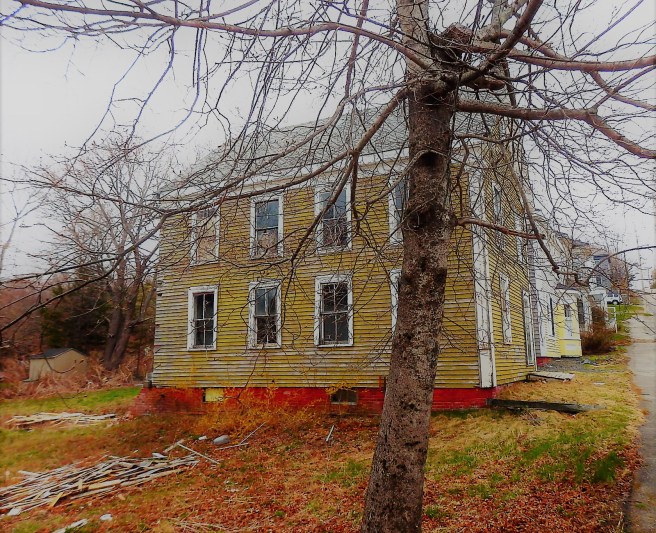
Somehow, I view the decaying landmark white churches and spires as mirroring a general decay in employment opportunities and a fraying social structure. As for families and friends? They’re not what they once were, either.
This is New England, after all, with images of Minuteman patriotism, Puritan uprightness, and democracy-in-action town meetings, not the Far West. “The way life should be,” as one of Maine’s travel slogans proclaims while overlooking some serious and troubling realities.
Are there any viable alternatives on the horizon?
How do we care for “the least among us” when we all seem to be racing to the bottom line?
Devastating downtown fires were a big hazard for 19th century American cities, large and small, from New York, Chicago, Boston, Baltimore, Pittsburgh, and St. Louis down to Portsmouth, New Hampshire, and Portland and Bangor, Maine, closer to home. (For the record, San Francisco actually suffered more from the fires than from the 1908 earthquake just before them.) It’s a long list, actually, and some center cities were leveled by flames and intense heat more than once.
Eastport was one of them, with great fires in 1839, 1864, and 1886 – the last one barely missing our house but leaving the rafters spookily charred.
That blaze, in October, started in one of the sardine factories on the waterfront and spread quickly, consuming almost every building along the harbor.

Remarkably, the city rebounded quickly, with most of the Water Street buildings completed and reopened within the next year or two – many of them designed by the same architect and resulting in a visual unity for the five-block stretch.
Today the entire downtown district is on the National Register of Historic Places.
Still, here’s what we have. Put another way, every city needs a center, and a shopping mall just ain’t the answer.


A downtown is more than a place to shop, for one thing, though that helps. It should be pedestrian friendly, with places to stop and sit and meet folks and chat or maybe just stroll afterhours. Cafes, restaurants, and pubs help, too. A post office and banks as well. Throw in a few theaters, nightspots, galleries, churches. Then offices, hair stylists and barbers, upstairs residences, even a hotel or more.


Tell us something that makes your community special. Where would you take us if we visit?
Foghorn.
Fishing boats.
Neighbor’s rooster.
Dripping coffee water.
Rabbits scratching at their cage, itchy to get out.
As for you?
When a commercial publisher issues a print edition of a new book, the process includes a long buildup. Advertising and press releases go out ahead of a release date, followed by the mailing of advance reader copies for reviewers, retailers, and involved parties to examine. The author might even be signed up and prepped for a book tour of public readings and interviews.
It hasn’t been quite that orderly for ebooks, though things are shifting.
~*~

A pre-release period is one alternative strategy. It gives booklovers an introduction to a coming attraction and an opportunity to be among the first line up for a new work, often at an attractively discounted price.
In effect, this creates two release dates – an advance ordering period followed by a second big occasion when the book itself is finally “published” and available to all. It’s one way for authors to build up a stronger initial sales tally on opening day, tweaking the important algorithms that determine the placement of the work in the digital lineup where it can be more easily seen.
Even a few buyers can make a huge difference, and this approach avoids the uneventful situation of simply dropping the book, ragtag, into the marketplace.
In my case, the big release date is set for September 8 at Smashwords and its affiliated digital bookstores, including the Apple Store, Barnes & Noble’s Nook, Scribd, and Sony’s Kobo. And until then, it’s being offered at half price.
~*~
This option also allows me time to tweak the text, if necessary, and invites you to share in building a buzz. Nothing beats word of mouth, for sure.
Quaking Dover is one work where people have told me they want to read the book when it comes out, and here’s their chance to confirm that.
So buy early and save. Pretty please?
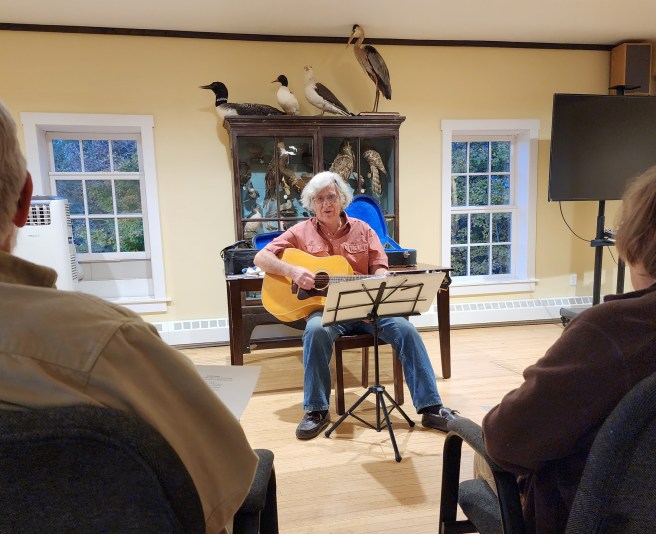
Even with the masks, it was an incredible experience. Appearing live in concert usually is.
Not every singer I’ve known enjoys performing in public, a situation that can be anxiety-inducing. Yes, even chorus members suffer butterflies. Going on stage or the equivalent is a much different encounter than singing together in a rehearsal space, perhaps even in a circle facing each other.
Wisely, our part of the program was shorter than usual, reflecting the Covid-restricted rehearsal schedule and our return after two years of distancing and general inactivity. Our vocal cords were rusty and have had to get in running order again.
Even after some of the pop standards I’d sung in the Boston Revels autumn equinox affair on the banks of the Charles River, I still didn’t expect to be performing a rock hit, much less a five-part arrangement that was mostly counterpoint with some wildly shifting time signatures. REM’s “Shiny Happy People,” anyone? It’s more sophisticated than I would have believed, even with a bass part that felt, well, like playing air bass guitar.
The Wailin’ Jennys’ “One Voice” and Eric Whitacre’s “Sing Gently” were gorgeous paeans to the art of vocal music made when we unite as one, in this case including singers and audience.
There was the premiere of conductor John Newell’s five-part memorial to longtime Eastport arts inspiration Joyce Weber, “Lux Aeterna.” I hope we did it justice.
The traditional spiritual “Keep Your Lamps” was lively fun with a bouncy piano accompaniment and some fine bass lines, something that’s not always a given.
Dan Campolieta’s passionate setting of Emily Dickinson’s “Will There Really Be a Morning” gave us males a chance to sit out and just listen.
The heart of a concert is the audience, somehow completing the art at hand and making it real. I’ll add there’s a parallel with a readership for a writer or poet or a table of diners for a chef.
The arts center’s upstairs performance space seats about 120, so we were close to an audience of family, friends, and neighbors sharing our love of making music together.
How can I not be looking forward to more?
Here’s hoping my reflections on life here at the Barn stimulate an awareness of so many of the riches around you, too.
A couple of incidents regarding my daughter’s chickens have me thinking about human affairs.
Her hens were increasingly picking on one another and squabbling until an incident with a neighbors’ dog posed a terror. In response, they instinctively banded together, including their otherwise useless rooster. For weeks after, their antisocial behavior was transformed, focused on a common enemy.
A year later, the same thing happened when a red tail hawk picked off two of the hens in the yard.
That leads to the question:
Do we humans really need some villain, however small, to make our own lives meaningful?
We see it in politics, for sure. And in sports. As for personal development and ethical living?
I am convinced we need to keep an eye on Satan, in whatever garb, but also need to be careful we don’t start “preaching for sin,” as early Quakers cautioned. The fact is that in fiction it is much easier to create a believable bad guy than a good one.
So even secular novelists must make sure to avoid exclusivity in their vision.
We also need to keep another eye on the Light and its leadings. Otherwise, well, we’d still be chickens at the mercy of foxes and weasels.
There are things I’d do differently if I were starting this blog over, but we do learn as we go.
I’d keep the merry-go-round approach but definitely tweak it. Well, the focus of the Barn has evolved over the decade, as has my life.
One of the things I didn’t know much about at the start was Categories, so the definition of some has become, shall we say, rather elastic. American Affairs is one, especially when I’m using it for a microcosm like Dover or Eastport. Still, I don’t want to create more, which I feel would lead to clutter.
Tags were even more elusive. At first, I had no clue I’d find them so useful when I turn to the WordPress Reader or to the Smashwords catalogue. Posting is another matter, where the advice is not to exceed ten per entry. Five somehow seems to be optimal. And then I chanced upon the difference between those that are what I consider factual, like the name of a state, and others that are more emotive, like “happy” or “fun” – which are supposed to get more hits. Again, how do we keep the list manageable?
So what I’d like to know is just how you use Categories and Tags, both as a blogger and as a reader. Any advice?
And while we’re at it:
Does anyone else miss WP’s daily Fresh Pressed selection? Maybe that dates me as a blogger, but it really was a great way to be introduced to new voices.