If you’re anywhere near Dover, New Hampshire, on Nov. 5, feel free to stop by the Quaker meetinghouse for the official Quaking Dover book release party.
The meet-and-greet event takes place at 7 pm at 141 Central Avenue and is free and open to the public. As a Covid precaution, we will be masking.
Copies of the book will also be available for purchase and author signing.
In the meantime, it’s release date is coming up on Saturday. Check with your local bookseller to order a copy.
One of the factors in our decision to relocate to Eastport was the quality of the local newspaper, which appears every second and fourth Friday of the month.
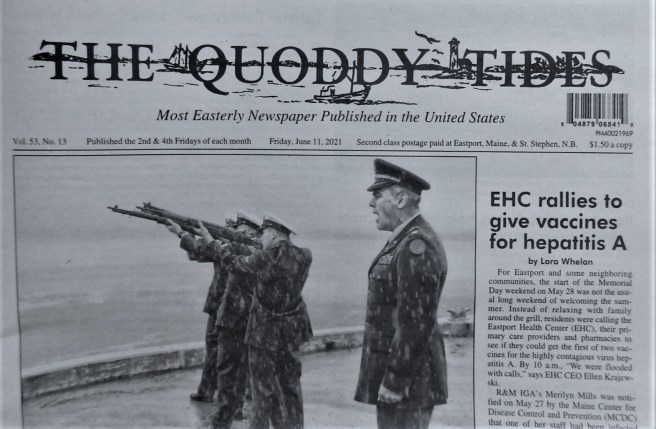
Typical front pages.
There’s nothing flashy about its tabloid-format editions, but everything I see strikes me as solid, even compelling, community journalism.
The quirky – and unique – use of Tides rather than Times in its name is not just humorous but altogether appropriate. The paper reports on all of the communities the tides touch on in Washington County, Maine, as well as many in neighboring Charlotte County, New Brunswick.
One of my ongoing criticisms of American newspapers over the past half-century is that very few of them give you a feel for the place they serve. Ownership by out-of-state corporations is only part of the problem. Continuing cutbacks in coverage is another. (I play with those and other factors in my novel Hometown News.)
For most dailies and weeklies, there’s a generic look and taste in the stories. Everybody has city-council and school-board meetings, for heaven’s sake, and most car crashes are just as boring.
Somehow, though, that’s not the case with the Quoddy Tides.
Consider the lead on a report of the start of the important commercial scallop harvest, a story that was presented on Page 2 but teased from the front page by a dramatic black-and-white photo of a fishing boat plowing through rough seas:
“Winds gusting over 50 knots did not deter many Cobscook Bay area scallop fishermen from going out on the first day of the season on December 1. About three-quarters of the fleet of over 20 draggers based in Eastport and about 10 boats from Lubec headed out that day.”
Remember, it’s not just windy with choppy surf. This is December, blowing icy water. As for a feel of the place, just listen to the quotes in the next sentence:
“Lubec fisherman Milton Chute observes, ‘The tops were blowing off the water like it was pouring,’ and Earl Small of Eastport says that while it was ‘sloppy steaming back and forth,’ once the boats were on the lee shore either off Lubec or down in South Bay, it wasn’t bad towing out of the wind. ‘It’s not as dangerous as people think,’ says another Eastport fisherman, Butch Harris, noting that two or three boats will fish together in case anyone gets in trouble. ‘It was a rough ride out, but once you’re there fishing it’s not that bad.’ Harris points out that scallop fishermen have only so many days that they’re allowed to fish. ‘If you don’t go, you lose it,’ he notes.”
Much of their quotes, I’ll venture, is pure poetry. And off the cuff, at that.
The rest of the story fills out the page, detail after detail. I bet you’ll think of some of this dedicated labor, too, next time you eat seafood.
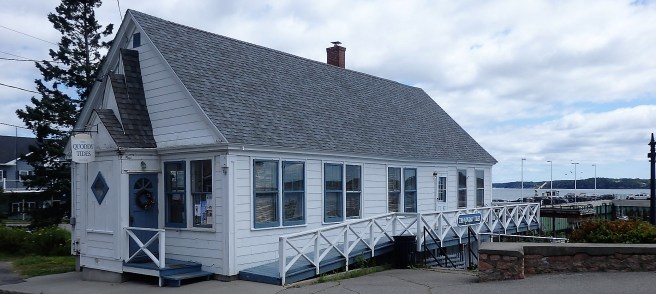
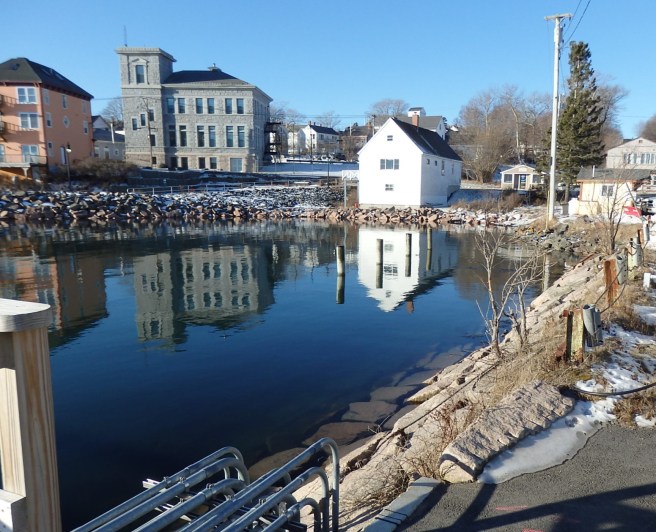
The newspaper offices occupy the 1917 Booth Fisheries headquarters downtown, once part of a sardine cannery.The building sits right on the harbor. The post office and former customs office stands to the left.
The Tides was founded in 1968 by Winifred B. French, the wife of Dr. Rowland Barnes French, M.D., and mother of five. They moved to Maine from Arizona in 1953 so he could help found the Eastport Health Center, itself a remarkable story in community medicine.
Winifred had no background in journalism, but she saw a need, studied hard, and ventured forth in launching and editing a small-town paper with a regional outlook. In 1979, for good reason, she was named Maine Journalist of the Year. Remember, the Tides isn’t a daily or even weekly newspaper, it’s every two or sometimes three weeks.
Reporters attend public meetings rather than chasing afterward by phone, correspondents provide meat-and-potatoes servings of neighborhood interest, Don Dunbar contributes top-drawer photography, and local columnists all weigh in for what becomes must-read pages throughout the area. The mix skirts the glib boosterism and doom-and-gloom morbidity too prevalent elsewhere.
Winifred died in 1995, but son Edward French and his wife, Lora Whelan, continue on her model. (Another son, Hugh, heads the Tides Institute and Museum – note that Winifred’s sense of “tides” continues there, too.)
I like the fact that the stories don’t carry datelines. Nope, the reader doesn’t get a chance to turn off on the basis of a single word. The region is closely interlinked by people living in one place and working in another or having family elsewhere, so it’s all of interest or should be – both sides of the U.S.-Canadian border.
I also like the fact that headlines come in just two sizes, with a serif face used for a touch of variety. There’s no need to scream to draw attention. Instead, we get an orderly and fair-minded sensibility.
So that’s an introduction. I could go on and on.
In some ways, it reminds me of Annie Proulx’ novel The Shipping News, without the dreariness and grimness.
Nothing flashy or sensationalized. Fits the character of the place.
One thing I would tweak is the nameplate, which goes back to the first edition. That shoreline still seems to strike out the paper’s name.
Still, it’s a joy to be retired and not have to be in the midst of producing all this. These days I do delight in being able to sit back and simply enjoy what I’m reading – even if I do on occasion feel an urge to “fix” something on the page.
What – or whom – do you look forward to reading the most? On a regular basis. (Apart from this humble scribe.)
Looking at Facebook, too many ads. Getting harder to file through to the posts by people I know or sites I follow.
In the past, I had largely ignored FB, returning sporadically, but after moving up here, where it’s like a telephone party line, back when people had landline phones, I’m finding more reasons to check in.
But not everyone, by a long shot, is hanging on to hear the gossip.
Too many ads. And maybe too much chatter.
The return was also prompted in the past year by an opportunity to catch up on a host of classmates I’d lost contact with in my moves across the continent.
That part’s been helpful.
But I’m also encountering too many folks who haven’t posted anything in three or more years. Likely haven’t checked in since then, either.
It’s like a state fair in the hippie, organic, granola-mind reality. There’s no midway with carnival rides, for sure, but for truly inquiring-minds folk, it’s an autumn equinox slash harvest-time celebration.
Yes, let’s declare a true Thanksgiving, minus turkeys.
Shortened in its post-Covid resurrection, this year’s gathering in Unity, Maine, is the premiere event of the Maine Organic Farmers and Gardeners Association (MOFGA), and runs Sept. 23 through 25.
Now that we’re living in Maine, we can identify as members and look forward to attending, even though in New Hampshire we were surrounded by devotees. Yes, it’s that boffo.
As an aside, I can attest to enjoying my best-ever souvlaki ever, from a wood stove, no less, at an earlier fair. Gee, and I hate standing in line. It was worth it.
This is definitely a hippie-vision positive manifestation of the radical mindset of nirvana. And there’s no honky-tonk.
This year’s poster will no doubt be displayed on a wall of our new abode.
Eastport’s tap water last summer took on a greenish color and a definite off-taste. It got to the point that we started running everything we’d be drinking or using for cooking through an activated charcoal filter.
The explanation was that the supply came from a large but shallow lake a dozen miles away and that every summer the algae bloomed. The private company that provides water to the city then had to heighten its use of chemicals for treatment, resulting in the offensive character.
Water to the Sipayik reservation also came from the same source but was delivered via a different pipeline and was, by reports, much more troubling.
In its attempts to redress the issue, the company announced it would be using an alternative to treat the water, and I have to say we haven’t noticed the off-taste or discoloration this year. We haven’t yet seen a chemical analysis yet, however, or heard about the current situation on the reservation.
Still, public water quality is something most Americans take for granted.
Funny how often we overlook a problem, even when it has, as I hope, been clearing up.
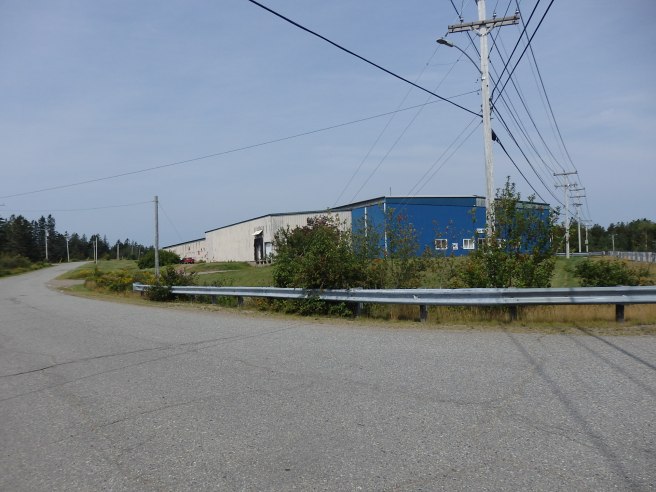
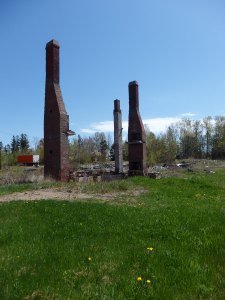
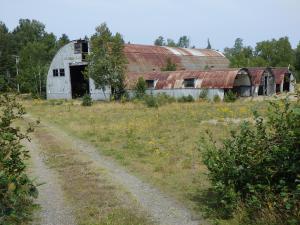
Most of Eastport’s small population resides in a semicircle around the Breakwater downtown. Quoddy Village stands apart, separated by a narrow neck around Carrying Place Cove. It also fronts Half Moon Cove, with a dead-end road to the former toll-bridge to the mainland. The place feels like an island of its own and is easily overlooked when you drive into town. The highway skirts it, and what you see is mostly former industrial, rusty, and all that.
A former factory looking for new uses gives no clue to passers-by of the residential neighborhood behind it.Chimneys are all that remain of the administrative headquarters and even a school that supported a federal project in the 1930s.
Until 1935, this was farmland, but then an ambitious but ecologically disastrous public works project took off, one to dam up most of Passamaquoddy and Cobscook bays to transform their vast tidal energy into electricity. A large but confusing working model of the engineering proposal can be viewed at the historical society’s gift shop in downtown Eastport. (The room-size three-dimensional map is water in and water out, mostly. If you don’t already know the area, it’s baffling – and the presentation is aimed at today’s tourists. I still think it would make for a really interesting model railroad layout.) The short-lived boondoggle’s most lasting contribution, apparently, was the causeway connecting Eastport to the mainland by filling in a former railroad line. No more toll bridge and longer loop. Oh, yes, and it also had a noticeable negative impact on the Old Sow, the world’s second-largest whirlpool, perhaps even pushing it more into Canada.
Significantly, the project needed housing for its estimated 5,000 workers, and that led to the construction of Quoddy Village.
Even though the plug was pulled a year later on what would have been the world’s largest tidal dam – it did require Canadian cooperation, among other things – 128 single-family, two-family, and four-family houses had been constructed, along with three large dormitories with dining rooms for single workers, plus a fire station, a hospital, a heating plant, a school, a large mess hall, and a large administration building that included a theatre, library, and sub post office. In other words, a small city unto itself. Even though the homes had been designed as temporary, many of them are still occupied today. Still, for a brief time, the village was home to a thousand people.
More evidence of abandoned projects, also seen from the state highway.
From 1938 to 1943 the National Youth Administration used Quoddy to train 800 city youth a year in vocational trades. It was also a Navy Sea Bee base named Camp Lee-Stephenson during World War II.
And then? It morphed into a residential neighborhood.
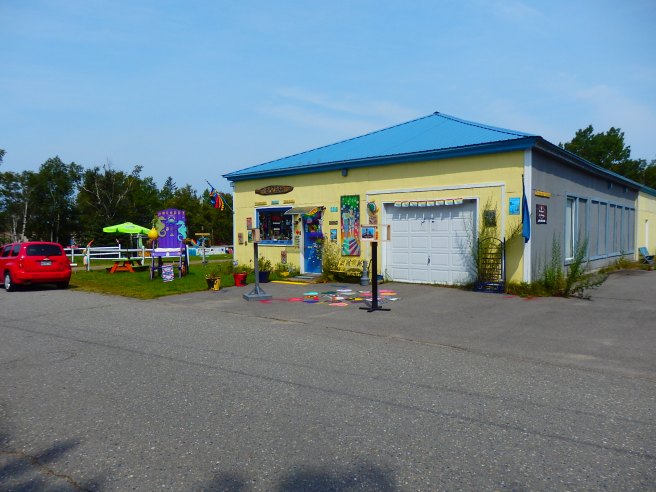
Its best-known attraction today is David Oja’s colorful and eccentric Bazaar, a gift shop that includes what’s arguably the best gourmet wine and cheese selection in Washington County. Think of it as a blast of Puerto Rico, Brooklyn, and Provincetown rolled into one. Who knows what the original function of the building was, we can be sure it was not nearly anything like this.
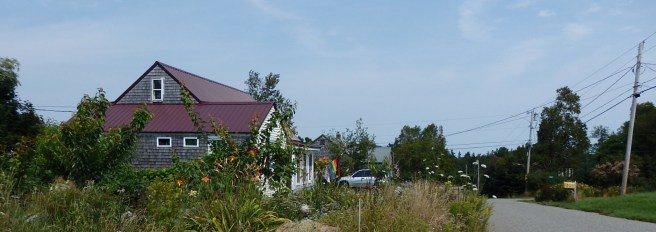
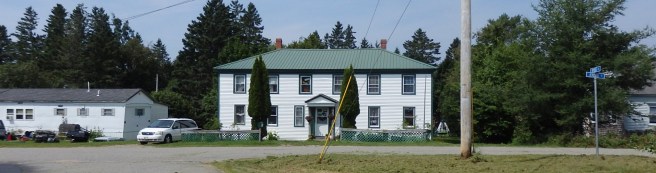
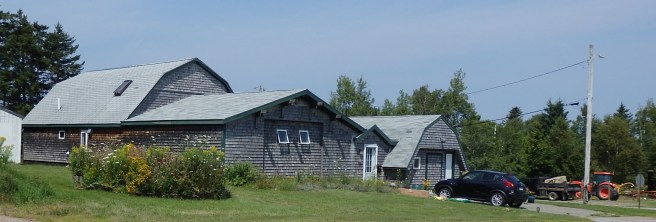
The one-of-a-kind Bazaar, seemingly out in the middle of nowhere.Today it’s mostly residential. I think of it as a small suburb.Anyone else see potential here?Yes, there’s a mix of housing, some of it from the ’30s.Much of it is also a working neighborhood. I’m all in favor of working from home, when you can.
We’ll be back in rehearsals starting Monday night, and it’s looking exciting.
Quoddy Voices will be preparing Henry Purcell’s “Ode to St. Cecilia’s Day” and works by Florence Price, Randall Thompson, and John Rutter, among others, for a program to be performed twice at the Eastport Arts Center before Thanksgiving.
Excuse me while I start vocalizing. Don’t want to sound rusty.