Our feisty orchestra has played its last concert

Last weekend the Passamaquoddy Bay Symphony Orchestra ended its run on a wild note. Our 30-some member ensemble tackled Hector Berlioz’ sprawling, opium-inspired Symphonie Fantastique in a program that also included a world premiere and a Mozart piano concerto.

It was, as usual, a daring combination.

Our sprawling county has a tad over 30,000 residents, many of them seniors, mirrored by a similar demographic in neighboring Canada. And you’re going to draw sufficient skilled musicians from that as well as a supportive audience?

Yet that’s basically what happened.

The amateur band, augmented by professional freelance “ringers,” has largely been an extension of Norwegian virtuoso violinist Trond Saevurud, its highly-charged conductor. What we’ve enjoyed are bracingly refreshing performances where impulsiveness and driving passion overcome any shortcomings in perfection or “the” definitive interpretation. It’s vibrant music-making and thrilling.

But now, after a dozen years at the helm and as the orchestra’s godfather, he’s stepping down to spend more time back home in Scandinavia.

Add to that the lingering impact of Covid, which has impaired all the performing arts. Here, the border closing cut off players and supporters on the Canadian side of the line. So much for the slogan “two countries, one orchestra.” Some musicians refused to be vaccinated and instead declined rehearsals and performances. Some concertgoers avoided live events in the intimate spaces the ensemble called home. It hurt.

A resurgence of local virus outbreaks canceled two of the three performances of a recent set of concerts, and that undoubtedly hit the finances hard. (I really was looking forward to Tchaikovsky’s first symphony, which I’ve never heard live, unlike a dozen or so renditions of his last, but I couldn’t make the remaining slot.)

That leads the PBSO to a crisis. Officially, the full ensemble is going into hiatus. Perhaps the organization can regroup, rebuild, attract a new music director, perhaps redefine itself and its mission. More likely, it will dissolve.

Locally, it’s also emblematic of how fragile our communities are. Sunrise County has high poverty levels. We’re don’t have deep pockets, either, the kind based on global conglomerate headquarters or old money. Fewer people are available for public service, especially as volunteers on city councils, school committees, town select boards, or the like.

Churches, too, are stretched thin.

You can no doubt think of many other civic interactions where you live, too.

So that’s the score for now.
Now for a word from Friends Journal magazine

A classy magazine published 11 times a year in Philadelphia and having a readership in all 50 states and 43 foreign countries has reviewed my book Quaking Dover. Yay!

As Friends Journal critic Marty Grundy asks, “What was it about Dover, N.H., on the Piscataqua River separating it from Maine, that enabled early Friends ministers to establish first a toehold and then to gather a third of the populace into the meeting, in spite of New England’s violent opposition to Quakers?”

Dover, I might venture, is way off the radar of the usual Quaker heritage addicts.

For answers, she notes, “This book offers an alternative history to the usual Puritan-centric stories,” a volume where “history is not just the result of the larger, impersonal scope of folkways, economic and political forces, or social class. It is lived by individuals who are part of families, individuals who make personal choices and influence those with whom they live. So Hodson also traces family connections showing that both a bold embrace of Quakerism and bitter persecution of the disturbers of the status quo tended to run in families.”

Yes, it is about people.

As Grundy also observes, “The book is an artifact of COVID in that it was created using what is available on the web, including secondary sources, much older published accounts, and summaries of meeting minutes … As anyone knows who has tried to do historical research recently, there is a gratifyingly wide variety of materials available electronically. Hodson has done a good job of mining; juxtaposing; and, as he says, ‘connecting the dots’ to produce a somewhat speculative but eminently well-argued and documented account,” one “also filled with verbal asides as the author comments on what he is discovering and sharing with the reader. He offers various versions of events and cheerfully acknowledges when he can’t find facts to fill in gaps.”

For the full review, see the magazine’s March issue.

My, and this was in a periodical going back only to 1827.

Just look at our new garden beds taking shape

Warning! Don’t get your soil tested. Ignorance can be bliss, until you discover you’re being poisoned.

Well, others in town told us we really should submit the samples. And then, when we opened the envelope with the results from the dirt we sent to Orono, we had to face the reality that the lead levels here are way off the charts.

It’s not just old paint, either, but decades of pesticides used on the apple trees all over the island, even before we get to the long-gone canneries. Maybe even the pearlescence factory, too.

Flowers are one thing, but what we plan on eating is another. And my wife is not only a devoted gardener but also a fabulous cook. Meaning fresh food from the garden is essential.

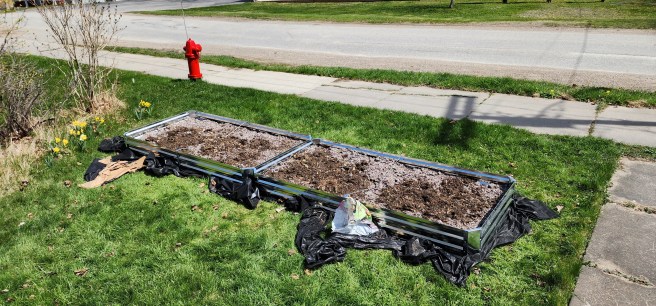
Contrary to the website blurb, these cannot be put together in five minutes. An hour and a half per bed is more accurate. The front yard, do note, has the best sunlight.

So here’s what’s happening. New raised beds, using kits ordered online. We went with metal, which prices out roughly about the same as wood these days and will definitely last longer. My experiences maintaining wooden frames in Dover had me leaning toward change here.

Set atop a layer of landscape fabric and cardboard to suppress grass and weeds, we then filled these with (ugh) purchased bags of soil and compost. As we were counseled, there was no guarantee local loam had been tested. We want to be safe.

Well, as she says, it’s cheaper than therapy.

Besides, we’re finding it’s generating a lot of talk around town and the conversations from the sidewalk are lively.

Now, if we can only keep the deer at bay. As they used to say on TV, please stay tuned.

There has to be great music

What would you look for in moving to a new community? It’s an interesting mental exercise, even if you’re staying in place.

What we’re seeing when we look at Eastport is the reality of how ephemeral much of what its attraction for us remains. Quite simply, people are a big part of what makes this place so special, and most of the population here skewers toward the gray end of the scale. Who’s in the wings to step up when they move on?

Our young director of Stage East, Mark Macey, for instance, is heading off to London on the theater fellowship. It puts a dent in the scene.

For me, having a Quaker Meeting is a central factor. Ours is small, older, and spread over a wide geographic area. It’s precious while it lasts.

And, as you’ve seen on this blog, natural wonder in the outdoors is important.

Let me add to that music, usually especially in a classical vein. Eastport is especially blessed on that front.

For example, before I had even met John Newell, his influence became a swing factor in my moving to Eastport. Other family members were already on board for relocating, but I was less ready to uproot, no matter the natural wonder of the place. But then, during a visit, I saw a poster for an upcoming Quoddy Voices concert and sensed this was no ordinary community chorus. Its repertoire was much like the one where I was singing in Boston – except that we didn’t yet have a piece in Chinese. Mandarin? (Which our conductor there did speak.) I also appreciate the fact the Down East ensemble is not auditioned and was told, at a small store downtown, that they’d likely really welcome another male voice. (Whew! I can’t imagine auditioning, only the fright.)

Flash ahead to actually living up here.

During the Covid lockdown, I joined the ensemble as it continued to rehearse via Zoom. At least it kept us in shape, and I did see how much fun everyone had together. But how would we sound when the time came?

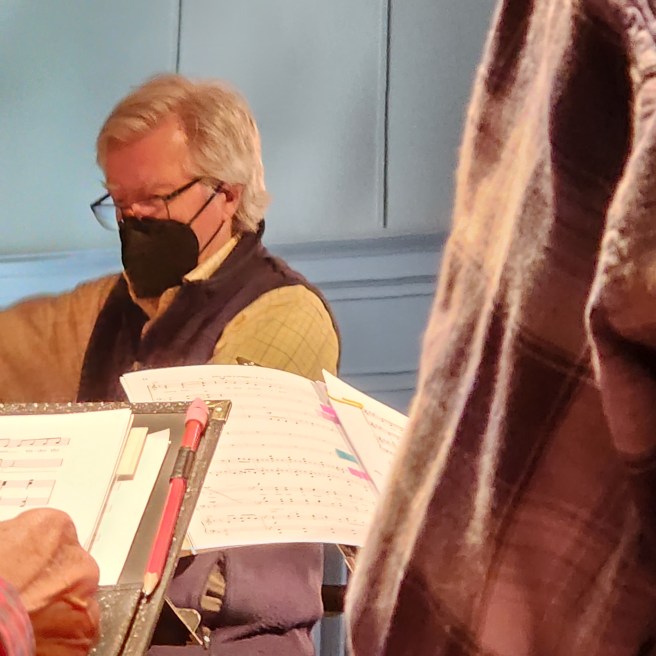
Here’s a surreptitious shot of John Newell rehearsing Quoddy Voices. We were so grateful the masks came off most of us for the actual concerts.

Quite simply, at our first in-person rehearsal post-Covid, I knew from the first two chords out of our mouths in warmup that this was home. After my first concert with the group, I especially appreciated an aside from another bass-section member, “We’re so happy to have you,” or something to that effect. It’s a much smaller chorus than my previous one, and thus more demanding.

Quoddy Voices is, of course, John’s dream and labor of love. Like my previous directors, he’s meticulous yet patient, a published composer, an excellent keyboardist, a clean conductor, and someone with fine senses of humor and delight who also genuinely cares about his singers and colleagues. (George Emlen and Megan Henderson deserve posts of their own. Note to self.)

How perfect!

But, after ten years at the helm of the chorus, he and his wife are relocating to be closer to family for much of the year.

One thing about singing together is the personal warmth people often develop. The right director can be especially admired, for many good reasons.

John will be missed, of course, and warmly remembered. Many thanks to him for all he’s given to us and the wider community.

If you want to see more of our feelings, visit the Eastport Arts Center’s Facebook site.

We do hope he’ll be back often, perhaps even singing under our next director, someone we know is also a Character in his own right.

Meanwhile, from here to September we have a gap in our Monday night schedules.

White supremacy was there all along

Maintaining a unique group identity can be perilous, no matter how necessary.

The necessity side, at its best, has to do with trying to make progress, improve justice and physical comfort, live healthier, counter the corrosive forces of status quo and lethargy, be smarter, and so on. Put it any way you want, things in general could be better, and even thinking something like that will set you apart from the status quo of broader society.

On the other hand, humans are social animals. We need others as family, friends, colleagues, cohorts. We even need them to share our stories, histories, songs, and place on this earth. Relax, right?

It’s a complex calculus, then, around the world.

What I started to see in researching my book on a Quaker community in New England, though, was a blatant arrogance within the Puritan wave of immigration. I suspect similar sides are apparent in the Spanish settlers to the south or the French to the north, or, well, back in the Old World, all the way to China. Even one tribe over another.

I’m trying to look at this clearly.

The English, of course, knew they were superior to the French, who I gather saw it the other way around. (Insert proper expletive and spit appropriately.) And they were both superior to the Spanish or Portuguese or Italians, according to this scenario.

Germans? Not really on the scene in earliest settlement in America, far as I can tell, though the Dutch of New Netherlands add their own twist.

Remember, the English also looked down on the Scots and Irish, as well as the Welsh and Cornish.

Sounds to me like the old game, King of the Hill.

The comedian Eddie Izzard has an insightful riff on this where he says it all comes down to a flag. If you have no flag, you have no claim to your country or land. So, here, I’ll stick mine in the ground and this place is mine.

That does make for a short ride on the papal Doctrine of Discovery. Look it up, if you must.

What I’ve seen in my research is how this air of superiority made equitable dealings between the Europeans and the Indigenous peoples impossible. There was no eye-to-eye even exchange. Even the concept of farming was viewed as more productive, and thus superior, than the Native hunting and gathering use of a piece of land.

Well, I could argue that God preferred a wild-game offering over grain in Cain vs. Abel, Genesis chapter 4.

You know, quality over quantity.

As for equality? We have our guns and Bibles.

Which points to another distinction: written language. I’m a writer and a reader. You expect me to not take sides here?

Still, in the New England story, the English weren’t shy about labeling the Natives as “barbarians,” “savages,” and “heathens.” Never mind many of the practices of the English and French, who not only offered bounties on scalps – Native and the other side’s European – but also indulged in the practice themselves. As for heathen? For the Puritans, with their Calvinist inclination of proclaiming themselves God’s Elect, most other Christians were also lumped in that group, perhaps at a slightly lesser degree.

Many of the consequences, however, have been tragic, for all sides.

In some theology, pride is a sin, right? Ahem. (Hopefully, in contrast to justifiable self-esteem.)

Well, as some among us might note, I’m proud to be a humble Quaker. Not that we didn’t fall into that trap of feeling superior, too.

There’s plenty of work for all to do on this issue. I’ll leave my end of the discussion at that, for now.

Attention span of sorts or shorts

Here we were, designing the newspaper of tomorrow. Meaning the next day’s editions.

As for the newspaper of the future?

Never thought it would be built around the dimensions of a computer screen or even a smart phone or have all of those links to follow.

The changing economics and business model are another subject altogether.

How are you getting your news?


Making a public presentation is a two-way affair

Feedback for an author is a vital part of the equation. Reader responses and honest reviews are more than essential feedback, they’re affirmations that others care about the subject and labor. You’re no longer alone. And often, you learn things you might not come upon by mere research.

As I found one more time, to our mutual amusement, when presenting some Maine aspects of my Quaking Dover book as a local writer in town, one early Maine family that’s spelled Treworgy is pronounced TRU-wurjee.

More or less.

Well, it was originally Cornish, by way of Devonshire, and came up to this end of the state from being among the first settlers down at the other end, right across from Dover Point.

Beyond that, writing and reading are ultimately one-on-one, despite the anonymity of the reader, who may be deeply touched personally, all the same.

That’s why it’s so meaningful when you speak up.

Add to this to our list of items made obsolescent in our lifetimes

Even before many folks switched to unlisted numbers, in part to evade obnoxious ding-a-ling solicitations, the annual telephone book began shrinking. The migration from landline to cell phones was apparently the final straw, along with Yellow Pages regulars who turned instead to website searches or FaceBook.

What was long a standard reference volume for local communities is now long gone.

When’s the last time you saw a phone book?


Looking forward to another open stage night

Here’s a shoutout to our monthly open stage at the Eastport Arts Center at 6 tonight or, if the weather’s bad, the same time tomorrow.

It’s always a lot of fun, alternating live music and spoken word. I even tried a section from Quaking Dover last month, instead of poetry or fiction, and some found my reading emotionally moving. I did bill the genre as creative non-fiction rather than history. Well, there are no footnotes and I’ve focused on the overall story and people more than mere names and dates. The reaction has me looking at additional opportunities for presenting the work.

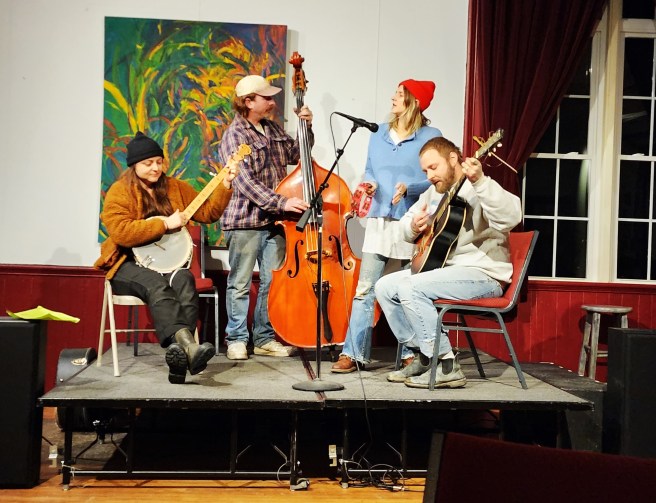
Here’s one band that showed up, and I’m hoping they’re back. They do look quintessentially Maine, and you can imagine their joyful sound.

The free event’s billed as “open mic” but I’ve long hated that spelling of “mike,” even if it’s become too widespread to counter.

Still, we had a fine turnout and went an hour longer than planned. I’d be really surprised if you wouldn’t be wowed by at least something. There’s so much talent around here.

These events leave me feeling confirmed as an author

Being invited to speak about my book, either as a solo outing or as part of a panel, is something quite new to me.

It’s distinctly different from being the featured poet at a café reading or even having a chapbook in hand for sale.

Since Quaking Dover is a factual history, the narrative ties into much more definable readerships than my novels have. I’m even able to present PowerPoint slideshows of people and places appearing in the story, and then be surprised afterward to meet descendants the families or the current residents of houses I’ve touched on.

Having a presentation be recorded and made available on YouTube, as happened through the Whittier Birthplace Museum in Massachusetts, is personally thrilling.

My previous YouTube appearance was private, for a selected audience, largely a sequence of appropriate Scripture and related images. It even had an original, emotionally moving musical score from a talented collaborator.

My face wasn’t visible there, by the way. Yes, the invisible writer as witness.

Alas, it’s gone and I do wish I had a copy.

Remember, writing is a solitary activity. Rarely do we get feedback from our finished efforts. Are we writers simply navel-gazing or do we somehow reach others, especially one on one? Have we actually been wasting our time?

In blogging, I’ll assume you, too, are a writer and know what this means.

Humbly yours, all the more.