The golden hour of late afternoon sunlight adds to the wonder.

Normally, Eastport’s waterfront would be visible from here.

You never know what we'll churn up in cleaning a stall
The golden hour of late afternoon sunlight adds to the wonder.
Normally, Eastport’s waterfront would be visible from here.
Back in my wildly ambitious youth, shortly after graduating from college, I envisioned writing a genre-bending novel blending politics and science fiction. Well, my degree was in political science and sci fi was one category of literature that had a growing readership.
My premise was space aliens dropping a young male off in an older suburb of Cincinnati, as in Ohio, where he would be groomed to run for president of the United States. With a nod toward what we now classify as AI, he would be perfectly programmed to fit the market surveys. And with another nod toward what is so-inaccurately called “reality television,” he would be given a fictional past and identity.
The working title was The Cowboy from Mars, and this was back in the early ‘70s.
~*~
I hate to admit that getting from there to an acutal campaign narrative required much more development than I was equipped to produce as an aspiring novelist, and a race for the White House could have been its own War and Peace in terms of characters and pages. Should I add that comedy is very hard to write?
Was I wrong to assume the project had potential?
Is what we’re facing today some kind of weird acid trip?
I mean, the man who presumptuously eliminated the periods from his initials for some kind of marketing vanity but grew up not that far south of me in what looks like far more privileged economic conditions now appears weirdly, well, like a silicon boob. I do hope that doesn’t offend anyone but it is the best I can do.
~*~
Looking at the current political situation has me seeing what would have been unimaginable in its absurdities. It really does seem fictional, outrageous, even tragic. It’s enough to make me wonder which candidate came from Mars or beyond.
As for those of you viewing this from outside of the USA? What are you making of it?
From what I’ve seen of the Founding Fathers of my country, I can say that they believed in rational thought. I hate to think they were wrong there.
Maybe that’s why I couldn’t write that novel.
I’ve mentioned a few others, such as the art museum, in other posts here. Now, to add a few more, in no particular order. Again, I’m looking at Greater Dayton rather than strictly inside the city limits.
My, all that was a world ago in my life.
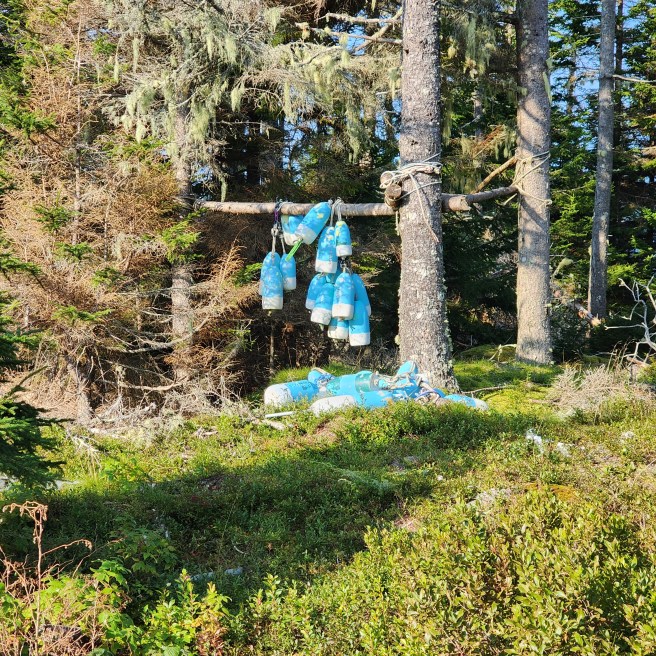
Isle au Haut, Maine.
The Dakotas, as I encountered them driving a U-Haul to Washington state, are a starkly open, even disturbing space that contrasts sharply to the expanses on either side of them. Much of my writing has included unique places as an essential element, sometimes approaching the role of an actual character.
Norris’ Dakota: A Spiritual Journey came to my attention after I had relocated to northern New England and was attempting to comprehend its unique landscapes and peoples. Her insights, with all of the directness of Midwest expression, proved helpful.
The friend who recommended – or perhaps even gifted – Dakota to me had lived as an Episcopal nun, and my ashram residency was a monastic experience, so Norris’ The Cloister Walk, following up on her introduction to a Benedictine community, was more like a dialogue. Yes, monks and nuns can be prankish and have a sense of humor, and as mystics, they’re often unexpectedly practical.
Norris was welcomed as an active Presbyterian to participate in the Roman Catholic convent without any pressure of conversion. Rather, her exchanges were mutually enhancing, akin to what both my friend and I repeatedly encountered in our own religious streams.
Building on that, Amazing Grace: A Vocabulary of Faith has been a helpful guide in translating key Christian words and expressions – jargon, if you will – in ways a wider contemporary audience might more clearly understand. I find it helpful to have at hand when writing directly about Biblical terms and thoughts.
Poets do make some of the finest prose writers, in my humble observation.
the worst of two ideas
yes, more than worse
you forker
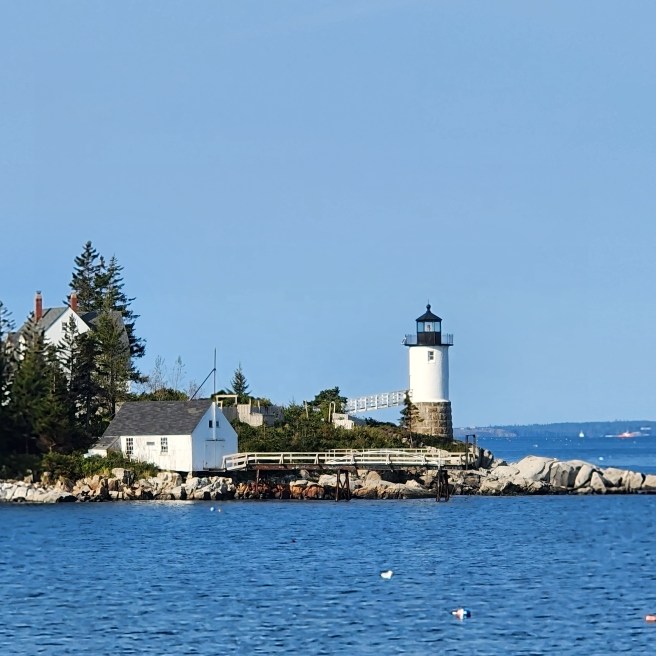
ashore in the morning
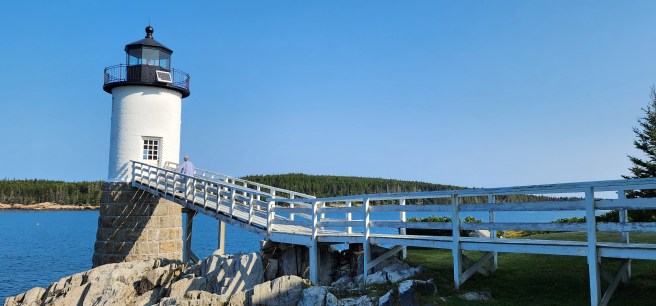
Astara and I hiked rocky shoreline
to the lighthouse
four or five intact lobster buoys tempted me
don’t find that at home
It was one of those stretches where nothing seemed to be happening. For me, that translates into stuck, or more accurately, an emotional funk.
And then, in a single day, the dumpster arrived, opening way for the big front of the upstairs demo to begin.
The plumber showed up, after a few months on a big project in the Midwest. He made necessary moves preparing the upstairs bathroom and laundry room for walling, lighting, and flooring to be finished before the toilet, bathtub, shower, sinks, and washer and dryer go in.
He also removed our one outdoor faucet, with its leaking pipe in the wall and no indoor shutoff valve, with three new spigots and lines, all of them closer to our gardens. This was a huge quality of life improvement we do enjoy right now.
Three cords of firewood were delivered, about a month after being ordered. It was our first time dealing with them, and while I wasn’t worried that they wouldn’t show up before the first snow fell, this was reassuring and I’m satisfied with the quality of their product. Now I’m spending an hour or so most days stacking it. (Let’s not overdo it, not at my age.)
We heard from the mason, who was slotting us in with other projects around town. He and a helper were on the scene a few days later to repair the top of the chimney. Added to his work were repairs to the facing on the foundation – something noted in the building inspection when we bid on the property – and several future tasks, including moving the wood stove and metal chimney to another part of the front parlor. This was our first time dealing with him, and I can say he takes pride in good work.
Our contractor installed the flooring on the deck, restoring use of the back door to us. The railing is next.
Each of these lifted another obstacle from the horizon. Each one felt quite invigorating. The deck even has us in amazement.
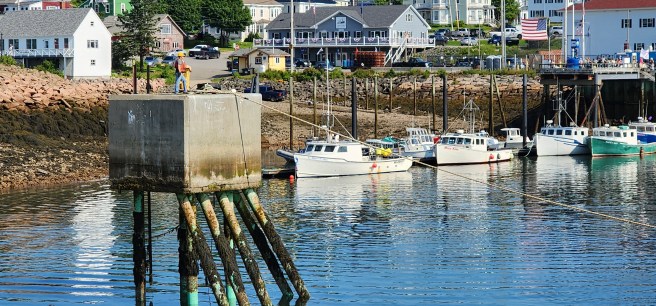 He’s waiting for the USS Oscar Austin to slacken the heavy line so he can heave the loop into the water as the destroyer prepares for departure during last year’s naval visit to town.

Here’s how it looked earlier in the week with the tide a bit higher. A worker had to haul the thick line up from the water.
I’m not sure when or where I began drafting my yoga novel or where, but I know the bones were in place before I began my self-declared sabbatical in 1986-87. Perhaps it was during my month of unemployment before landing in Baltimore. For one thing, I had revisited the ashram in the year before my big writing spree and perhaps even driven past it the previous year. I was hoping to get some answers for questions regarding my manuscript must say the encounter was unsettling. I wasn’t even allowed inside the center, and the woman who had taken over as guru declared herself too busy to say hi. A deputy was dispatched for that, with tea, while I sat beside Swami’s grave.
Well, that was a perk of being “on the road” as a newspaper features salesman, otherwise known as “field representative.” I even got my name in brochures and full-color ads in the industry magazine Editor & Publisher.
My ashram residency a dozen or so years earlier had been life-changing, but the connection broke completely when I relocated to the Pacific Northwest in 1976. Swami had demanded a large chunk of my meagre salary, and besides, I was newly married with a wife in college. The upshot, quite simply, was that I felt ostracized. I was certainly shunned it that social call. In the bigger picture, the yoga movement itself had gone into eclipse and my own spiritual journey had resettled in the Quaker vein.
Still, the yoga life in America was a largely untold story, even if it had put “karma” and “om” into the American vocabulary and mindset.
When I began drafting the book, I had no idea where everyone had scattered and had no way of contacting them. I mean, if I was ostracized, what was the point of contacting the headquarters? Did I even know that Swami had died? Perhaps, though some communication I had with someone who had been a regular guest and went from being a rock-band manager to a Messianic Christian comedian. I managed to make that connection through a wire-service news story I came across before my leap to Baltimore. So now I’m thinking the yoga novel originated even earlier than I’d thought. (I really do need to sit down with my journals for a very deep dive.)
I do see that some of the outtakes from Subway Hitchhikers were woven into what became my second published book, Adventures on a Yoga Farm, which came out as pioneering PDF ebook from PulpBits.com in 2005.
~*~
What do you do with a rogue outfit like ours? I definitely wanted to avoid the sticky sweet guru worship I’d seen in other books, and I definitely wanted to avoid a scandal-mongering expose, though I would later find that nearly all of the religious imports from Asia would face financial or sexual embarrassment. Michael Downing’s 2002 Shoes Outside the Door: Desire, Devotion, and Excess at San Francisco Zen Center would cover that reality in one of the more prominent and, up till then, respectable organizations.
When I sat down to write my novel, I decided to stick to one day in the community’s life. I created a composite of eight young yogis and their woman swami guru. Each resident student represented a different stage of development. It also involved compressing the two years of my experience into a single day. I’m guessing the one-day focus reflected the Greek theater ideal.
And I do stand by my original structure of eight disciples within a single day.
The book was republished via Smashwords in 2013, this time with more popular platform choices than PDF. My, have times changed.
What I really wanted, I think, was my own version of Be Here Now.
I don’t think I could have adequately presented the inner turmoil of a charismatic leader without a college degree now having a tiger by the tail much less uncovered all that got covered up in the frenzy.
Would anyone really care?
 Jnana's Red Barn