Our white deer and a fawn

Eastport, as you may have gleaned from this blog, can be overrun with deer. They do make gardening a challenge.

The encounters become more lively when mention of an albino deer arises. We’re discovering that Moose Island, where we live, has had a series of white deer, including fawns with the gene.

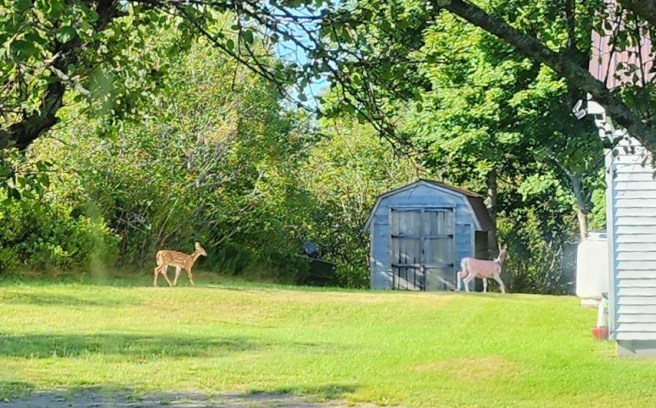
For the record, they’re probably not albino but leucistic, and as I saw in this case, mostly pink. Defining piebald has its own set of technicalities.

This encounter was on a Sunday morning while I was heading out of town on my way to Quaker Meeting for worship. I passed what I thought was lawn decoration and then realized it wasn’t. When I whipped back, this was the best I could capture before lowering the car’s window, and by then they had slipped behind the house. Wily critters they can be.

The deer in question, by the way, is on the right in the photo.

Ever feel like an imposter?

My first brush with the concept came in a hearing a classical musician talk about his arrival in a major symphony orchestra and looking around at all the talent and amazing sound they were creating. “I felt like an imposter,” he said.

Oh, my, I could identify.

Little did I know of the Imposter Syndrome, a term coined by psychologists in the 1970s.

Rather than go into the details and nuances – there are many, look them up if you wish – I’ll mention ten places it hits me.

  1. Music circles. Yup, despite my extensive knowledge of repertoire and so on, I can find myself cowered at times in choir when a technical issue pops up. We’re singing in what key, now that we’ve hit this chord? What do you mean? Or of course I’m supposed to know which Chopin etude that is, not that I play piano.
  2. Books. No matter being a fairly well-read author, there’s no way I can keep up with the output. “Have you read” has a 99.9 percent chance of a negative answer, even in one of my specialty areas. Reading the New York Review makes me feel like a complete ignoramus. How about you?
  3. Poets. At least few other poets or poetry lovers know of the writers I’m most fond of, even the ones considered major figures. Now, what are their best lines?
  4. News events. Forty years in a newsroom and I still can’t follow it all. Local? Regional? National? International? As for the players’ names? Which leads to ….
  5. Politics. A congressman, for one, faces more proposed new legislation than anyone could ever examine. And I’m supposed to be one up? How about city council issues? Like when I’m having a beer once a week with some fine neighbors?
  6. Cambridge. Despite singing in a chorus with a number of Harvard and MIT grads, they are an inside circle. Being told my portrait hangs in one of the dorms on the Yard – I don’t remember which one – only made things worse.
  7. Quakers. There are circles I know but so many more I don’t. As for keeping up with the current reading? Back to books!
  8. People’s names and faces. I’m really at a loss there most of the time. Sorry.
  9. Money dealings. I’m still baffled by our cell phone contract and the monthly bills. As for dealing with car salesmen or realtors? WTF? A guy’s supposed to be savvy with this, right? Well, that leads to truly painful area:
  10. Male role: Yup, capable of repairing anything, solving any problem, knowing just who to contact when needed.

Tell me I’m not alone. Please?

Acid test essayist and poet: Kenneth Rexroth (1905-1982)

Indiana-born in the shadow of Chicago, Rexroth’s childhood took place in a liberal household filled with socialist activity in the years before the First World War. The radical network across the Midwest that he details in his Autobiographical Novel will surprise most Americans, who believe it was confined largely to big East Coast cities. Not so, as he insists.

His family was at a less restrictive edge of the Brethren heritage, today a handful of pacifist denominations where some still resemble the Amish. It was very much a counterculture from its arrival in Colonial Pennsylvania and Maryland and on through the Civil War. While Rexroth himself headed in a much different direction, some of those roots continued to shape his actions and his religious questioning and questing.

Orphaned in his teens, he broke loose at 19, filled with anarchist thought and an IWW (Wobbly) identity, hitchhiked west, and worked odd jobs, including a Forest Service stint at the Marblemount Ranger Station in the North Cascades, where Gary Snyder would later spend several crucial summers in the high fire watch posts, as did others who came under Rexroth’s spell.

With a wife, a painter, he settled in San Francisco in 1927 as what his biographer calls “forerunners of the flower children who flocked to northern California during the fifties and sixties.” All along, he was notably active in civil rights, anti-war, and feminist circles, along with jazz and Buddhist influences. His book, Communalism: from Its Origins to the Twentieth Century, remains a fine overview of counterculture communities over the centuries. In some of these circles, he was aligned with Brethren, Quakers, and Mennonites, perhaps without being fully aware of the connection. His personal life, however, had its tangles.

His translations of classic Chinese and Japanese poetry are what first caught my attention, and still do. His own works are strongly crafted, often with an erotic strand.

He’s sometimes called the father or even the heart of the Beat movement, both as a mentor and as the MC at the famed reading at San Francisco’s Gallery Six in 1955, but it would be more accurate to call him a godfather of the Bay Area poetry renaissance that began blossoming before that and flourished for several decades after. Weekly readings in his house now sound like a who’s who of literature.

I remember that when he died, about the same time John Cheever did, Cheever got the accolades in the press while Rexroth got brief mention. I still think they had it backward, considering the lasting influence of each.

Considering historical accuracy, too  

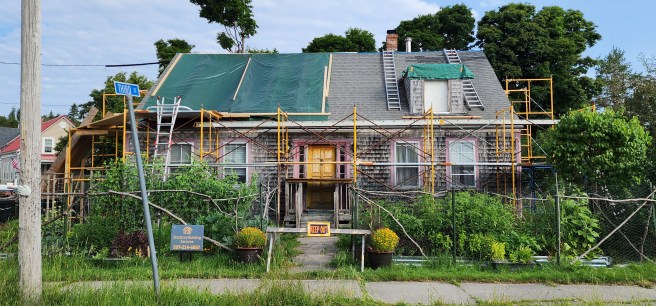
The two small dormers in the front bedroom were more of a pain to remove than you’d expect. That part was labor intensive, and they weren’t even braced to handle the weight load of the rafters above them. No, those had merely been sawed off. We have no idea how the heavy slate roofing that came later didn’t crush everything beneath it. (I’ll save that history for later.)

The dormers apparently weren’t added until after 1850, anyway. (Again, an explanation that can wait for later.)

The cedar-shake siding came even later, maybe the early 1990s. For a while before that, it was green asphalt siding. Yes, like what you might see on a roof.

The house color by 1830 was yellow, though we haven’t yet found any evidence of that.

All of that gives us more leeway for redesign, no?

With the front of the house, we’re keeping the outermost panels of the original roofline in recognition of the Cape Cod style. In the renovation, though, we still needed to upgrade the support beneath them, even before replacing the roof covering.

The dormers, by the way, were not identically distanced from the ends of the house. There was a half-foot or so difference. Did they not have tape measures? Make that yardsticks?

The single, big dormer will be a dramatic change, inside and out.

Here it comes!

When a fictional scene can use a shot of reality

While I’m thinking about visuals, let me mention a few ways they’ve helped me in creating my novels.

Not to slight dialogue, even when you nail it, or, for that matter, narrative, but a visual detail can be a great way to spark attention in a character development or a scene. It can make a passage visceral. It can rescue a connecting passage that’s gone flat or leaving you floundering for just the right idea.

I don’t know about you, but my memory overlooks a lot of telling specifics in the history I’m investigating. It’s not just memory, either, but so much that should be obvious but we simply block from awareness. That’s where I’ve found photographs to be a great prompt. Sometimes they even provide data, as my Orphan George blog demonstrates in posts examining family photos, when they’ve been available. Other genealogists can weigh in on ways snapshots and portraits have provided crucial data.

Through many of my moves, I didn’t even have a camera. I have no shots of many of the people who were central in my life, not even some of the lovers or places I’ve inhabited. The shots can counter my tendency to idealize. A bit of grit can restore some reality.

In the process of writing and revising my novels, I began collecting photos from magazines or other sources as prompts. This character in my book (often they’re a compression of several real people) might look like the one in this photo or wear something in that. Or here’s a small-town square that would work. They even allowed me to reconstruct a darkroom for Kenzie.

The Internet, of course, has made this backgrounding much easier.