rational
rationale
actresses believe your zoo
You never know what we'll churn up in cleaning a stall
actresses believe your zoo
Eggemoggin Reach
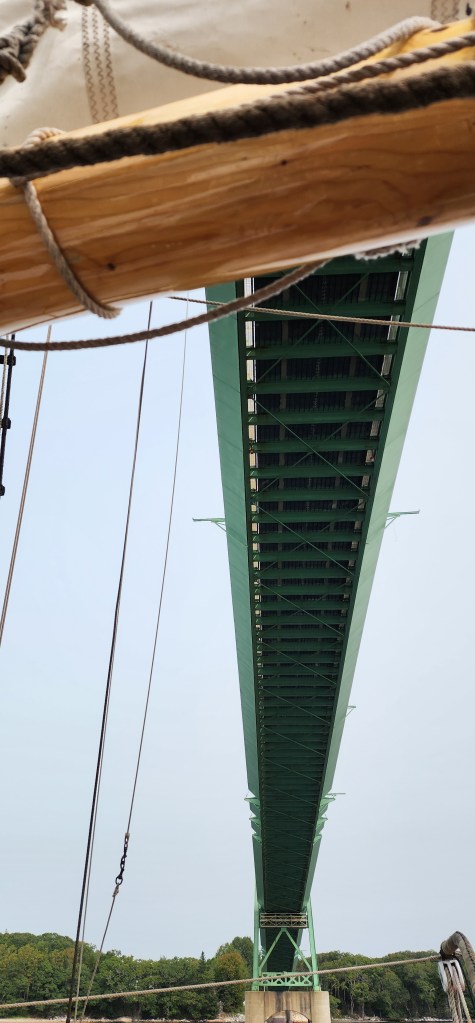
the Deer Isle bridge ahead
we’ll barely clear
six inches or sixty feet, what’s the difference?
other than a margin of error
the electronic gizmo’s
soundings in feet
at mean lower low water
I got to steer today
a feel of command
aiming for the arch of the bridge

Taking forever to get to the span
Deer Isle Bridge, as seen by vehicular traffic
Eggemoggen Reach Bridge from the water
a fixed bridge meaning
it doesn’t draw open
one more detail on the chart
(see Note B)
which I can’t find anywhere
until it’s pointed out in the margin,
same color type as the notice
we’re pushed by Greyhound
the inboard yawl
the motor behind me as a drone note
humming above lapping water
people bundled up this morning muted sun water depth 64
just gone to 72
Eggemoggen Reach broader
than Friar’s Road
where I live
Working the line of our old house downward quickly led to a tangle. You’ve been following what I uncovered at the Washington County courthouse, but at this point, an earlier reference was not recorded in the transaction at hand. Zip, zero, nada. Without that, I was stuck at 1975, well within my own lifetime, not exactly historic in my viewpoint.
The sale to the Greenlaws, according to the record, involved Oscar L. Whalen, executor for estate of Arline F. Vaughn, of New York, and someone named Rose Lee. But there was no Book and Page mention to lead me to the next entry.
The best I could do was to try working from the earliest residents and hope to build a line to 1975.

Since the 1855 map labeled our house “Shackford Est,” looking at the Shackford family made sense. Maybe Arlene was one of them.
Revisiting the Tides Institute and Museum of Art’s online survey of the homes of Eastport, I found that they had added a notation to their photo of our house. They quoted the weekly Eastport Sentinel account of U.S. Navy Commander Albert Buck returning home after World War II. Home, of course, is the one where we’re now living.
Buck? That gave me another family to start investigating, especially since they were living across the street in the 1855 map.
In preparing this weekly series about things that were behind my novels, I wasn’t expecting to see how much of what was happening in my own life during a revision could also impact a manuscript based on much earlier events. It’s not something I’ve seen mentioned in author interviews.
One of the writing adages I’ve kept at hand is this: “Steer into the pain.” I’m not sure where I found it or perhaps adapted it, but it has been helpful in reminding me not to take the emotionally easier way out when facing a situation, whether personal history or fictional abstraction. The pain is where the higher-level energy is as well as the revelation.
So add to the advices, “Write about what you’re discovering.”
In a way, it’s a reminder to write about what you don’t want to know but with the added kicker, “What you don’t want to admit.”
For those of you doing the NaNoWriMo challenge this month, may you add that insight to your energizers.
More recently, I would add to that something else that motivates me: The magic!
Or, in my case, pure wonder. Again, what do I know? And celebrate?
I’m finding they’re both essential currents in my life’s work.
~*~
Let me say I rather miss Cassia from my novel What’s Left. After prodding me to that round of big revisions of my previously published fiction, she’s gone off on her own. She was even remote when it came to my nonfiction volume that more recently demanded my fullest attention. Well, she did earn her own category here at the Barn – Cassia’s World, based on the research and many outtakes from her novel’s drafting.
As for the real-life inspiration for many of my characters, let me repeat: Where are they all now? Or more accurately, where did they go? I don’t mean the aging rockers. I can think of social activists who kept the faith and marched on, largely out of the spotlight, though they’re aging, without replacements in line. But as for the others? I’m unsure of most of their names. And let’s forget the boilerplate disclaimer regarding all persons living or dead, even for futuristic space journeys or fantasies deep into the past.
~*~
As I look back on the history underpinning my novels, I have to insist the potential was there. I must also ask, what if we had a more solid social structure and tradition, with something akin to elders? The dorm I lived in, the core of the opening half of the revised Daffodil novel, has today become something of the center I envisioned, without the radical political edge.
I suppose I could have told these stories time after time after work in a bar, but to me they seem to address a different collective experience. Besides, journalists have their own “war stories” to compare.
Just where were we gathering now, anyway? And where have we gone to get here?
A few have found a progressive faith community – church, synagogue, sangha, or perhaps a masonic order or fraternal lodge. But for the others?
Should I point back to the posts on the breakdown of community?
And here we had thought we were creating tribe.
As an extra point of emphasis, I’ll add: I’ve never returned to many of the locations where I’ve lived.
… the liberties of Rome proved the final victim to her military triumphs … A standing force therefore us a dangerous, at the same time that it may be a necessary provision. One the smallest scale, its has its inconveniences. On an extensive scale, its consequences may be fatal.
James Madison in Federalist No. 41
How do people with full-time careers and even families slash serious relationships find time to cheat?
Can they even be trusted on their paying jobs?

With winter fast approaching, what could be more comforting than these, especially on a lazy weekend morning?
Perhaps, even, waking up to the aroma of them still in the oven?
Oh, lucky me!
While Reese’s will probably still be the favorite., followed by M&Ms, when it comes to trick or treaters, other top choices may vary depending on where you live.
For instance:
The rest of the country goes for more traditional brands – at least ones I’m familiar with.
I’m still not sure about that candy corn, which is supposed to be universally loved this time of year.

Also known as tamarack and hackmatack around here. It’s a conifer that loses its needles each fall.
My poetry efforts bloomed burgeoned in two periods. The first was in the decade after I left the ashram, culminating in my four years in the Pacific Northwest. The second was in my first two decades in New England.
Bly came center stage for me in that second round as I began working increasing in Deep Image directions, without yet having heard the term.
Bly, as it turned out, was a major proponent of the concept. I did find his essays very helpful, especially the idea of riding a dragon or even the dragon smoke, along with the ways we humans think with three brains and his criticism of most English poetry as being miniature sermons.
His own work and much of what he translated is infused with a darkness I hadn’t found in the Beat-based poetry of the San Francisco renaissance, including the Northwest.
The majority of the writers I’ve most admired possessed a strong sense of place, and Bly was no exception. His return to rural Minnesota after Harvard and Norway is a prime example.
While he’s also lauded as a founder of the men’s movement, I had been working in other fronts of the issue and found Iron John rather forced as an argument. Gary Snyder’s earlier Dimensions of a Haida Myth impressed the importance of folktales on me much more.
Reading that his examinations of male identity sprang from the emotional crisis he encountered after being divorced by his first wife, Carol, leads to the questions of how much she shaped his earlier work and quite possibly what followed. Her short stories are memorable. When she died in 2007, she was hailed as Minnesota’s lioness of letters.
A public reading he gave with his close friend Donald Hall in Concord, New Hampshire, remains memorable. Throughout their careers, they mailed new work to each other for critique before showing it elsewhere. Their styles were so different. The reading itself came shortly after the death of Hall’s wife, the poet Jane Kenyon, and was in her honor.
 Jnana's Red Barn