- Jonathan Winters, comic and actor
- Phil Donahue, television talk show host
- Martin Sheen, actor
- Brooklyn Decker, model
- Roger Clemens, major league pitcher
- Billy Strayhorn, jazz great
- Dorothy Gish, silent movies star
- Erma Bombeck, newspaper humorist
- Luke Grimes, actor
- Rob Lowe and younger brother Chad, actors
- Chris Collinsworth, football star and broadcaster
Getting in the groove

Things are getting crafty around here.
Acid test essayist: Tom Wolfe (1930-2018)
Not to be confused with the Depression-era novelist Thomas Wolfe, the journalist Tom came to prominence in the final years of the New York Herald Tribune, my favorite newspaper ever.
With its clean, classic design, smart writing and editing, and sometimes playfully tabloid headlines, it was a standout in a very competitive newspaper market but looking for one more edge to assure its survival.
Voila, Wolfe emerged with his hyper, supercharged, Pop art zeitgeist, in-your-face, “Look at this!” writer for the paper’s Sunday magazine (which would continue on its own as New York magazine after the newspaper itself ceased publication). He even moved up to the daily paper itself as a columnist, alongside Jimmy Breslin.
Quite simply, he was fun to read.
Maybe it was a reflection of his Manhattan success or the counterculture themes he picked up on, but Wolfe created a marketable visual image as a dandy in a white, often three-piece, suit, with oversized glasses. He was about getting attention for himself, counter to the usual advice to reporters to make themselves invisible so they could more objectively view the events unfolding before them.
Not so, Tom. Or, in my case, with the college prof who thought I’d be the next Tom Wolfe.
His Electric-Acid Kool-Aid Test, following Ken Kesey and the Merry Pranksters as avatars of LSD, became a bestselling sensation leading memorably to the Right Stuff about astronauts.
Apart from this writing style, he knew how to sniff out a trend. In contrast, I ultimately went counter-trend.
I do wonder how much he influenced me. Perhaps in Subway Visions.
As for others, Hunter Thompson seems to have most closely built on the legacy.
By the way, the novelist Wolfe was notorious for excess writing, too, though of a masterly sort.
As for the Herald Trib, you can get a taste of it in my post “Establishing my creds” of September 11, 2014.
Kinisi 238
pink keyboard card facts
special Chinese grandparents sing
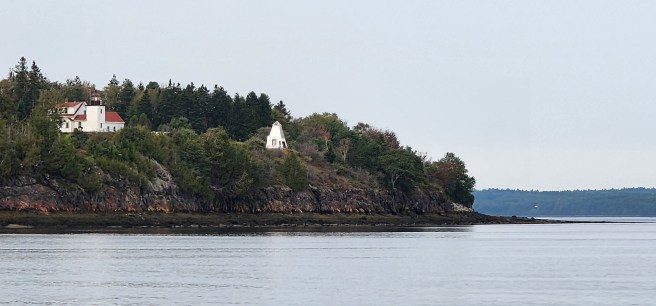
Fort Point at Stockton Springs
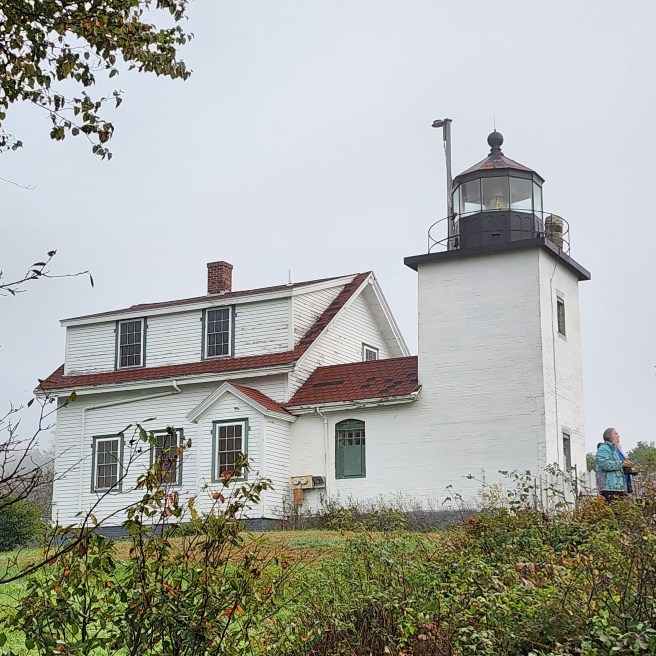 Having passed Searsport and now at anchor in Stockton Springs
Captain Becky’s reading in the galley
from Lincoln Ross Colcord’s Sailing Days on the Penobscot
of the treacherous trip from here,
where the crooked, tricky Penobscot River is said to begin
and the 24 miles to Bangor and Brewer at the first falls
and all the lumber collected from upstream
even the 18 miles from Bucksport was a terror
in the days of sails
 tidewalkers
broken logs along the shoreline
and river
can sink a ship

60 boats a day at Bangor and Brewer

schooners lashed three abreast
for the Bangor stretch
pulled by a steamboat
Make way!
All in the family, one way or another
After all of that, I backtracked and realized Commander Albert Buck never owned the house. It had instead passed to Fisher Ames Buck’s daughter, Alice May Buck, who died in August 1955. Presumably, she had no children.
And after that, ownership passed to Arline F. [Fallon] Vaughn (1898-1974), the daughter of George and Fanny (Buck) Fallon — Fisher’s daughter. Arline was employed for many years by Moore-McCormick Shipping Lines in New York. Her obituary listed no husband or children. She was buried at Hillside.
Also named in the proceedings was Rose Lee, presumably the remarried widow. The search goes on.
In short, by 1975 our house had apparently become a summer home or rental property under absentee ownership.
More than my life changed since retiring from the newsroom
It’s been a dozen years since I left full-time employment, but I can say I still don’t know what “retirement” is. Could it be because I don’t play golf or tennis?
After years of hoping to be financially able to leave the newsroom and instead concentrate on a life as an author, I finally made it to freedom. In the years leading up to that, I had put together detailed plans of running on a tight schedule, rising to meditate and pray, do some yoga, attend to correspondence, tackle some heavy new writing, and so on, but that’s not how things turned out. At least guilt hasn’t kicked in. I haven’t exactly been a slacker.
In those earlier schemes, I didn’t envision swimming laps every day at the city’s indoor pool or my weekly trip to Boston to sing in a choir. Nor was self-publishing the novels and poetry or the expanse of blogging or other social media. Photography, even of a digital sort, was an unexpected new hobby. Yearly Meeting responsibilities, however, were on the list and duly enjoyed. I’m embarrassed to admit that many yoga exercises are now beyond me – it’s amazing what 50 years of physical neglect can do.
I’m still trying to discover my natural sleep cycle, too. Eastport is a place where most folks rise early, and that’s generally what I’m doing – often, 3 am in the summer and a bit later in winter. The roads around here are busier at 5:30 in the morning than at 5:30 in the late afternoon or evening. A nap helps but isn’t always a daily option. And I’m spending more time at the keyboard than is probably healthy.
~*~
The most obvious way my life changed my writing life was is in having longer periods where I could concentrate on a given work or project. I wasn’t writing on the fly, like graffiti, as I have quipped, or immersing myself for a vacation week or two and then reluctantly putting the manuscript aside. My attention wasn’t diverted as often, either. I no longer had the daily commutes as time for reflection, but it’s amazing what bubbled up as a swam my half-mile of laps – some of my favorite lines in What’s Left, especially.
No longer writing or revising on the fly apparently made my new work more difficult.
At the beginning of my new life, I took up blogging, first to clear out much of my backlog of writing and small-press first publications, and then the photography came forward. One blog became five. Networking face-to-face with other writers once a month was on my rounds, and there were other events for poets, too. That led to the release of most of my scripted fiction, a huge emotional relief.
Curiously, I haven’t written poetry. The focus has been on prose, especially my one new novel, What’s Left. You’d think in my expanded creative schedule combined with my earlier experience of shaping fiction, this would have been a breeze. Instead, it was the thorniest project. Its purpose was to wrap up the hippie era, drawing together my Kenzie stories. The book kept shifting focus, and even finding an appropriate title was elusive. (A cover image was even more problematic.) It was also the least autobiographical, even with the new Greek-Orthodox circle in my life.
I can’t say which of my novels underwent the most exhaustive transformation from their first published version to the way they stand now, but What’s Left was the most painful as well as the biggest turning point. None of the others changed that drastically from their starting point to what hit print. The changes from first published version to what now stands is another matter.
But What’s Left did prompt that deep reworking of all the earlier ones, as well as the big round of republication.
My other piece of new fiction was perhaps the easiest of all, the middle novella in the Secret Side of Jaya. This was set between two earlier ones that had undergone multiple revisions before I inserted Jaya as a unifying voice.
~*~
If I thought I could kick back after those revisions, I was mistaken. Quaking Dover was on the horizon.
It was the book I didn’t want to write, I was truly tired, but the one that’s carried me the farthest with readers. It wasn’t even fiction.
And it proved as difficult in its revisions as What’s Left had. There was the challenge of fitting myself into the text as the “gently laughing curmudgeon” that one insightful beta reader suggested. It ran counter to all of my journalistic training as a neutral observer and my yoga humility of rendering myself invisible.
When I undertook Quaking Dover, Covid broke out. My laps in the pool ended, as did Revels Singers in Boston. After finishing the first draft, I relocated to Way Downeast Maine in what became an ideal writer’s retreat. It was amazing what I could find online in my research and revision.
As I’ve said, our move was the next step in some necessary downsizing in our life. Over the past decade, I’ve shifted to the Web and am now largely paper-free. I am going to have to face considerably more purging when we get the rest of my book collection out of storage and try to fit what we can (or what I need) into this smaller house. And let’s not forget, there’s no barn here.
~*~
Quaking Dover did lead to live and streamed PowerPoint presentations, a further new skillset for me.
Among other things, my concentration isn’t what it was. I learned in a few months of working as a 2020 Census enumerator that my stamina has also faded – it was an exhausting job. My spelling’s declined. And I’m not as sharp-eyed as an editor, either. In fact, I’m more tolerant.
I’m reading mostly ebooks, avoiding the filled shelves conundrum.
I don’t feel an urgency trying to “understand my problem.”
Even the journaling is slowing.
And there was a round of renewed therapy, ending shortly before the death of my therapist.
On the wise conduct of public debate
MODERATION on one side, and PRUDENCE on the other.
James Madison in Federalist No. 43
Ain’t gonna happen now
AMBITIONS: to develop a widespread readership aka bestseller; also, revive the Society of Friends
ONE DAY: to be influential and famous
Sleet and mix precip on the scene
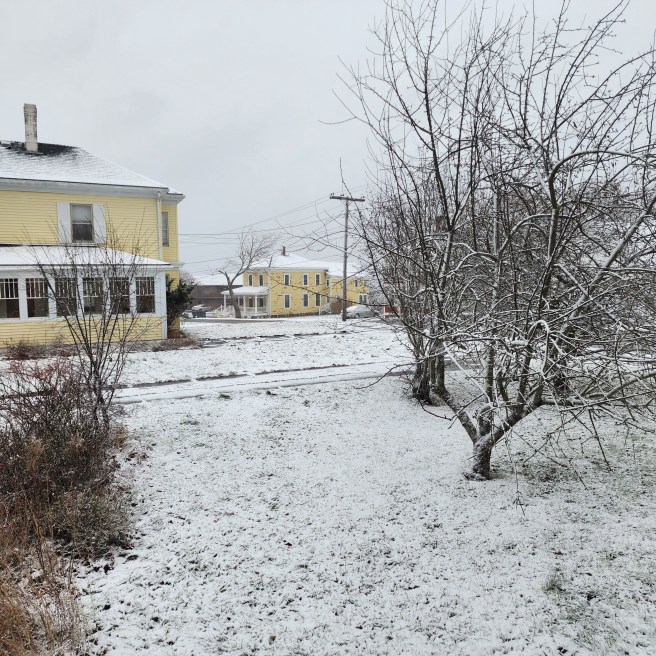
We’re bracing ourselves, of course. Weather like this can be accompanied by electrical power outages.

