EXODUS

If spring arrives without rain,
would the root and leaf open?

Seed that has not rotted
or satisfied hunger,

become buried too deep
or fallen on stone,

may reply, in its own season. And so,
in your own way, rise up and walk.

Keeping your heart tender,
within reason.

Poem copyright 2015 by Jnana Hodson
To see the full Green Repose collection,
click here.

IN A WHIMSICAL VEIN

Atop Fanueil Hall.
Atop Fanueil Hall.

The cricket design of the weather vane atop Faneuil Hall always delights me. Or, as I long wondered from the ground, could it be a grasshopper?

Whichever, the craftsman and the client both demonstrate a lasting sense of delight in the realms of nature. Turns out to be a cricket after all, crafted in 1742 by Deacon Shem Drowne, perhaps inspired by similar weather vanes on London’s Royal Exchange building. The cricket, by the way, is the only part of the historic building to remain unchanged from the 1742 original. A 1761 fire gutted merchant Peter Faneuil’s original structure, and in 1805 architect Charles Bulfinch designed additions that doubled the width and length of the building while keeping the basic style to produce what we see today.

Boston is a rich and varied destination – the Hub of New England, or the Universe, as they used to say. Living a little more than an hour to the north, we’re well within its orb.

ANOTHER OF THOSE OLD WATERTOWN FAMILIES

Lately, I’ve been running into references to Saltonstalls. It’s an old prominent New England family, admittedly, but I had never really connected the dots.

One is an imposing Colonial saltbox house in Haverhill, Massachusetts, with 1712 emblazed on the central chimney. It sits at One Saltonstall Square.

Another dot to the family came in a reference to two (Robert and Sir Richard) as purchasers in the charter for provincial New Hampshire, perhaps buying out the first settlers of Dover. “Probably in 1633,” as the account goes.

Then there’s the principled judge (Nathaniel) who resigned in 1692 in disgust from the direction the Salem witch trials were taking.

That stirred memories of hearing of a U.S. senator from Massachusetts (Leverett II) or a family that owned a small daily newspaper north of Boston.

Now I see I’d taken photos of the statue of Sir Richard Saltonstall, a founder of Watertown in 1630. (Since Watertown is where my choir rehearses weekly, it’s on my radar.)

While Sir Richard returned to London two years later, two of his sons remained and established what became a Boston Brahmin family, one that produced at least one graduate of Harvard in every generation, plus governors of Massachusetts and Connecticut. Before leaving the New World, Sir Richard was among those granted a patent of Connecticut – and back in Europe he had his portrait painted by Rembrandt.

I suppose that’s enough for now. The full story could run on for volumes.

But it’s not the kind of world I grew up in, not out in the Midwest.

I’m left wondering if old establishment families like this functioned as close-knit networks or even as tribes and how much individual deviation was permitted. Who were the chiefs and elders, especially? What was the role of religion or political affiliation?

Maybe that would be an entirely different kind of history than we’re accustomed to seeing. What are your thoughts?

REAL DEVELOPMENTS IN THE YEARS SINCE I DRAFTED THAT NOVEL

The years since I drafted Big Inca versus a New Pony Express Rider have brought significant, often dramatic, restoration and redevelopment to long neglected historic mills like the ones at the heart of my novel.

One impetus for the renewal appeared in a handful of towns in Maine, where credit-card giant MBNA transformed old mills into attractive call centers that in turn revitalized local economies. Even after being shut down in a later buyout, the benefits linger, and other developers had concrete models to follow.

Visionary entrepreneurs like the late Joseph Sawtelle here in New Hampshire as well as nonprofit agencies or local government-backed councils entered the picture, making mills in other towns emerge as small-business incubators or readily adaptable buildings for new arrivals, especially enterprises growing rapidly.

And, if the location’s right, they can attract artists of all stripes – painters, sculptors, printers, dancers, musicians, craftsmen, bakers and caterers – as an affordable alternative with natural light and high ceilings. (We love the annual studio tours and open houses in the mills in one nearby town.)

Sometimes the downtown locations lend themselves to conversion into residential condos as well. And then there are universities, health-care organizations, and museums that move in for convenience. (Well, one mill in downtown Manchester, New Hampshire, does have a helicopter pad on the roof.)

In other words, there are some fascinating case studies just about everywhere I turn.  But I still haven’t found any where the top of the tower is turned into a tiny penthouse, not the way Bill did at one point in the novel. I’m still quite fond of that touch.

RIDGES AND RIVERS

Someday I’ll learn the identities of clouds. Buy the chart, memorize their qualities and forms, and then watch the flowing sky afresh. This is, after all, yet another strand of mapping.

From childhood, I’ve absorbed maps. Mind travel. Concepts augmented by photographs and writings, which have often furnished a sense a such familiarity that when I arrive in a new place, strangers stop me to ask directions, even on my inaugural visit. Foliage, waters, buildings, and people fill in the lines of his maps as they stretch toward some new border. But this move, with its desert, has been an exception. Nothing’s been predictable or particularly comforting. Besides, I experience a vague agitation when venturing to the edge of my known universe. If possible, when visiting new locale, I push out a few miles further, to determine what’s over the next ridge or river — or at least down the road — as if to anchor myself within some context, rather than remain at its periphery. Curiously, I feel more secure when placing that border at some shoreline or rise — countryside, at the least — rather than within seemingly endless tracts of housing, factories, stores, and pavement. Even a round earth has places where monsters may lurk. Gaps exist in any map. Consider the clouds. Everything is, after all, changing. Even that rock, where Kokopelli is sitting.

For more insights from the American Far West and Kokopelli, click here.

PRELUDE & FUGUE 44/

no clouds except in the sky as yet
snow sits atop cones
in long-needled pine

*   *   *

in long-needled pine, a gray hill
beyond the snow-covered cones
becomes cloudy sky
yet pussy willows are molting

gray clouds of snowy pine
yet the sky covers cones atop long-needled pine
in the primrose sunrise the snow covers
pussy willows before you believe summer is coming

yes, beyond the snow-covered gray hill
wisps of clouds are melting
into pussy willows and pinecones

with the melting snow atop cones
the long-needled primrose sun sets
in a gray hill of pussy willows
you believe summer is coming

no clouds with the melting
wall atop gray cones

beyond the pussy-willow clouds
with the melting gray wall

birch beyond pussy willows, not clouds
melting the gray wall atop long-needled cones
beyond the pussy willows

~*~

Poem copyright 2016 by Jnana Hodson
To see all 50 Preludes & Fugues, click here.

RELICS, IN TIME

1

along the edge
where river after river, cove and forking
confuse and disguise without end
each minaret has a name, often two

a badge
capped by a dome
a green-copper half-moon
above glass and the flash
or a triangular
arrowhead pointing to Heaven

the occasional towers standing in pairs
are to be read as eleven, rather than two
in the mathematics of waves

along Cape Cod, Cape Ann, Cape Elizabeth

2

token of peril
crag and sandbar

a warning
to welcome
a warning

acknowledging most shipwrecks
occurred within sight of shore

however deceptive the calm

3

a preference for lighthouses on craggy sites
to those on lawns or hillocks

still all stand

arrayed as white prayer flags along the coast
these relics, in time

all fall away

as we journey

Poem copyright 2016 by Jnana Hodson
To see the full set of seacoast poems,
click here.

AMONG THE SCATTERED SEASONS

WATCHING THE FLITTING flashes of my mind, I jot down notes. Many of them later prompt poems or a scene in fiction or a line of thought that later bears fruit.

Some fall by the wayside. Others find development decades later. Consider:

  • Seasons of flight.
  • Seasons of nesting.
  • Seasons of doubt.
  • Seasons of turbulence.
  • Anger, jealousy, hurt, fear.
  • Encountering the demons: the Dark Night journey, melancholy, depression, loss, etc.
  • Seasons of awareness: times when we’re more open to revelation that others. Our usual defenses are stripped away, and we leap into change or retreat into solitude. In the immediate aftermath of divorce, for instance, or a close death.
  • Times of dreaming deeper or in new ways.
  • Seasons of praise and assurance.
  • Seasons out of the spirit: war / greed / oppression and oppressing.

Add to these and amplify them as you wish.

~*~

Few are prepared or willing for total immersion in the Spirit. Especially when we’re feeling our lives are already full.

There is reason to fear falling into the hands of a Living God.

This is acknowledged, “Thank God for the good old Church of England. It’s our last line of defense between God and ourselves.” Substitute your own institution or practice, as needed.

Giving, with nothing in return. (So it so often seems … route for burnout.)

~*~

Moses and Aaron, confronting graven images:

  • Aha! They’re fleeing sleek Egypt, so visual – they instead use words, an entirely different focus for worship from the image-driven supplication in Egypt.
  • They leave civilization for wilderness, where certain words are carefully repeated.
  • On the lips, from the heart: What we know could become singing.

~*~

Or else simply rootless:

  • How do we reach out while being so fragmented?
  • A lack of continuity instills clinging.
  • How will our paths cross more frequently?
  • People come and go, and we make no effort to find out why.
  • Diversity is no strength unless drawn into the circle.
  • A phantom church, with no telephone listing.

Here we go, warbling.

~*~

Make sense, as you can:

  • A handcuffed person.
  • Movie night in the meetinghouse: double features, free popcorn: invite the homeschool crowd.
  • Opera orgies … Met broadcasts.

Yes, we want the cost-free pleasures.

The Hebrew lack of first-person personal pronouns – it’s not my house, but the house God has blessed me with or gifted unto me for safe-care.

~*~

For more Seasons of the Spirit, click here.


WEEDS ARE ALREADY RISING

Just a taste of what’s popping up. In case you were looking for a prompt.

~*~

  1. The amount of sunlight these days is equivalent to September. That equinox thing. But with snow and no foliage or even plain gray, the sensation’s quite different from autumn green turning golden and hazy.
  2. Spring rainfall turns our side yard into a glade. Are ‘gators next?
  3. So who do they resemble, these women in my life? Which movie stars? Which protagonists in fiction? Even before we get to the guys.
  4. On a walk about town, I stop at a bakery and pick up a selection pastries as a surprise for later in the morning. As my wife and elder daughter view me strolling up our street, they notice the box wrapped in ribbon and the way I speak with other pedestrians, and quip, “What a perfect picture of a guy a woman would want to have coming home.”
  5. How delightful, too, walking three miles on a leg of the Community Trail beside rapids and sparkling waters. No need to drive several hours to the mountains for a similar experience. Reminds me of my hidden retreat at Lake Massabesic, back when I was residing on Wellington Hill in Manchester.
  6. When I enter a house of worship, I close my eyes and feel the vibrations. Too often, the air feels leaden or dead, rather than welcoming, warm, filled with deep calm. Maybe I’m spoiled by so many Quaker meetinghouses and other sanctuaries of quiet heart-centered devotion.
  7. Suppose I’d wound up back in Dayton or Cincinnati, rather than moving on? The very thought has me feeling emotionally constrained.
  8. A reminder. Be authentic to your dreams, even in the face of the Greek chorus intoning, “Yay,” “Boo,” Ahh,” even “Mmm,” throughout. Much less Job’s friends in those periods of siege.
  9. What do we do with the superrich freeloaders?
  10. Internally, I’m still on Standard Time. How can it be so late already?

~*~

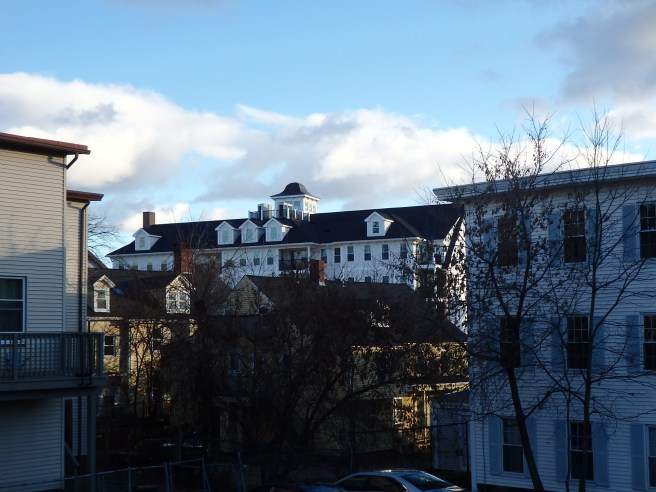
A view from Fourth Street, Dover.

MOVING, AS IN SEEKING ROOT

we move. like the water, like the wind
– across rock, across soil –
until people speaking of common activities
and customs will completely baffle

sometimes the growing season’s quite short
compared to our place of origin
even so, she wants tropics
where everything in the closet
will mildew before sunrise
and there’s no worry of frost

we’ve gone underground, ourselves
after trusting too much in human love
emerged not on rock or air wholly
but collected from scattered places
and pieced back, as best anyone can
with blueberry-stained hands

so what’s the name of your divinity?
your desires? your natures?
the apple of your eye?

even the forest seeks climax
she’ll say, quartering a winesap
its burgundy ringing

Poem copyright 2016 by Jnana Hodson
For more,
click here.