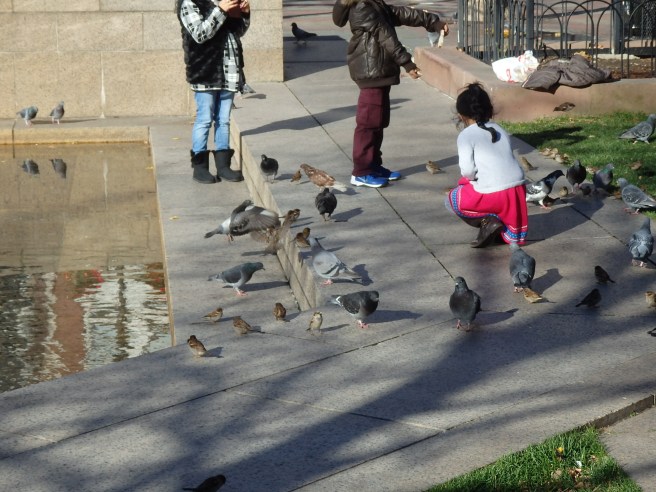
They’re the national bird of many cities.
Boston is a rich and varied destination – the Hub of New England, or the Universe, as they used to say. Living a little more than an hour to the north, we’re well within its orb.
You never know what we'll churn up in cleaning a stall
They’re the national bird of many cities.
Boston is a rich and varied destination – the Hub of New England, or the Universe, as they used to say. Living a little more than an hour to the north, we’re well within its orb.
If you delve into genealogy or even read obituaries, you may run across references to someone as a “Mayflower descendant.” The assumption is that at least one of their ancestors arrived (and survived) the 1620 voyage to Plymouth Bay. Their lines have been carefully detailed.
More broadly, though, you’ll come across those who consider all Plymouth arrivals of the first decade as Mayflower ancestors, not that I’m finding that online at the moment. So I’ll leave it as a hearsay argument. Still, after all, the Mayflower itself made a second crossing in 1629 – one of 10 vessels to arrive there in that period – and this is where things can get confusing.
Add to that many others landing to the north in this period – at Salem, especially, and then Boston, plus a scattering at other New England ports. The region was quickly filled with settlers, including the Hiltons at Dover, where I live in New Hampshire.
These can all be long lines, some much better recorded than others.
Any workplace holds confidences you can never reveal. Not that you don’t want to expose company secrets. Then, considering the office computers, fax machines, and photocopiers, you realize they’re incapable of guilt. They simply do their job — and you might find that unsettling.
Whenever I do manage to tap genuine emotions regarding this employment, no one’s more shocked than myself. Take something as simple as a pane of glass between my desk and the trees outdoors. Even on my job in Appalachian mountains, I wanted a window. One the size of a book would suffice, although a picture view would be preferred. I’ve always appreciated a panorama, a sense of precisely where I fit into the weather of a particular day. Instead, I feel trapped underground, half-buried in regulations and routine. Only a band of natural light at the far end of the fluorescent-and-steel expanse hints of sun, moon, sky, or clouds — and even that aperture is tinted. Why are my hours on the job so cut off from the rest of life? “We may as well be coal miners in carbonized veins or muscular razorbacks sweltering in midnight foundries. Is it only the sun we miss? Examine the calendar. Check on the moon’s phase.”
I could just plot my escape. I am surrounded by desert. Trek there alone. Right to the heart.
He recall the words of another friend who spoke of the paradox of Zen Buddhist freedom: the very limitations the practice imposes also lead to an extraordinary freedom. An individual who’s free in the Spirit can be placed in prison and yet not be captive — persecuted and yet unbowed — denounced and still spotless.
The Dedicated Laborious Quest, as my Teacher taught, is a truly free way.
Free, yes, with the labor.
I pick up the phone and hear Kokopelli’s whistle. He wants us to get going. Then tells me of the dance where we’ll be playing.
For more insights from the American Far West and Kokopelli, click here.
Here’s a section from a collection of contemporary American sonnets I’ve done along the lines of those by the late and wonderful Ted Berrigan. It’s one of 60 from Braided Double-Cross.
~*~
As I said at the time …
In defining poetry, Berrigan’s concept of a windup toy serves well for me. How basic can I make it? (A single word? Maybe two?) As well as how extended or elaborate!
I still don’t like poetry that’s written as code, an intellectual equation of meaning.
Also, I prefer lines that are long enough to have something happen within each one.
I love when literature (or any art, for that matter) opens as a state of awareness – or fullest existence – which also expands into epiphanies of dancing or singing or perhaps, well, just imagine. Think twice about the chemically aided experiences – pinot, martini, pot? Yes, the Zone, when it graces. In a continuum, with differing specifics.
A set of skills and disciplined thought and, I would hope, tradition / culture. Not that every time I read a book or sit to write I’m there. Indeed, there may be good reasons we cannot dwell long in that Zone (Is it too isolated? Too exclusionary? Self-centered even when we find it occurring in Otherness?) …
A break, then. And then back to work.
~*~
A green-streaked sentry flanked by thistles
on every town common is more explicit
than any boom box. Please, my darling, please
don’t let carnal memories expire between us.
I set forth at a disadvantage.
Ribbons of baby oil. Snaking Chinese dragons.
One flesh, lagoons. Trembling like the wind
in shrubs and flowers. You chained
criticism on my Academy of St. Martin
in the wallpaper, provoking blatant spice factory
peppers and cinnamon misrepresentations
of common logic, as if you were running for office.
Without proper camouflage, there’s nothing to repulse
destitution overtaking military-issue fortifications.
Poem copyright by Jnana Hodson
(originally appeared in the journal Plungelit)
For more, click here.

what blows
to kindle sunset and sunrise
sprouts wings on the field
is faith planting
for a harvest at the end
all these tough nuts to open
amid rest
* * *
each day
always more
bands of light
turn within
fields and currents
tempted by more as well as less, but first
those cries being born
* * *
crossing water
invites rest
answering the call to dinner
when we are vanilla
chocolate the strawberry
rhubarb and asparagus
a cake topped in cherries
sweet corn and trout
with apricots and peaches
the scallions, leeks, garlic
carrots, potatoes, yams
spiced pumpkin
whipped cream, fresh butter
applesauce with pancakes
a bowl of black walnuts
yogurt and sharp cheddar
or baby Swiss
when we are sap returning to maple
when we are …
when we are snow peas or sugar snaps
a pear or …
fordhooks or limas
I’ve had a taste of these things
Hindu Yogi
Zen Buddhist
Sufi
Amerindian
Mennonite, Dunker, Amish
Old-Style Quaker
all of them, with holy visions
Poem copyright 2016 by Jnana Hodson
To see the full set, click here.
OF COURSE WE’RE PUZZLED to observe how many conversations begin with comments about the weather. Everybody can see it’s snowing or raining or feel the heat and humidity. What’s actually happening, of course, is the establishing of a commonality – putting ourselves in a shared space. You make a joke in reply, or a factual statement, and edge into conversation, however superficial or deep, gossipy or plaintive.
No matter how introverted or reclusive an individual is, being human requires social interaction. From birth, we require more nurture and protection than other animals do before we are able to move about on our own, much less survive. We learn from each other, and we are highly vulnerable, despite all our acquired knowledge. We are creatures of culture, not inherited instinct. We make bargains and trade. We court and seduce with words as much as our dance steps or glances.
While experiential religion demands individual practice and awareness, few of us undergo its labors and trials all alone. We find mentors and companions along the way, people who have also encountered and value these matters. Even a secluded monk has an abbot or guru; a nun, her mother superior. Confession is part of the practice. What we find of value we feel compelled to pass along.
Our affinity with these spiritual companions has its own intimacy. These friends hold a mirror to ourselves, to point to our shortcomings and prod us to reach for ever greater fidelity to our purpose. They provide harmony and, when we fail, counter self-loathing and blame with compassion and comfort. Ideally, this exists between husband and wife. Sometimes it is found between prayer partners – two people who agree to hold each other in prayer through the week. Much of the life in the monastic confines of the ashram endeavored on this plain, though the bonds broke down quickly outside of it. Whether one-on-one or within the circle of a community of faith, this companionship has the added dimension of spiritual presence and encounter. Sometimes it spans denominations, when the “invisible church” opens in conversation with another or in venturing into a small group along the way, as I have with Mennonites and Brethren. Sometimes it appears in the context of romantic relationship, in the quest for mutual aspirations.
As much as I’d like to say spiritual companionship is forever, the reality often proves otherwise. I’ve seen those who have maintained this through a lifetime, including couples who’ve become connected through the marriages of their children. More often, I’ve found intense periods where paths cross for a year or two and then part.
Typically, the interactions are words spoken together. Sometimes, as in the excerpts that follow, they arise in lengthy correspondence. Who knows what trail will be left from the emails of the Internet.
~*~
For more Seasons of the Spirit, click here.
Why wait for the dust to settle? Here are 10 bullets from my end.
~*~
~*~



Within the range of distinctives
of nasty red, the Capitol black
the ethereal albino instead
he aligns with the eastern gray
and the western gray.
Yet who would be saint of the squirrel?
Not Lord Rama, who caresses one
as a pet. Nor the cultivating Hermes.
The Blackfoot know him as Old Man.
As he was becoming.
* * *
of course squirrels have faith
of a practical sort
in running the wire, in leaping from a branch
and landing a full eight feet between trees
with such airy jurisdiction
* * *
in a flash such as music
or the tail as a sail
just leap
and grab hold somewhere
* * *
the question, at heart, what was in his blood?
as well as what was it becoming?
not the patriarch, then free from bondage
* * *
overhead, the years overlap
underfoot, the roots tangle
to be light, then lighter than pigeons
or laughter and tears
become gray pussy-willow at the end of winter
Poem copyright 2015 by Jnana Hodson
To read the full set of squirrelly poems, click here.
In the aftermath of the recent national elections, trying to make sense of the American scene today is, well, downright scary. The fact we have one party so willing to risk constitutional crisis rather than work cooperatively on solutions to common problems strikes at the very heart of democracy. And that’s before we get to the divisions revealed geographically, demographically, and economically.
Several of the phrases floating around the campaigns continue to ring in my ears. Describing one party, we have an “echo chamber” of “misfits,” which begins to look far larger than would be healthy for any society. And for the other party, the race came down to a “technocrat” versus “activist,” in itself suggesting a division between an appeal to the brain versus the heart.
Much of this situation, I’ll contend, springs from a lingering state of denial involving the encounters of those of us who came of age during the 1960s and ’70s. Coming across a summary of William Clark Roof’s 1993 A Generation of Seekers: The Spiritual Journeys of the Baby Boom Generation, I had to sit up and take notice when he noted that a low level of community involvement accompanied our search for personal meaning. It’s something that’s certainly happened across American society over recent decades, although I’d say increasing demands on our careers and suburban family lifestyles have taken their toll, too.
As Douglas Gwyn comments in Seekers Found: Atonement in Early Quaker Experience:
Roof’s study confirms many impressions of baby boomers in the ’60s, but adds a new perspective. Many tried drugs, were sexually active, and went to rock concerts and political protests. But many did not. Half of those surveyed say they did not try drugs; a third never attended a rock concert; and 80% were not politically active in that period. On the whole, Roof finds boomers to be nearly evenly divided between traditionalist and countercultural affinities.
A conventional view might look at this split along the lines of the Vietnam war issue, with the traditionalists joining the military and the hippie side in full opposition. But Roof’s criteria turn the angle: more than a few servicemen experimented with pot and other drugs in ‘Nam, along with free love, and moved easily into hippie circles on their return. Meanwhile, I sense more than a few hippies never did drugs, out-of-wedlock sex, or political protests. For them, maybe it was all about the music?
As Gwyn continues his reflections on Roof’s study, he prophetically notes:
But in subsequent decades, with a tightening of the American economy, the assumption of abundance often turned from utopian to belligerent, as Americans vented their frustration over lowered or failed expectations. Given their expanded subjective and expressive registers, boomers are already more likely to consider themselves wounded by defects in their religious upbringing. When religious institutions or leaders fail their expectations today, boomers are all the more likely to feel cheated, wounded, or even victimized.
It’s not just religion, let’s be honest. This cuts across the entire society.
Gwyn makes one other argument that lingers, one that involves the kind of association each seeker is drawn to. One is process driven, and the ways we can become captive to the mechanics of a particular system. (He names capitalist democracy as an example.) Here, the procedures outweigh results. I love his observation, “If civility is too strongly identified with democratic processes, then true seeking and conversation to one’s neighbor will tend to be subverted. Caucus politics or the contest of interests may usurp the conversation.”
The alternative, goal driven identity, can override the process altogether, in which the ends justify any means of getting there.
The vital tension Gwyn encourages “requires a disciplined and sustained dialogue between seriously considered and passionately held positions,” a “drama of faith, which is played out upon a level civic stage of public concern.”
Quite simply, where is that dialogue today? And where is the open exchange in questioning and refining the factual essence of the positions? An “echo chamber,” on either side, simply cannot do the job.
~*~
More of my own reflections on alternative Christianity are found at Religion Turned Upside Down.

The burial ground in Boston Common is the resting place of early patriots, among them the composer William Billings – the latter, by assumption rather than documentation. Historians will note that the headstones in the city’s oldest graveyards no longer stand over their intended bodies, but were moved around by convenience.
Boston is a rich and varied destination – the Hub of New England, or the Universe, as they used to say. Living a little more than an hour to the north, we’re well within its orb.


