I am not responsible for the state of the universe
or for others’ shortcomings or failures
or for things breaking, at least not most things.
I am responsible
for my own feelings
and acts of caring
at hand.
You never know what we'll churn up in cleaning a stall
I am not responsible for the state of the universe
or for others’ shortcomings or failures
or for things breaking, at least not most things.
I am responsible
for my own feelings
and acts of caring
at hand.
This is desert. And logging country, too, where the best place to find loggers is in a bar, any bar. Just listen.
“When I’m real loose, I like t’dance t’country-westron music. Out seven nights a week, then a month without any. Can’t work anyplace but woods. Done everything but hemlock. Started skidding horses in Colorado. Now driving a diesel Ford. Not much time for thinking. Slick roads, sharp corners, dumb ladies in the way.”
Here’s how it works, as Kokopelli and I play along.
“Aim a load down logging roads and then highway t’ the mills. A thirty-, fifty-mile stretch each way, four to six times a day while the CB chatters.
“Every spring when the ground’s too wet, the Forest Circus shuts ya down, the heavy equipment breaks the roads.
“That’s our vacation, three months off, taking unemployment.
“Head for Hawaii, Reno, or Vegas. There’s no money in mud. So ya take care of yard work, fix the house, prune the orchards.
“Successful loggers have expensive hobbies like race cars or airplanes. Mechanics, anyway.
“The drought will cut our pay in half. They’ll keep us out. Fire hazard.”
As they say.
Kokopelli tells me doors define a room, more than walls and roofs. Tells me to see their potential. An opportunity to spy or exit at will. Or interrupt. Doors with keys invoke power. Ownership. Think of all the doors in Versailles.
For me, the greatest freedom comes outdoors or while playing a dance with Kokopelli. Now the cat wants out.
Decisions are doors, too. Take style and size. Standardization leads toward smallness. Once, they were French-doubled or twelve-feet tall. Bronze portals to cathedrals. Red doors and oak doors. Lacy castings for an office. Frosted glass at the bank. Now they’re internationally uniform. The small millwright goes under, as well as local characteristics.
When the cat went out, my wife came in. Everybody seems to like her. But I see her other side, when she’s really destructive. I want to scream.
Instead, I blurt out, “To hell with the dark stupidity of their Christian indoctrination! Bring on wild goats! Pan pipes! My roaring conch will shake the walls of this slumber!” I have no idea what prompts that thought. Why Christian, other than the fact it’s the predominant religion in this country? Just where would a person start without any teaching? Most likely, I meant dogma, which I see repeated with only a superficial understanding. But that could apply to any faith tradition, couldn’t it? So just what am I fleeing? And what do I really hope to find?
Maybe it’s a door. Or a corridor. A cavern. A current of water. A trail. A strait gate with a narrow way.
Choose one. And then enter.
I want full awareness. Experience, rather than theory. Ecstasy, especially. For whatever reasons, I veer away from the Judeo-Christian prophetic stream and toward the shamanic traditions, wondering whether the Siberian word shaman arises from the Pali samana, for holy man. I accept the argument that meditation grew out of primitive hunting, the waiting for the game, the belief that game is supernatural, requiring supernatural aid. I must remember to thank the trapped bear, if the time comes. “Boy, do the local elk hunters have a lot to learn,” I whistle — me, who’s never gone hunting.
Kokopelli raises one arm as if he’s holding a rifle. Then, with his other hand, he pulls a trigger. I think he felled what he wanted.
“Yes, hunting antedates farming,” I whisper to no one but him. “See that, Cain and Abel!”
Maybe that’s why I’ve come so far west, just to see the sunrise.
But just as there’s light, there’s also darkness. Trust and distrust.
List the names of deities. As for a supernatural trickster, Mara or Maya seems to relate to Satan, who in turn relates to Coyote. Now for Pan!
Arcane teachings. I consider delving into palmistry, followed by astrology, Tibetan texts, more deeply into Tantra, and back through meditation. If only my paying job didn’t requiring more and more of my time, I might pick up the thread from hunting, tracking holiness through food traditions. The balance of feasting and fasting. The importance of prohibitions as strengthening the ability to say NO as well as reinforcing a group identity. “So what kind of vegetarian are you?”
Kokopelli reminds them this is desert. If it weren’t for irrigation or berry-picking trips to the high mountains, you’d starve.
For more insights from the American Far West and Kokopelli, click here.
just a warning, of Concord, revolution or dancing
the bridge or the barn, different eras
come, swim across the pond, watching
a commuter train race along the wooded hilltop
a shot, yes, by the river a bronze Minuteman regards now
with its great writers buried in its bosom
maybe you expect a great calm while packing
or overlook the state prison and traffic rotary
pressed together, “a port of entry and departure”
all of these pages, yes, being “bubbles in our wake”
~*~
the temple wall folds
to the green river
of migrating salmon
its unbroken factory façade
springs from gravel
not here or there
with the neon lights, if you would
export calico
or denim
from a carp pool
To continue, click here.
Copyright 2015
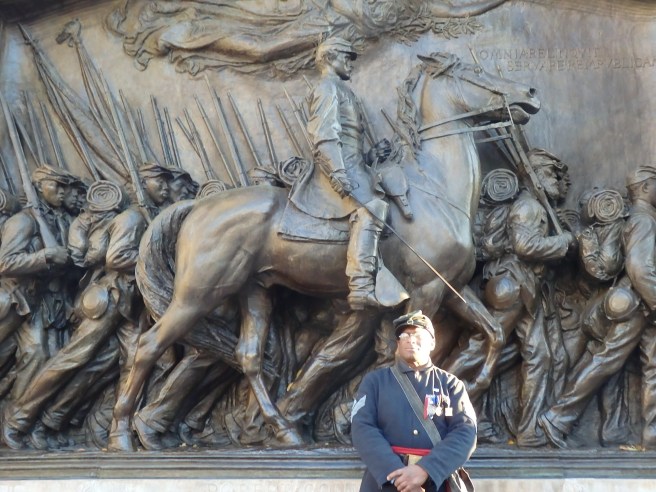
Public sculpture typically celebrates famed men or mythological figures, but the Memorial to Robert Gould Shaw Memorial and the Massachusetts 54th Regiment, which sits across from the State House, is in a league of its own.
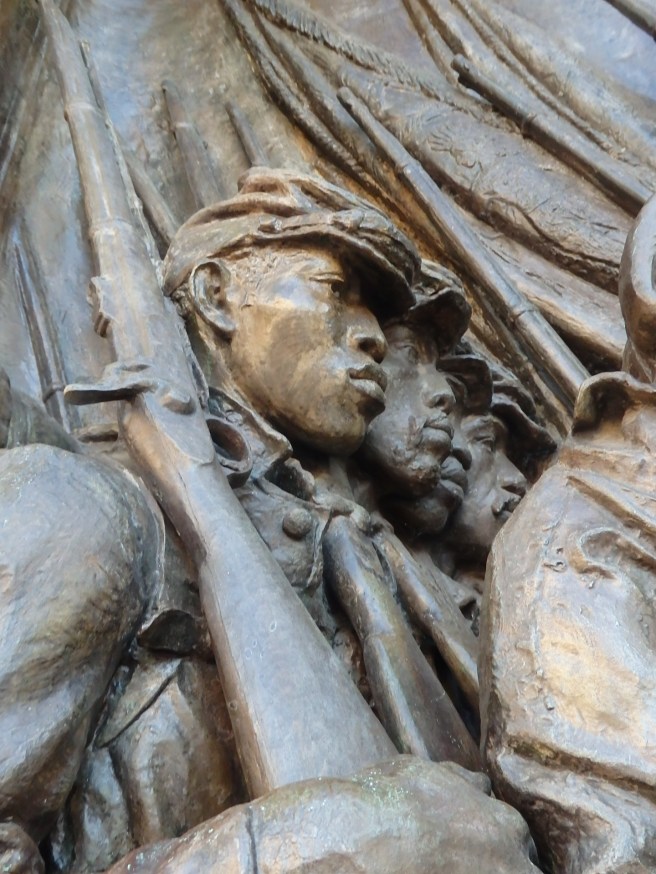
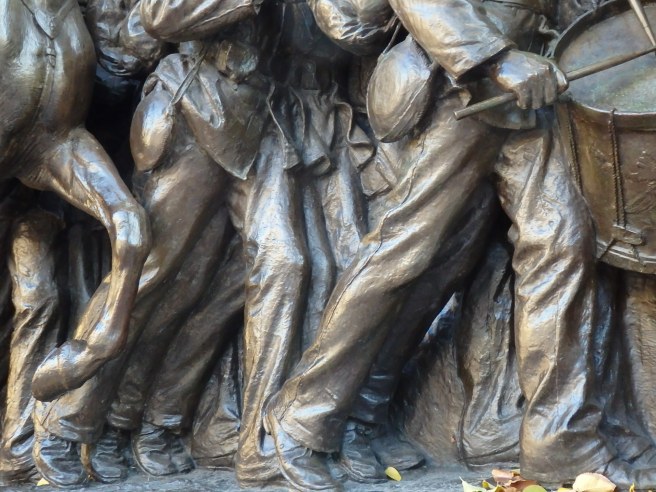
Within its unified design, the focus turns to each of the enlisted black soldiers as they resolutely march to battle to free slaves. Every face is unique, sympathetic, tragic, and each body moves with muscle, even anger and justice. If August Saint-Gaudens had created no other work, this masterpiece would have sealed his reputation.
Boston is a rich and varied destination – the Hub of New England, or the Universe, as they used to say. Living a little more than an hour to the north, we’re well within its orb.
As I would have said at the time: Note to folks living below the Mason-Dixon Line: It’s time to remove the Confederate monuments. They look too much like a sore loser.
Let’s remember, those shafts (at least the ones I’ve seen) have to be offensive to every descendant of every slave in America.
Think of all the German-Americans who never erected Kaiser monuments in honor of their dead kin. Japanese-Americans who could have placed Hiroshima/Nagasaki reminders. Italian-Americans, with Mussolini railroad efficiency. Vietnamese, Native-Americans, French?
It’s one thing to respect the dead, but this has felt defiant. From my view of history, it was a rich man’s war fought by the poor who continued to suffer poverty long after. Including many of my ancestors.
Now, what do I make of the statues of Civil War soldiers found on every town green in New England?
The wounds linger, don’t they.
the cluster of eight small rugged islands
(or more, depending on the tide
and how one’s counting)
ten miles out from New Hampshire
and Maine
Appledore, Star, White, Smuttynose
among them – the landing at Gosport
ornithological laboratory, conference hotel
lighthouse and keeper’s housing
distinctly hot, hazy ashore
a threat of afternoon fogging
obstructing the islands
board the M/V Thomas Laighton, named
for Celia’s brother, HARBOR CRUISE & TOUR
and it’s twenty degrees cooler offshore
windy, nine-foot tide normal
far from anything, a kite flies, wagging a long tail
gulls flock a fishing boat
“whistlebones, cricket sticks”
a young woman sings
approaching the unfamiliar light of an afternoon squall
“everyone on the deck, down under – now!”
quickly enwrapped
in a darker fog, a gray luminescence
viewed from the inside
of a pearl
all passing in minutes
you could volunteer for the trip
to thin hop vines overrunning her garden
bring home rootlets
for a memorial planting
to stabilize and flavor
your own bottles
fermented in late fall and deep winter
Poem copyright 2016 by Jnana Hodson
To see the full set of seacoast poems, click here.
As I related at the time:
Our Meeting has been undergoing some fascinating growth, both spiritually and in numbers. At the moment, the meetinghouse (1768) is about ten feet in the air, jacked up for another two or three weeks while a new foundation is excavated and poured, to make room for religious education classes and to permit us to use both sides of upstairs for worship. (It’s been getting crowded.)
The resistance I originally encountered to Biblically-based messages has vanished, and these days it’s not uncommon to find two or three members reading quietly from their Bibles at some point during the Meeting, while references to Christ or to Scripture are now heard in a third to half of the vocal messages. That’s encouraging. And now a committee has been appointed to arrange for regular Bible study; though I would prefer we simply work our way through a book at a time (starting with Jonah, then the Gospel of John, one of Paul’s epistles, and the opening chapters of Genesis), there’s some interest in using Mary Morrison’s Pendle Hill pamphlet as the base, while others are leaning toward Sondra Cronk’s Tract Assn. peace booklet. Will be interesting to see what emerges.
~*~
For more Seasons of the Spirit, click here.
Just a taste of what’s popping up. In case you were looking for a prompt.
~*~
~*~

clapping dragon – prayer banner
blessing the northern wind:
Indra, Vayu, and Varuna
conspiring
with brooding swirls
to drum our roofs and nurse
our earth.
gather us
in logs
beneath
thundering rain
– with Handel and Bach
we speak of broad leaves
and our friends:
opposites
within jagged walls
brushed white –
this reassembled skin,
its rice paper sphere
and we take tea. minor elegance
rough wood improves –
the drenching opens
unnamed doors
in Monday’s clover
and Tuesday’s spruce –
drowns the shrew-mouse
on Wednesday’s trail –
awakens sleeping polychromes.
makes pokeberry tall
beyond our yard.
shakes tulips from twigs
and fattens swamps.
urges telegrams of morning birds
to break our sleep –
rumbles within our karst –
as current
entering swallow holes
will rise where mills
once twirled
soft wheat.
Poem copyright 2015 by Jnana Hodson
To see the full Green Repose collection, click here.
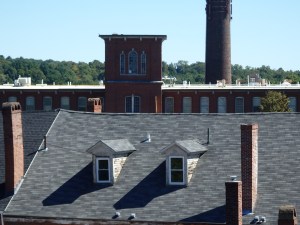

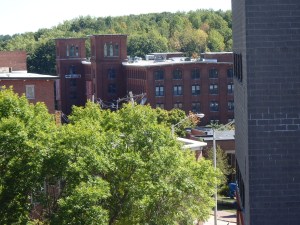
Hard as it is to imagine, Dover once had twice as many mills along the river, plus tanneries and other supporting enterprises.
My fondness for old mills, by the way, did prompt a novel, Big Inca.

