IMMEDIATELY, THEREIN

denying my weaknesses
even now

as I peel

*   *   *

ascribing the heavenly
reflection

I’ve sought only loveliness
or brilliance

less stable than marble

guilty, all the same
to be
uniformly repulsed by deformity

truly
transitory beauty cloaks
impending hideousness
of the flesh

though I’ve been so famished for affection
and tenderness

to be blinded
in my transgressions

as by a blister

*   *   *

who would not doubt, considering all the evidence
unanswered
in lonesome infidelity
without an angelic trance

on waterless ground

Poem copyright 2016 by Jnana Hodson
To see the full set, click here.

WITHIN THE BADGE OF HERESY

Regular visitors to the Barn are aware of my interest in radical thought, especially of the religious variety. It’s not just Quaker, either, or related Anabaptists like the Mennonites, Brethren (including my Dunker ancestry), or Amish. No, it ranges across Biblical times, First Americans, and Asian traditions, too. Just think of the yoga, Zen, and Tibetan Buddhism, for perspective.

Well, a footnote in Douglas Gwyn’s Seekers Found: Atonement in Early Quaker Experience has made me stare in wonder. It’s a great title, to be frank: The Baptists: Fount of All Heresy, a 1984 essay by J.F. McGregor.

Look, anyone familiar with Christian history knows that accusations of heresy go way back to the earliest days of the church, and for that matter, the concept can be found in Judaism and Islam, the other faiths arising from the Book. Those in other traditions can weigh as they wish.

My point, of course, is that heresy way outdates the 1640s of McGregor’s focus. The Inquisition itself would need to be considered, along with all of its victims.

Still, his provocative title has merit, apart from any argument he develops.

A reading of John M. Barry’s Roger Williams and the Creation of the American Soul: Church, State, and the Birth of Liberty, examining the life and influence of the founder of the first Baptist church in America – events in the 1630s – could place Williams as the fount of heresy in New England. Of course, there are others who could be added to the list. The name of Hansard Knollys has popped up again, a minister who came to Dover in the 1630s after troubles in Massachusetts and then returned to England as a prominent figure in the emerging Particular Baptists there, not that I’d call him the fount, but hey, he may have plowed the ground here for Quakers a few decades later.

This really can get arcane, can’t it.

~*~

More of my own reflections on alternative Christianity are found at Religion Turned Upside Down.

SEASONS OF PLAY

as a chorus, the pigeons coo
the mockingbird invents endless variations

the vernal pools erupt in peepers
under the lofty moon

*   *   *

there’s no team
named for his kind
or hers

no Mighty Squirrels
on the field
or the court

a squirrel is not a hero figure
no Cary Grant or James Bond
though maybe an outfielder or a forward
as for the ladies?
a swish of ponytail? or a scamper?

yes, we are born naked
with our eyes closed

*   *   *

it’s the grip, after all
to measure
to treasure

*   *   *

tra-la-la
as they sing

only that cartoon character Rocky
with the moose

or the skunks under the barn

awaiting comedy
while the leaves fell

to speak of simultaneous balance
and signaling

                     Poem copyright 2015 by Jnana Hodson
To read the full set of squirrelly poems,
click here.

UNDER THE SIGN OF CANCER

Just a taste of what’s popping up. In case you were looking for a prompt.

~*~

  1. Hard to believe we’ve entered our 17th summer here. The garden’s looking gorgeous, even stunning, in its simplicity of blocks and clumps rather than straight, unbroken rows. Our soil is so much livelier than it was when we arrived. The house and barn have undergone many renovations, too – with much more remaining on the to-do list. That is to say, this bit of land has become home. I return to the old lesson from Boy Scouts – leave a campsite cleaner than you found it. And she even dares raise the possibility of moving?
  2. Asked when he knows a poem’s finished, Gary Snyder replies: “When I lose interest.” Or I might add, “Energy.” Just what is it in a text that energizes, anyway? Smolders. Seduces. Dances?
  3. The point of my writing fiction, essentially: I want to make sense of all this. Or even some corner.
  4. It’s so clear – so painfully, embarrassingly clear – I’ve needed permission to feel anything. All my emotions, being repressed, generate my mask!
  5. I’ve forgotten how to read an astrological chart. What are all these strange symbols?
  6. After recasting a novel, I recognize a pattern that requires two more sweeps of revision, even after a proof-read. One looks for repeated words that could be changed to synonyms. The other inserts slang and more color.
  7. Nothing like a rainfall to bring forth the dreaded garden slugs.
  8. My psychic color this decade? Barn red! Traditional New England barn red.
  9. You can’t expect a bolt from the blue. (There is a responsibility.)
  10. We need to get praying. Any way we find fitting.

~*~

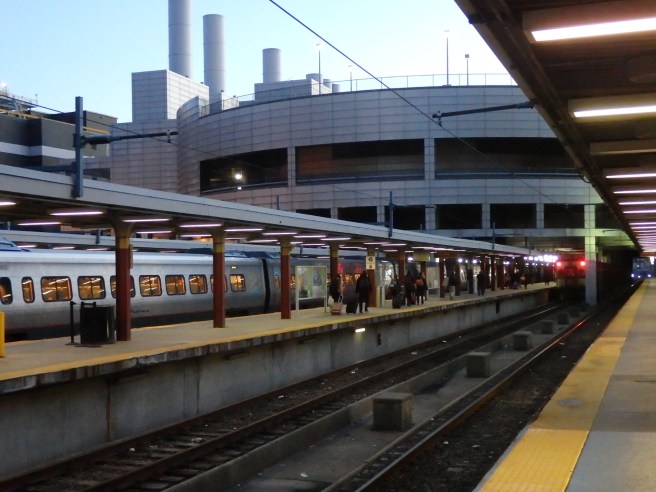
A Purple Line doubledecker awaits departure.
An MBTA Purple Line double-decker awaits its call for departure.

Whenever possible, I love taking Amtrak’s Downeaster to North Station in Boston. Or the C&J bus to South Station. It beats finding parking — expensive parking — in the heart of the city. Alas, most of my forays wind up in the suburbs, where driving makes much more sense.

At South Station, Amrak connects to New York City and points south and west.
At South Station, Amtrak connects to New York City and points south and west.

INSIDE HISTORY AT FANEUIL HALL

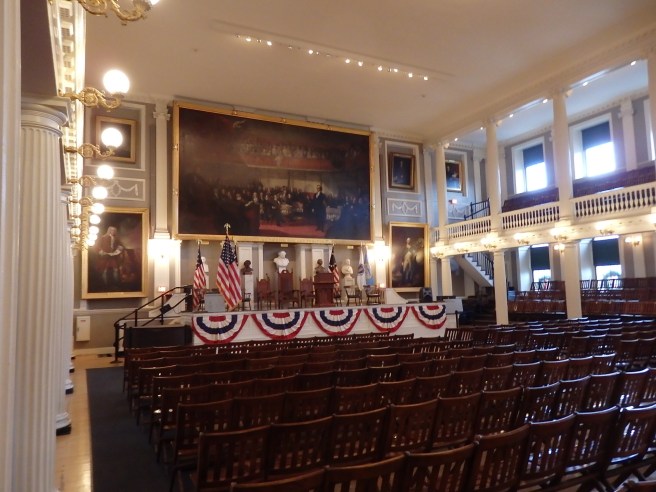
Just imagine the figures who have spoken here through the course of American history.

Maybe it’s all a reflection of classic proportions, but so much in Peter Faneuil’s historic town hall and marketplace simply feels right ever since it was erected in 1742 and enlarged in 1805 under Charles Bulfinch’s masterful design.

Boston is a rich and varied destination – the Hub of New England, or the Universe, as they used to say. Living a little more than an hour to the north, we’re well within its orb.

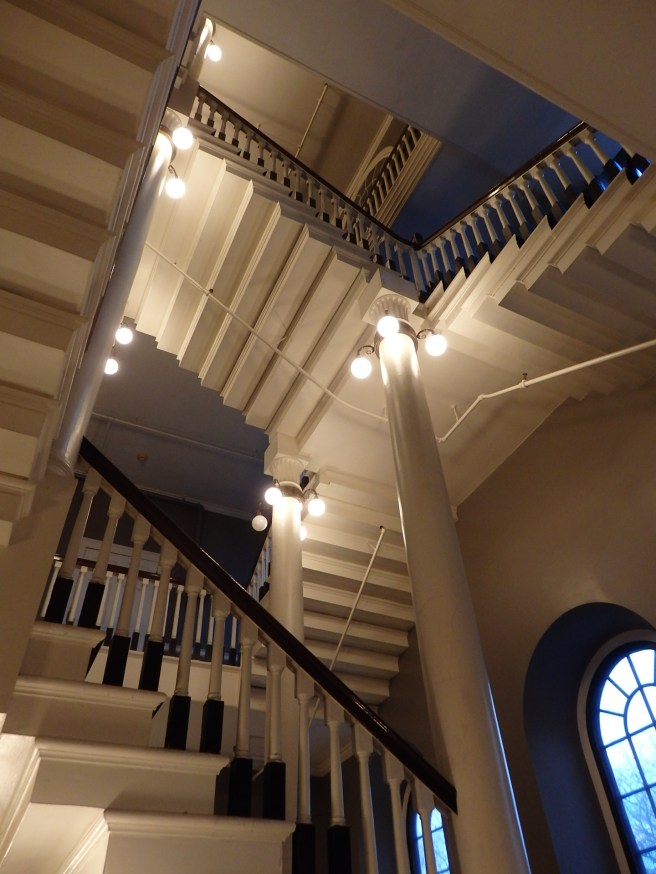
Reaching for the top of the hall.


STARTING OVER DINNER

the scene broke up the night D and V
connected the same time R and M did

all in one apartment . for me
only torment and loss

her haunted poster of the gaunt Gypsy
came off the wall a week later

~*~

of course, the living arrangements
would change . “when I first met you,
you were giving off funky vibes
like at a 90-degree angle . all nervous energy”
of course, we remained friends
for a while

~*~

there they were
like a bad novel
on Doubleday Street

there, he smiled from the kitchen
“anyone want some cooked garbage”

To continue, click here.
Copyright 2015

HUNTING IN THE OLD DAYS

True hunters in this country live on what they track, Kokopelli explains.

Articulating this precinct means drawing on three language stocks: Sahaptian, spoken by Klickitat, Yakama, Kittitas, Wanapam, Palus, Nez Pierce, Cayuse, and Umatilla; Salishan, by Wenatchi and Columbia; and Chinook, by Clackamas and Wishram.

Nine thousand years ago the climate resembled today’s. Around seven thousand years ago, Mount Mazama lost its head and Crater Lake emerged. Did the ash fall reduce the game? Kokopelli assumes so. About that time, Olivella shell beads show up in archeological sites, revealing coastal trade, in addition to a new kind of projectile point. About 6,500 years ago the roost became drier and warmer. Rivers ran significantly lower. Adz blades of nephrite and serpentine, about 4,500 years ago, permitted heavy woodworking and expose trade relations with what is now British Columbia. “That’s when I got this pipe,” Kokopelli says, allowing me to stroke the instrument. As winter temperatures became warmer, sizable winter villages gathered in river valleys for fuel, fresh drinking water, and greater protection from bitter winds. Such clustering required food storage capabilities and also permitted greater social and ceremonial activity, perhaps a result of more efficient food gathering. Most likely this involved salmon fishing, properly dried and preserved, caught in great numbers; fish traps and weirs were much more efficient than spears, lines, dip nets, or bows and arrows.

From this came pit houses, some of them earth-covered for insulation, others covered with mats and grass or brush. The mats swelled and froze in winter to keep wind and rain out; as spring temperatures rose, thawing provided ventilation. Such housing required well-drained soil, such as that of desert.

The tipi was introduced much later, from the Great Plains.

A-frame mat houses developed from the pit design. Their emergence especially reflected the introduction of horse culture, which added to trade possibilities and also brought saddles, bridles, quirts, dress, and ornamentation such as feathered headdresses, but above all else, ideas about tribal organization. Appaloosa were on the way. Whalebone clubs, as well as fishing nets and harpoons, were acquired through expanded trade networks.

Horses allowed more food to be brought back from summer sojourns in the mountains. Soon bowl-shaped mortars and elongated pestles were used to prepare food. “Let me tell you about real progress,” Kokopelli insists.

Each local group assumed stewardship over the economic resources of its locale. Leadership arose out of respect, not law. Ritual purification occurred in sweat houses. Three-day workouts weren’t uncommon. I wonder whether voters and candidates alike should do the same before Election Day. There is, after all, a kinship to hunting and fishing.

Kokopelli agrees.

The major run of king salmon and oil-rich sock-eye salmon comes in late May or early June, when most of the year’s food supply is caught. The best spot for dip netting is where rivers bear down through narrow channels or over low falls. Wooden platforms tied precariously to basaltic cliffs hang over whirlpools and eddies. Such stations are inherited and highly prized. Permission must be sought before fishing there.

Fish head pulverized in a mortar, then carefully packed in baskets and stored for winter, provides a highly concentrated protein food. Even a few ounces serves as a full meal.

Bears caught in a dead-fall were hunted mostly for claws and teeth — ceremonial ornaments.

Wapatoo was a type of wild potato, perhaps like camas.

Cooperative hunting and salmon harvests were common. Women’s berry picking parties, too, even though some tribes were basically river folk. Excepting the Wishram band, the Yakamas believed in individual rights. They differed from coastal tribes, which possessed slaves who might fall to a cannibal ceremony.

Much the way rabbit skins are cut in a spiral to produce long strips, I keep learning. Once you acknowledge the importance of certain foods in a given turf, you discern zone-specific energies. In ecologically aware feasting, hamburger and hot dogs are thoroughly inappropriate for many reasons. They have no authentic geographic home.

For more insights from the American Far West and Kokopelli, click here.

PURPORT

I confess everything
I’m guilty
even when it comes to crime
I’ve failed
I can’t even lie, if I try
as for confronting an issue
I understand none of the charges

they say a house
even an old house
settles
but that’s not precisely
accurate, where
sinking
and sagging
are more apt

Poem copyright 2016 by Jnana Hodson
To see the full set of
Partitas, click here.

ALONG WITH HIGH STYLE

Rouge on lips or toenails, the glimmer of gold jewelry or a gemstone, the glossy photograph or the slick magazine, the light in a drop of costly perfume, the shimmer in a particular weave or pattern of spectacular cloth, or the haute (hoity-toity) air of a trendy boutique: each reflects eternal desires and feminine intrigue. The interplay of status-seeking, gamesmanship, the swift-changing hunt, and the theater of fashion spreads out far from its urban epicenters – and crosses nations, languages, continents, and ages. How quickly a little girl insists on her own definitive style! The poet and poetry are not immune, either, infused with their own tastes and passions. Where a dictionary observes  gloss as “the luster or sheen of a polished surface,” there is also the danger of “a deceptive or superficial appearance” as well as “an effort to hide or attempt to hide (errors, defects, etc.).” Still, a gloss may also attempt to interpret or translate. The curve or the motion, the smile or the gaze, skin itself, or hair in sunlight or moonlight, each concealing while hinting of revelations. So often, awaiting next month’s editions.

These are the poems that conclude my newest collection, Foreign Exchange.

~*~

Foreign Exchange
Foreign Exchange

For these poems and more, visit Thistle/Flinch editions.

CURRENT, CURLING

1

 prevalent, from the west
clear and cooler, from the north
rain on the way, from the south
tempest, from the east

reading the wind

in a flag
in smoke
in running clouds
or water in a clear thistle tube

2

listen, a storm approaches
through leaves and hills
the same sound as falling water

surf repeats its snare drumming
along the shoreline

matching a far-off airplane

all voice great power
resounding

in a stream
in the tide
in air
even in a light bulb

what’s present, now
within some great
motion

around each wing
the flow of thought
keeps running

3

ring around the moon
as a warning

listen, rainfall
will warm the ocean

and swimming is best
just after high tide

Poem copyright 2016 by Jnana Hodson
To see the full set of seacoast poems,
click here.